科大讯飞

Search documents
AI语料概念上涨2.00%,6股主力资金净流入超亿元
Zheng Quan Shi Bao Wang· 2025-12-31 09:42
Group 1 - The AI corpus concept rose by 2.00%, ranking 7th among concept sectors, with 39 stocks increasing in value, including DeSheng Technology and Zhangyue Technology hitting the daily limit up [1] - Notable gainers in the AI corpus sector included FuShi Holdings, ZhiDeMai, and Century Tianhong, which increased by 10.68%, 6.98%, and 5.54% respectively [1] - The sector saw a net inflow of 1.927 billion yuan from main funds, with 33 stocks receiving net inflows, and 6 stocks exceeding 100 million yuan in net inflow [2] Group 2 - The top net inflow stock was Kunlun Wanwei, with a net inflow of 394 million yuan, followed by Zhangyue Technology, Keda Xunfei, and DeSheng Technology with net inflows of 295 million yuan, 265 million yuan, and 150 million yuan respectively [2] - The net inflow ratios for DeSheng Technology, Zhangyue Technology, and Hanwang Technology were 35.28%, 25.56%, and 16.69% respectively, indicating strong investor interest [3] - The AI corpus sector's performance was contrasted with other sectors, such as the silicon energy sector, which saw a decline of 1.03% [2]



软件赛道还有机会吗?2026机会展望,逻辑已经变了
和讯· 2025-12-31 09:13
Core Viewpoint - The software services sector is entering a new phase of differentiation, driven by AI, with opportunities becoming more concentrated but of higher quality [2]. Group 1: Industry Overview - By 2025, the A-share software services industry is expected to show a moderate but certain recovery, with an overall market value growth of approximately 18%, increasing from 3.32 trillion yuan at the beginning of the year to 3.9 trillion yuan by year-end [3]. - The market perception is shifting from "growth anxiety" to "capability reassessment," indicating a more mature evaluation of companies in the sector [3]. - The growth in market value across different segments is relatively balanced but still shows tiered differences, with the highest growth seen in Information Technology Consulting and Other Services at +19.6%, reflecting a renewed demand for IT consulting and industry solutions [3][4]. Group 2: Market Segmentation - The market performance of various segments in 2025 is as follows: - Internet Services and Infrastructure: 5,156.09 billion yuan (+16.16%) - System Software: 632.39 billion yuan (+16.12%) - Information Technology Consulting and Other Services: 11,274.12 billion yuan (+19.61%) - Application Software: 21,970.58 billion yuan (+17.00%) - Total: 39,033.18 billion yuan (+17.62%) [4]. - The software services market has evolved from a broad-based growth model to one focused on industry depth, organizational replacement capabilities, and long-term cash flow [4]. Group 3: Leading Companies - As of the end of 2025, there are 319 software service companies listed in A-shares, with a focus on those excelling in R&D innovation, profitability, growth potential, and market performance [5]. - The top ten companies identified include: 1. Kingsoft Office 2. Tonghuashun 3. Runze Technology 4. Huada Jiutian 5. 360 6. Dameng Data 7. Hengniu Shenzi 8. Hongsoft Technology 9. Baoxin Software 10. Hehe Information [7][8]. Group 4: R&D and Financial Health - The R&D innovation performance in the software services sector shows significant polarization, with 57 companies scoring above 400 points (17.9%) and a majority scoring between 200 and 400 points (65.5%) [9]. - Financial health scores indicate that many companies are under pressure, with 87.5% of firms scoring between 300 and 500 points, reflecting challenges such as narrowing profit margins and increased cash flow pressures [11]. Group 5: Growth Potential and Future Trends - Growth potential scores reveal a clear differentiation in the sector, with standout companies in two categories: those benefiting from AI infrastructure and emerging platforms, and those driven by AI and data intelligence technologies [12]. - The structural growth in the software services industry validates the logic of AI technology and domestic substitution, with a focus on three main lines for 2026: 1. Deepening AI applications in system software and entertainment software [15]. 2. Increasing domestic substitution in foundational software like operating systems and databases [15]. 3. Expanding global presence in gaming and industrial software [15].





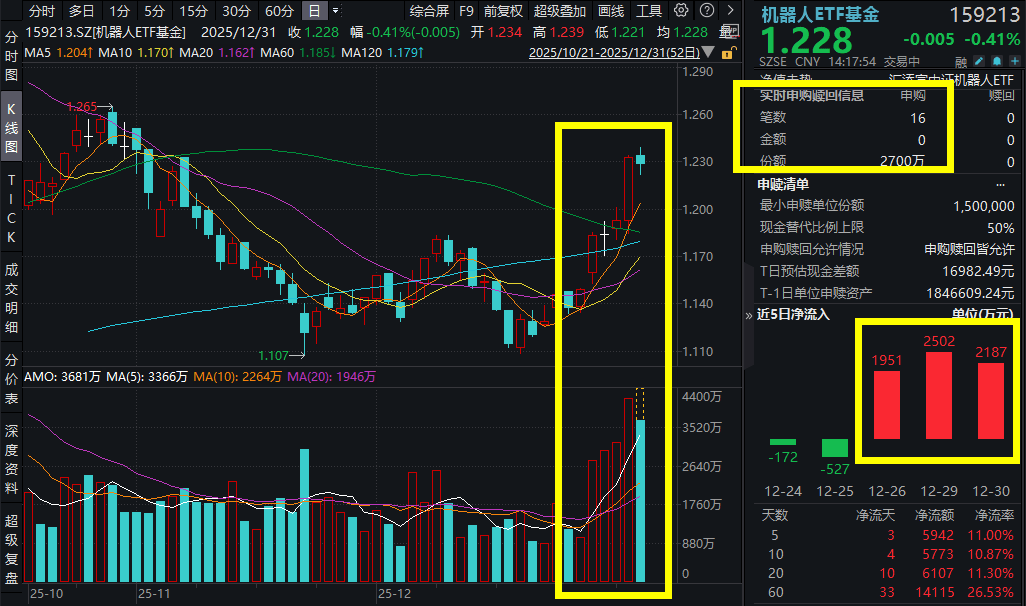
机器人回调,大族激光跌超1%,机器人ETF基金(159213)已经连续4日净流入近1亿元!2025年人形机器人量产元年已过,2026年"飞轮时刻"将启动?
Sou Hu Cai Jing· 2025-12-31 08:53
Core Viewpoint - The A-share market shows a mixed trend with the robotics sector under pressure, yet there is a significant inflow of funds into the robotics ETF fund (159213), indicating investor confidence despite market fluctuations [1][3]. Group 1: Market Performance - As of 14:25, the robotics ETF fund (159213) experienced a decline of 0.41%, marking its first pullback after five consecutive days of gains [1]. - The fund saw a net inflow of over 33 million yuan during the day, contributing to a total net inflow of nearly 100 million yuan over the past four days [1]. Group 2: Component Stocks - The top ten component stocks of the robotics ETF fund show mixed performance, with notable gains from Keda Xunfei (2.70%) and Zhongkong Technology (1.27%), while Huichuan Technology and Dazhu Laser both fell over 1% [2][4]. Group 3: Industry Developments - The robotics sector is experiencing a significant boost, with rumors of an upcoming administrative order on robotics expected in 2026, and suppliers actively engaging in North America [3]. - The year 2025 is highlighted as a pivotal year for robotics, with strong initial growth followed by adjustments and renewed interest due to events like the World Robot Conference [3]. Group 4: Future Outlook - The robotics ETF fund manager indicates substantial advancements in mass production, with companies like UBTECH and ZhiYuan set to achieve significant production milestones by 2025 [6]. - The industry is expected to see a surge in human-like robots, with projections indicating that domestic sales could exceed 10,000 units in 2026, driven by technological advancements and commercial viability [7].


“人工智能+”:中国AI开源破局,烟火落地
Xin Hua She· 2025-12-31 08:41
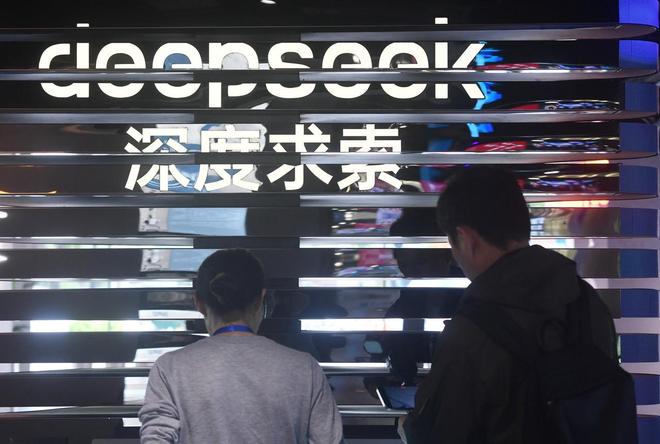
Core Insights - The article discusses the rapid integration of artificial intelligence (AI) into daily life in China, highlighting its practical applications across various sectors by 2025, showcasing a shift from experimental technology to everyday utility [1][2][3] Group 1: AI Development and Ecosystem - The "Artificial Intelligence +" initiative is a significant strategic deployment by the Chinese government, aiming to combine digital technology with manufacturing and market advantages, supporting the widespread application of large models and the development of new intelligent terminals [2][3] - China's open-source AI ecosystem is accelerating, with data showing that as of August 2025, the cumulative download of open-source models in China has surpassed that of the United States, indicating global developer interest [2][3] - The emergence of the open-source model DeepSeek-R1 marks a critical milestone in China's AI technology, challenging the dominance of closed-source models from major U.S. companies [3][4] Group 2: Technological Breakthroughs - DeepSeek's open-source approach has led to significant advancements in AI, with its models achieving performance scores close to leading closed-source models, demonstrating the potential of open-source innovation [3][4] - The launch of DeepSeek's open-source initiatives has resulted in a rapid increase in user engagement, with its app reaching over 30 million daily active users within 21 days of launch [5][6] - The performance and quality of Chinese AI models are nearing parity with those of the U.S., as highlighted in the Stanford University AI Index Report [5][6] Group 3: AI in Industry and Daily Life - AI is transforming various industries, enhancing productivity and efficiency, particularly in creative fields, software development, and healthcare, by automating complex tasks and reducing costs [8][13] - The integration of AI into daily life is evident, with applications ranging from health monitoring to educational assistance, making AI a valuable partner in everyday activities [15][16][17] - AI's role in content creation and software development is revolutionizing traditional processes, allowing for rapid production and lowering barriers for small businesses and individual developers [13][19] Group 4: Challenges and Future Directions - Despite the rapid growth of AI, challenges such as technical limitations, ethical concerns, and the need for regulatory frameworks remain, necessitating a collaborative approach to address these issues [19][20][21] - The future of China's AI industry is expected to focus on deepening application scenarios, enhancing open-source ecosystems, and establishing robust ethical and safety standards [22][23]
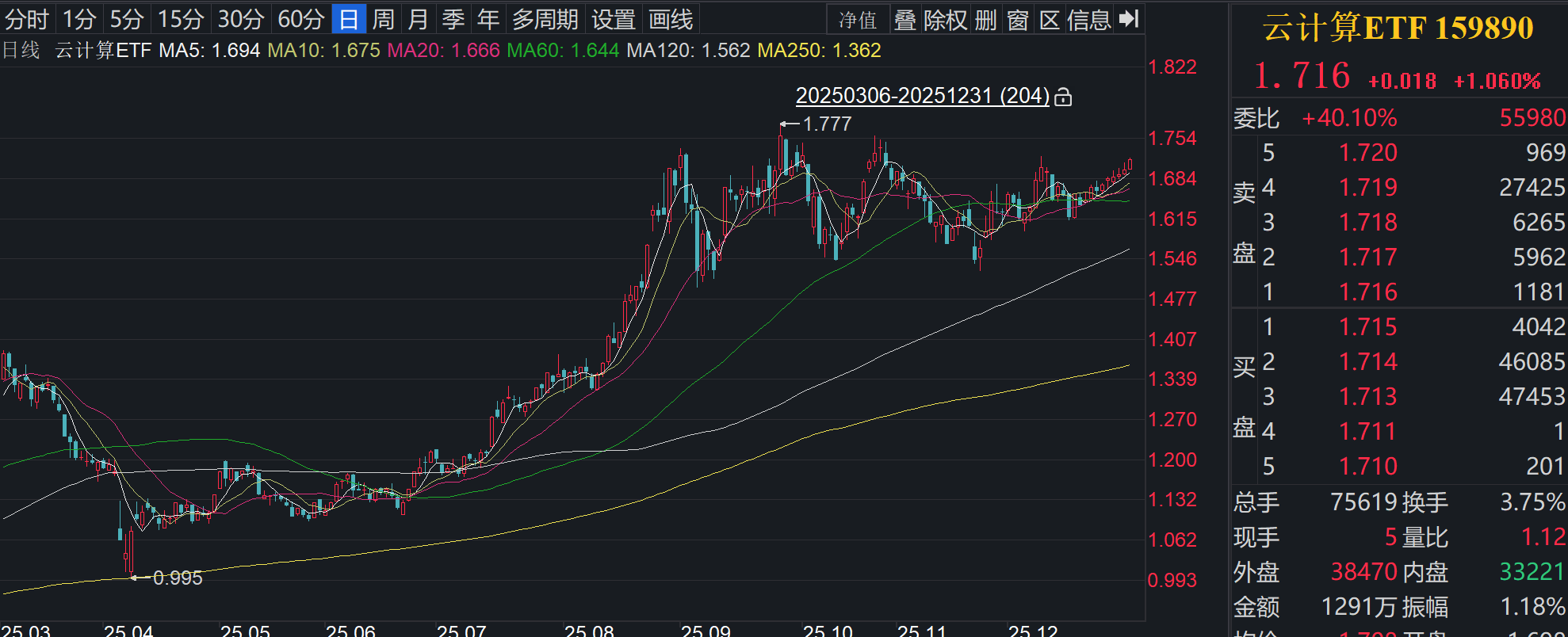
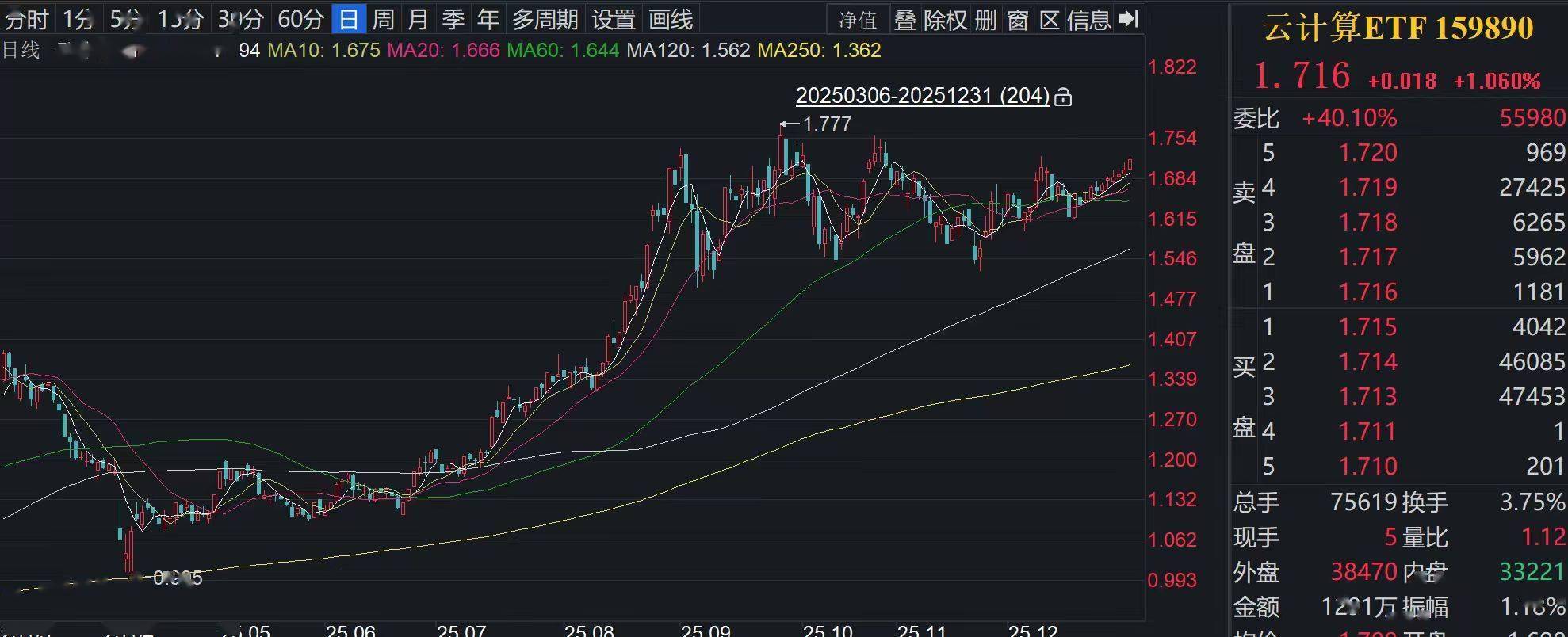
AI算力方向强势收官2025!云计算ETF(159890)午后上攻强势冲击6连阳
Sou Hu Cai Jing· 2025-12-31 06:27
Core Viewpoint - The AI computing power sector is experiencing significant growth, driven by government initiatives and increasing demand for domestic AI chips, particularly the H200 chip, which is set to be delivered to Chinese customers soon [3][4][5]. Group 1: Market Performance - On the last trading day of 2025, AI computing stocks saw a strong afternoon rally, with the cloud computing ETF (159890) rising over 1% and achieving a six-day winning streak [1]. - Notable stock performances included a rise of 11.46% for Yidian Tianxia, over 8% for Hand Information, and more than 4% for companies like Zhongke Xingtai and Wanxing Technology [1]. Group 2: Policy and Industry Developments - A key government official announced the implementation of the "AI+" initiative, which aims to create extensive application scenarios for AI computing power chips, leading to rapid growth in demand and innovation within the sector [3]. - The conditional opening of the H200 chip to China is seen as a positive development, with major tech companies like Alibaba and ByteDance planning significant purchases to enhance their AI capabilities [4]. Group 3: Domestic Chip Strategy - Domestic companies are adopting varied strategies in response to the H200 chip's availability, with Alibaba and ByteDance pursuing large-scale purchases, while Baidu focuses on self-developed Kunlun AI chips to reduce reliance on external suppliers [4]. - Tencent is exploring indirect methods to acquire advanced computing power, aiming to secure over $1.2 billion in usage rights for the latest B200/B300 chips [4]. Group 4: Growth Projections - According to IDC and Inspur, China's intelligent computing power is projected to reach 1,037.3 EFLOPS by 2025, with a compound annual growth rate of 46.2% from 2023 to 2028 [6]. - The general computing power in China is expected to grow to 85.8 EFLOPS by 2025, with a compound annual growth rate of 18.8% during the same period [6]. Group 5: Investment Opportunities - The current landscape of the AI computing market presents numerous opportunities for investment, with a focus on domestic chip development and technological innovation [5][6]. - The cloud computing ETF (159890) tracks a diverse range of companies involved in AI infrastructure and applications, indicating a comprehensive approach to the AI computing era [6].


南京玄武区:大数据中寻潜力 赋能AI新应用
Xin Hua She· 2025-12-31 06:25
Group 1 - The core idea of the articles revolves around the development and application of artificial intelligence (AI) in the tourism and data industries, particularly in Nanjing's Xuanwu District, which is leveraging AI to enhance user experience and drive innovation [1][2][5] - The Xuanwu District is implementing the "Artificial Intelligence +" initiative to promote AI applications across various sectors, addressing challenges such as land scarcity and slow growth in traditional industries [1][2] - The district has established three major platforms: Jiangsu International Data Port, Xuanwu Large Model Factory, and Jiangsu Data Exchange, aimed at strengthening data infrastructure and fostering an innovative entrepreneurial ecosystem [2][3] Group 2 - Xuanwu District has developed 22 large AI models, accounting for over one-third of the total in Jiangsu Province, positioning itself as a leader in AI model development [3][4] - The district is attracting major companies like Baidu and Siemens, which bring advanced technologies and talent, further enhancing the local AI ecosystem and encouraging collaboration among businesses [4][5] - The data industry in Xuanwu is projected to generate revenue of 78.3 billion yuan in 2024, representing nearly 20% of the district's GDP, indicating significant growth and economic impact [5]
“人工智能+”行动定调算力基建,云计算ETF(159890)午后上攻冲击6连阳!
Sou Hu Cai Jing· 2025-12-31 06:23
Core Viewpoint - The AI computing power sector is experiencing significant growth, driven by government initiatives and increasing demand for domestic AI chips, particularly the H200 chip, which is expected to enhance the capabilities of major tech companies in China [3][5]. Group 1: Market Performance - On the last trading day of 2025, AI computing stocks showed strong performance, with the cloud computing ETF (159890) rising over 1% and achieving a six-day winning streak [1]. - Notable stock performances included a rise of 11.46% for Yidian Tianxia, over 8% for Hand Information, and more than 4% for companies like Zhongke Xingtai and Wanxing Technology [1]. Group 2: Policy and Industry Developments - A key government official announced the implementation of the "Artificial Intelligence +" initiative, which is expected to create extensive application scenarios for AI computing power chips, leading to rapid growth in demand and innovation within the sector [3]. - The conditional opening of the H200 chip to China is seen as a positive development, with major tech firms like Alibaba and ByteDance planning significant purchases to enhance their AI capabilities [3][4]. Group 3: Domestic Chip Strategy - Domestic companies are adopting varied strategies in response to the H200 chip availability; Baidu is focusing on its self-developed Kunlun AI chip to reduce reliance on external suppliers, while Tencent is exploring indirect methods to access more powerful chips [4]. - The release of the H200 chip is viewed as a catalyst for strengthening the long-term strategy of achieving self-sufficiency in domestic computing power [5]. Group 4: Growth Projections - According to IDC and Inspur, China's intelligent computing power is projected to reach 1,037.3 EFLOPS by 2025 and 2,781.9 EFLOPS by 2028, with a compound annual growth rate of 46.2% from 2023 to 2028 [6]. - The general computing power in China is expected to grow to 85.8 EFLOPS by 2025 and 140.1 EFLOPS by 2028, with a compound annual growth rate of 18.8% during the same period [6]. Group 5: Investment Opportunities - The domestic computing power market is seen as having significant potential for growth, with opportunities arising from capital expenditure and technological innovation [6]. - The cloud computing ETF (159890) tracks a diverse range of companies involved in AI infrastructure and applications, indicating a comprehensive approach to the AI computing power era [6].
京东与宇树科技首家线下门店开业!机器人ETF(562500) 放量调整成交破10亿,震荡区间迎布局良机
Mei Ri Jing Ji Xin Wen· 2025-12-31 06:20
Group 1 - The Robot ETF (562500) is down 0.59%, currently consolidating below the zero axis, which may provide a reasonable entry point for year-end positioning [1] - Key holdings are performing well, with Boke Co. leading the gains by over 4%, and AI leader iFlytek rising by over 3% [1] - Despite market adjustments, liquidity remains strong with trading volume exceeding 1.078 billion yuan, indicating active capital exchange [1] Group 2 - JD.com and Yushutech have launched their first offline store, located at JD Mall in Beijing's Double Qiao, set to officially open on the 31st at 10:58 AM, with customers already waiting [1] - The store features various Yushutech robots, including the Go2 robotic dog and the G1 humanoid robot [1] - Dongfang Securities predicts rapid advancements in motion control for humanoid robots by 2025, with mass production expected to be a key focus in 2026 [1] - Recent demonstrations by Tesla and Yushutech showcase significant progress in humanoid robot technology [1]


国投证券(香港)港股晨报-20251231
国投证券(香港)· 2025-12-31 05:55
Core Insights - The report highlights a slight rebound in the Hong Kong stock market, with the Hang Seng Index rising by 0.86% and the Hang Seng Tech Index increasing by 1.74% [2] - The report notes a significant increase in the revenue of the company Zhiyu (智谱), with a total revenue of 190 million yuan in the first half of 2025, representing a year-on-year growth of 325% [7] - The report emphasizes the strong growth potential of the enterprise-level large language model market, projecting a compound annual growth rate (CAGR) of 60% over the next five years [8] Company Overview - Zhiyu, established in 2019, focuses on achieving Artificial General Intelligence (AGI) and has released the GLM framework for pre-trained large models [6] - As of June 30, 2025, Zhiyu has open-sourced over 50 large models with a cumulative download exceeding 45 million times [6] - The company has over 8,000 institutional clients for its AI large model services [6] Financial Performance - In the first half of 2025, Zhiyu's localized deployment revenue reached 160 million yuan, accounting for 85% of total revenue, while cloud deployment revenue was 29 million yuan [7] - The company's R&D expenditure for the same period was 1.6 billion yuan, representing an 86% year-on-year increase [7] - Adjusted net loss for the first half of 2025 was 1.8 billion yuan, compared to losses of 1 billion yuan in the same period last year [7] Industry Status and Outlook - The report cites Frost & Sullivan data predicting that the Chinese AI market will reach 218.9 billion yuan in 2025, growing by 36% year-on-year [8] - The large language model market in China is expected to grow to 9.93 billion yuan by 2030, with a CAGR of 35% from 2025 to 2030 [8] - The competitive landscape shows Zhiyu holding a 6.6% market share in the Chinese large language model market, ranking second behind iFlytek [8] Advantages and Opportunities - The enterprise-level scenario is identified as a key commercial application for large language models in China, indicating a broad industry outlook [9] - Zhiyu possesses a comprehensive model matrix and a one-stop MaaS platform that facilitates model commercialization [9] - The company has a strong R&D team of 657 members, including leading figures in the AI field [9] IPO Information - The IPO subscription period is from December 30, 2025, to January 5, 2026, with trading expected to commence on January 8, 2026 [11] - The cornerstone investors have subscribed for 25.68 million shares, amounting to approximately 3 billion Hong Kong dollars, representing 69% of the global offering [12] - The expected net proceeds from the fundraising are estimated at 4.173 billion Hong Kong dollars, with 70% allocated for AI large model R&D [13]
慧辰股份与合十思维达成战略合作!机器人ETF(562500) 早盘探底回升,成交额近8亿
Mei Ri Jing Ji Xin Wen· 2025-12-31 05:54
Core Viewpoint - The robot ETF (562500) shows resilience with a slight decline of 0.20%, indicating strong market interest and liquidity, supported by notable performances from key stocks in the sector [1][2]. Group 1: Market Performance - The robot ETF experienced a "V"-shaped recovery after hitting a daily low, demonstrating strong anti-drawdown resilience [1]. - Key stocks such as Boke Co. surged over 5%, with Xinsida and Jingpin Tezhuang also showing significant gains, enhancing sector sentiment [1]. - The ETF's trading volume exceeded 7.9 billion yuan within the first hour of trading, indicating high liquidity and active trading [1]. Group 2: Strategic Developments - Huichen Co. announced a strategic partnership with He Shi Siwei (Beijing) Technology Co., aiming to advance embodied intelligence applications across diverse scenarios [1]. - Citic Securities highlighted ongoing rebound trends in the robot sector, driven by various catalysts including Tesla's shipment expectations and major events showcasing robotics [2]. - The robot ETF is the only one in the market with a scale exceeding 20 billion yuan, covering various segments such as humanoid robots, industrial robots, and service robots, facilitating investor access to the entire robotics supply chain [2].