西部证券

Search documents
基金托管牌照扩容降温 年内6家券商撤回申请
2 1 Shi Ji Jing Ji Bao Dao· 2025-08-20 23:10
Core Viewpoint - The recent regulatory changes have led to a significant reduction in the number of brokerages applying for fund custody qualifications, with only three institutions remaining in the queue, primarily due to heightened entry barriers established by new regulations [1][2][3]. Group 1: Regulatory Changes and Impact - The China Securities Regulatory Commission (CSRC) has published a notice indicating that only three institutions are currently applying for fund custody qualifications, down from seven in the past [1][3]. - In just over eight months, six brokerages have withdrawn their applications for fund custody qualifications, primarily due to the new regulations that have raised the entry threshold significantly [2][5]. - The new regulations aim to shift the industry focus from "quantity expansion" to "quality competition," implementing "hard thresholds and dynamic supervision" to reshape the industry ecosystem [2][5]. Group 2: Financial Requirements - The new regulations require brokerages to have a net asset of at least 300 billion yuan, which has led many smaller brokerages to withdraw their applications as they do not meet this requirement [5][6]. - Prior to the new regulations, the minimum net asset requirement was 200 billion yuan, indicating a substantial increase in the standards for obtaining custody qualifications [5][6]. Group 3: Industry Concentration and Trends - The fund custody industry is experiencing a trend towards concentration, with banks and a few large brokerages controlling approximately 80%-90% of public and private fund custody [7]. - Over 70% of brokerages have not obtained fund custody qualifications, highlighting a growing disparity between larger and smaller firms in the industry [7][8]. - The top five brokerages in terms of fund custody account for 65.71% of the total custody numbers, indicating a significant concentration of business among leading firms [8]. Group 4: Future Outlook and Strategies - Smaller brokerages that cannot meet the new requirements may need to explore differentiated survival strategies, such as partnering with larger institutions for operational support [9][10]. - The custody license is shifting from being a "scarce resource" to a "capability certification," suggesting that larger brokerages will leverage technology to maintain their advantages while smaller firms may transition to service outsourcing roles [10].

买买买!是谁在做多市场?
Zheng Quan Shi Bao Wang· 2025-08-20 15:43
Group 1: Market Overview - A-shares have seen a significant increase in trading volume, with daily turnover surpassing 2 trillion yuan, indicating heightened market activity [1] - Institutional investors have been more active in the market compared to individual investors, with a notable increase in institutional account openings [5][6] - The overall sentiment among individual investors remains cautious, with new account openings showing only moderate growth [3][4] Group 2: Retail Investor Participation - Recent surveys indicate that retail investors, particularly those born in the 1980s and 1990s, are showing a mild increase in market participation, but not at a rapid pace [2] - The current participation level of retail investors is estimated at around 120 points on a scale where last year's peak was 200-300 points, suggesting a lack of urgency in entering the market [2][3] - The trend of retail investors entering the market is expected to accelerate if the market continues to rise, particularly among younger demographics [2] Group 3: Institutional Investor Dynamics - The number of new institutional accounts has reached historical highs, indicating a strong interest from institutional investors, especially private equity [5][6] - The correlation between new institutional account openings and the issuance of equity funds suggests that the market may be entering a new phase driven by institutional investment [5] - Active trading by high-net-worth individuals and private equity has contributed significantly to recent market movements [6] Group 4: Foreign Investment Trends - Foreign investment in Chinese stocks has increased, with hedge funds buying at a rapid pace since late June, primarily driven by bullish sentiment [7] - South Korean investors have significantly increased their trading volume in Chinese stocks, with a total trading amount reaching $5.514 billion by the end of July [7] - Despite increased interest from foreign investors, there remains a divergence in their investment strategies regarding Chinese assets [8]
买买买!是谁在做多市场?
券商中国· 2025-08-20 15:27
Core Viewpoint - The analysis indicates that while A-shares have seen significant index increases and daily trading volumes exceeding 2 trillion, the influx of new retail investors remains moderate, with institutional investors, particularly private equity, being the primary drivers of market activity [2][6]. Group 1: Retail Investor Participation - Recent grassroots surveys show a mild increase in retail investor account openings, primarily among younger generations, but no significant surge in online account openings through platforms like Alipay [3][4]. - The current enthusiasm of retail investors is described as cautious, with a scoring system indicating a participation level of around 120 points, compared to much higher levels seen in previous market peaks [3][4]. - Data from East Wu Securities indicates that new retail investor accounts have not shown a concentrated influx, with July's new accounts at 1.96 million, similar to April's figures, suggesting a lack of aggressive market entry by retail investors [4][5]. Group 2: Institutional Investor Activity - Institutional investors have shown a marked increase in account openings, surpassing personal accounts, with private equity and high-net-worth individuals being particularly active [2][6]. - The number of new institutional accounts has reached historical highs, correlating positively with the issuance of equity funds, indicating a potential "institutional bull market" on the horizon [6][7]. - Recent data shows that leveraged funds have been actively entering the market, with an average daily inflow of 5.5 billion since July, and private equity positions have increased significantly [6][7]. Group 3: Foreign Investment Trends - Foreign investment in A-shares has been increasing, with global hedge funds buying Chinese stocks at a rapid pace, primarily driven by bullish sentiment [8][9]. - Korean investors have significantly increased their trading volume in Chinese stocks, with cumulative transactions reaching $5.514 billion by the end of July, surpassing the previous year's total [8][9]. - Despite the growing interest from foreign investors, there remains a divergence in investment strategies, with some institutions still cautious about diversifying into Chinese assets [8][9].


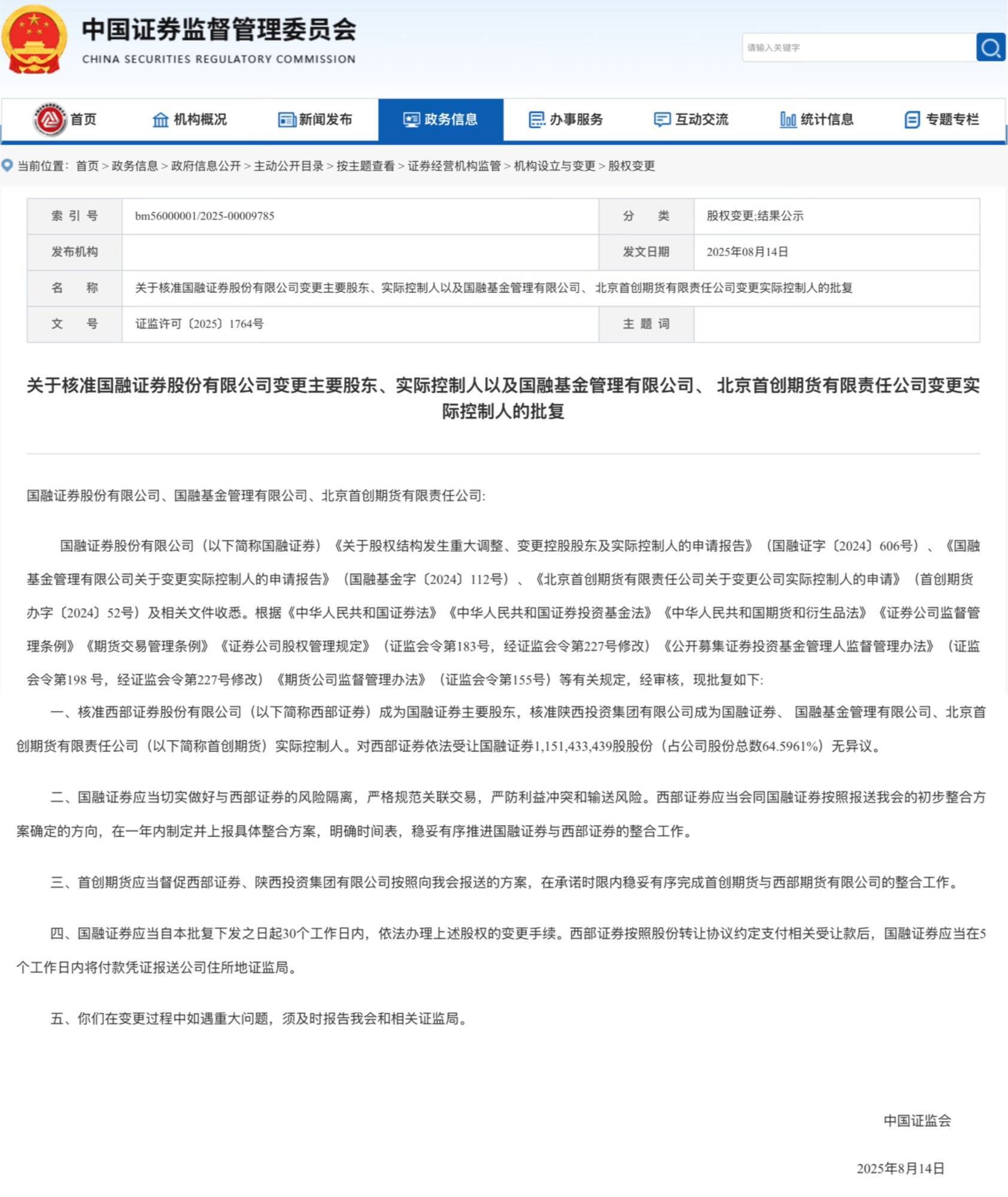
千亿级券商再添一家 西部证券收购国融证券正式获批
Sou Hu Cai Jing· 2025-08-20 13:01
Core Viewpoint - The acquisition of Guorong Securities by Western Securities marks a significant step in the ongoing trend of mergers and acquisitions in the securities industry, driven by both policy and market logic [1][12]. Group 1: Acquisition Details - The China Securities Regulatory Commission (CSRC) has approved Western Securities to become the major shareholder of Guorong Securities, acquiring 1.151 billion shares, which accounts for 64.6% of the total shares [3][8]. - Western Securities is required to submit a detailed integration plan within one year, following the initial integration direction submitted to the CSRC [3][8]. - The acquisition process began on June 21, 2024, with a total transaction value of approximately 3.32 yuan per share, amounting to 3.825 billion yuan [9]. Group 2: Business Impact - Western Securities has a strong presence in Shaanxi, with nearly 60% of its branches located in the province, while Guorong Securities focuses on regions like Inner Mongolia, Beijing, and Shanghai, indicating complementary business structures [10]. - In 2024, Western Securities reported revenues of 6.712 billion yuan and a net profit of 1.403 billion yuan, while Guorong Securities had revenues of 1.119 billion yuan and a net profit of 81 million yuan [10]. - The merger is expected to enhance Western Securities' capabilities, optimize regional layout, and improve asset management business, potentially transforming it into a nationwide comprehensive securities firm [10]. Group 3: Industry Trends - The trend of mergers in the securities industry is expected to accelerate, with the central financial work conference emphasizing the cultivation of leading investment banks and institutions [11][12]. - The new "National Nine Articles" policy supports major institutions in enhancing core competitiveness through mergers and reorganizations, indicating a shift towards increased industry concentration [11][12]. - Analysts predict that the integration wave in the securities sector will continue for an extended period, reshaping the competitive landscape [11][12].

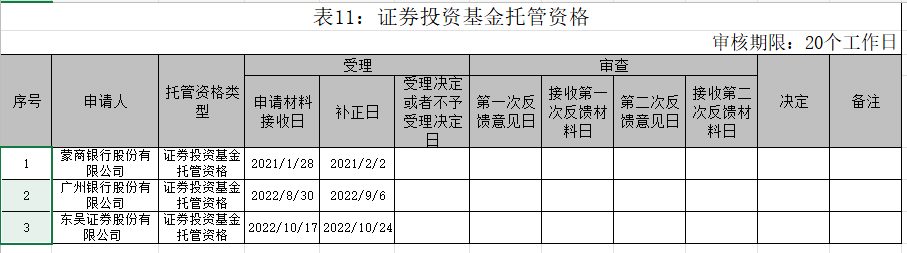
基金托管牌照扩容降温,年内6家券商撤回申请
2 1 Shi Ji Jing Ji Bao Dao· 2025-08-20 11:37
Group 1 - The core point of the news is the significant reduction in the number of securities firms applying for fund custody qualifications, with only three remaining in the queue, primarily due to new regulatory requirements that have raised the entry barriers for such qualifications [1][2][4] - As of the end of 2024, there were originally seven securities firms applying for fund custody qualifications, but six have withdrawn their applications in just over eight months, leaving only Dongwu Securities remaining [1][4][8] - The new fund custody regulations aim to shift the industry focus from "quantity expansion" to "quality competition," implementing "hard thresholds and dynamic supervision" to reshape the industry ecosystem [1][7] Group 2 - The new regulations have increased the net asset requirement for securities firms to 300 billion RMB, which many smaller firms cannot meet, leading to a wave of withdrawals from the application process [6][7] - Among the seven firms that were previously in the application queue, only Dongwu Securities met the new net asset requirement, with a net asset of 429 billion RMB as of the first quarter of this year [8] - The current landscape shows that only 68 institutions in China have fund custody qualifications, with 36 being banks and 30 being securities firms, indicating a concentration of custody services among a few large players [4][9] Group 3 - The fund custody industry is experiencing a trend towards concentration, with banks and a few large securities firms managing approximately 80%-90% of public and private investment funds [9][10] - The top five securities firms in terms of the number of private fund custody services account for 65.71% of the total, highlighting the dominance of larger firms in the market [10] - The market dynamics suggest that smaller securities firms may need to explore differentiated survival strategies, such as collaborating with larger firms for operational support, as they face increasing marginalization [11]
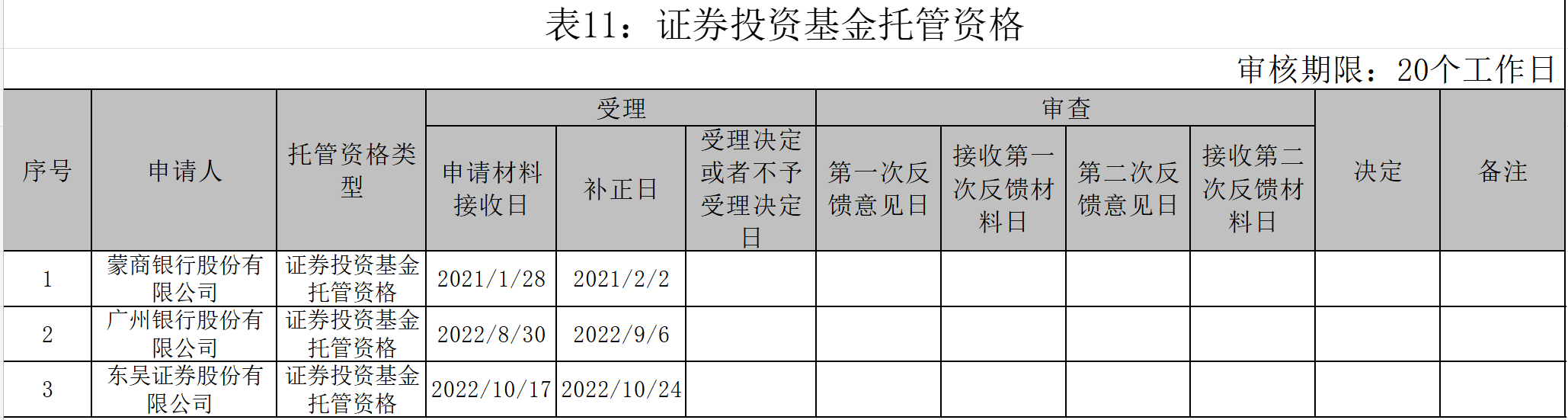
300亿净资产等多个指标提高门槛,多家中小券商放弃基金托管牌照
Xin Lang Cai Jing· 2025-08-20 07:03
Core Viewpoint - The recent regulatory changes have significantly increased the entry barriers for fund custody qualifications, leading to a sharp decline in the number of brokerages applying for such licenses, with only three remaining in the queue as of now [1][3][4]. Group 1: Regulatory Changes - The new regulations have raised the net asset requirements for commercial banks to no less than 500 billion and for securities companies to no less than 300 billion [3]. - Institutions applying for fund custody qualifications must have a regulatory rating of level 2 or A class or above for the past three years [3]. - The new rules require institutions to demonstrate substantial operational capabilities and a sustainable business model, with total asset scale or equity public fund sales ranking among the industry leaders [3][4]. Group 2: Impact on Brokerages - The number of brokerages applying for fund custody qualifications has decreased from seven to one within a year, as many could not meet the new regulatory standards [1][4]. - The heightened requirements have created significant pressure on small and medium-sized brokerages, making it difficult for them to achieve the new net asset thresholds [3][4]. - The new regulations are expected to concentrate fund custody business among larger institutions, as smaller firms lack competitive advantages in this area [4][6]. Group 3: Industry Dynamics - The new regulations are likely to accelerate the concentration of resources towards leading institutions, as the exit mechanism will eliminate those who do not actively engage in fund custody business [4][6]. - The landscape of the securities industry is shifting from a focus on scale expansion to quality competition, with a clear division emerging between large and small brokerages [6]. - The ability of top brokerages to establish specialized subsidiaries for refined operations will be crucial in competing against banks, which currently dominate the fund custody market [6].

芯片股午后集体拉升 国产半导体行业迎来并购浪潮 美关税或重构全球半导体供应链
Zhi Tong Cai Jing· 2025-08-20 06:37
Group 1 - Semiconductor stocks experienced a collective surge, with notable increases in shares of companies such as SMIC (3.5% increase), Hua Hong Semiconductor (3.09% increase), and others [1] - Hua Hong Semiconductor announced plans to acquire a controlling stake in Hua Li Micro through a combination of share issuance and cash payment, focusing on a portion of Hua Li Micro's mature process business [1] - This acquisition is part of a broader trend of mergers and acquisitions in the domestic semiconductor industry, aimed at strengthening Hua Hong's strategic focus on mature processes and specialty technologies, enhancing its competitive edge in automotive, industrial, and consumer electronics markets [1] Group 2 - On August 6, former President Trump announced a 100% tariff on semiconductor imports to the United States, which is expected to significantly increase production costs and raise electronic product prices, potentially suppressing demand [1] - Following the tariff announcement, companies with investment plans in the U.S. showed positive stock market performance [1] - The long-term implications of tariffs may lead to a restructuring of the semiconductor supply chain, with production locations becoming more influenced by tariff-related factors rather than intangible elements [1]

7家券商中6家撤回基金托管申请【导读】7家券商中6家撤回基金托管申请
Zhong Guo Ji Jin Bao· 2025-08-20 06:34
Core Viewpoint - Six out of seven brokerages have withdrawn their applications for fund custody qualifications, leaving only Dongwu Securities remaining in the queue [2][3] Group 1: Regulatory Changes - The China Securities Regulatory Commission (CSRC) released new regulations in April, raising the asset requirement for securities firms from 20 billion to 30 billion yuan [5] - The new regulations also introduced a "holding and maintaining license" requirement, which could lead to disqualification if the average monthly custody scale is below 5 billion yuan for 36 consecutive months [5][6] Group 2: Industry Impact - The withdrawal of applications by smaller brokerages is a strategic decision influenced by the increased resource demands for system development, client promotion, and risk control [4][6] - Currently, there are 66 financial institutions with custody qualifications, with a significant concentration among the top firms, as the top five brokerages hold 65.71% of the custody market [7] Group 3: Future Trends - The custody industry is expected to evolve from basic custody services to value-added services such as performance evaluation and compliance monitoring, forming a "custody+" service model [7] - Major brokerages like Citic Securities and Guotai Junan are focusing on expanding their service offerings and enhancing operational efficiency to capture a larger market share [8]

华致酒行H1扣非降76% 净利连降3年2019年上市募9.7亿
Zhong Guo Jing Ji Wang· 2025-08-20 06:12
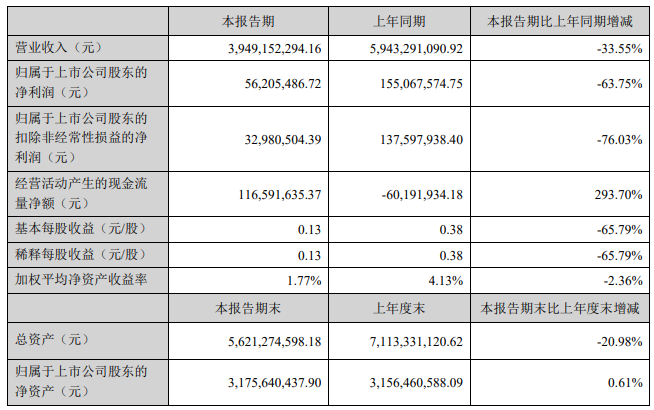
Core Points - The company reported a significant decline in revenue and net profit for the first half of 2024, with revenue at 3.949 billion yuan, down 33.55% year-on-year, and net profit attributable to shareholders at 56.21 million yuan, down 63.75% [1][2] - The net profit excluding non-recurring items also saw a substantial decrease of 76.03%, amounting to 32.98 million yuan [1][2] - The operating cash flow showed a positive trend, increasing by 293.70% to 116.59 million yuan [2] Financial Performance - For the first half of 2024, the company achieved operating revenue of 39.49 billion yuan, a decrease from 59.43 billion yuan in the same period last year [2] - The basic and diluted earnings per share fell by 65.79% to 0.13 yuan [2] - The weighted average return on equity decreased to 1.77% from 4.13% [2] Asset and Equity Position - Total assets at the end of the reporting period were 5.621 billion yuan, down 20.98% from the previous year [2] - The net assets attributable to shareholders increased slightly by 0.61% to 3.176 billion yuan [2] Historical Context - In 2023, the company reported a net profit of 44.45 million yuan, down 81.11% year-on-year, and a revenue of 9.464 billion yuan, down 6.49% [1][4] - The company has experienced a consistent decline in net profit over the past two years, with decreases of 45.77% and 35.78% in 2022 and 2023, respectively [4]

撤回潮!6家券商撤回基金托管申请
Zhong Guo Ji Jin Bao· 2025-08-20 05:53
Core Viewpoint - Six out of seven brokerages have withdrawn their applications for fund custody qualifications, leaving only Dongwu Securities remaining in the queue [1][2]. Group 1: Regulatory Changes - The China Securities Regulatory Commission (CSRC) has raised the asset requirement for securities firms from 20 billion yuan to 30 billion yuan for fund custody qualifications [4]. - The new regulations also introduced a "holding license" requirement, where institutions with an average custody scale below 5 billion yuan for 36 consecutive months may lose their qualifications [4]. Group 2: Industry Impact - The withdrawal of applications by smaller brokerages is attributed to increased resource demands for system construction, client promotion, and risk control [3]. - Currently, there are 66 financial institutions with custody qualifications, with a significant concentration among the top firms, as the top five brokerages account for 65.71% of the custody volume [5]. Group 3: Future Trends - The custody industry is expected to evolve from basic custody services to value-added services such as performance evaluation and compliance monitoring, forming a "custody+" service model [5]. - Major brokerages like Citic Securities and Guotai Junan are enhancing their service offerings and operational efficiencies to capture a larger market share [6].