国家电投

Search documents
退役电池如何“数字重生”?云储新能源“储能黑科技”给出答案
Qi Lu Wan Bao· 2025-09-17 07:59
Core Insights - The 2025 Shandong Clean Energy Industry Expo opened in Yantai, featuring over 300 companies, including major players like China National Nuclear Corporation, China General Nuclear Power Group, State Power Investment Corporation, and China Huaneng Group, showcasing advanced technologies and high-end equipment in clean energy sectors such as wind power, photovoltaics, energy storage, offshore renewable energy, charging and swapping, hydrogen energy, and nuclear energy [1] Group 1: Dynamic Reconfigurable Battery Technology - Cloud Storage New Energy Technology Co., Ltd. presented its "black technology" in energy storage, a megawatt-level dynamic reconfigurable battery storage technology, which addresses the "weakness effect" in battery systems, providing a safe, long-lasting, and cost-effective solution for large-scale energy storage [1][3] - The dynamic reconfigurable battery network technology allows for individual energy management of each battery pack, maximizing the utility of batteries with varying states, fundamentally changing the logic of traditional fixed series and parallel battery storage systems [3] Group 2: Case Study and Applications - The 10MW/34MWh digital energy storage station project in Inner Mongolia serves as a typical example of Cloud Storage New Energy's large-scale application of retired power battery utilization, utilizing dynamic reconfigurable battery network technology for digital reorganization and intelligent management of retired batteries [5] - This project represents the largest single-point centralized energy storage station for retired power batteries internationally, enabling seamless integration of battery assets from vehicles to energy storage systems without the need for individual disassembly, thus promoting green, low-carbon, and efficient utilization throughout the battery lifecycle [5] Group 3: Company Overview and Future Plans - Cloud Storage New Energy Technology Co., Ltd. is a technology transfer enterprise from Tsinghua University, headquartered in Yantai, Shandong Province, specializing in energy internet core network equipment, solutions, and operational services [5] - The company's core technology has been widely applied across various scenarios, including power generation, grid, user side, and data centers, with plans to establish a production, research, and sales network from north to south, aiming to provide safe, efficient, and economical energy storage solutions and promote the transition to a safer, more efficient, and greener low-carbon energy system [5]

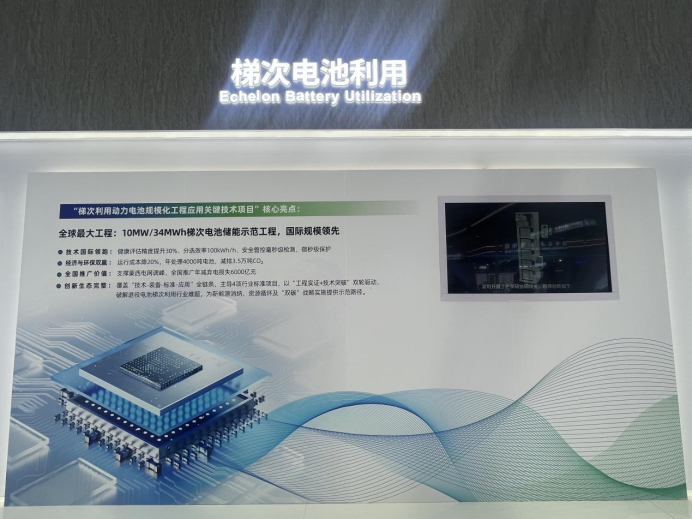
全程无人工!中核二四这条智能产线单班次年产能36000件
Qi Lu Wan Bao· 2025-09-15 14:25
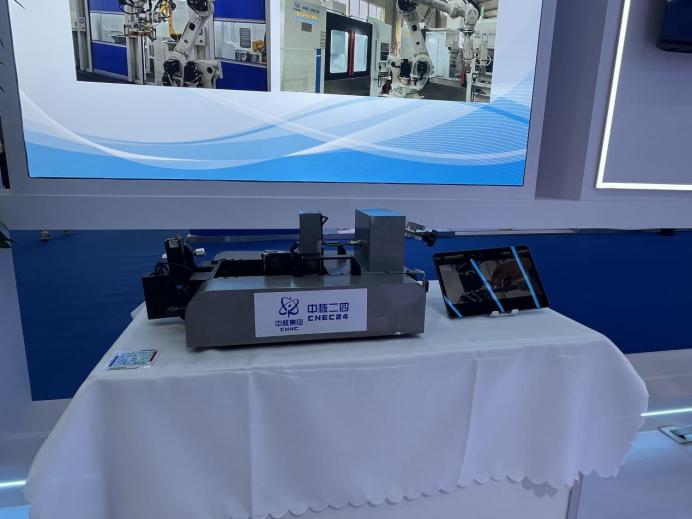
Group 1 - The 2025 Shandong Clean Energy Industry Expo and the 18th Yantai International Nuclear Power Industry and Equipment Expo opened simultaneously in Yantai, featuring over 300 companies, including more than 60 industry leaders such as China National Nuclear Corporation and China General Nuclear Power Group, showcasing advanced technologies and high-end equipment in clean energy fields like wind power, solar energy, energy storage, offshore renewable energy, hydrogen energy, and nuclear energy [1][3] - China Nuclear Industry 24 Construction Co., Ltd. presented 22 advanced technological achievements at the expo, including modular construction of various nuclear reactor types, digital construction, automated welding, and advanced detection technologies [3] - The intelligent manufacturing production line for nuclear power station embedded parts is designed to be flexible, automated, green, intelligent, and requires minimal human intervention, achieving automatic loading and unloading of raw materials at each workstation [5] Group 2 - The automated production line features processes such as automatic laser rust removal, automatic hole processing of steel plates, automated welding, and grinding, all without human intervention, ensuring digital linkage of the entire production line, stable quality, and high-efficiency production [5] - The production line has an annual capacity of 36,000 pieces per shift, meeting the needs of multiple Hualong reactor units, and serves as a demonstration project for future factory-based intelligent manufacturing in China's nuclear construction sector [5] - China Nuclear Industry 24 has undertaken several nuclear power projects in Shandong, including the Haiyang AP1000 first batch and second phase projects, and is committed to providing high-quality materials and technical support for nuclear power construction [5]
国家电投巡检机器人助力智慧电厂建设
Huan Qiu Wang Zi Xun· 2025-09-15 03:54
巡检机器人搭载的高精度红外热像仪识别0.1摄氏度温差,全天候守护万家灯火,维护电力安全! 来源:环球网 ...

2025山东清洁能源产业博览会,看山东如何“向绿而行”
Qi Lu Wan Bao· 2025-09-12 10:33
Core Viewpoint - Shandong province is transitioning from a traditional energy powerhouse to a leader in clean energy, with significant advancements in renewable energy capacity and a major clean energy expo scheduled for September 2025 [1][2][4]. Group 1: Clean Energy Transition - As of November 2024, Shandong's renewable energy and new energy installed capacity reached 10,642.6 MW, surpassing coal power for the first time, with a share of 46.9% of total installed capacity [2]. - By July 2023, Shandong's renewable energy capacity reached 123.24 million kW, with solar power accounting for 91.3 million kW and wind power for 27.49 million kW, contributing to 40% of the public grid's green electricity [2]. Group 2: 2025 Clean Energy Expo - The 2025 Shandong Clean Energy Industry Expo will take place from September 15 to 17 at the Yantai Bajiao Bay International Convention Center, focusing on clean energy equipment manufacturing and technology cooperation [1][3]. - The expo will cover over 40,000 square meters and will feature more than 300 exhibitors, including major industry players like State Power Investment Corporation, Huaneng, and China Nuclear [3]. Group 3: Policy and Technological Integration - The expo aims to promote the integration of policy, technology, and capital to foster high-quality development in the green and low-carbon industry [4]. - Five major exhibition areas will be established, covering the entire energy production, storage, transmission, and application chain, along with 11 high-level professional conferences [4]. Group 4: Yantai's Clean Energy Leadership - Yantai has become a clean energy demonstration city with an installed capacity exceeding 17 million kW, the highest in Shandong province [5][6]. - The city has implemented several demonstration projects, including a "zero-carbon" heating city and the first city-level virtual power plant in the country [6].
电力央企抢滩“AI+能源”新赛道,央企现代能源ETF(561790)盘中涨近1%
Sou Hu Cai Jing· 2025-09-11 05:43
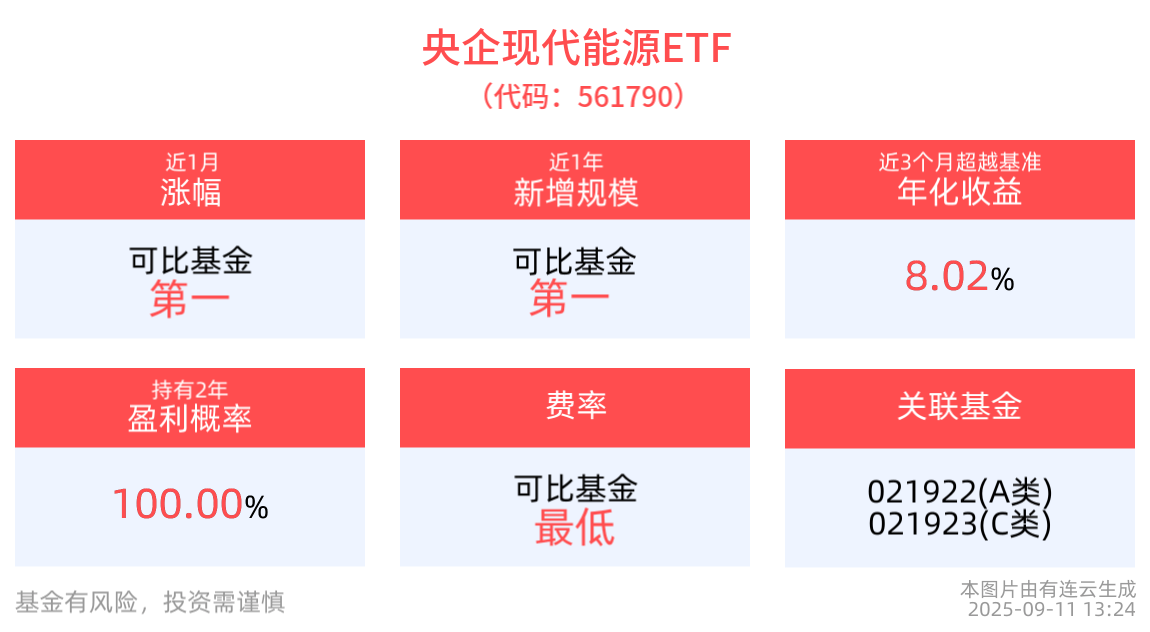
Core Insights - The China Modern Energy Index has seen an increase of 0.85% as of September 11, 2025, with notable gains in constituent stocks such as China Rare Earths (up 6.32%) and China National Materials Technology (up 6.25%) [3][4] - The China Modern Energy ETF (561790) has also risen by 0.87%, with a latest price of 1.16 yuan, and has shown a cumulative increase of 1.14% over the past week [3][4] - The National Development and Reform Commission and the National Energy Administration have jointly issued guidelines to promote the integration of artificial intelligence with the energy sector, aiming to leverage significant strategic opportunities [3][4] Market Performance - The China Modern Energy ETF has experienced a significant growth in scale, increasing by 232.85 million yuan over the past year, ranking in the top third among comparable funds [4] - The ETF closely tracks the China Modern Energy Index, which includes 50 listed companies involved in modern energy sectors such as green energy and fossil fuels [4] Sector Developments - Major state-owned energy enterprises are actively transitioning towards "AI + New Energy" and "AI + New Energy Business Models," aligning with the new policies [3][4] - The energy sector is well-positioned for AI integration due to its strong digital foundation, high data quality, and diverse application scenarios [4] - The top ten weighted stocks in the China Modern Energy Index account for 48.28% of the index, with companies like Yangtze Power and China Nuclear Power leading the list [4]

国家政策与千亿投资同频共振,电力央企抢滩"AI+能源"新赛道
Hua Xia Shi Bao· 2025-09-10 12:43
Core Viewpoint - The integration of artificial intelligence (AI) with the energy sector is becoming an inevitable trend, driven by the release of the "Implementation Opinions on Promoting High-Quality Development of 'Artificial Intelligence + Energy'" by the National Development and Reform Commission and the National Energy Administration [1][2] Group 1: Policy and Strategic Goals - By 2027, a preliminary framework for the integration of energy and AI is expected to be established, with significant breakthroughs in core technologies and broader applications [2][6] - The policy outlines the deployment of AI across various energy sectors, including electricity, coal, oil, and gas, aiming to enhance the digital and intelligent transformation of traditional fossil energy industries [2][3] Group 2: Industry Initiatives and Developments - Major state-owned power enterprises, such as State Power Investment Corporation and China Energy Group, are actively implementing AI technologies in areas like resource exploration, production operations, and safety monitoring [1][4] - The National Energy Group is focusing on AI for efficient and clean coal utilization, with AI algorithms optimizing boiler combustion parameters to reduce coal consumption by 3%-5% [5] - Huaneng Group is collaborating with China Telecom to enhance digital transformation and AI integration in the energy sector [5] Group 3: Technological Advancements - AI systems are being utilized to optimize coal combustion in traditional power plants, resulting in a reduction of coal consumption by 4.2 grams per kilowatt-hour [6] - The development of AI load forecasting systems has improved short-term load prediction accuracy to over 97%, significantly enhancing grid stability [6] Group 4: Future Outlook and Market Potential - The market for digitalization in the power sector is projected to reach approximately 180 billion yuan by 2030, driven by the implementation of AI technologies [5] - The establishment of a collaborative mechanism between computing power and electricity is expected to create a green, economical, safe, and efficient energy consumption model [2][6]
国家政策与千亿投资同频共振,电力央企抢滩“AI+能源”新赛道
Hua Xia Shi Bao· 2025-09-10 08:55
Core Viewpoint - The integration of artificial intelligence (AI) with the energy sector is becoming an inevitable trend, as highlighted by the recent implementation opinions from the National Development and Reform Commission and the National Energy Administration aimed at promoting high-quality development in this area [1][2]. Group 1: Policy and Strategic Goals - By 2027, a preliminary integration system for energy and AI is expected to be established, with significant breakthroughs in core technologies and broader applications [2][6]. - The policy outlines the development of over five specialized AI models in various energy sectors, aiming to identify more than ten replicable and competitive demonstration projects by 2027 [2][3]. - By 2030, the AI-specific technologies and applications in the energy sector are projected to reach a world-leading level [2][6]. Group 2: Industry Initiatives and Developments - Major state-owned power enterprises, including State Power Investment Corporation and China Energy Group, are actively advancing towards "AI + new energy" and "AI + new energy business models" [1][4]. - The National Energy Group is focusing on AI applications for efficient and clean coal utilization, with AI algorithms optimizing boiler combustion parameters to reduce coal consumption by 3%-5% [5]. - Huaneng Group is collaborating with China Telecom to enhance digital transformation and AI integration in the energy sector [5]. Group 3: Technological Advancements - AI systems are now capable of real-time analysis of numerous parameters in traditional power plants, leading to significant reductions in coal consumption and operational efficiency [6]. - The AI load forecasting system developed by the State Grid Power Research Institute has improved short-term load prediction accuracy to over 97% [6]. - The implementation of AI in energy management is expected to enhance the overall efficiency of energy systems, contributing to a smarter and more efficient energy landscape [7]. Group 4: Future Outlook - The continuous release of policy dividends and proactive measures by power enterprises are paving the way for a new era of intelligent, efficient, and safe energy systems [7]. - The National Energy Administration emphasizes the need for coordinated efforts in implementing the policy, focusing on top-level design and support to ensure effective execution [7].
能源高质量发展专家谈丨能源科技实现历史性跨越,一大批大国重器传来好消息
国家能源局· 2025-08-28 09:24
Core Viewpoint - The article emphasizes the importance of technological innovation in driving high-quality energy development during China's 14th Five-Year Plan, highlighting breakthroughs in clean energy, fossil energy cleaning, and integrated energy development, which collectively support energy security and the transition to a low-carbon economy [2][3][4]. Group 1: Clean Energy Development - During the 14th Five-Year Plan, the energy structure is rapidly adjusting, with non-fossil energy power generation capacity reaching 2.23 billion kilowatts by July 2025, accounting for 60.8% of total power generation capacity [3]. - The efficiency of N-type TOPCon solar cells has surpassed 27%, with the cost of electricity dropping to approximately 0.13 yuan/kWh, a reduction of about 50% compared to 2020 [3]. - The largest hydropower unit in the world, the Baihetan hydropower station, has been completed, and the pumped storage capacity exceeds 58 million kilowatts, maintaining the world's leading position for nine consecutive years [3]. Group 2: Fossil Energy Cleaning - Fossil energy continues to play a stabilizing role in energy security, with over 500 million kilowatts of coal-fired power units undergoing energy-saving, heating, and flexibility upgrades [4]. - Significant projects include the completion of Asia's first ultra-deep exploration well and the world's first 100,000-ton deep-water semi-submersible oil production platform [4]. - The CCUS demonstration project in Taizhou has been established with a capacity of 500,000 tons, marking a significant step in carbon capture technology [4]. Group 3: Integrated Energy Development - The smart grid is undergoing continuous upgrades, with the capacity for "West-to-East Power Transmission" increasing from 260 million kilowatts to 360 million kilowatts [4]. - The energy consumption of proton exchange membrane (PEM) electrolyzers has decreased to 4.2 kWh/Nm3, and key technologies for hydrogen refueling stations have achieved localization [4]. - The cost of lithium iron phosphate energy storage systems has dropped to around 0.4 yuan/Wh, with advancements in compressed air and vanadium flow battery storage technologies [4]. Group 4: Original Technological Innovation - The construction of a new power system aims to maximize the integration of renewable energy, with projections indicating that by 2060, wind and solar installations will exceed 900 million kilowatts, accounting for over 70% of power generation [5]. - The development of a new type of high-voltage direct current (HVDC) converter valve has been achieved, demonstrating 100% failure resistance in practical applications [6]. - The flexible HVDC technology has been successfully exported, with significant projects in the Middle East and a successful bid for the Dolwin6 offshore wind project in Germany [6]. Group 5: Strengthening National Strategic Technological Forces - The article highlights the need to address issues of fragmentation and homogeneity in energy technology innovation, advocating for a unified national strategy to enhance research capabilities [8]. - The establishment of national laboratories and innovation alliances in the energy sector aims to consolidate resources and focus on major national energy needs [8]. - Collaborative efforts among various stakeholders, including government, enterprises, and research institutions, are emphasized to drive technological advancements in flexible coal-fired power generation [9][10].
济南起步区今年将新开工建设一批新能源汽车产业项目
Qi Lu Wan Bao Wang· 2025-08-28 03:12
Group 1 - Jinan city is implementing the "Industrial Strong City Development Strategy" with a focus on advanced manufacturing projects in the new energy vehicle sector, aiming to accelerate the emergence of a trillion-yuan industrial cluster [1] - The new energy vehicle base of BYD in Jinan has produced eight models, contributing nearly 100 billion yuan in output value since its establishment in 2022 [1] - The Aishuo Solar Energy project has achieved a light-to-electricity conversion efficiency of over 24.4%, leading the international commercial component efficiency rankings for 30 consecutive months [1] Group 2 - The National Power Investment's hydrogen energy industrial base project is operating three production lines with an annual capacity of 1,000 units each for various fuel cells, expanding hydrogen energy applications [2] - The "Hydrogen Teng" fuel cell has been successfully deployed at the Antarctic Qinling Station, and commercial vehicles using fuel cells from the start-up area have been promoted in Shandong, Henan, and Hebei [2]

大规模甩卖分布式光伏后,电力央企集体转向“大基地”
Sou Hu Cai Jing· 2025-08-26 04:57
Core Viewpoint - Recent strategic adjustments by major state-owned enterprises (SOEs) in China's energy sector indicate a shift from distributed solar projects to large-scale wind and solar base projects, signaling a significant transformation in the photovoltaic market [1][7]. Group 1: Recent Developments - Five major SOEs, including China Three Gorges Corporation and China Energy Investment Corporation, have transferred 19 solar business companies, primarily focusing on distributed solar assets [1]. - Major power SOEs have identified large-scale wind and solar base projects as a key focus for their upcoming work, reflecting a strategic pivot in renewable energy development [2][4]. Group 2: Reasons for the Shift - The transition to large-scale wind and solar base projects is driven by three main factors: 1. Scale effects and lower electricity costs make large-scale projects more competitive, with costs as low as 0.20-0.25 yuan/kWh compared to 0.25-0.30 yuan/kWh for distributed solar [8]. 2. Policy support for cross-provincial trading allows large-scale projects to secure favorable electricity prices, reducing volatility risks associated with distributed solar [9]. 3. Increasing risks associated with distributed solar projects, including limited grid capacity and regulatory changes, have prompted SOEs to focus on large-scale projects [10]. Group 3: Market Trends - The growth of photovoltaic installations has historically favored large-scale projects, with 68% of new installations in 2020 being centralized [10]. - By the end of 2024, distributed solar installations are projected to reach 370 million kW, but challenges such as consumption difficulties are becoming more pronounced [11][13]. - The government has planned approximately 455 million kW of large-scale projects by 2030, with over 200 million kW expected to be completed during the current five-year plan [14]. Group 4: Future Outlook - The upcoming five years are expected to see significant growth in large-scale wind and solar base projects, with potential total installations exceeding 500 million kW [14]. - This expansion will likely drive demand for photovoltaic products, including components and supports, significantly impacting the solar market [14].