福田汽车

Search documents
国星光电:公司在车载业务领域布局了采用微显示技术的汽车外部交互显示LED产品
Zheng Quan Ri Bao Wang· 2025-11-10 08:10
Core Viewpoint - The company has made significant advancements in the automotive sector by integrating micro-display technology into various LED products, enhancing its supply chain capabilities with major domestic automotive brands [1] Group 1: Automotive Business Development - The company has developed automotive external interactive display LED products, including backlighting for in-car screens and intelligent ambient lighting [1] - The company has successfully entered the supply chains of major domestic brands such as Changan, Geely, and SAIC by leveraging its internal advantages and integrating packaging and module manufacturing resources [1] Group 2: Product Innovation and Performance - The company's interactive display modules utilize mature experience from commercial display components, showcasing comprehensive design, development, and manufacturing capabilities [1] - Continuous innovation in design and manufacturing has led to superior contrast and saturation characteristics in the modules, which are now featured in popular vehicle models [1] Group 3: Cabin Display LED Products - The company has upgraded its design experience from television backlighting to automotive applications, successfully developing a complete series of automotive instrument backlighting and display backlighting products [1] - These products have been applied in various models from brands such as Changan, Geely, Chery, and Foton due to their outstanding performance [1] Group 4: External Lighting Signal Products - The company has enhanced its LED components for external lighting signals by upgrading key parts like chips and brackets, covering multiple platforms including daytime running lights and brake lights [1] - These products have passed rigorous testing in the company's reliability laboratory and have received third-party automotive quality certification, currently being used in models from brands like Changan and SAIC [1] - Notably, the company's ceramic headlight components have demonstrated exceptional performance after extensive aging tests, achieving leading levels among domestic products [1]

商用车出海再提速!福田这场全球大会放出了哪些大招?
第一商用车网· 2025-11-10 07:29
Core Viewpoint - Foton Motor aims to become a world-class commercial vehicle enterprise by 2030, with over 50% of its models being new energy vehicles and overseas sales exceeding 300,000 units [3][5][22] Group 1: Global Strategy and Goals - Foton Motor is actively participating in global competition, focusing on industrial intelligence, digitalization, and connectivity to drive the development of the Chinese automotive industry [3] - The company plans to accelerate overseas industrial investment, establishing over 10 industrial bases in countries such as Thailand, Indonesia, South Africa, Brazil, Mexico, Saudi Arabia, and the EU within the next five years [5][12] - Foton's global strategy report outlines clear goals for achieving a leading position in design, manufacturing, and quality experience in the commercial vehicle sector [3][5] Group 2: Regional Cooperation and Emerging Markets - Brazil and South Africa are identified as crucial strategic points in Foton's global layout, with significant local support for the company's investments [7][10] - The Brazilian government is promoting initiatives that align with Foton's sustainable transportation strategy, encouraging investments in decarbonization and innovation [8] - Foton's local assembly plant in South Africa is highlighted as a significant automotive investment, marking the company's commitment to local production and regional development [10] Group 3: Product Innovation and Technology - Foton is transitioning from being a market participant to a global technology leader, focusing on new energy, intelligent driving, and a multi-energy approach [14] - The company has developed proprietary technologies in electric, hybrid, and hydrogen fuel cell vehicles, achieving high efficiency and extensive testing [14] - Foton's intelligent driving technologies aim to enhance operational efficiency and safety, with significant data integration into its logistics services [16] Group 4: Future Business Planning - Foton aims to achieve a target of 200,000 units in overseas sales by 2026, with significant growth expected in heavy trucks and buses [18] - The company is focused on innovative marketing models and new product promotion, particularly in the new energy sector [18] - Foton's commitment to building a comprehensive vehicle ecosystem is evident in its plans for digitalization and service expansion [16][18] Group 5: Recognition and Awards - Foton Motor recognized outstanding partners in its global development journey with various awards, emphasizing collaboration and innovation [20]



从单车净赚10万元到断崖式下跌,出口俄罗斯“退烧”,中国车商做了个大胆的决定
3 6 Ke· 2025-11-10 03:37
Core Insights - The export of Chinese automobiles to Russia has significantly declined, with a 58% drop in the first nine months of 2025 compared to the previous year, marking a shift in the export landscape [3][11][12] - Mexico has overtaken Russia as the largest destination for Chinese automobile exports, reflecting a changing dynamic in the market [3][11] - Increased taxes and economic challenges in Russia, including a rise in scrappage taxes by 70% to 85%, have negatively impacted the profitability and attractiveness of the Russian market for Chinese exporters [8][9][11] Export Trends - In the first nine months of 2025, China exported 35.77 million vehicles to Russia, a significant decrease from previous years when Russia was the top destination for Chinese car exports [3][11] - The top three destinations for Chinese automobile exports are now Mexico, the UAE, and Russia, indicating a shift in market focus [3][11] Market Challenges - Factors such as rising import taxes, scrappage taxes, and economic instability in Russia are contributing to a decline in demand for Chinese vehicles [8][9][11] - The Russian market is experiencing a structural economic decline, with inflation at 10% and high interest rates affecting consumer purchasing power [11] Industry Response - Chinese automobile manufacturers are shifting strategies from quick profits to long-term investments in local production and service networks in Russia [16][18] - Companies like Great Wall Motors and Chery are establishing local assembly plants to increase localization and reduce import costs [18][19] Future Outlook - Industry experts suggest that Chinese car manufacturers need to enhance localization, improve after-sales service, and reshape brand perception to succeed in the Russian market [19] - The transition to a more sustainable and competitive approach in the Russian market is expected to take three to five years, requiring patience and strategic planning [19]

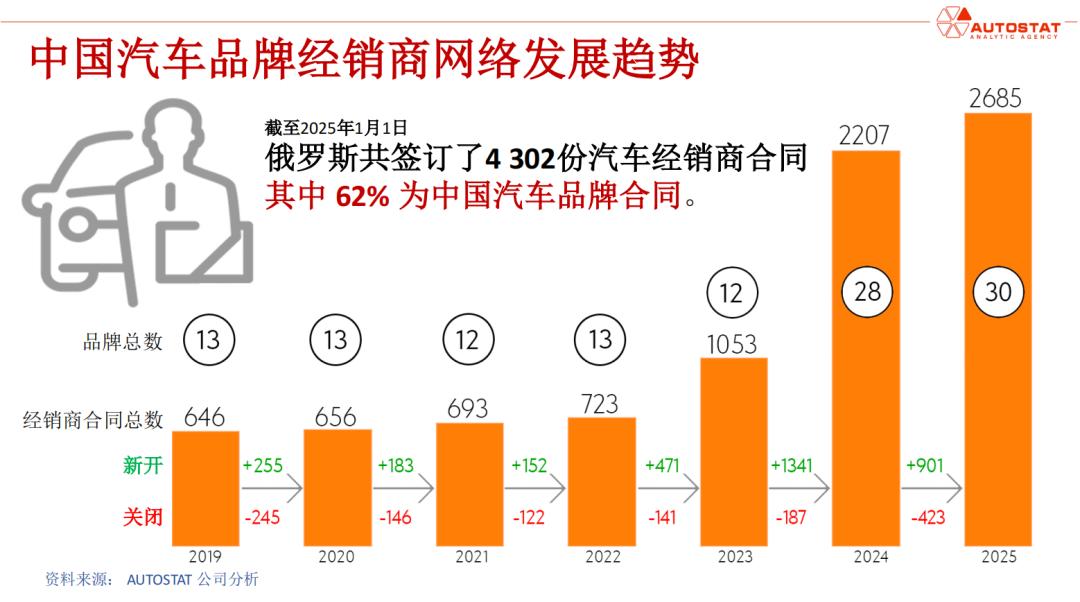
俄罗斯大幅加税,中国汽车出口骤降58%
Mei Ri Jing Ji Xin Wen· 2025-11-10 00:41
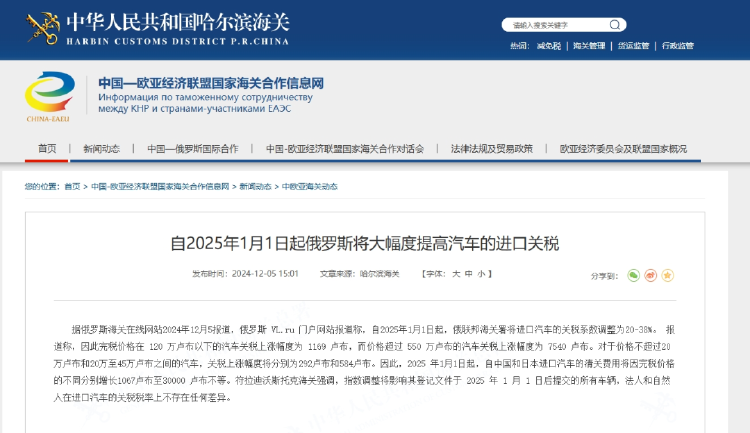
Core Viewpoint - The export of Chinese automobiles to Russia has significantly declined, with a 58% drop in the first nine months of 2025 compared to the previous year, as new taxes and changing market dynamics impact the industry [3][5][7]. Group 1: Market Dynamics - In the first nine months of 2023, China exported 5.71 million vehicles, a year-on-year increase of 21%, with Mexico becoming the largest export destination, followed by the UAE and Russia [1][3]. - Russia, which was previously the largest market for Chinese automobile exports, has now fallen to third place, with exports dropping to 357,700 units in 2025 [3][7]. - The shift in export destinations indicates a significant change in the landscape of Chinese automobile exports, moving away from reliance on the Russian market [3][7]. Group 2: Tax and Regulatory Impact - Starting October 1, 2024, the scrap tax for new imported vehicles in Russia will increase by 70% to 85%, particularly affecting used cars with engine sizes between 2 to 3 liters and over three years old, where the tax will rise from 1.3 million rubles (approximately 114,000 RMB) to 2.37 million rubles (approximately 208,000 RMB) [5][7]. - Additionally, from January 1, 2025, import tariffs on vehicles will be adjusted to 20% to 38%, leading to increased clearance costs for Chinese automobiles [5][7]. Group 3: Industry Challenges - The Russian economy is experiencing structural decline, with high inflation rates of 10% and a long-term benchmark interest rate of 21%, leading to increased car loan rates and reduced purchasing power [7][10]. - Chinese brands are facing declining sales in Russia, with significant drops reported for brands like Haval and Geely, which saw year-on-year declines of 15.5% and 39.3%, respectively [7][10]. - The closure of 274 car dealerships in Russia, with 78% being Chinese brands, highlights the challenges faced by Chinese automobile exporters in maintaining market presence [7][10]. Group 4: Strategic Shifts - Chinese automobile manufacturers are shifting from a focus on quick profits to establishing a long-term presence in the Russian market, emphasizing local production and service [13][14]. - Companies like Great Wall Motors are adopting a localized assembly model, achieving over 65% localization to mitigate high import taxes and benefit from local subsidies [14][15]. - Experts suggest that to succeed in the Russian market, Chinese manufacturers must enhance local production, improve after-sales service, and reshape their brand image to counter negative perceptions [14][15].
武汉商用车展探馆!东风/中集包场 解放推新能源 江淮秀无人车 谁最有看点?| 头条
第一商用车网· 2025-11-09 23:26
Core Insights - The 2025 China International Commercial Vehicle Exhibition in Wuhan serves as a significant indicator of new trends and opportunities in the commercial vehicle industry, coinciding with the conclusion of the 14th Five-Year Plan and the planning of the 15th Five-Year Plan [1] Group 1: New Energy Vehicles - FAW Jiefang showcased five new energy truck models, including the J6L pure electric feed transport vehicle and the J6P heavy-duty pure electric dump truck, targeting various market segments [3][4][5] - Dongfeng Commercial Vehicle presented six new heavy-duty trucks, emphasizing keywords like large battery capacity, supercharging, and hybrid technology, including the Dongfeng Tianlong KL Huawei megawatt supercharging tractor [8][12] - Shaanxi Automobile displayed four heavy-duty trucks and five engine products in collaboration with Cummins, focusing on high power, fuel efficiency, and a mix of traditional and new energy vehicles [16][20] Group 2: Diverse Product Offerings - Foton Motors presented a wide range of products across its brands, including Ouman, Auman, and others, showcasing its comprehensive approach in the commercial vehicle sector [23] - Dongfeng Liuqi introduced a full lineup of vehicles, including LNG tractors and electric models, aligning with market trends towards electrification and intelligence [31][34] - Jianghuai Automobile highlighted its upcoming Kunpeng ET9 light truck and showcased the Kara unmanned delivery vehicle, featuring L4-level autonomous driving technology [39][44] Group 3: Industry Innovations - CIMC Vehicles emphasized its "Only Star Chain" strategy, showcasing logistics, tank, and special vehicles, and announced the upcoming release of new models for 2026 [43] - BYD displayed four new energy commercial vehicles, including the T4 electric truck, and set up a dynamic experience area to demonstrate the vehicle's capabilities [48][51] - Nanjing Iveco presented its star products, including the Eurovan series, demonstrating its leadership in the light commercial vehicle market [53][54] Group 4: Market Trends - The exhibition highlighted the increasing focus on new energy, intelligence, and high power in commercial vehicles, with many companies launching products that align with these trends [83] - The presence of specialized vehicle and component manufacturers at the exhibition indicates a broader market transformation affecting all sectors [83]




俄罗斯大幅加税 中国汽车出口骤降58%!1辆净赚几万已成过去
Mei Ri Jing Ji Xin Wen· 2025-11-09 23:25
Core Viewpoint - The export of Chinese automobiles to the Russian market is facing significant challenges, with a notable decline in sales and increasing operational costs due to new taxes and changing consumer sentiment [1][4][11]. Group 1: Export Trends - In the first nine months of 2025, China's automobile exports to Russia fell to 357,700 units, a decrease of 58% year-on-year, marking a significant shift in export dynamics [4]. - Russia has dropped from being the largest export destination for Chinese automobiles to the third position, with Mexico and the UAE now leading [4][11]. - The overall export volume of Chinese automobiles reached 5.71 million units in the first nine months of the year, reflecting a 21% increase, but the focus has shifted away from Russia [1][4]. Group 2: Market Challenges - The introduction of new taxes, including a 70% to 85% increase in the scrappage tax for imported vehicles, has severely impacted the profitability of exporting to Russia [9][11]. - The economic situation in Russia, characterized by high inflation (10%) and a fluctuating ruble, has led to decreased purchasing power and rising costs for consumers [11]. - The interest in foreign brands returning to the Russian market has caused potential buyers to adopt a wait-and-see approach, further dampening demand for Chinese vehicles [15] . Group 3: Industry Response - Chinese automobile manufacturers are shifting strategies from quick profits to establishing a long-term presence in the Russian market, focusing on local production and service [20][21]. - Companies like Great Wall Motors are already implementing localized production strategies, achieving a localization rate of over 65% to mitigate import tax impacts [20]. - Industry leaders emphasize the need for improved after-sales service and brand perception to counteract negative stereotypes about quality [21].

研判2025!中国新能源轻卡行业政策、产业链、销量、市场占比及未来前景展望:新能源轻卡市场高歌猛进,前三季度销量达12.19万辆[图]
Chan Ye Xin Xi Wang· 2025-11-09 02:13
Core Insights - The article highlights the significant growth and development of the new energy light truck (新能源轻卡) industry in China, driven by government policies and market demand for environmentally friendly logistics solutions [1][9][10]. New Energy Light Truck Industry Overview - New energy light trucks are defined as environmentally friendly vehicles powered by electricity or hybrid systems, primarily used for urban delivery and short-distance transportation [6]. - The market is dominated by pure electric light trucks, which accounted for 92.55% of sales in the first three quarters of 2025, showing a 94.2% year-on-year growth [10]. Industry Policies - The Chinese government has implemented various policies to promote the development of the new energy vehicle industry, including subsidies for replacing old trucks and initiatives to enhance electric vehicle infrastructure [4][5]. - Key policies include the "Action Plan for Accelerating the Construction of a New Power System (2024-2027)" and the "Automobile Industry Stabilization Growth Work Plan (2025-2026)" [4]. Industry Supply Chain - The supply chain for new energy light trucks includes raw materials and components such as steel, aluminum, carbon fiber, batteries, and electric motors [6][8]. - Steel production in China has seen significant growth, reaching nearly 1.4 billion tons by 2024, providing a stable supply for the manufacturing of new energy light trucks [8]. Market Growth and Sales Data - Sales of new energy light trucks in China increased from 35,400 units in 2021 to 99,300 units in 2024, with a compound annual growth rate of 41.03% [1][10]. - In the first three quarters of 2025, sales reached 121,900 units, representing a year-on-year increase of 122.86% [1][10]. Competitive Landscape - The market is characterized by high concentration, with the top three companies—远程新能源商用车, 福田汽车, and 江淮汽车—holding over 45% of the market share [11][12]. - 远程新能源商用车 leads the market with a 20.47% share, followed by 福田汽车 at 17.35% [11]. Development Trends - Future competition will focus on technological advancements, with an emphasis on improving the efficiency of electric systems and integrating smart technologies [14][16]. - The industry is expected to shift towards customized solutions for specific logistics scenarios, enhancing product differentiation [15][16]. - Charging efficiency improvements will be crucial for the widespread adoption of new energy light trucks, with advancements in fast-charging technologies and smart charging management systems [17].


京津冀携手筑起新能源汽车“配套圈”
Bei Jing Ri Bao Ke Hu Duan· 2025-11-08 23:48
Core Insights - The Beijing-Tianjin-Hebei Intelligent Connected New Energy Vehicle Technology Ecological Park (Shunyi) has received approval for the automotive core component standard factory project, aimed at accelerating the development of an industrial cluster and enhancing collaboration among local automotive enterprises [3][4] Group 1: Project Overview - The project covers a total construction area of over 80,000 square meters, including standardized factories and supporting facilities, providing specialized production space for automotive core component companies [3] - The ecological park is planned to occupy over 8,000 acres, divided into three zones: Shunyi in Beijing, Wuqing in Tianjin, and Langfang in Hebei [3][4] - The Shunyi zone will focus on automotive electronics, smart vehicles, and quality upgrades, aiming to create a high-efficiency, green, and intelligent operational environment [3] Group 2: Development Phases - The project is divided into three phases: - Phase 1 focuses on production services and intelligent driving systems, expected to be operational by June 2026 [4] - Phase 2 will include electric motor control systems and smart cockpit development, anticipated to be completed by December 2027 [4] - The expansion area will target new material systems and smart automotive computing platforms, aiming for completion by the end of the 14th Five-Year Plan [4] Group 3: Industry Impact - The ecological park is expected to enhance the scale of the automotive component industry, attracting high-tech and high-value-added enterprises, thereby improving the self-sufficiency of core components [4] - Once completed, the park will create a "30-minute supply circle" with local automotive production bases and a "2 to 3-hour supply circle" with Tianjin and Hebei, promoting deep integration across the industry chain [4] Group 4: Recent Developments - Two significant projects have recently been signed to establish operations in the ecological park: Shanghai Tongyu Automotive Technology and Beijing Wanjitech, both focusing on intelligent chassis and laser radar technologies [6] - Shanghai Tongyu plans to invest 500 million yuan to build its northern headquarters and establish multiple intelligent production lines [6] - The addition of these companies is expected to strengthen the critical links in the park's industrial chain and foster a collaborative innovation ecosystem [6]


南非年轻人青睐中国车
Xin Hua She· 2025-11-08 22:07
Core Insights - Chinese automotive brands are rapidly gaining popularity in South Africa, with increasing market presence and consumer preference, particularly among the youth [1][2][3] Group 1: Market Trends - South African cities are witnessing a surge in the presence of Chinese automotive brands such as Haval, Chery, BYD, and BAIC, with dealerships emerging rapidly [1] - In September, new car sales in South Africa continued to grow, with Chery and Great Wall Motors ranking 4th and 6th respectively in sales [2] - Chinese brands are reshaping consumer perceptions in South Africa, meeting demands for price, design, and technology [2] Group 2: Consumer Preferences - Young South African consumers are increasingly favoring Chinese brands, with Chery being one of the top ten brands financed by young buyers [2] - The Chery Jetour X70 Plus, launched in September last year, is noted for its high cost-performance ratio and reliability, appealing to local drivers [2] Group 3: Economic Impact - Chinese automotive companies are contributing to local employment and industry development by investing in manufacturing plants, such as BAIC's facility in Port Elizabeth, which has created over 3,000 jobs [3] - The unique technological features of Chinese vehicles, even in entry-level models, are highlighted as a significant factor in their growing popularity [3]

驭见中国智造:福田专列开启全球合作新程
Huan Qiu Wang· 2025-11-08 08:49
Core Insights - The event showcased Foton Motor's rapid growth and commitment to high-quality manufacturing, emphasizing the integration of advanced technology and cultural heritage [1][3][5] Group 1: Event Overview - A special Foton Motor train carried over 450 partners from more than 140 countries to the company's intelligent manufacturing base in Weifang, Shandong [1] - The event highlighted China's high-speed rail capabilities and Foton's journey from a domestic brand to a global player in just 29 years [3] Group 2: Manufacturing Excellence - Foton's multi-functional vehicle manufacturing center features a high automation rate of 73% in various production processes, including the use of mobile robots and advanced welding technologies [3] - The Oukan Super Power Plant, with an investment exceeding 1.5 billion yuan, integrates European technology with Foton's R&D, achieving industry-leading precision and green manufacturing standards [3] Group 3: Cultural Integration - The event included a visit to the Weifang Intangible Cultural Heritage Museum, showcasing the blend of advanced manufacturing technology and Chinese cultural charm [5] - A foreign partner expressed admiration for the combination of manufacturing technology and cultural warmth experienced during the event [5] Group 4: Future Outlook - The 2026 Global Partner Conference is expected to attract nearly 2,000 international partners to Beijing, aiming to outline new cooperation strategies [7] - The event illustrated China's manufacturing industry's open approach to global collaboration, driven by innovation and cultural integration [7]