
邮储银行

Search documents
YiwealthSMI|银行广告怎么拍不招烦?来看平安银行、吉林银行
Di Yi Cai Jing· 2025-12-31 12:13
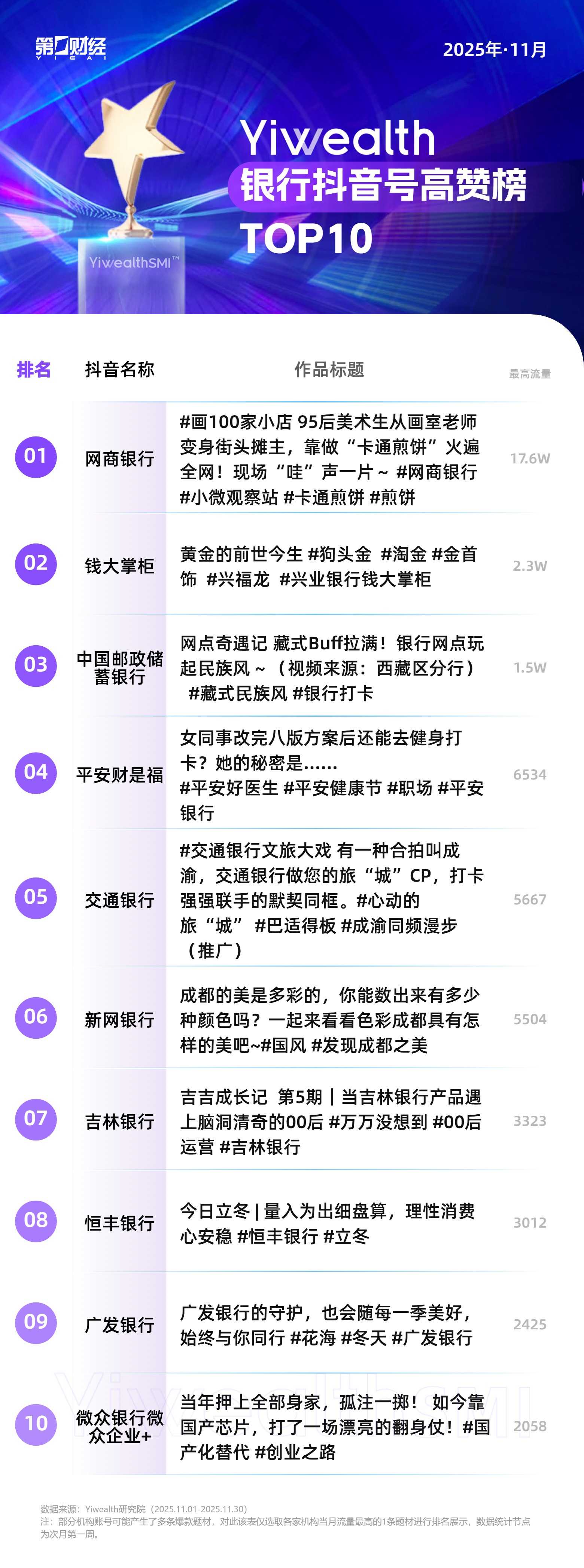
Group 1: Social Media Index Overview - The overall Bank Social Media Index (SMI) for November 2025 showed slight fluctuations, with significant reshuffling at the bottom of the rankings. Notable banks that dropped out include China CITIC Bank, Tianjin Bank, Changsha Bank, and Jiangxi Bank, while banks like Industrial Bank, Chongqing Bank, Zhejiang Commercial Bank, and Zhengzhou Bank entered the rankings [1] - Industrial Bank's ranking has experienced considerable volatility over the past three months, primarily due to the inconsistent update frequency of its Douyin account "Qian Da Zhang Gui," which affected its sub-index and overall SMI [1] Group 2: High Engagement Content - In November's high-engagement content rankings, WeBank's "Drawing 100 Small Shops" continued to dominate, while "Creative Storylines" emerged as a new trend for attracting traffic [2] - Banks like Ping An Bank and Jilin Bank produced highly rated advertisements. Ping An Bank utilized a classic "office worker" theme to highlight its app's "AI Doctor" feature, while Jilin Bank showcased the creative process behind a consumer loan product, effectively integrating product promotion with engaging storytelling [2] - "Scenario-based marketing" became a highlight, with banks transforming their branches into cultural showcases. For instance, China Postal Savings Bank's "Branch Adventure" featured its Tibet branch, breaking stereotypes about bank outlets [2] Group 3: Focus on Gold - Gold remains a key area of interest for users, with Industrial Bank's "The Past and Present of Gold" series gaining significant traction, averaging over 16,000 likes per video across three episodes [3]



迈向“十五五”!以非凡答卷,赴壮阔新程
21世纪经济报道· 2025-12-31 12:00
Group 1 - The "14th Five-Year Plan" has led to significant changes in daily life and has built a foundation for the upcoming five years, showcasing a robust and upgraded manufacturing sector that strengthens the real economy [1] - Continuous breakthroughs in key technologies illuminate various industries, providing a strong basis for future development in China [3][4] - The consumption wave is surging forward, with diverse demands activating deep potential in the market, indicating a broader market landscape ahead [6] Group 2 - Various business entities are exhibiting vibrant energy, from bustling industrial parks to lively streets, contributing to a fertile development environment for the future [8][9] - Smart agricultural machinery is enhancing rural revitalization, painting a brighter picture for the countryside [11] - Financial strength is essential for progressing towards the "15th Five-Year Plan," with Postal Savings Bank committed to supporting China's modernization efforts [16]

工行、农行、中行、建行、交行、邮储,集体宣布
2 1 Shi Ji Jing Ji Bao Dao· 2025-12-31 11:49
Core Viewpoint - The digital renminbi will officially end its "interest-free era" as major state-owned banks announce that starting January 1, 2026, the balance in real-name digital renminbi wallets will earn interest based on the current deposit rate [1][4][5]. Group 1: Digital Renminbi Interest Policy - Six major state-owned banks, including ICBC, ABC, BOC, CCB, Bank of Communications, and Postal Savings Bank, will implement interest payments on digital renminbi wallet balances according to the current deposit rate [1][4]. - The interest payment policy is a result of the People's Bank of China's recent action plan aimed at enhancing the management and service system for digital renminbi [4][5]. - The new interest mechanism marks the transition of digital renminbi from a "digital cash" to a "digital deposit currency" [5][8]. Group 2: Digital Renminbi Overview - Digital renminbi is a legal digital currency issued by the People's Bank of China, applicable in various scenarios such as transportation, dining, shopping, and public services [6]. - The pilot program for digital renminbi has expanded from select cities to entire provinces, with applications in both consumer and governmental sectors [6]. - As of November 2025, digital renminbi has processed 3.48 billion transactions totaling 16.7 trillion yuan, with 230 million personal wallets opened [7]. Group 3: Future Implications of Interest Payments - The introduction of interest payments changes the liability nature of digital renminbi, making it a liability of commercial banks rather than the central bank, thus aligning it more closely with traditional bank deposits [8]. - This shift is expected to enhance the monetary elasticity of digital renminbi, allowing it to support credit activities and deposit expansion mechanisms [8]. - The future digital renminbi will be a modern digital payment and circulation tool, regulated by the central bank and possessing attributes of commercial bank liabilities [8].





邮储银行:陈雪担任非执行董事的任职资格获核准
Zhi Tong Cai Jing· 2025-12-31 11:47
邮储银行(601658)(01658)发布公告,该行2025年第二次临时股东大会审议通过了选举陈雪女士为该 行非执行董事的议案。该行于近日收到《国家金融监督管理总局关于陈雪邮储银行董事任职资格的批 复》(金复[2025]777号),据此国家金融监督管理总局已核准陈雪女士的任职资格。根据相关规定,陈雪 女士自2025年12月29日起就任该行非执行董事,任期3年。同时,陈雪女士担任该行董事会风险管理委 员会委员、董事会提名和薪酬委员会委员。 ...
工行、农行、中行、建行、交行、邮储,集体宣布
21世纪经济报道· 2025-12-31 11:44
Core Viewpoint - The digital renminbi will officially end its "interest-free era" as major state-owned banks announce that starting January 1, 2026, the balance in real-name digital renminbi wallets will earn interest based on the current deposit rate [1][4][10]. Group 1: Digital Renminbi Interest Policy - Six major state-owned banks, including ICBC, ABC, BOC, CCB, BOCOM, and PSBC, will implement interest payments on digital renminbi wallet balances according to the current deposit rate starting January 1, 2026 [1][4]. - The interest will be calculated based on the People's Bank of China's regulations for current deposits, with interest credited quarterly [3][4]. - The introduction of this interest policy is part of the People's Bank of China's action plan to enhance the management and service system for digital renminbi [4][10]. Group 2: Transition to Digital Deposit Currency - The implementation of the interest policy marks the transition of digital renminbi from a "digital cash" model to a "digital deposit currency" model [10]. - Previously, digital renminbi was classified as M0, similar to cash, and did not earn interest, limiting its attractiveness compared to bank deposits [10]. - With the new policy, digital renminbi will be treated as a liability of commercial banks, allowing it to support credit activities and deposit expansion mechanisms, thus enhancing its monetary elasticity [10][11]. Group 3: Current Status and Future Prospects - As of November 2025, digital renminbi has processed 3.48 billion transactions with a total transaction amount of 16.7 trillion yuan [8]. - The digital renminbi is being tested in various scenarios, including daily consumption and government services, and is expanding into cross-border payment initiatives [7][8]. - The future digital renminbi will be a modern digital payment and circulation tool, supported by the central bank and possessing attributes of commercial bank liabilities [10][11].

2025年中国创投:重拾向上动能,奔赴投资新程
Zheng Quan Shi Bao Wang· 2025-12-31 11:43
Group 1: Industry Recovery and Trends - In 2025, China's venture capital industry emerged from a two-year downturn, showing signs of recovery across the entire investment chain, driven by a combination of funding and project highlights, as well as supportive policies [1] - The year-end activities of venture capitalists indicate a strong return to the industry, fueled by a new wave of technological changes and ongoing policy benefits [1] Group 2: Government Investment Fund Policies - The State Council issued a significant document aimed at promoting the high-quality development of government investment funds, focusing on stricter controls on new fund establishments and optimizing investment policies [2] - Various local governments have responded by issuing supporting policy documents, further regulating the operation of government investment funds to promote high-quality industry development [2] Group 3: Banking Sector Involvement - Since the announcement of expanded pilot programs for bank-affiliated financial asset investment companies (AICs), banks have accelerated their entry into the primary market, with several major banks successfully establishing AICs [3] - As of now, AICs from six major state-owned banks and three national joint-stock banks have been established, with total investments reaching 45.272 billion yuan, a year-on-year increase of approximately 37.7% [3] Group 4: Special Bonds for Government Guidance Funds - Several local governments have issued special bonds to support government guidance funds, breaking the previous norm that prohibited such investments [4] - A total of 52 billion yuan in special bonds have been issued by nine provinces and cities, significantly enhancing the funding pool for the venture capital industry [4] Group 5: Long-Term Government Guidance Funds - New government guidance funds established this year have extended their duration beyond the typical 10 years, with some lasting up to 20 years, providing long-term support for projects [5] - This trend of extending fund durations is expected to create a more patient investment environment, allowing for better exit strategies [5] Group 6: Mergers and Acquisitions - The introduction of policies supporting private equity funds in acquiring listed companies has led to a surge in related acquisition cases, with several venture capital firms actively pursuing stakes in public companies [6][7] - The trend of startups acquiring listed companies is also on the rise, indicating a new strategy for both startups and venture capital firms to explore exit routes [7] Group 7: Domestic PE Firms Acquiring Foreign Brands - Domestic top-tier private equity firms have increasingly acquired the Chinese operations of overseas consumer brands, highlighting a trend of local capital participating in the localization of foreign brands [8] - This trend is driven by the combination of ample funding, local operational expertise, and the stable cash flow of established foreign brands [8] Group 8: Technology Innovation Bonds - The introduction of technology innovation bonds has opened new fundraising channels for venture capital institutions, with several private firms successfully issuing bonds at competitive interest rates [9] - The issuance of these bonds has significantly boosted market confidence and marked a transition towards a more normalized support phase for private venture capital institutions [9] Group 9: Mainland VC/PE Expansion into Hong Kong - Several mainland investment institutions have established offices in Hong Kong, attracted by the region's supportive environment for technological innovation [10] - The Hong Kong government's initiatives, including the establishment of a significant innovation and technology fund, have further encouraged mainland VC/PE firms to expand into the market [10] Group 10: Return of Dollar LPs to China - Multiple venture capital firms have successfully raised dollar-denominated funds, indicating a renewed interest from international investors in the Chinese market [11][12] - The return of dollar LPs coincides with the rapid growth of China's AI industry, highlighting the potential undervaluation of Chinese assets [11][12] Group 11: National Entrepreneurship Investment Fund - The establishment of a "carrier-level" national entrepreneurship investment fund aims to support startups across key economic regions in China, with a focus on early-stage investments [13] - This fund features a long duration of 20 years and aims to provide substantial financial backing to venture capital institutions and startups, enhancing the overall investment landscape [13]




年度盘点丨2025年中国创投:重拾向上动能,奔赴投资新程
Zheng Quan Shi Bao Wang· 2025-12-31 11:43
Group 1 - In 2025, China's venture capital industry emerged from a two-year downturn, showing signs of recovery across the entire "fundraising, investment, management, and exit" chain [1] - The government issued a significant policy document aimed at promoting the high-quality development of government investment funds, focusing on controlling new fund setups and optimizing investment policies [2] - Bank-affiliated financial asset investment companies (AICs) accelerated their entry into the primary market, with a notable increase in capital contributions since the policy announcement [3] Group 2 - Local governments have begun issuing special bonds to support government-guided funds, with a total of 52 billion yuan issued across nine provinces and cities this year [4] - New government-guided funds are being established with extended durations, some lasting up to 20 years, providing long-term support for projects [5] - Venture capital institutions and startups are increasingly acquiring listed companies, indicating a trend towards using public companies as exit strategies [6] Group 3 - Top domestic private equity firms are actively acquiring overseas consumer brands' operations in China, driven by their financial resources and local operational expertise [7] - Venture capital institutions are eagerly issuing technology innovation bonds, with significant interest from private firms leading to successful issuances [8] - Mainland venture capital and private equity firms are establishing offices in Hong Kong, attracted by the region's supportive environment for technology innovation [9][10] Group 4 - Dollar limited partners (LPs) are returning to the Chinese venture capital market, with several firms successfully raising dollar-denominated funds amid a booming AI sector [11] - The National Entrepreneurship Investment Guidance Fund has officially begun investing in three regional funds, marking a strategic deployment in key economic areas [12]
数字人民币迎来升级!2026年1月1日起,实名钱包余额开始计息
Xin Lang Cai Jing· 2025-12-31 11:37
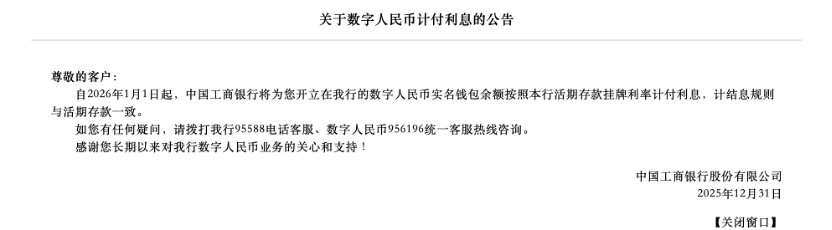
建设银行指出,自2026年1月1日起,该行数字人民币实名钱包余额将按照该行活期存款挂牌利率计付利 息,计结息规则与活期存款一致,并相应修订《中国建设银行数字人民币钱包个人客户服务协议》相关 内容。该行也在公告中介绍到,数字人民币是指中国人民银行发行的法定数字货币和相关支付体系,采 用双层运营架构,由中国人民银行向数字人民币业务运营机构发行,再由数字人民币业务运营机构兑换 给公众。自2026年1月1日起,数字人民币钱包(不含四类钱包)中的钱包余额按照中国人民银行规定的 活期存款计结息规则计付利息,并由乙方依法代扣代缴利息税(如有)。 2026年1月1日起,数字人民币实名钱包余额将开始计付利息。 12月31日,工行、农行、建行、交行、邮储银行等国有银行公布了数字人民币钱包余额计息的规则。 工商银行、农业银行、邮储银行表示,为数字人民币实名钱包余额按照活期存款挂牌利率计付利息,计 结息规则与活期存款一致;交通银行表示,自2026年1月1日起,交通银行将数字人民币实名钱包(包含 一类、二类、三类个人钱包和单位钱包)余额,按照该行公布的活期存款挂牌利率计付利息。如用户开 立的数字人民币钱包为四类个人钱包,则钱包内的余额 ...

全面降息下的“存款搬家”
Di Yi Cai Jing Zi Xun· 2025-12-31 11:20
Core Insights - The article discusses the significant changes in the deposit market in China, highlighting a shift from traditional savings to diversified asset allocations due to a low-interest-rate environment [2][3][7]. Group 1: Deposit Market Changes - By the end of 2025, traditional high-interest three-year and five-year fixed deposits are becoming scarce, with rates generally dropping to the "1" range [2]. - A wave of interest rate cuts has been observed across various banks, with state-owned banks leading the way, followed by smaller banks that have implemented more frequent and larger cuts [3][5]. - The trend of "deposit migration" is accelerating, with residents moving funds from traditional deposits to wealth management, insurance, and gold [2][7]. Group 2: Interest Rate Trends - As of May 20, 2025, six major state-owned banks reduced their deposit rates, with three-year and five-year fixed deposit rates cut by 25 basis points [3]. - The net interest margin for commercial banks has narrowed, with the average net interest margin reported at 1.42% as of the end of Q3 2025, marking a historical low [5]. Group 3: Impact on Asset Allocation - Data shows that from January to November 2025, the growth of residents' fixed deposits has significantly slowed, leading to a decrease in their share of total financial assets [6]. - The interaction between non-bank institutions and residents' deposits has increased market activity, indicating a trend towards diversified asset allocation [6]. Group 4: Future Outlook - Industry experts predict that the adjustment in the deposit market will deepen in 2026, with the trend of "deposit migration" expected to continue [7]. - It is anticipated that approximately 2-4 trillion yuan will flow into non-fixed deposit investment areas in 2026, reflecting a shift in residents' savings behavior [7]. Group 5: Banking Strategies - Different banking institutions are expected to adopt varied strategies in 2026, with state-owned banks focusing on wealth management to offset net interest margin pressures, while smaller banks may be more sensitive to deposit rates [8]. - Banks are encouraged to innovate product designs and improve service levels to enhance the proportion of short-term deposits, while also implementing a differentiated pricing system based on customer contributions [8].

邮储银行(601658) - 中国邮政储蓄银行股份有限公司关于董事任职资格获国家金融监督管理总局核准的公告
2025-12-31 11:01
证券代码:601658 证券简称:邮储银行 公告编号:临 2025-069 中国邮政储蓄银行股份有限公司 关于董事任职资格获国家金融监督管理总局核准的 公告 根据相关规定,陈雪女士自 2025 年 12 月 29 日起就任本行非执 行董事,任期三年。同时,陈雪女士担任本行董事会风险管理委员会 委员、董事会提名和薪酬委员会委员。 陈 雪 女 士 的 简 历 请 见 本 行 刊 载 于 上 海 证 券 交 易 所 网 站 (www.sse.com.cn)的《中国邮政储蓄银行股份有限公司 2025 年第 二次临时股东大会会议资料》。本行董事会对陈雪女士的加入表示欢 迎。 特此公告。 中国邮政储蓄银行股份有限公司董事会 二〇二五年十二月三十一日 中国邮政储蓄银行股份有限公司董事会及全体董事保证本公告内容不存在 任何虚假记载、误导性陈述或者重大遗漏,并对其内容的真实性、准确性和完整 性承担法律责任。 中国邮政储蓄银行股份有限公司(以下简称本行)2025 年第二 次临时股东大会审议通过了选举陈雪女士为本行非执行董事的议案。 近日,本行收到《国家金融监督管理总局关于陈雪邮储银行董事任职 资格的批复》(金复〔2025〕777 ...