
圆通速递

Search documents
快递费一夜暴涨!电商人哭晕,9.9包邮将成历史?
Sou Hu Cai Jing· 2025-08-12 15:29
Core Viewpoint - The recent surge in express delivery fees, driven by policy changes, has sparked significant concern among e-commerce merchants, with potential annual losses estimated at 21.9 million for high-volume businesses [1][4]. Group 1: Price Increase Impact - Major express delivery companies, including Shentong, YTO, Zhongtong, and Yunda, have collectively raised their base prices from 1 yuan to over 1.4 yuan per package, particularly affecting small items [1][3]. - The price increase is seen as a response to the government's call to end "bloodletting competition" in the logistics sector, aiming to improve service quality [3][4]. Group 2: Merchant and Consumer Reactions - Merchants are facing a dilemma: raising prices may lead to reduced customer traffic, while not raising prices could result in unsustainable profit margins [3][4]. - There are concerns that if merchants pass on the increased delivery costs to consumers, low-cost shipping options like "9.9 yuan with free shipping" may disappear, impacting consumer purchasing behavior [4]. Group 3: Industry Challenges - The express delivery industry has been struggling with declining per-package revenue, approaching cost levels, and a high turnover rate among delivery personnel, leading to service quality issues [4]. - Despite the government's strict regulations against pricing below 1.4 yuan, the effectiveness of these measures remains uncertain due to potential non-compliance by franchise operators [4].


申通快递20250812
2025-08-12 15:05
Summary of Shentong Express Conference Call Company Overview - **Company**: Shentong Express - **Industry**: Express Delivery Key Points and Arguments 1. **Direct Operation Rate**: Shentong Express has increased its direct operation rate to 94%, significantly enhancing operational efficiency and processing capacity, effectively reducing unit costs [2][3][4] 2. **Capacity Expansion**: The company plans to increase its capacity by nearly 80% over three years with a capital expenditure of 10 billion, raising daily capacity from 42 million items in 2021 to approximately 75 million by 2024 [2][3] 3. **Business Volume Growth**: In 2023, Shentong Express achieved a business volume growth rate of 35.2%, significantly surpassing the industry average, narrowing the market share gap with Yunda [2][6] 4. **Profitability Improvement**: Cost control and revenue optimization measures have improved the net profit per ticket, with expectations for net profit to double due to price increases in the South China region [2][12] 5. **Free Cash Flow**: The company is expected to achieve positive free cash flow in 2024, driven by operational model changes and capacity enhancements [2][7] 6. **Industry Policy Support**: National postal policies are aimed at preventing vicious competition in the express delivery industry, promoting high-quality development and protecting frontline employees' rights [2][8] 7. **Acquisition of Daniao Logistics**: The acquisition of Daniao Logistics for 360 million yuan is expected to help Shentong become the third-largest player in the industry and open up new cooperation opportunities [4][17] 8. **Future Profit Projections**: For 2025, Shentong Express anticipates a net profit of over 300 million yuan, with a net profit per ticket of 0.05 yuan, which could double if it reaches 0.10 yuan [4][13] 9. **Market Valuation**: The current P/E ratio is below 9, indicating that the company is undervalued compared to the industry average [4][13] 10. **Regional Price Increases**: A price increase of 0.4 yuan in the South China region is expected to significantly boost profits for Shentong and its competitors [12][14] Additional Important Content 1. **Operational Efficiency**: The company has optimized franchise management and product offerings, particularly in heavy cargo, which has contributed to its growth since 2018 [3][6] 2. **Response to Market Conditions**: Shentong Express has adapted to market changes, including the impact of the pandemic and competition from Jitu Express, which led to losses in 2020-2021 [3][6] 3. **Long-term Development Potential**: The company is well-positioned for long-term growth due to its strategic initiatives and partnerships, particularly with Alibaba [16][19] 4. **Risks**: Potential risks include a return to aggressive price competition or slower-than-expected growth in business volume, which could impact performance [20]

快递反内卷,涨价能持续、能扩散吗?
2025-08-12 15:05
Summary of the Conference Call on the Express Delivery Industry Industry Overview - The express delivery industry is experiencing intense price competition, with a price increase and volume increase ratio reaching 40% in the first half of 2025, surpassing the 34% and 32% seen in 2020 and 2021 respectively [5][1] - The government is implementing measures to combat "involution" in the industry, including price correction drafts and compliance guidelines from regulatory bodies [1][6] Key Points and Arguments - **Market Dynamics**: The express delivery market is expected to grow by 16.3% in 2025, with future growth projected at 6%-9% over the next two to three years. Companies are expected to manage this growth without excessive price competition [1][15][16] - **Company Performance**: - **SF Express**: Maintains healthy growth with cost reductions due to volume increases, showing no signs of involution [7] - **Yunda**: Focused on stable development, with price increases slightly above industry levels [7] - **YTO Express**: Achieved increases in volume, revenue, and prices, indicating high-quality development [8] - **Shentong**: Experienced a smaller price drop than the industry average, with a volume increase above the average [8] - **Postal Express**: Underperformed compared to YTO and Shentong, with lower pricing [9] - **Franchisee Issues**: Franchisees are facing intense competition, with a significant portion of the revenue being retained by them, leading to price wars [10] Government Measures - The government has taken steps to address involution, including: - Emphasizing political and economic correctness in central meetings [6] - Implementing price correction drafts for the first time since 1998 [6] - Enforcing compliance guidelines for online trading platforms [6][17] Future Trends - **Technological Advancements**: The industry is expected to benefit from digitalization and automation, leading to cost reductions and improved efficiency [19][22] - **New Revenue Streams**: New business avenues such as cross-border delivery, factory delivery, and emergency logistics are anticipated to enhance industry revenue and profits [19][22] - **Profit Projections**: The total profit for five major companies in the industry is expected to reach 30 billion in 2025, potentially increasing to 50-60 billion by 2030 [21][22] Regional Insights - **Jinhua**: Experienced a price drop of 0.09 yuan in the first half of 2025, with a projected annual decrease of 0.13 to 0.14 yuan [11] - **Linyi**: Saw a price reduction of 0.15 yuan, with an expected total decrease of 0.22 to 0.23 yuan for the year [12] - **Jieyang**: Noted significant price competition, with a drop of 0.37 yuan in the first half of 2025 [13] - **Baoding**: Experienced a price drop of 0.76 yuan, with an annual forecast of around 1 yuan [14] Conclusion - The express delivery industry is navigating a complex landscape of price competition, regulatory scrutiny, and technological advancements. The focus on maintaining healthy competition and exploring new revenue streams is expected to drive growth and profitability in the coming years.
广东快递底价上调0.4元:运费整体上涨,对低客单价商家影响大
Sou Hu Cai Jing· 2025-08-12 09:13
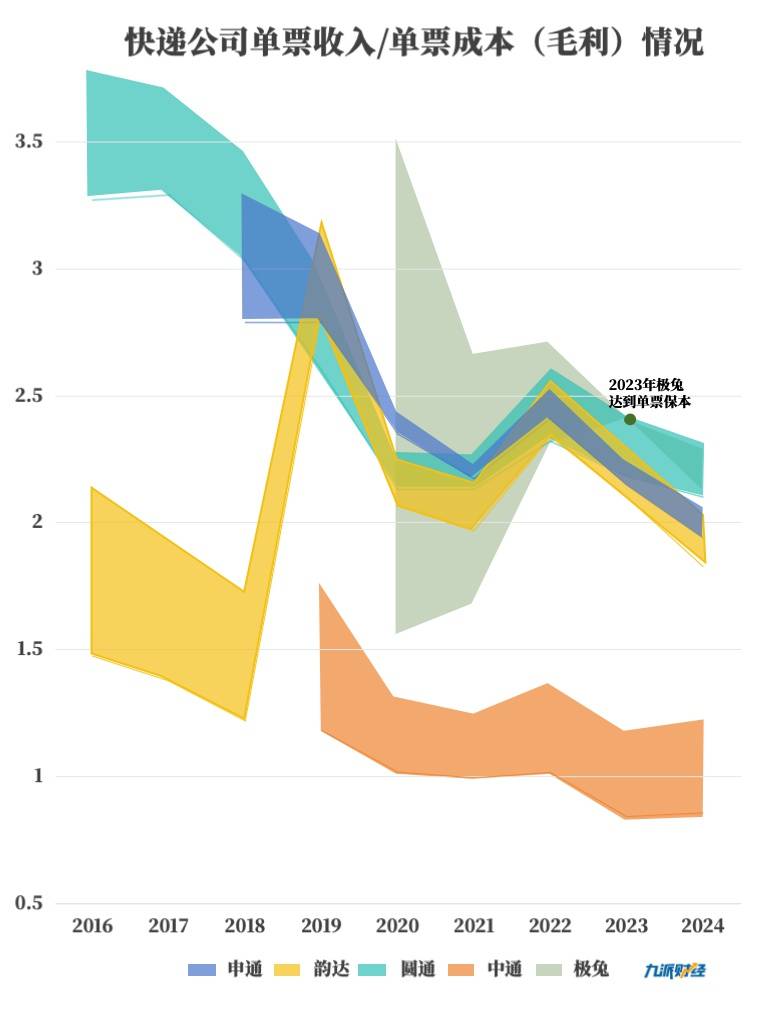
Core Viewpoint - The recent increase in express delivery base prices in Guangdong and Yiwu reflects concerns over the intense competition and low profitability in the express delivery industry, which has led to a downward trend in per-package revenue for major companies [1][2][3]. Group 1: Price Adjustments - Starting from August 4, the base price for express delivery in Guangdong has been raised by 0.4 yuan per package, bringing the average price to over 1.4 yuan [1]. - Yiwu also raised its express delivery base price by 0.1 yuan to 1.2 yuan starting July 18 [1]. - The overall express delivery costs have increased by approximately 0.4 yuan, although delivery personnel have not yet received news of a corresponding increase in their compensation [1]. Group 2: Revenue Trends - Major express companies, including Shentong, Yunda, Zhongtong, and Yunda, have seen a significant decline in per-package revenue, with figures for 2024 projected at 2.05 yuan, 2.3 yuan, 1.21 yuan, and 2.01 yuan respectively, representing a decrease of about 30% to 40% compared to 2019 [3]. - In June, Shentong and Yunda reported further declines in per-package revenue, dropping below the 2 yuan mark to 1.99 yuan and 1.91 yuan respectively, while Zhongtong decreased to 2.1 yuan [5]. - SF Express maintains a relatively stable per-package revenue of around 15 to 16 yuan, but has also experienced a decline of 11% to 14% compared to the previous year due to industry price wars [5][12]. Group 3: Delivery Challenges - The continuous decline in per-package revenue has led express companies to implement cost control measures, including reducing delivery fees for last-mile services [7]. - The delivery personnel face pressure to choose between home delivery and depositing packages at collection points, with a significant increase in the use of collection points, reaching a 72% entry rate in 2022 [11]. - Complaints regarding non-delivery to specified addresses have surged, with over 19,000 complaints related to this issue, highlighting the challenges in balancing delivery efficiency and service quality [11]. Group 4: Impact on Low-Cost Merchants - The recent price adjustments in express delivery services are expected to significantly impact low-cost merchants, as the low logistics cost is crucial for their survival [15]. - Merchants have indicated that a delivery cost exceeding 3 yuan is no longer sustainable for their profit margins, as the historical rate has been around 1 yuan for small packages [15].



你的快递费 开始贵了
Xin Lang Cai Jing· 2025-08-12 06:58
Group 1 - The core point of the article is that starting from August 4, the minimum price for express delivery in Guangdong Province has been raised by 0.4 yuan per ticket, with the average price per ticket exceeding 1.4 yuan [1] - The price adjustment is mandated by relevant authorities, and companies are prohibited from collecting below the cost price of 1.4 yuan, or they will face severe penalties [1] - As of August 5, major express delivery companies in the Tongda system (Shentong, Yuantong, Zhongtong, Yunda) have begun implementing the price increase [1] Group 2 - The current price increase primarily affects low-priced items from e-commerce, particularly packages weighing 0.3 kilograms or less [1] - Industry observers and e-commerce practitioners have been consulted regarding the price adjustment, but as of the report's publication, no responses have been received from the contacted express companies [1]

新华视点·追踪丨国家邮政局:指导相关快递企业优化收费计重规则
Xin Hua Wang· 2025-08-12 06:37
稿件发出后,国家邮政局高度重视,迅速组织开展核查工作,指导相关企业结合自身实际,参照快递服 务国家标准优化完善服务收费计重规则,即计费重量以千克为单位,保留小数点后至少1位。 据了解,目前多家企业已优化计重收费规则,并进行公示(公布)—— 新华社北京7月17日电(记者叶昊鸣、张千千)新华社"新华视点"栏目7月11日播发《快递计重、停车计 时等"向上取整",合理吗?》,报道部分快递企业向消费者提供服务时存在"向上取整"计重现象, 即"不足1公斤按1公斤计算"等形式。 圆通:首重不足1千克的,按1千克计算;续重以0.1千克为计费单位,不足0.1千克的,按0.1千克计算。 中通:使用秤、卷尺等计量用具测量快件的实际重量和体积,确定正确的计费重量。计费重量以千克为 单位,保留小数点后至少1位。 极兔:首重1千克,不足1千克按1千克计费;续重以0.1千克为计重单位,即1.3千克按1.3千克计算运 费。 下一步,邮政管理部门将持续督促各企业按照已公布的收费规则开展经营活动,履行服务承诺。 【纠错】 【责任编辑:薛涛】 京东:首重不足1千克的,按1千克计算;续重以0.5千克为计费单位,不足0.5千克的,按0.5千克计算。 ...
上半年净融资超过1万亿元——银行间债市加码支持实体经济
Xin Hua Wang· 2025-08-12 06:20
Group 1 - The interbank market has increased support for the real economy, with debt financing instruments issued amounting to 4.73 trillion yuan in the first half of 2022, a year-on-year increase of 6%, resulting in a net financing scale of approximately 1.1 trillion yuan, an increase of about 500 billion yuan year-on-year [1] - The unified registration model for debt financing instruments (DFI, TDFI) allows qualified issuers to register once and issue multiple times, significantly facilitating corporate financing [1] - Major state-owned enterprises, such as China Merchants Group, issued 290 billion yuan in debt financing tools to optimize debt structure and reduce financing costs [1] Group 2 - In the logistics sector, the interbank market supported four private enterprises, including SF Express and Yunda, in issuing 5 billion yuan in debt financing tools to supplement operating funds and optimize debt structure [2] - The interbank market actively supports infrastructure construction and major project financing, with 151.5 billion yuan issued for water conservancy projects and 1.62648 trillion yuan for transportation, energy, and agriculture sectors [2] - Leading companies in various industries, such as China Merchants, State Grid, and Sinopec, have benefited from this financing support, contributing to economic stability and fulfilling social responsibilities [2] Group 3 - The aviation industry, significantly impacted by the pandemic, has received increased support from the interbank market, with companies like Air China and China Eastern Airlines registering 123 billion yuan in various debt financing tools [3] - The issuance target for bonds in the aviation sector is set at 200 billion yuan, with 120 billion yuan already provided by the interbank market [3] - As of June 2022, civil aviation companies have issued a total of 965.9 billion yuan in debt financing tools [3] Group 4 - The interbank market has implemented measures to waive transaction fees for private enterprises, further signaling support for them [4] - In 2022, membership fees for private enterprise issuers were waived, and additional fee reductions for bond issuance and financing services were introduced [4] - The interbank market aims to enhance information disclosure and registration efficiency to meet corporate financing needs and support macroeconomic stability [4]
四大快递龙头上半年经营数据出炉 价格战持续单票收入下降
Xin Hua Wang· 2025-08-12 05:49
Core Viewpoint - Despite ongoing price wars leading to a decline in service prices, major express delivery companies in China have maintained steady growth in revenue and net profit in the first half of the year, indicating overall market expansion [1][5]. Revenue Performance - In June, three companies reported year-on-year revenue growth: SF Express achieved 16.704 billion yuan, up 3.59%; Shentong Express reported 3.36 billion yuan, up 12.67%; and YTO Express reached 4.246 billion yuan, up 3.39% [2]. - Yunda Express lagged behind with a revenue of 3.665 billion yuan, down 11.47%, and a business volume of 1.581 billion parcels, down 2.04% [2]. - SF Express expects a net profit of 4.02 billion to 4.22 billion yuan for the first half of 2023, a year-on-year increase of 60%-68% [2]. Business Volume Trends - In June, SF Express experienced a slight decline in business volume, handling 1.017 billion parcels, down 0.29%; Shentong Express saw a significant increase of 28.26% to 1.523 billion parcels; YTO Express grew by 14.03% to 1.792 billion parcels [2]. - Yunda Express's business volume decreased, but it anticipates a net profit growth of 37.31%-75.12% for the first half of the year [2]. Single Ticket Revenue - SF Express reversed its declining trend with a single ticket revenue of 16.42 yuan, up 3.86%; however, Shentong, YTO, and Yunda reported declines in single ticket revenue [3]. - Shentong's single ticket revenue fell to 2.21 yuan, down 11.95%; YTO's to 2.37 yuan, down 9.33%; and Yunda's to 2.32 yuan, down 9.73% [3]. Industry Outlook - The overall performance of the express delivery sector shows signs of stabilization and recovery, with most companies adapting to market demand and improving operational efficiency [5]. - The second half of the year is expected to see continued growth in the express delivery industry, driven by economic recovery and e-commerce market expansion [6].

驿站&快递员:全员社保下的“生死”纠结?
3 6 Ke· 2025-08-12 02:23
当基层驿站在派费压缩与社保支出间左右为难,当劳动者担忧着扣除社保后的当下生计,眼前现实与长远保障的深刻矛盾暴露无疑。 社保强制令来了? 据《工人日报》日前报道,8月1日,最高人民法院发布《最高人民法院关于审理劳动争议案件适用法律问题的解释(二)》(以下简称《解释 (二)》,明确劳动者因用人单位未依法缴纳社会保险费解除劳动合同并要求经济补偿的,法院予以支持,该解释自今年9月1日起施行。 其中,最受关注的,当属社保相关规定。 《解释(二)》第十九条规定,"用人单位与劳动者约定或者劳动者向用人单位承诺无需缴纳社会保险费的,人民法院应当认定该约定或者承诺无效。" 近年来,平台经济领域涌现出大量新就业形态劳动者,快递员、外卖骑手、网约车司机等从业者人数快速增长,总规模已达到8400万人。为数字经济注入 活力同时,也暴露出新就业形态劳动者社保覆盖不够全面、权益无法得到完全保障等问题。 毋庸置疑,社保是劳动者应享的基本权利,也是平台应尽的基本责任。比如外卖行业,今年2月中旬京东宣布"自3月1日起,京东将逐步为京东外卖全职骑 手缴纳五险一金,为兼职骑手提供意外险和健康医疗险"后,外卖平台相继宣布为外卖骑手缴纳社保。 与之形成 ...

圆通速递(600233)8月11日主力资金净流出2082.89万元
Sou Hu Cai Jing· 2025-08-11 11:57
Core Viewpoint - YTO Express (圆通速递) reported a decline in net profit despite a revenue increase, indicating potential challenges in profitability [1] Financial Performance - As of Q1 2025, YTO Express achieved total revenue of 17.06 billion yuan, a year-on-year increase of 10.58% [1] - The net profit attributable to shareholders was 857 million yuan, a decrease of 9.16% year-on-year [1] - The non-recurring net profit was 810 million yuan, down 10.29% year-on-year [1] - The current ratio was 1.166, the quick ratio was 1.151, and the debt-to-asset ratio stood at 31.68% [1] Stock Performance - As of August 11, 2025, YTO Express's stock closed at 16.37 yuan, down 3.42% [1] - The turnover rate was 0.99%, with a trading volume of 338,400 hands and a transaction amount of 557 million yuan [1] - The net outflow of main funds was 20.83 million yuan, accounting for 3.74% of the transaction amount [1] Investment and Business Activities - YTO Express has made investments in 13 companies and participated in 16 bidding projects [2] - The company holds 13 patents and has obtained 3 administrative licenses [2] Company Background - YTO Express was established in 1992 and is based in Dalian, primarily engaged in postal services [1] - The registered capital is approximately 3.44 billion yuan, with paid-in capital of about 2.82 billion yuan [1]