
快递行业反内卷

Search documents
交通运输产业行业研究:1-2 月快递业务量同比增长 7% 中东地缘扰动持续影响航运
SINOLINK SECURITIES· 2026-03-22 12:10
Investment Rating - The report does not explicitly provide an investment rating for the transportation sector Core Views - The transportation index decreased by 2.2% during the week of March 14-20, 2026, underperforming the Shanghai Composite Index by 0.2% [1] - The logistics sector is expected to improve due to rising chemical prices, with a focus on companies like Milkyway, Hongchuan Wisdom, and others [3] - The air travel sector is seeing a recovery with a 3.34% increase in planned international passenger flights for the summer season of 2026 [4] - The shipping sector is facing geopolitical pressures, but the oil transportation index remains high due to geopolitical factors [5] - The road and rail sectors are showing resilience, with increased truck traffic and a focus on coal transportation [6] Summary by Sections Transportation Market Review - The transportation index fell by 2.2%, while the Shanghai Composite Index dropped by 2.4%, ranking 5th out of 29 sectors [1][13] Industry Fundamental Status Tracking Shipping and Ports - The export container shipping market is under pressure from geopolitical tensions, with the CCFI index at 1120.61 points, up 4.5% week-on-week but down 6.0% year-on-year [5][22] - The oil transportation index BDTI increased to 2849.2 points, reflecting a 1.3% week-on-week rise and a 194.6% year-on-year increase [39] Aviation and Airports - The average daily flights increased by 4.79% year-on-year, with domestic flights up by 17.85% [4] - The Brent crude oil price rose to $112.19 per barrel, impacting operational costs for airlines [74] Rail and Road - National railway passenger volume increased by 10.53% year-on-year, while freight volume saw a slight decline of 0.59% [86] - The number of trucks on highways increased by 14.75% week-on-week, indicating a robust road transport sector [90] Express and Logistics - The express delivery sector saw a revenue increase of 7.9% year-on-year, with major companies like Zhongtong Express expected to recover in market share and profitability [2]
快递行业二月数据点评:反内卷延续较强力度,看好快递淡季挺价
Shenwan Hongyuan Securities· 2026-03-21 15:01
Investment Rating - The report maintains an "Overweight" rating for the express delivery industry, indicating a positive outlook for the sector's performance relative to the overall market [2]. Core Insights - The express delivery industry demonstrated strong resilience in demand during January and February, with a year-on-year growth rate of 7.1% driven by factors such as the New Year holiday and consumption subsidies [2]. - The report highlights a divergence in growth rates among major players in the industry, with YTO Express showing the highest growth at 16.67%, followed by Shentong Express at 11.23%, while Yunda Express experienced a decline of 6.67% [2]. - The report emphasizes the ongoing "anti-involution" policies that are expected to support high-end delivery fees, leading to a recovery in single-ticket prices and gradually releasing profit elasticity for companies [2]. Summary by Relevant Sections Company Performance - SF Holding's logistics business reported a total revenue of 21.604 billion yuan in February, a year-on-year increase of 17.60%, with express delivery revenue reaching 16.421 billion yuan, up 24.88% [2]. - YTO Express achieved express product revenue of 4.452 billion yuan in February, a growth of 3.76%, while Shentong Express reported 3.908 billion yuan, up 12.76% [2]. - Yunda Express's revenue declined by 15.07% to 3.004 billion yuan, with a significant drop in business volume by 26.13% [2]. Market Trends - The report notes that the express delivery market is entering a phase of high-quality development, with leading companies expected to concentrate profits and market share [2]. - The report recommends focusing on YTO Express and ZTO Express, which have shown continuous advantages since the implementation of anti-involution policies, and highlights Shentong Express for its profit elasticity [2]. - Jitu Express is noted for its accelerated growth in Southeast Asia and new markets, indicating a strong future competitive position [2].



“快递停运”冲上热搜 多家快递企业回应:春节“不打烊”、时效受影响
Zhong Guo Jing Ying Bao· 2026-02-12 15:05
Core Viewpoint - The express delivery industry is ensuring uninterrupted service during the Spring Festival, addressing consumer concerns about potential delivery halts, while also focusing on reducing internal competition and improving profitability [1][2][3]. Group 1: Service Operations During Spring Festival - Multiple express companies, including Zhongtong Express, Shentong Express, and Jitu Express, have confirmed that they will maintain normal operations during the Spring Festival, with specific arrangements for employee shifts to ensure service continuity [1][3]. - Zhongtong Express will operate from February 16 to February 21, while Jitu Express has planned resource allocation to ensure operational stability during the holiday period [3][5]. Group 2: Industry Trends and Financial Performance - The express delivery sector is experiencing a "reverse involution," leading to an increase in single-ticket revenue for companies like Shentong Express and Yunda Express, with expectations for continued growth in 2026 [2][6]. - From late 2025, the industry has shifted from price competition to profit recovery, with Yunda Express reporting a 5.9% year-on-year increase in single-ticket revenue in December 2025 [6]. Group 3: Fundraising and Financial Strategies - Zhongtong Express plans to issue $1.5 billion in convertible senior notes, with a net amount of approximately $1.404 billion allocated for refinancing and general corporate purposes [7]. - Shentong Express intends to issue medium-term notes not exceeding 2 billion yuan to enhance liquidity and support project development [7]. Group 4: Market Outlook - Analysts predict that the express delivery industry is in the early stages of an upward cycle, with improving profitability and a shift towards higher service quality, which is expected to foster sustainable development [7].



中通快递20260203
2026-02-04 02:27
Summary of Zhongtong Express Conference Call Company Overview - **Company**: Zhongtong Express - **Industry**: Express Delivery and Logistics Key Points and Arguments Industry Dynamics - The express delivery industry is undergoing significant changes due to the end of "involution" and the comprehensive compliance of e-commerce taxes, leading to a more concentrated market share among leading companies [1][10] - The industry is transitioning from a high-growth phase to a mature stage, with growth rates declining to single digits for the first time in history [18][23] Zhongtong's Historical Performance - Zhongtong became the largest private express company in China in October 2016 and has maintained the highest market share for eight consecutive years [2][19] - Key factors for Zhongtong's rise include the implementation of a paid delivery fee system and the direct management of transfer centers, which transformed relationships with franchisees [2][3] Competitive Advantages - Zhongtong's core competitive advantages stem from effective cost control, management of franchisees, and a robust incentive mechanism for employees [1][5] - The company has invested heavily in infrastructure, including automated sorting technology and direct management of transfer centers, leading to significant improvements in operational efficiency [4][9] Recent Challenges - In 2024 and Q1 2025, Zhongtong experienced a temporary decline in market share due to intensified competition and a strategic shift towards balancing service quality and profitability over sheer volume [10][11] - The overall e-commerce landscape has become increasingly competitive, with platforms engaging in price wars that devalue package worth, impacting Zhongtong's business [11][12] Strategic Shifts - Zhongtong is shifting its focus from volume-driven growth to a balanced approach that emphasizes service quality and profitability [13][14] - The company has seen a 40% year-on-year increase in its high-margin single-item business, indicating the effectiveness of its differentiated competitive strategy [14] Future Outlook - The express delivery market is expected to return to a state where leading companies regain market share as the industry stabilizes and competition rationalizes [15][18] - Zhongtong's strong financial position, with a cash flow of 30 billion and a debt ratio below 30%, allows for increased shareholder returns through dividends and buybacks [19][23] - The company anticipates a 10% to 15% growth in performance, supported by a favorable competitive landscape and a potential valuation recovery to 15 times PE [23] Investment Recommendations - The report recommends Zhongtong as a strong investment opportunity, highlighting its potential for market share, profit, and valuation growth [23] Additional Important Information - The company has established a network of over 90,000 outlets and is exploring direct delivery models to reduce costs further [20][21] - Zhongtong's diversified investments in cold chain logistics and air freight are positioned to enhance its competitive edge [22] This summary encapsulates the key insights from the conference call regarding Zhongtong Express and the express delivery industry, emphasizing the company's historical performance, competitive advantages, recent challenges, strategic shifts, and future outlook.
中通快递-W:持量质并举,长期价值凸显-20260124
Guoxin Securities· 2026-01-24 00:45
Investment Rating - The investment rating for ZTO Express is "Outperform the Market" [6] Core Viewpoints - The report emphasizes that ZTO Express maintains significant competitive advantages, including leading market share, superior network operational capabilities, brand premium, stronger stability among franchisees, and robust financial strength [3][14] - In the short to medium term, ZTO's strategy of "pursuing both volume and quality" is expected to enhance its market share as the demand structure in the express delivery industry optimizes due to price increases and e-commerce taxation [3] - Long-term, as the competitive landscape stabilizes, ZTO is anticipated to develop a diversified service system, leading to improved profitability [3] Summary by Sections Industry Development Review - The express delivery demand in China has transitioned from rapid growth to steady growth, with the volume expected to increase from 2.34 billion pieces in 2010 to 199 billion pieces by 2025, reflecting a compound annual growth rate (CAGR) of 34.5% [1][34] - The competitive landscape has returned to rationality, with price competition being controlled within reasonable limits [1] Company Development Review - ZTO Express has distinguished itself in the industry through innovative models and strategic foresight, becoming the first private express company to open inter-provincial network services in 2005 and implementing a paid delivery fee model in 2007 [2] - The company has consistently led in investments in resources such as trunk vehicles and automation equipment, establishing a virtuous cycle of scale, cost, profit, and quality [2] Company Highlights - ZTO Express's competitive advantages remain strong, with expectations for continued market share growth and an optimized competitive landscape [3] - The company is projected to achieve net profits of 9.48 billion, 10.59 billion, and 11.78 billion yuan for the years 2025, 2026, and 2027, respectively, with year-on-year growth rates of 7.5%, 11.7%, and 11.2% [3][5] - The current stock price is considered to be at a low point, with a price-to-earnings (PE) ratio of 12X and 11X for 2026 and 2027, respectively, indicating significant long-term investment value [3]
申万宏源:年货节错期、暖冬影响快递业增速 推荐圆通速递等
智通财经网· 2026-01-20 07:47
Core Viewpoint - The express delivery industry faces multiple uncertainties regarding demand and self-discipline policies, but the trend of concentration in market share and profits among leading companies is confirmed [1] Group 1: Company Performance - YTO Express reported a December revenue of 6.496 billion yuan, a year-on-year increase of 7.48%, with a business volume of 2.884 billion pieces, up 9.04% year-on-year, while the average revenue per piece decreased by 1.43% to 2.25 yuan [1] - Yunda's December express service revenue was 4.626 billion yuan, a year-on-year decrease of 1.49%, with a business volume of 2.148 billion pieces, down 7.37% year-on-year, and an average revenue per piece of 2.15 yuan, up 5.91% [1] - Shentong Express achieved a December revenue of 5.836 billion yuan, a year-on-year increase of 28.23%, with a business volume of 2.501 billion pieces, up 11.09% year-on-year, and an average revenue per piece of 2.33 yuan, up 15.35% [1] - SF Holding's total revenue from express logistics, supply chain, and international business in December was 27.339 billion yuan, a year-on-year increase of 3.41%, with express revenue reaching 20.378 billion yuan, up 3.78% year-on-year, and a business volume of 1.476 billion pieces, up 9.33% [1] Group 2: Industry Trends - The growth rate of express delivery business volume in December was 2.6%, significantly down due to factors such as price increases, the timing of the New Year goods festival, and e-commerce taxes [2] - The industry average price in December was 7.94 yuan, showing a month-on-month increase of 0.31 yuan, indicating a continued upward trend in pricing amid industry self-discipline [2] - There is a divergence in business volume growth among companies, with Shentong (+11.1%) and SF (+9.3%) showing positive growth, while Yunda (-7.4%) experienced a decline [3]
机构:预计快递行业“反内卷”政策将持续
Zheng Quan Shi Bao Wang· 2026-01-20 00:29
Core Insights - The China Express Development Index is projected to reach 466.8 by December 2025, indicating a stable and safe industry operation with continuous improvement in service quality and expansion of the foundational network [1] - The "anti-involution" trend in the express delivery industry is expected to exceed expectations, driven by regulatory measures, cost management, and a shift towards value competition as volume growth slows [1][2] Group 1: Industry Performance - The development scale index, service quality index, development capability index, and development trend index are reported at 631.6, 650.8, 253.1, and 61.7 respectively [1] - The express delivery industry achieved record highs in business volume and revenue for the year [1] Group 2: Regulatory and Competitive Landscape - Regulatory efforts are expected to continue addressing "involution" competition, promoting a more rational pricing environment [1] - The introduction of new social security regulations is anticipated to streamline cost and price transmission pathways for companies [1] - The trend towards smaller packages is expected to weaken, while stricter compliance from e-commerce platforms may lead to a reduction in inflated delivery volumes [1] Group 3: Future Outlook - The "anti-involution" policy is expected to have a positive impact, with the industry likely to maintain healthy competition and improve profitability [2] - The successful implementation of "anti-involution" in 2021 has led to a dual recovery in performance and valuation for the e-commerce express sector [2]
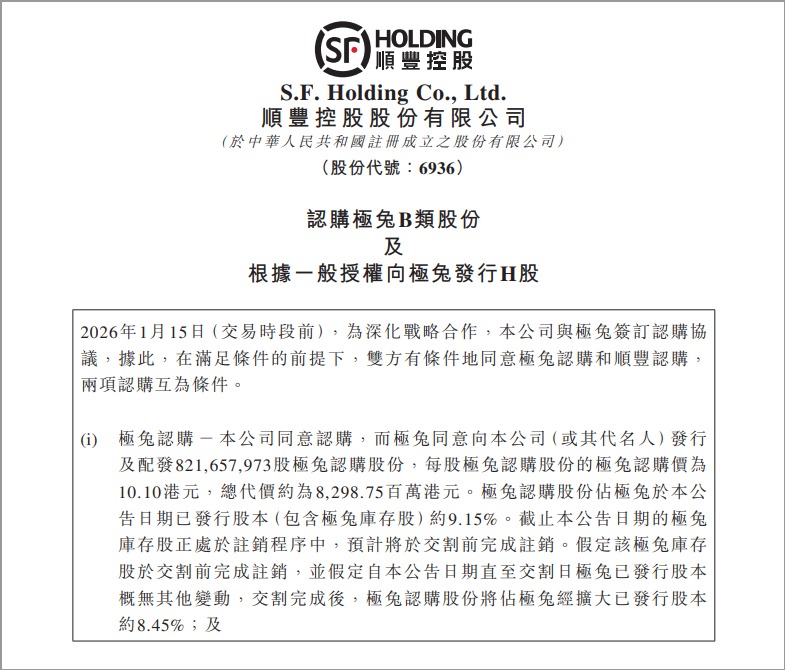
顺丰极兔“联姻”,“反内卷”背后的电商议价权之争
Guan Cha Zhe Wang· 2026-01-16 12:03
Core Viewpoint - SF Holding and Jitu Express have announced a strategic mutual shareholding agreement worth up to HKD 8.3 billion, marking a significant move in the domestic express delivery industry towards reducing internal competition and fostering industry consolidation [1][3]. Group 1: Strategic Partnership - SF Holding will issue 226 million H shares to Jitu Express at HKD 36.74 per share, while Jitu Express will issue 822 million Class B shares to SF Holding at HKD 10.10 per share [3]. - Post-transaction, SF Holding will hold 10% of Jitu Express, and Jitu Express will hold 4.29% of SF Holding [3]. - The partnership is expected to enhance operational efficiency and pricing power in the face of competition from e-commerce platforms [3][4]. Group 2: Industry Context - The Chinese express delivery market is projected to reach a revenue of CNY 1.8 trillion and handle 216.5 billion parcels by 2025, with a year-on-year growth of 6.4% and 11.5% respectively [4]. - Despite growth, the industry faces challenges with low profit margins, often relying on extreme price competition, leading to a situation where the cost of delivery is unsustainable [4][6]. - The average revenue per parcel for major express companies has been declining, with significant drops noted for companies like YTO and ZTO [5]. Group 3: Market Dynamics - The industry is experiencing a shift towards price increases, with regulatory bodies pushing for better pricing strategies to combat the "involution" phenomenon [6][8]. - Major express companies are beginning to raise prices, although the long-standing culture of low pricing remains a significant hurdle [8][9]. - The consolidation of the market is evident, with major players like Jitu and SF Holding seeking to enhance their market positions through strategic partnerships [10]. Group 4: Cross-Border Opportunities - The partnership aims to leverage cross-border logistics, with SF Holding focusing on high-end logistics and Jitu Express on e-commerce deliveries, creating a complementary business model [11][16]. - The international logistics market is expanding, with significant growth in overseas warehouse construction and parcel volume, particularly in Southeast Asia [11][14]. - Both companies are positioned to enhance their competitive edge in international markets, where profit margins are generally higher than in the domestic market [11][17]. Group 5: Pricing Power Challenges - The express delivery sector faces challenges in regaining pricing power against e-commerce platforms, which exert significant influence over logistics costs [17][20]. - Recent trends indicate that platforms like Shopee are increasingly building their logistics capabilities, which could further pressure express companies to lower prices [17][20]. - SF Holding's recent negotiations with Douyin highlight the importance of maintaining pricing power in lucrative segments like returns logistics [21][22].
2026年快递板块全梳理
2026-01-16 02:53
Summary of Conference Call Records Industry Overview: Express Delivery Sector Key Companies Involved - **SF Express (顺丰)** - **J&T Express (极兔)** Core Insights and Arguments 1. **Collaboration Benefits** SF Express and J&T Express are collaborating to enhance cross-border logistics capabilities. SF Express will leverage J&T's end-network advantages in Southeast Asia, while J&T will utilize SF's resources in cross-border transport, warehousing, and supply chain management to improve operational efficiency. This partnership aims to expand into the European and American markets [1][2] 2. **Impact of Capital Increase** The mutual capital increase of HKD 8.3 billion will lead to SF holding 10% of J&T and J&T holding 4.3% of SF. This transaction is expected to enhance business synergy, allowing both companies to provide better services for Chinese enterprises going abroad. The collaboration may also inspire other express companies to adopt similar strategies to reduce internal competition and increase cooperation [2][7] 3. **Market Performance and Strategy** SF Express has seen a decline in market attention over the past six months, with profits falling below expectations. The company is implementing a "first increase, then optimize" strategy, focusing on volume growth before profit optimization. It is anticipated that profit growth will begin in Q4 2026, marking a potential turning point [2][9] 4. **Industry Growth Projections** The express delivery industry is expected to experience moderate growth in 2026, with an estimated growth rate in the mid-single digits (around 8%). The competitive landscape is stabilizing, with price stability and strong regulatory oversight contributing to a healthier adjustment in the market [2][10][13] 5. **J&T's Market Performance** J&T has exceeded expectations since its IPO, benefiting from high-growth and profitable markets. The company has shown strong performance in Southeast Asia, with e-commerce penetration rates expected to increase by 67%-70% in 2026. J&T's strategy in China is now focused on stable operations rather than rapid market share growth [5][6] 6. **Regulatory Environment** The regulatory landscape for the express delivery industry is becoming more stringent, with measures aimed at preventing price wars and ensuring fair treatment for franchisees and couriers. This regulatory focus is expected to facilitate a more stable pricing environment and promote the concentration of market share among leading companies [11][15][16] 7. **Investment Recommendations** Investors are advised to focus on companies like ZTO Express and YTO Express, which have potential for market share growth and profitability. Additionally, Shentong Express, which has expanded into instant delivery services, and SF Express's instant delivery segment are also highlighted as promising investment opportunities [17] Other Important Insights - The collaboration between SF and J&T is likely to increase investor interest in companies with international operations within the express delivery sector [7] - The overall outlook for the express delivery industry remains optimistic, with expectations of stable customer growth and improved profitability for leading companies [13][14]
全国邮政会议召开,地缘再显油运价值
Zhong Guo Neng Yuan Wang· 2026-01-13 01:28
Group 1: Industry Dynamics - The national postal conference held on January 7, 2026, forecasts an 8% year-on-year growth in express delivery volume, reaching 2.14 billion packages in 2026 [1][2] - The conference emphasizes a shift from traditional growth models focused on scale and speed to quality improvement and reasonable growth, urging companies to abandon the "price for volume" model to curb irrational competition [1][2] - The government is expected to play a more active role in industry governance, enhancing regulatory effectiveness and establishing a comprehensive policy framework [2] Group 2: Company Performance - Jitu Express reported a 14.5% year-on-year increase in package volume for Q4 2025, totaling 8.46 billion packages, with Southeast Asia and new markets seeing growth rates exceeding 70% [3] - The company plans to continue investing in infrastructure and optimizing its network partnerships to enhance operational efficiency [3] Group 3: Regulatory Developments - The Jiangxi Provincial Postal Administration held a meeting to address "anti-involution" in the express delivery industry, focusing on protecting couriers' rights and standardizing delivery fee structures [4] - The meeting called for a unified delivery fee standard across the province and emphasized the need for emergency response mechanisms for issues like wage arrears [4] Group 4: Aviation Industry Insights - The civil aviation industry reported a total profit of 6.5 billion yuan in 2025, with significant increases in transportation metrics, including a 10.5% rise in total turnover and a 13.3% increase in cargo volume [7] - The International Air Transport Association (IATA) noted a 5.7% year-on-year growth in global passenger demand for November 2025, with a record load factor of 83.7% [8] Group 5: Shipping and Port Activity - Recent unrest in Iran could impact oil exports and shipping rates, with potential scenarios including increased oil prices and shipping costs due to geopolitical tensions [9] - South Korean shipowners are actively acquiring older VLCCs, indicating a positive outlook for the VLCC market [10] - Container throughput in Chinese ports decreased by 0.65% week-on-week, while container volume increased by 6.27% [12] Group 6: Logistics and Supply Chain - The logistics sector in China is operating smoothly, with national rail freight down 8.54% and highway freight traffic down 14.87% during the last week of December 2025 [13] - The supply chain logistics sector is expected to benefit from a shift towards quality and efficiency, with companies like Debon Logistics and Aneng Logistics showing promising growth potential [17]