
上海家化

Search documents
轻工、美护2026年年度策略:内需筑底深挖潜力,出海突围打开新局
HUAXI Securities· 2026-01-07 02:30
Group 1: Industry Overview - The light industry and beauty sector is expected to stabilize and improve due to the dual drivers of domestic demand policies and steady export growth [3] - The "14th Five-Year Plan" marks a year of enhanced domestic demand policies, coupled with consumers' increasing pursuit of high-quality living, creating significant growth opportunities for the industry [3] - The penetration rate of cross-border e-commerce has ample room for improvement, and the recovery of international relations and demand from emerging markets will further drive market expansion [3] Group 2: Beauty Sector - The cosmetics market is projected to grow steadily, with the skincare segment being the largest, reaching a market size of 4,619 billion yuan in 2024, and expected to grow at a CAGR of 8.6% from 2024 to 2029 [19] - The high-end cosmetics market is rapidly expanding, with the market size for high-end skincare products increasing from 749 billion yuan in 2019 to 1,144 billion yuan in 2024, reflecting a CAGR of 8.84% [19] - Key companies in the beauty sector include: - **Mao Geping**: Revenue reached 25.88 billion yuan in H1 2025, with a growth rate of 31.28% [23] - **Lin Qingxuan**: Revenue grew to 10.52 billion yuan in H1 2025, marking a 98.28% increase [27] - **Marubi**: Revenue is expected to reach 29.70 billion yuan in 2024, recovering from previous declines [32] Group 3: Medical Aesthetics - The medical aesthetics sector is facing short-term pressure due to cautious consumer spending, but the long-term growth potential remains strong, with a projected CAGR of 10%-15% from 2024 to 2027 [36] - The market penetration rate for medical aesthetics in China is currently at 4-5%, indicating a growth potential of 2-5 times compared to countries like the US and South Korea [36] - Key companies in the medical aesthetics sector include: - **Jinbo Biological**: Achieved revenue of 12.96 billion yuan in Q1-Q3 2025, with a year-on-year growth of 31.10% [45] Group 4: Daily Chemicals - The daily chemical industry is benefiting from domestic demand policies, with local brands poised to capture market share [49] - Companies such as **Dengkang Oral Care** and **Runben** are highlighted for their strong market positions and growth potential [51][55] - **Shanghai Jahwa** has shown significant growth, with revenue reaching 49.61 billion yuan in Q1-Q3 2025, reflecting a 10.83% increase [59] Group 5: Home Furnishing - The home furnishing sector is under pressure due to weak real estate sales, with a 15% decline in residential investment in 2025 [65] - National subsidies for home appliances and furnishings have provided some support, but the long-term effects are limited [65] - Leading companies such as **Oppein Home** and **Kuka Home** are noted for their strong channel capabilities and multi-category layouts [65]




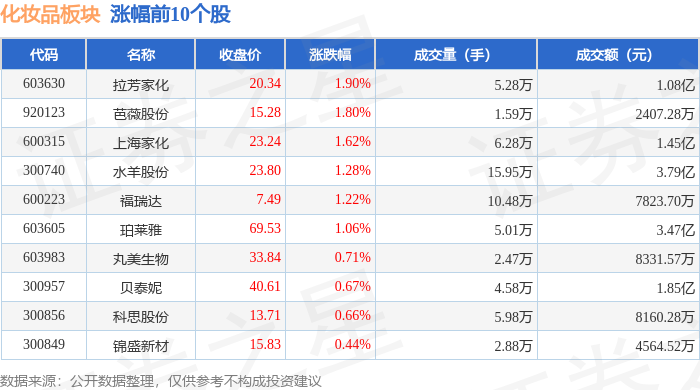
化妆品板块1月6日涨0.46%,拉芳家化领涨,主力资金净流出8196.79万元
Zheng Xing Xing Ye Ri Bao· 2026-01-06 09:03
Group 1 - The cosmetics sector experienced a rise of 0.46% on January 6, with Lafang Jiahua leading the gains [1] - The Shanghai Composite Index closed at 4083.67, up by 1.5%, while the Shenzhen Component Index closed at 14022.55, up by 1.4% [1] - Lafang Jiahua's closing price was 20.34, reflecting a 1.90% increase, with a trading volume of 52,800 shares and a transaction value of 108 million yuan [1] Group 2 - The cosmetics sector saw a net outflow of 81.97 million yuan from institutional investors, while retail investors had a net inflow of 67.35 million yuan [2] - The trading data indicates that major stocks like Shanghai Jahwa and Lafang Jiahua had mixed net inflows and outflows from different investor types [3] - Shanghai Jahwa had a net inflow of 9.64 million yuan from institutional investors, while it faced outflows from retail investors [3]




可选消费W01周度趋势解析:免税优异表现拉动增长,港股消费跌幅较大-20260105
Haitong Securities International· 2026-01-05 14:47
Investment Rating - The report assigns an "Outperform" rating to multiple companies including Nike, Midea Group, JD Group, Haier Smart Home, Gree Electric, and others, while Lulu Lemon is rated as "Neutral" [1]. Core Insights - Duty-free sales have shown exceptional performance, driving growth in the discretionary sector, while Hong Kong consumer stocks have experienced significant declines [4][11]. - The luxury goods sector has outperformed, with a weekly increase of 1.5%, while the retail sector also saw a rise of 1.1% [5][13]. - The report highlights that the overall sentiment in travel-related sectors remains high, contributing positively to the discretionary consumption outlook [3]. Weekly Performance Review - The weekly performance of various sectors is as follows: luxury goods > retail > overseas sportswear > overseas cosmetics > US hotels > domestic sportswear > credit cards > snacks > pets > domestic cosmetics > gold and jewelry > gaming, with respective weekly changes of 1.5%, 1.1%, 0.8%, -0.3%, -0.4%, -2.4%, -2.4%, -2.8%, -2.9%, -4.5%, -4.6%, and -5.6% [11][12]. - The retail sector's growth was significantly driven by China Duty Free, which saw a 7.6% increase due to strong sales during the New Year holiday [6][13]. Monthly and Year-to-Date Performance - Monthly performance shows retail leading with a 4.9% increase, followed by overseas sportswear and US hotels, while domestic cosmetics and gaming sectors faced declines [11]. - Year-to-date performance indicates that overseas cosmetics and US hotels have performed well, while domestic cosmetics and snacks have shown negative growth [12]. Valuation Analysis - The report notes that the valuation of various sectors remains below their average over the past five years, with expected PE ratios for 2025 indicating significant potential for growth [9][14]. - Specific sectors such as overseas sportswear are projected to have a PE of 31.2 times, which is 59% of the past five-year average, while domestic sportswear is at 13.3 times, 70% of the average [14][15].
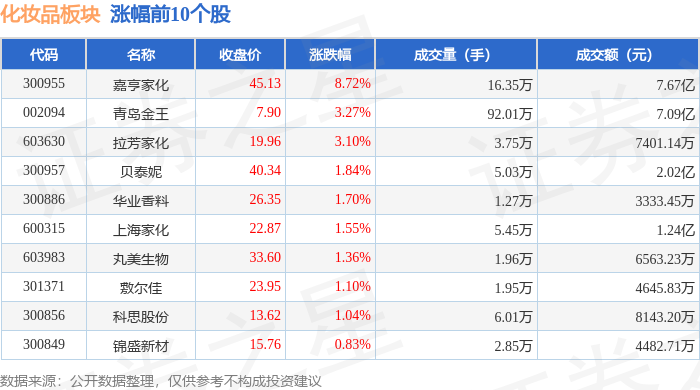
化妆品板块1月5日涨1.27%,嘉亨家化领涨,主力资金净流出1610.63万元
Zheng Xing Xing Ye Ri Bao· 2026-01-05 09:09
证券之星消息,1月5日化妆品板块较上一交易日上涨1.27%,嘉亨家化领涨。当日上证指数报收于 4023.42,上涨1.38%。深证成指报收于13828.63,上涨2.24%。化妆品板块个股涨跌见下表: | 代码 | 名称 | 主力净流入(元) | 主力净占比 游资净流入 (元) | | 游资净占比 散户净流入(元) | | 散户净占比 | | --- | --- | --- | --- | --- | --- | --- | --- | | 300955 嘉亨家化 | | -2016.87万 | 2.63% | 1166.11万 | 1.52% | -3182.98万 | -4.15% | | 300132 青松股份 | | 861.02万 | 3.98% | 632.95万 | 2.93% | -1493.97万 | -6.91% | | 603630 拉芳家化 | | 852.36万 | 11.52% | -650.13万 | -8.78% | -202.24万 | -2.73% | | 300849 | 锦盛新材 | 542.75万 | 12.11% | -163.79万 | -3.65% | -378 ...
7.06亿元敲定控制权!嘉亨家化易主
Shen Zhen Shang Bao· 2026-01-04 00:24
Core Viewpoint - Jiaheng Jiahua (300955) announced a share transfer agreement involving its founder and actual controller, Zeng Bensheng, who will transfer a total of 29.70% of the company's shares to Hangzhou Pinbianyi Network Technology Co., Ltd. and two other entities at a price of 33.21 CNY per share. This move is seen as a strategic investment to help the company improve its operational capabilities amid declining performance [2][3][4]. Group 1: Share Transfer Details - Zeng Bensheng signed a share transfer agreement with Hangzhou Pinbianyi to transfer 19.40% of the company's shares, amounting to 19,555,200 shares [3]. - A second agreement was signed with Wenzhou Cangxiao Enterprise Management Partnership to transfer 5.20% of the shares, totaling 5,241,600 shares [3]. - A third agreement was made with Hangzhou Runyi Enterprise Management Consulting Partnership to transfer 5.10% of the shares, totaling 5,140,800 shares [4]. Group 2: Offer and Financial Implications - Following the share transfer, Hangzhou Pinbianyi plans to launch a partial tender offer to acquire an additional 21.10% of the company's shares, which amounts to 21,268,800 shares [5]. - The total estimated funding required for this tender offer is not expected to exceed 706 million CNY, with a performance guarantee of 141 million CNY to be deposited within two trading days [6]. - The acquisition aims to enhance the company's long-term value and operational capabilities, leveraging the acquirer's resources in the consumer goods sector [6]. Group 3: Company Performance Context - Jiaheng Jiahua has faced declining performance, with revenue decreasing by 9.45% in 2022 and 3.41% in 2023, and a net profit drop of 28.25% and 42.39% in the same years [7]. - In 2024, the company reported its first loss since going public, with a loss of 23.7 million CNY and a revenue decline of 9.13% [7]. - By the third quarter of 2025, the company reported a revenue of 860 million CNY, a year-on-year increase of 24.42%, but a net loss of 29.5 million CNY, surpassing the total loss of the previous year [7].

美容护理系列深度报告2:技术、需求双轮驱动,PDRN应用提速
Orient Securities· 2025-12-31 15:40
Investment Rating - The report maintains a "Positive" investment rating for the beauty and personal care industry, specifically focusing on PDRN applications [6]. Core Insights - The report highlights that PDRN (Polydeoxyribonucleotide) is expected to unleash stronger commercial potential due to increasing registrations and search metrics. The extraction of PDRN is transitioning from animal sources to microbial fermentation and synthetic biology, laying a solid foundation for accelerated applications in the medical beauty and skincare sectors [3][4]. - The report emphasizes that domestic beauty companies are likely to redefine the value boundaries of PDRN, with leading firms accelerating their strategies in this competitive landscape [3][4]. Summary by Sections PDRN Overview - PDRN, derived from salmon and other sources, has a high similarity to human DNA (98%) and is known for its skin repair and cell regeneration properties. Its historical development spans from the 15th century to its current applications in medical aesthetics and cosmetics [8][13][19]. Market Growth Potential - The PDRN market is projected to grow significantly, with estimates indicating an increase from USD 0.72 billion in 2024 to USD 8.55 billion by 2031, reflecting a CAGR of 43%. The demand for anti-aging products is a core driver of this growth [8][30]. Competitive Landscape - Domestic companies are actively entering the PDRN medical and skincare sectors, with significant advancements in extraction technologies. Companies like Huaxi Biological and Lepu Medical are leading the charge in developing PDRN-based products [8][30][34]. Key Mechanisms and Benefits - PDRN operates through two main mechanisms: acting as an agonist for the adenosine A2A receptor to suppress inflammation and providing nucleotides for DNA synthesis, thus promoting cell regeneration and tissue repair [34][36]. - The primary benefits of PDRN include skin repair, anti-inflammatory effects, and anti-aging properties, making it suitable for various cosmetic and medical applications [34][39].


化妆品板块12月31日涨1.33%,水羊股份领涨,主力资金净流入5068.78万元
Zheng Xing Xing Ye Ri Bao· 2025-12-31 09:07
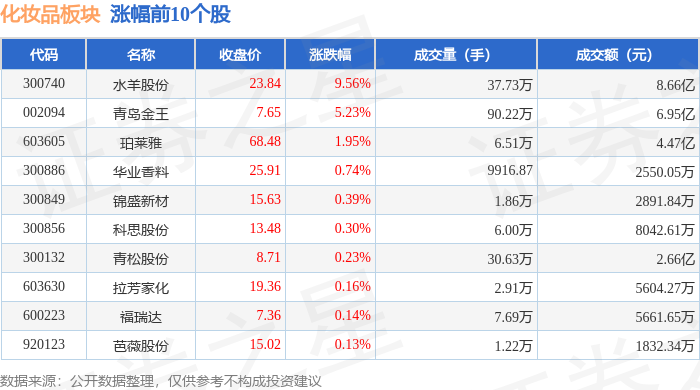
Group 1 - The cosmetics sector experienced a rise of 1.33% on December 31, with Shuiyang Co., Ltd. leading the gains [1] - The Shanghai Composite Index closed at 3968.84, up 0.09%, while the Shenzhen Component Index closed at 13525.02, down 0.58% [1] - Key stocks in the cosmetics sector showed varied performance, with Shuiyang Co., Ltd. closing at 23.84, up 9.56%, and Qingdao Kingking closing at 7.65, up 5.23% [1] Group 2 - The cosmetics sector saw a net inflow of 50.68 million yuan from institutional investors, while retail investors experienced a net outflow of 89.73 million yuan [2] - The stock performance of individual companies showed that Qingdao Kingking had a significant net outflow of 50.75 million yuan from institutional investors [3] - Shuiyang Co., Ltd. had a net inflow of 32.23 million yuan from institutional investors, indicating strong interest despite overall retail outflows [3]


化妆品板块12月30日涨0.36%,青松股份领涨,主力资金净流入4663.64万元
Zheng Xing Xing Ye Ri Bao· 2025-12-30 09:08
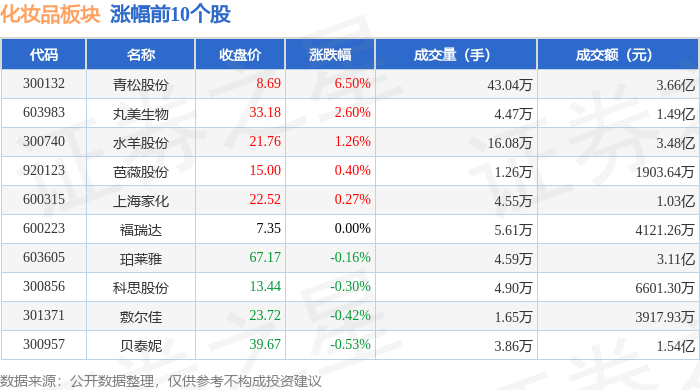
Core Viewpoint - The cosmetics sector experienced a slight increase of 0.36% on December 30, with Qingsong Co., Ltd. leading the gains. The Shanghai Composite Index closed at 3965.12, showing no change, while the Shenzhen Component Index rose by 0.49% to 13604.07 [1]. Group 1: Stock Performance - Qingsong Co., Ltd. (300132) closed at 69.8, up by 6.50%, with a trading volume of 430,400 shares and a transaction value of 366 million yuan [1]. - Marubi Biological Technology (603983) closed at 33.18, increasing by 2.60%, with a trading volume of 44,700 shares and a transaction value of 14.9 million yuan [1]. - Shuiyang Co., Ltd. (300740) closed at 21.76, up by 1.26%, with a trading volume of 160,800 shares [1]. - Other notable stocks include Shanghai Jahwa (600315) with a slight increase of 0.27% and a closing price of 22.52, and Furuida (600223) remaining unchanged at 7.35 [1]. Group 2: Capital Flow - The cosmetics sector saw a net inflow of 46.64 million yuan from institutional investors, while retail investors experienced a net outflow of 68.77 million yuan [2]. - Qingsong Co., Ltd. had a significant net inflow of 34.30 million yuan from institutional investors, while retail investors showed a net outflow of 30.07 million yuan [3]. - Shanghai Jahwa recorded a net inflow of 17.15 million yuan from institutional investors, with a net outflow of 17.20 million yuan from retail investors [3].

化妆品板块12月29日跌1.26%,上海家化领跌,主力资金净流出9493.86万元
Zheng Xing Xing Ye Ri Bao· 2025-12-29 09:02
Group 1 - The cosmetics sector experienced a decline of 1.26% on December 29, with Shanghai Jahwa leading the drop [1] - The Shanghai Composite Index closed at 3965.28, up 0.04%, while the Shenzhen Component Index closed at 13537.1, down 0.49% [1] - Key individual stock performances in the cosmetics sector included Qingdao Kingway up 1.38% and Shanghai Jahwa down 3.06% [2] Group 2 - The net outflow of main funds in the cosmetics sector was 94.94 million yuan, while retail funds saw a net inflow of 41.59 million yuan [2] - The main fund flow for Shanghai Jahwa showed a net outflow of 1.0677 million yuan, with retail funds showing a net inflow of 2.0905 million yuan [3] - Qingdao Kingway had a significant net outflow of 24.09 million yuan from main funds, while retail funds experienced a net outflow of 23.17 million yuan [3]

新成分带来行业增长新引擎
East Money Securities· 2025-12-29 08:37
Investment Rating - The report maintains an "Outperform" rating for the beauty and personal care industry, indicating a positive outlook for growth opportunities in the sector [3]. Core Insights - The report emphasizes that innovation in ingredients, particularly new materials like PDRN (Polydeoxyribonucleotide) and ECM (Extracellular Matrix), is a significant driver for growth in the beauty and medical aesthetics industry. Companies that successfully integrate these new components into their product lines are expected to enhance their growth potential and market competitiveness [5][14]. Summary by Sections 1. PDRN: A New Ingredient Driving Growth - PDRN has been validated in overseas markets for over a decade and is recognized for its effectiveness in promoting tissue regeneration and anti-inflammatory properties. The introduction of PDRN products in the medical aesthetics sector has shown a compound annual growth rate (CAGR) of 30% from 2014 to 2024 for companies like PharmaResearch, which has established a strong market presence with its Rejuran product line [5][18][32]. - The domestic market for PDRN is expected to grow significantly, with a projected revenue of approximately 330 million RMB from Q4 2024 to Q3 2025, indicating robust demand for PDRN products in China [5][20]. - The report highlights that the increasing awareness and education around PDRN among consumers, coupled with regulatory clarity and rapid supply chain development, will further drive demand in the medical aesthetics sector [5][68]. 2. ECM: Potential in Regenerative Fields - ECM is gaining attention as a promising ingredient in both medical aesthetics and cosmetics, with applications in serious medical fields already established. The report notes that the market for ECM products is still developing, with several companies beginning to explore its potential in aesthetic applications [5][24][28]. - The report suggests that the introduction of ECM products could fill existing gaps in the market, particularly in the medical aesthetics sector, where consumer education and awareness are crucial for adoption [5][24]. 3. Investment Opportunities - The report recommends focusing on companies with established pipelines for new materials, particularly in the medical aesthetics sector, such as Lepu Medical and Marubi Biotechnology, which are expected to lead in the approval and commercialization of PDRN products [5][6]. - In the cosmetics sector, brands that are quick to adopt PDRN and other innovative ingredients are likely to gain a competitive edge, with several major brands already launching PDRN-infused products in 2025 [5][6].
