
上港集团

Search documents
突破5500万标箱 上海港“16连冠” 再创历史新高 再居全球港口之首
Jie Fang Ri Bao· 2026-01-07 01:44
Core Insights - Shanghai Port's container throughput is projected to exceed 55 million TEUs in 2025, marking a year-on-year increase of approximately 3.5 million TEUs from 2024, maintaining its position as the world's busiest port for 16 consecutive years [1] - The resilience of the Chinese economy and the irreplaceability of Chinese manufacturing are highlighted by the port's performance amidst a complex global political and economic landscape [1] Group 1: Container Throughput and Trade Growth - In the first 11 months of 2025, Shanghai's import and export value reached 4.1 trillion yuan, a year-on-year growth of 5.7%, surpassing the national average by 2 percentage points [1] - Exports alone amounted to 1.83 trillion yuan, reflecting an 11.2% increase year-on-year [1] Group 2: Port Upgrades and Efficiency Improvements - Shanghai Port has accelerated its digital transformation and continuously optimized port services, leading to significant efficiency gains [2] - The intelligent operation control system for automated terminals has improved the overall loading and unloading efficiency of Yangshan Phase IV by 5.37% and nearly doubled the average operational efficiency of external trucks at the Luojing container terminal [2] - Traditional terminal upgrades have also progressed, with the container turnover rate for large shipments at Yangshan Phase I and II dropping from 55.8% to 7.2% [2] - The use of AI models at Yangshan Phase III has increased loading speed by 13 times and reduced the turnover rate by 20.6%, with the terminal expected to exceed 10 million TEUs in throughput for the first time in 2025 [2] Group 3: Maritime Innovations and Environmental Initiatives - The implementation of innovative measures such as "dual-direction navigation" and "dual-window departure" has positioned Shanghai's maritime operations among the world's best, with berth utilization rates remaining stable at around 84% [3] - In 2025, the port conducted 227 high-difficulty collaborative operations, saving an average of 2 hours per vessel, which unlocked an additional operational potential of approximately 1.08 million TEUs [3] - Shanghai Port has also begun refueling international vessels with domestically produced green methanol, with a local 100,000-ton green methanol project set to commence by the end of 2025, enhancing the port's clean energy refueling capabilities [3]

上海国际港务(集团)股份有限公司2025年半年度权益分派实施公告
Sou Hu Cai Jing· 2026-01-06 07:39
本公司董事会及全体董事保证本公告内容不存在任何虚假记载、误导性陈述或者重大遗漏,并对其内容 的真实性、准确性和完整性承担法律责任。 重要内容提示: 本次利润分配方案经上海国际港务(集团)股份有限公司(以下简称:"公司")2025年12月16日的2025 年第一次临时股东大会审议通过。 二、分配方案 1.发放年度:2025年半年度 2.分派对象: 截至股权登记日下午上海证券交易所收市后,在中国证券登记结算有限责任公司上海分公司(以下简 称:"中国结算上海分公司")登记在册的本公司全体股东。 四、分配实施办法 1.实施办法 除公司自行发放对象外,公司其他股东的现金红利委托中国结算上海分公司通过其资金清算系统向股权 登记日上海证券交易所收市后登记在册并在上海证券交易所各会员办理了指定交易的股东派发。已办理 指定交易的投资者可于红利发放日在其指定的证券营业部领取现金红利,未办理指定交易的股东红利暂 由中国结算上海分公司保管,待办理指定交易后再进行派发。 2.自行发放对象 上海国有资本投资有限公司、亚吉投资有限公司、上海城投(集团)有限公司、上海同盛投资(集团) 有限公司、上海国有资产经营有限公司持有公司股份的现金红利 ...
世界级港口群,打法变了
2 1 Shi Ji Jing Ji Bao Dao· 2026-01-06 03:53
新年刚上班,两份港口的"成绩单"就摆在了眼前: 连续17年雄踞中国内贸第一港的广州港,外贸集装箱占比首次突破50%;深圳港集装箱吞吐量突破3500 万标箱,创下历史新高。 看似是两件事,说的却是同一个趋势:在全球贸易的版图上,粤港澳大湾区的港口群,正在改变打法。 广东"十五五"规划建议多次提及港口群,明确提出打造世界一流港口群,强化大机场、大港口的整体统 筹、功能集成。 2025年,以香港为国际航运中心,广州港、深圳港为枢纽,东莞港、佛山港等为喂给港的粤港澳大湾区 港口群,集装箱处理能力约占到全国总量的四分之一。大湾区这片中国最繁忙的港口群,用实实在在的 行动,划出了三条通向"世界最强"的清晰轨迹。 第一,越是风高浪急,越要把大门敞开。当"逆全球化"的声音不时传来,这里的港口,正把航线铺向更 远的地方。 广州港一年新增10条外贸航线,首次把航线直接拉到了南美西海岸;深圳港的"国际朋友圈"扩大到29个 友好港。它们没有收缩,反而把网络织得更密。广州港目前已与全球100多个国家和地区的400多个港口 建立了紧密的航运联系,深圳港国际集装箱班轮航线累计达279条,覆盖全球6大洲12大航区。 这张不断延伸的航线网络, ...


免税店概念下跌1.08%,主力资金净流出19股
Zheng Quan Shi Bao Wang· 2026-01-05 10:07
Group 1 - The duty-free shop concept index declined by 1.08%, ranking among the top declines in concept sectors, with Hainan Development hitting the limit down, and Hainan Airport, and Caesar Travel Industry also experiencing significant declines [1] - Among the duty-free shop concept stocks, 13 stocks saw price increases, with China Merchants Shekou, Dongbai Group, and Tibet Zhufeng leading the gains at 4.40%, 3.20%, and 1.99% respectively [1] - The duty-free shop sector experienced a net outflow of 1.51 billion yuan from main funds, with 19 stocks seeing net outflows, and 5 stocks exceeding 100 million yuan in outflows, led by China Duty Free Group with a net outflow of 606 million yuan [2] Group 2 - The top gainers in today's concept sectors included brain-computer interfaces at 13.70%, high-pressure oxygen chambers at 7.01%, and blood oxygen monitors at 5.65%, while the Hainan Free Trade Zone and duty-free shop concepts saw declines of 2.93% and 1.08% respectively [2] - The main funds saw significant inflows into stocks such as China Merchants Shekou, Dongbai Group, and Shanghai Port Group, with net inflows of 78.56 million yuan, 64.29 million yuan, and 29.35 million yuan respectively [2] - The duty-free shop concept stocks with the largest net outflows included China Duty Free Group, Hainan Development, and Hainan Airport, with net outflows of 606.9 million yuan, 566.7 million yuan, and 186.1 million yuan respectively [3]





自由贸易港概念下跌0.94%,6股主力资金净流出超亿元
Zheng Quan Shi Bao Wang· 2026-01-05 09:26
Group 1 - The Free Trade Port concept declined by 0.94% as of the market close on January 5, ranking among the top declines in concept sectors [1] - Within the Free Trade Port sector, Haikou Airport, Hainan Rui Ze, and Antong Holdings experienced significant declines, while 20 stocks saw price increases, with Waigaoqiao, Milkewei, and Shanghai Jianke leading the gains at 7.04%, 4.02%, and 2.88% respectively [1][2] - The Free Trade Port sector saw a net outflow of 1.833 billion yuan in main funds today, with 33 stocks experiencing net outflows, and 6 stocks seeing outflows exceeding 100 million yuan [2] Group 2 - The top net outflow stock was China Duty Free, with a net outflow of 606 million yuan, followed by Hainan Airport, Haima Automobile, and HNA Holding with net outflows of 186 million yuan, 172 million yuan, and 160 million yuan respectively [2][3] - Conversely, the stocks with the highest net inflow included Shanghai Port Group, Jinjiang Online, and Wanlin Logistics, with net inflows of 29.35 million yuan, 27.07 million yuan, and 11.41 million yuan respectively [2][3] - The Free Trade Port sector's outflow list included China Duty Free, Hainan Airport, Haima Automobile, and HNA Holding, all showing significant declines in stock prices [3]


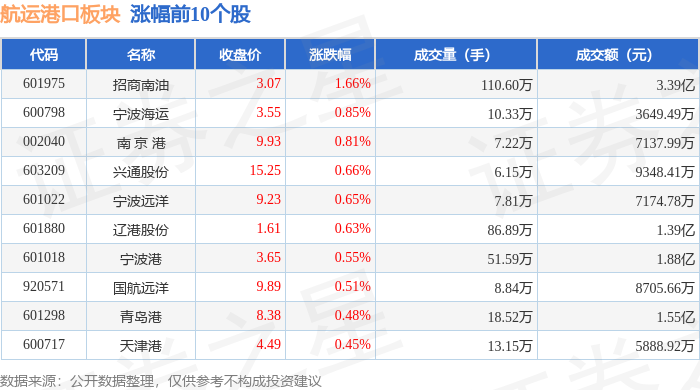
航运港口板块1月5日跌0.59%,安通控股领跌,主力资金净流出6.46亿元
Zheng Xing Xing Ye Ri Bao· 2026-01-05 09:09
证券之星消息,1月5日航运港口板块较上一交易日下跌0.59%,安通控股领跌。当日上证指数报收于 4023.42,上涨1.38%。深证成指报收于13828.63,上涨2.24%。航运港口板块个股涨跌见下表: 从资金流向上来看,当日航运港口板块主力资金净流出6.46亿元,游资资金净流入9779.2万元,散户资金 净流入5.48亿元。航运港口板块个股资金流向见下表: | 代码 | 名称 | 主力净流入(元) | 主力净占比 游资净流入 (元) | | 游资净占比 散户净流入 (元) | | 散户净占比 | | --- | --- | --- | --- | --- | --- | --- | --- | | 601975 招商南油 | | 3904.19万 | 11.50% | -2680.93万 | -7.90% | -1223.26万 | -3.60% | | 600018 | 上港集团 | 3218.87万 | 14.70% | 792.70万 | 3.62% | -4011.57万 | -18.32% | | 601298 | 黄明 | 866.73万 | 5.59% | -929.47万 | -5.99% ...

上港集团(600018) - 上港集团2025年半年度权益分派实施公告
2026-01-04 08:00
上海国际港务(集团)股份有限公司 证券代码:600018 证券简称:上港集团 公告编号:2026-001 相关日期 | 股份类别 | 股权登记日 | 最后交易日 | 除权(息)日 | 现金红利发放日 | | --- | --- | --- | --- | --- | | A股 | 2026/1/12 | - | 2026/1/13 | 2026/1/13 | 差异化分红送转: 否 一、 通过分配方案的股东大会届次和日期 本次利润分配方案经上海国际港务(集团)股份有限公司(以下简称:"公司")2025 年 12 月 16 日的2025年第一次临时股东大会审议通过。 二、 分配方案 2025年半年度权益分派实施公告 本公司董事会及全体董事保证本公告内容不存在任何虚假记载、误导性陈述或者重大遗 漏,并对其内容的真实性、准确性和完整性承担法律责任。 重要内容提示: 每股分配比例 A 股每股现金红利0.05元 截至股权登记日下午上海证券交易所收市后,在中国证券登记结算有限责任公司上海分 公司(以下简称:"中国结算上海分公司")登记在册的本公司全体股东。 上海国有资本投资有限公司、亚吉投资有限公司、上海城投(集团)有限公 ...
“共抓大保护,不搞大开发”,长江经济带十年绘就壮美画卷
Xin Lang Cai Jing· 2026-01-04 01:29
Core Viewpoint - The article emphasizes the importance of ecological protection over large-scale development in the Yangtze River Economic Belt, highlighting a decade of progress in balancing economic growth with environmental sustainability [2][10][11]. Group 1: Ecological Protection - The Yangtze River Economic Belt covers 11 provinces and municipalities, accounting for about one-fifth of China's land area and half of its population and economic output [2]. - Since 2020, the Yangtze River has maintained a Class II water quality for six consecutive years, with increased biodiversity and aquatic resources [2][10]. - The initiative "co-grasp major protection, not engage in major development" reflects a shift towards high-quality, green, and low-carbon development [3][11]. Group 2: Economic Development - By November 2025, the foreign trade import and export value of the 11 provinces and municipalities along the Yangtze River reached 19.12 trillion yuan, accounting for 46.4% of the national total [2]. - The Yangtze River Economic Belt has formed five major industrial clusters, including electronics, high-end equipment, automobiles, home appliances, and textiles, with a projected GDP of over 63 trillion yuan in 2024, growing at 5.4% [22]. Group 3: Policy and Governance - The article discusses the establishment of a comprehensive ecological protection and governance system, including measures like a ten-year fishing ban and pollution control initiatives [10][18]. - Collaborative mechanisms among provinces have been strengthened to ensure coordinated management of the river basin, enhancing ecological compensation and protection efforts [19][20]. - The government is promoting innovative approaches to ecological protection, such as the river and lake chief system, which assigns responsibility for every river and lake [21]. Group 4: Community Engagement and Sustainable Practices - Local communities are actively involved in ecological protection, with initiatives to train fishermen in alternative livelihoods and promote eco-tourism [27][28]. - The article highlights successful case studies where ecological restoration has led to improved local economies, such as the transformation of polluted areas into recreational spaces [28]. Group 5: Future Outlook - The article concludes with a vision for the Yangtze River Economic Belt to become a model of harmonious coexistence between nature and development, ensuring sustainable benefits for future generations [28].
“共抓大保护,不搞大开发” 长江经济带十年绘就壮美画卷 “现在路子是对的,要继续走下去”
Ren Min Ri Bao· 2026-01-03 22:17
Core Viewpoint - The development of the Yangtze River Economic Belt emphasizes ecological protection over large-scale development, aiming for a harmonious coexistence between nature and economic growth [1][5][9]. Economic Development - By November 2025, the foreign trade import and export value of the 11 provinces and cities along the Yangtze River Economic Belt reached 19.12 trillion yuan, accounting for 46.4% of the national total, marking a historical high [2]. - The Yangtze River Economic Belt has formed five major industrial clusters, including electronic information and high-end equipment, with a projected GDP of over 63 trillion yuan in 2024, growing at 5.4% [20]. Ecological Protection - Since 2020, the main stream of the Yangtze River has maintained a Class II water quality for six consecutive years, indicating significant ecological recovery [1][2]. - The initiative "coordinated protection, no large-scale development" has led to major achievements in ecological protection and restoration, including a ten-year fishing ban and pollution control measures [8][10]. Biodiversity and Species Recovery - The successful artificial breeding of the Chinese sturgeon has established a self-sustaining population, with significant increases in their numbers observed in the Yangtze River [2][3]. - The monitoring of sturgeon migration has shown positive results, indicating a recovery in the ecological health of the Yangtze River [3][4]. Systematic Governance - The governance approach has shifted from fragmented management to a comprehensive system that emphasizes collaboration among provinces for ecological protection [18][19]. - Innovative compensation mechanisms have been introduced to enhance ecological protection efforts, transitioning from a focus solely on water quality to a more integrated ecological service model [18]. Green Development - The Yangtze River Economic Belt is exploring a new path of ecological priority and green development, with initiatives to promote low-carbon industries and sustainable practices [11][20]. - The transformation of industrial zones from pollution-heavy to eco-friendly areas has been highlighted, showcasing the potential for economic growth alongside environmental stewardship [10][11].
补齐本地化绿色甲醇加注能力短板 10万吨级沪产绿醇项目投产
Jie Fang Ri Bao· 2026-01-02 02:34
Core Viewpoint - The Shanghai green methanol project, which began construction on January 2, 2025, and was completed and put into operation within 361 days, aims to provide green fuel for international shipping vessels at Shanghai Port and enhance Shanghai's pricing power in the global green shipping fuel market [1][4]. Group 1 - The project is significant for China's early achievement of its "dual carbon" goals, as green methanol serves as a crucial alternative to traditional energy sources [2]. - The project addresses the lack of local green methanol refueling capabilities at Shanghai Port, which previously relied on transporting green methanol from other regions [2][4]. - The project integrates waste management and resource recycling, creating a full-cycle green supply chain from waste to raw materials to production and refueling [2][3]. Group 2 - The proximity of the project to Shanghai Port allows for local production and refueling of green methanol, significantly reducing carbon emissions and logistics costs associated with transportation [3]. - The project has received ISCC EU and PLUS certifications, granting it access to the European market, and aims to fill the local refueling gap at Shanghai Port [4]. - With an annual production capacity of 100,000 tons, the project is positioned as a stabilizing force for the supply of green methanol, which is critical for meeting the fuel demands of international shipping vessels [4].

