渝农商行

Search documents
银行周报(2026/1/12-2026/1/16):12月收支表:居民存款边际活化,中小银行配债意愿或有下降-20260118
GUOTAI HAITONG SECURITIES· 2026-01-18 07:44
股 票 研 究 12 月收支表:居民存款边际活化,中小银行配债意愿或有下降 [Table_Industry] 商业银行 银行周报(2026/1/12-2026/1/16) | [姓名table_Authors] | 电话 | 邮箱 | 登记编号 | | --- | --- | --- | --- | | 马婷婷(分析师) | 021-23185608 | matingting@gtht.com | S0880525100001 | | 陈惠琴(分析师) | 021-38676666 | chenhuiqin@gtht.com | S0880525100003 | 本报告导读: 12 月收支表:负债端,居民储蓄存款出现边际活化迹象;资产端,大型银行票据压 降力度较大,中小银行中长期贷款增幅较为显著,12 月债市波动,中小银行配债意 愿或有下降。 投资要点: [Table_Summary] 负债端:低基数下非银存款大幅多增 1)个人存款:同比多增 4287 亿元,其中活期储蓄存款、定期储蓄 存款分别同比多增 1000 亿元、少增 391 亿元,居民储蓄存款出现边 际活化迹象,定期储蓄存款延续由中小银行向大型银行迁 ...
资产规模持续提升 农商行集聚效应凸显
Xin Lang Cai Jing· 2026-01-16 19:05
Core Insights - Rural financial institutions are transitioning from a "blooming" phase to a "concentration of leading players" phase, with five rural commercial banks exceeding one trillion yuan in assets, accounting for over 11% of total assets in the sector [1][3] - The emergence of provincial-level unified legal person rural commercial banks with assets over 500 billion yuan indicates a trend towards further concentration in the rural financial sector [1][3] - The competitive landscape is shifting from individual institutions to a focus on systemic capabilities, with an emphasis on sustainable, low-risk financial services [1][4] Group 1: Development of Leading Rural Commercial Banks - Chongqing Rural Commercial Bank was the first to exceed one trillion yuan in assets in 2019, followed by Shanghai, Guangzhou, and Beijing Rural Commercial Banks in 2020 [2] - Chengdu Rural Commercial Bank joined the ranks of trillion-yuan banks in early 2026, benefiting from the national strategy of the Chengdu-Chongqing economic circle [3] Group 2: Competitive Landscape Changes - The shift to concentrated operations in rural finance is a necessary response to challenges such as declining efficiency and negative growth in loans and deposits [4] - The competitive focus is moving from scale expansion to efficiency and value, with a layered industry structure emerging that emphasizes targeted resource allocation [4] Group 3: Challenges and Strategies for High-Quality Development - Achieving high-quality development requires a shift from a focus on scale to optimizing structure, especially in a context of narrowing net interest margins [5][6] - Rural commercial banks need to enhance their profitability by optimizing their liability structure and deepening their understanding of local industries and risks [6] Group 4: Risks and Governance Issues - As rural commercial banks grow, they face new challenges related to risk management, capital constraints, and governance complexities [7] - The transition from individual loan risks to structural risks necessitates a more proactive and comprehensive approach to risk management [7]

企业端发力支撑信贷
HTSC· 2026-01-16 12:01
Investment Rating - The report maintains a "Buy" rating for several banks, including Chengdu Bank, Chongqing Rural Commercial Bank, Nanjing Bank, Industrial and Commercial Bank of China, Shanghai Bank, and China Construction Bank, while recommending "Hold" for Chongqing Rural Commercial Bank [8][35]. Core Insights - The report highlights that corporate lending has become the main driver of credit growth, with December's new loans reaching 910 billion yuan, exceeding expectations, while household loans contracted significantly [2][5]. - The total social financing for 2025 is projected to be 35.6 trillion yuan, an increase of 3.34 trillion yuan year-on-year, supported mainly by government bonds [5][12]. - The report indicates a recovery in corporate bond financing, with December seeing an increase of 1.54 billion yuan, while government bond financing decreased significantly due to a high base effect from the previous year [3][5]. Summary by Sections Credit Growth - December's new loans amounted to 910 billion yuan, with corporate loans increasing by 1.07 trillion yuan, while household loans decreased by 916 billion yuan [2][5]. - The overall loan growth rate for December was 6.4%, remaining stable compared to November [2][12]. Social Financing - The total social financing in December was 2.21 trillion yuan, with a year-on-year decrease of 646.2 billion yuan, primarily due to fluctuations in government bonds [1][5]. - For the entire year of 2025, social financing is expected to grow significantly, driven by government support [5][12]. Monetary Supply - M1 and M2 growth rates for December were 3.8% and 8.5%, respectively, with M1 showing a decline due to limited demand for corporate current funds [4][12]. - New deposits in December reached 1.68 trillion yuan, with a year-on-year increase of 3.08 trillion yuan [4][12]. Investment Recommendations - The report recommends specific stocks for investment, including Chengdu Bank (target price 23.25 yuan), Nanjing Bank (target price 14.78 yuan), and Industrial and Commercial Bank of China (target price 8.31 yuan) [11][35].



12月金融数据点评:政府债支撑减弱下社融增速回落,对公信贷同比多增
Orient Securities· 2026-01-16 09:42
Investment Rating - The report maintains a "Positive" investment rating for the banking sector in 2026, indicating a favorable outlook for returns relative to the market benchmark [6][24]. Core Insights - The banking sector is expected to return to a fundamental narrative in 2026, supported by policy financial tools and resilient asset expansion. The sector is currently in a deposit repricing cycle, which is likely to stabilize net interest margins. Structural risks are anticipated to receive policy support [3][24]. - The report highlights two main investment themes: 1. High-quality small and medium-sized banks with confirmed fundamentals, including Nanjing Bank (601009, Buy), Ningbo Bank (002142, Buy), and Chongqing Rural Commercial Bank (601077, Buy) 2. State-owned large banks with stable fundamentals and good defensive value, including Bank of Communications (601328, Not Rated) and Industrial and Commercial Bank of China (601398, Not Rated) [3][25]. Summary by Sections Social Financing and Loan Growth - In December 2025, social financing grew by 8.3% year-on-year, with a month-on-month decrease of 0.2 percentage points. The total social financing increment was 2.21 trillion yuan, which was 646.2 billion yuan less than the previous year. The structure showed that corporate loans increased by 140.2 billion yuan, while government bonds decreased significantly by 1.0733 trillion yuan [9][10]. - The report notes that retail demand remains weak, while corporate loans increased by 580 billion yuan, driven by local government debt limits allocated for project construction [13][14]. Monetary Aggregates - M1 growth continued to decline, with a year-on-year increase of 3.8% in December 2025, while M2 grew by 8.5%. The difference in growth rates between M2 and M1 increased to 4.7 percentage points [21][22]. - New RMB deposits in December amounted to 1.68 trillion yuan, with a year-on-year increase of 3.08 trillion yuan, primarily due to a rise in household deposits [21][23]. Investment Recommendations - The report emphasizes the potential for absolute returns in the banking sector in 2026, with a focus on quality small and medium-sized banks and stable large state-owned banks as key investment targets [24][25].
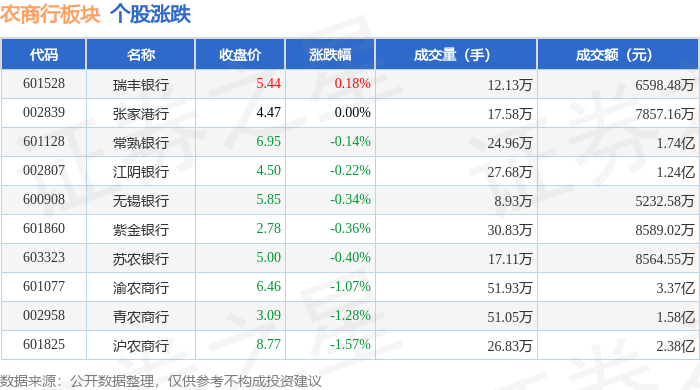
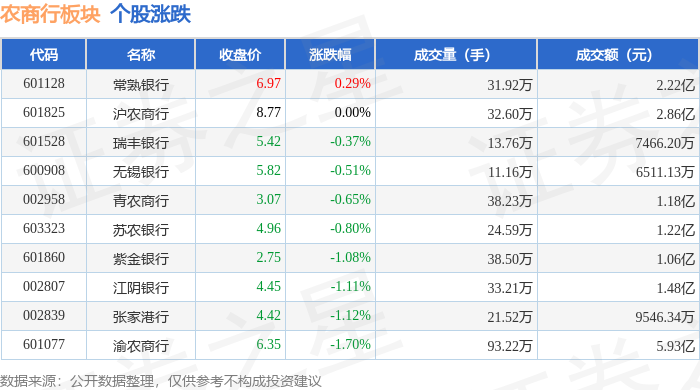
农商行板块1月16日跌0.64%,渝农商行领跌,主力资金净流出617.66万元
Zheng Xing Xing Ye Ri Bao· 2026-01-16 08:56
Group 1 - The agricultural commercial bank sector experienced a decline of 0.64% on January 16, with Yunnan Agricultural Commercial Bank leading the drop [1] - The Shanghai Composite Index closed at 4101.91, down 0.26%, while the Shenzhen Component Index closed at 14281.08, down 0.18% [1] - The trading volume and turnover for various agricultural commercial banks are detailed, with Changshu Bank closing at 6.97, up 0.29%, and Yunnan Agricultural Commercial Bank closing at 6.35, down 1.70% [1] Group 2 - The net outflow of main funds from the agricultural commercial bank sector was 6.1766 million yuan, while retail funds saw a net outflow of 12.6 million yuan [1] - The table shows the net inflow and outflow of funds for individual banks, with notable figures such as 14.69% net inflow for Shanghai Agricultural Commercial Bank from main funds [2] - Jiangyin Bank had a significant net outflow of 30.1445 million yuan from main funds, indicating a 20.35% decrease [2]


银行“十万亿俱乐部”成员达10家
21世纪经济报道· 2026-01-16 03:03
记者丨叶麦穗 编辑丨方海平 银行业绩快报捷足先登,截至1月15日,已经有浦发银行、中信银行2家银行先后发布了2025 年的"成绩单",双双实现归母净利润正增长,不过从业绩快报来看,两家银行去年的发展路 径,有一定的区别,其中中信银行"稳扎稳打",浦发银行则是"高举高打",值得一提的是, 两大股份行还联袂迈入"10万亿俱乐部",至此该俱乐部的成员达到10家 。 规模指标上,报告期末,浦发银行集团口径下资产总额达100817.46亿元,较上年末增加 6198.66 亿 元 , 增 长 6.55%; 负 债 总 额 92573.16 亿 元 , 较 上 年 末 增 加 5402.17 亿 元 , 增 长 6.20%。 资产质量方面,两家银行则全部得以改善。中信银行不良率1.15%,略降0.01个百分点;拨备 覆盖率203.61%,同比下降5.82个百分点。整体来看算是"稳扎稳打"。 浦发银行则明显更加"进攻"。不良率1.26%,同比下降0.10个百分点;拨备覆盖率200.72%, 同比上升13.76个百分点显示出要将"蛋糕做大"的想法。 浙商证券银行业分析师邱冠华的观点认为,2025年浦发银行规模增长方面,总资产同 ...



国信证券晨会纪要-20260116
Guoxin Securities· 2026-01-16 01:25
Macro and Strategy - December financial data shows a significant recovery in corporate financing, with new social financing reaching 2.21 trillion yuan, exceeding expectations of 1.82 trillion yuan, and new RMB loans at 910 billion yuan, surpassing the forecast of 679.4 billion yuan. M2 growth year-on-year was 8.5%, above the expected 7.9% [7][8] - The improvement in corporate loans indicates a recovery in financing demand, aligning with the manufacturing PMI returning to expansion territory, suggesting a positive economic outlook towards the end of the year [7][8] - The People's Bank of China announced a reduction in structural monetary policy tool rates, effective January 19, 2026, to enhance support for key sectors and stabilize expectations for bank net interest margins [12][8] Industry and Company - The banking sector is expected to see a significant reduction in the decline of net interest margins in 2026, indicating a potential end to the current downtrend cycle. This is contrasted with the previous two years of uncertainty regarding the bottom line of net interest margins [13][17] - The acquisition of 67.48% of Zhejiang Jiali Industrial Co., Ltd. by Debang Lighting for 1.454 billion yuan is aimed at expanding its presence in the automotive lighting sector, which is expected to grow significantly [18] - The banking industry is focusing on risk resolution, with the regulatory framework remaining consistent with previous years, emphasizing the need to mitigate risks in small financial institutions and the real estate sector [13][17]
家庭资配视角:日本存款也搬家了吗?
NORTHEAST SECURITIES· 2026-01-15 14:42
Investment Rating - The report assigns an "Outperform" rating for the banking sector, indicating that the sector is expected to outperform the market benchmark in the next six months [5]. Core Insights - The core insight of the report is that the allocation of household assets in Japan is primarily influenced by the risk-return ratio. Even with declining deposit rates, the proportion of cash and deposits in household asset allocation tends to increase when risk aversion rises. There is no systemic shift of deposits towards riskier assets observed in the long term [1][10][16]. Summary by Sections Household Asset Allocation - The report examines the changes in household asset allocation in Japan since 1990, highlighting that the core factor influencing this allocation is the risk-return ratio. When risk aversion increases, the proportion of cash and deposits rises despite falling interest rates [1][10]. - The report suggests that household wealth allocation behavior aligns with the "Merton Rule," where the proportion of risk assets depends on expected returns, excess returns over risk-free rates, risk levels, and the household's risk aversion coefficient [2][12]. Financial Asset Flow and Structure - From a short-term perspective, the net flow of equity and fund investments is closely correlated with stock market performance. Positive net inflows occur during strong market performance, while negative outflows happen during weak performance [3][13]. - Long-term observations show that from 1994 to 2002, the proportion of deposits and cash increased from 49% to 54%, despite a shift in the structure of deposits where time deposits saw negative net flows while demand deposits increased [14][15]. Investment Outlook for 2026 - The report anticipates that high real interest rates will continue to suppress credit demand from private enterprises and retail sectors, with local state-owned enterprises expected to drive growth due to increased investment in larger provinces as per the "14th Five-Year Plan" [26]. - It is expected that there will be a significant interest rate cut in the first quarter of 2026, which may improve bank interest margins in the latter half of the year [26].
苏州农商行吸收合并江苏张家港渝农商村镇银行获股东会通过,反对票达13.08%
Bei Jing Shang Bao· 2026-01-15 13:15
Core Viewpoint - Suzhou Rural Commercial Bank has announced the decision to absorb and merge Jiangsu Zhangjiagang Yurun Rural Commercial Village Bank, with approximately 13.08% of votes against the proposal during the shareholder meeting [1] Group 1: Merger Details - The merger involves acquiring 100% of the shares held by all shareholders of Zhangjiagang Yurun Rural Commercial Village Bank, which will be transformed into a branch of Suzhou Rural Commercial Bank after the merger [1] - Zhangjiagang Yurun Rural Commercial Village Bank was established in April 2010 with a registered capital of 200 million yuan, and the main initiating bank holds a 90% stake [1] Group 2: Financial Performance of Zhangjiagang Yurun Rural Commercial Village Bank - As of the end of 2024, Zhangjiagang Yurun Rural Commercial Village Bank reported total assets of 537 million yuan, total deposits of 154 million yuan, total loans of 469 million yuan, and a net profit of 20.33 million yuan [1] - The bank has a non-performing loan ratio of 0.73% and a provision coverage ratio of 930.51% [1] Group 3: Strategic Implications - The merger is expected to enhance the operational resources of Suzhou Rural Commercial Bank and optimize its branch network [1]

农商行板块1月15日跌0.94%,沪农商行领跌,主力资金净流出4296.1万元
Zheng Xing Xing Ye Ri Bao· 2026-01-15 08:59
Group 1 - The agricultural commercial bank sector experienced a decline of 0.94% on January 15, with Hu Nong Commercial Bank leading the drop [1] - The Shanghai Composite Index closed at 4112.6, down 0.33%, while the Shenzhen Component Index closed at 14306.73, up 0.41% [1] - The trading volume and turnover for various agricultural commercial banks are detailed in a table, showing mixed performance among individual stocks [1] Group 2 - The net outflow of main funds from the agricultural commercial bank sector was 42.961 million yuan, while retail funds saw a net outflow of 56.997 million yuan [1] - The table of fund flows indicates that some banks, like Changshu Bank and Zhangjiagang Bank, had positive net inflows from retail and speculative funds, while others like Yunnan Agricultural Bank and Jiangyin Bank faced significant outflows [2] - Specific data shows that Changshu Bank had a main fund net inflow of 8.1314 million yuan, while Yunnan Agricultural Bank had a net outflow of 25.5857 million yuan [2]