OPPO

Search documents
不只人工智能赛事 东莞滨海湾接住青年人创业梦
Nan Fang Du Shi Bao· 2025-11-06 23:13
赛事破圈 全球青年才智的"竞技场" 智能交互创新赛是中国高校计算机大赛八大板块赛事之一,自创办以来,已成为面向高校学生的重要科 技创新实践平台。本届赛事以"面向移动终端的AI智能体创新"为核心赛题,参赛团队以智能体为核心, 构思并呈现了众多兼具创意与实用价值的创新方案,展现出新一代青年开发者在智能交互领域的前沿思 考与实践能力。 大赛面向全球高校在校生,报名高校数量与参赛队伍均创历史新高,共吸引3626支队伍,4939人报名, 覆盖全国及海外共477所高校,其中147所"双一流"建设高校覆盖率94%,原42所"双一流"覆盖率100%。 滨海湾新区。 智能交互创新赛全国总决赛上,滨海湾发出"青春合伙人"邀约。 从能帮助老人管理用药的AI智能长者关怀引擎,到让学习效率更高的智能交互学习书桌,再到为残障 朋友设计的视障安全导引实时响应系统……11月2日,由浙江大学、OPPO及东莞滨海湾新区联合承办 的第四届中国高校计算机大赛——智能交互创新赛全国总决赛举行,一批极具创意的项目同台竞技。 这是今年以来滨海湾承接的又一场高水平人工智能赛事,也是广东"百万英才汇南粤"行动计划在地方的 鲜活落地。滨海湾正以赛事为纽带,打破 ...



AI手机按下加速键,广东移动多款产品“上新”
2 1 Shi Ji Jing Ji Bao Dao· 2025-11-06 13:17
Core Insights - China Mobile Guangdong Company held a quarterly terminal ordering and AI product promotion conference, emphasizing the future of the AI terminal ecosystem with over 300 participants including industry experts and leading smartphone manufacturers [1] - The company has accelerated the development of the AI smartphone industry since the first AI smartphone ordering conference in August, launching multiple AI smartphone models with significant sales achievements [1][2] Group 1 - The conference featured presentations from major manufacturers like ZTE, Huawei, realme, vivo, OPPO, and Honor, showcasing their latest AI terminal products and exclusive ordering policies [1] - The cumulative sales of AI smartphones have surpassed 148,000 units, with a single-day peak sales of over 2,200 units [1] Group 2 - China Mobile Guangdong Company aims to expand market boundaries through a "hit product matrix" and has partnered with vivo, Honor, and OPPO to launch four new AI smartphone models [2] - The company plans to implement precise policies to activate cooperation, offering comprehensive and high-impact policy support to enhance customer and channel store participation [2] - Future strategies include extending marketing efforts into more scenarios and continuously iterating AI terminal products and services in collaboration with industry partners to enhance user experience and drive high-quality industry development [2]

机构:2025年三季度中国智能手机销量同比下降2.7%,但四季度开局乐观
Bei Jing Shang Bao· 2025-11-06 13:16
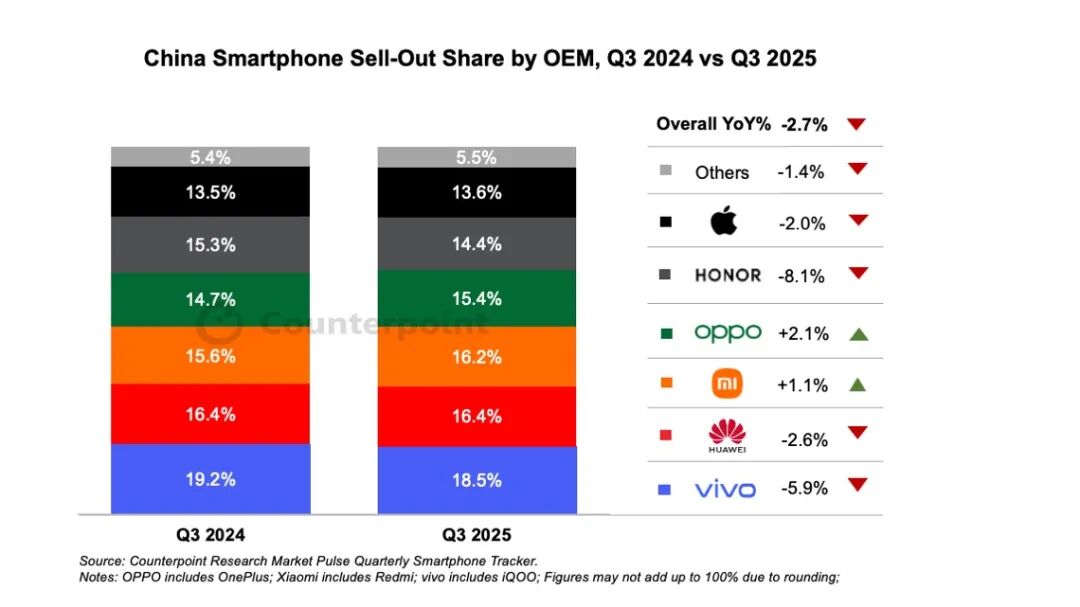
值得注意的是,该机构称Q4市场开局强劲,10月前两周中国智能手机整体销量同比增长11%,分析师 预计,在iPhone 17需求推动下Q4销量增长势头向好。 前五名依次为vivo、华为、小米、OPPO及荣耀,苹果位列第六。 北京商报讯(记者陶凤 王天逸)11月6日,Counterpoint Market Pulse发布初步数据显示,2025年Q3中国 智能手机销量同比下降2.7%。受到暑假和开学季的持续经济影响,消费者需求依然低迷。尽管国家补 贴政策的影响在Q1后有所减弱,但该政策仍持续支撑着中国智能手机的平均售价(ASP)。 ...
OPPO的公关,跟不上OPPO的技术
Ge Long Hui· 2025-11-06 12:03
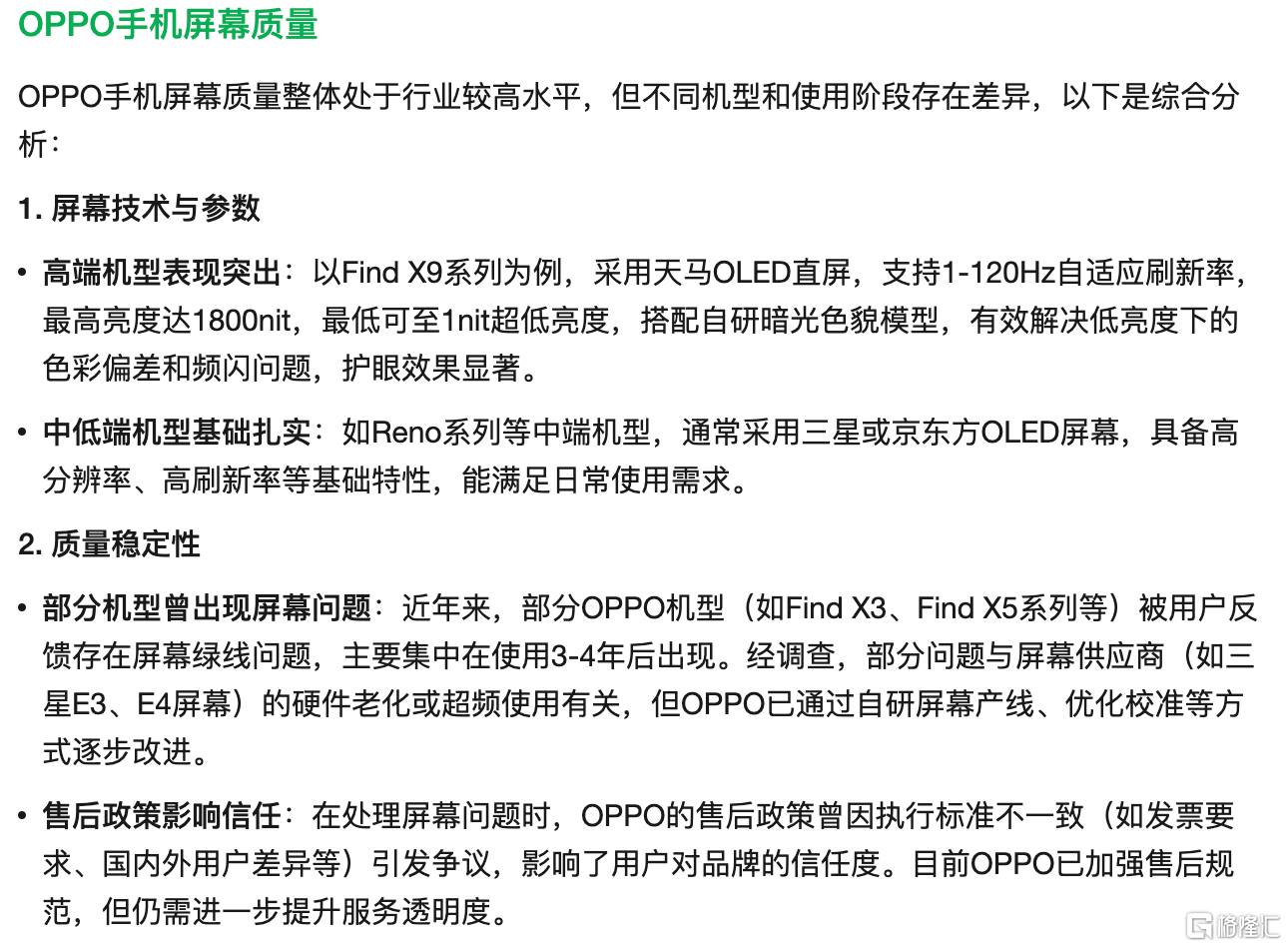
Core Viewpoint - OPPO's recent sales success with the Find X9 series is overshadowed by negative publicity surrounding the "green line" issue, highlighting the need for improved public relations and brand positioning as the company aims for higher-end market penetration [2][4][18]. Sales Performance - The Find X9 series achieved over 1 million units sold within 10 days of its launch on October 22 [2]. - Despite a slight decline of 0.6% in China's smartphone shipments year-on-year by Q3 2025, OPPO is the only domestic brand among the top five to show growth [2]. Public Relations Challenges - The "green line" controversy erupted around the same time as the Find X9's launch, leading to speculation about potential external influences [4]. - OPPO's decision to remain silent on the issue has resulted in a vacuum of information, allowing negative narratives to dominate public perception [13][18]. - Users reported difficulties in contacting customer service and dissatisfaction with the company's response to the screen issue, which has further damaged its reputation [8][9]. Comparison with Competitors - Apple's handling of similar issues in the past, such as the iPhone X's screen problems, contrasts with OPPO's approach, as Apple managed to maintain sales momentum despite negative press [7][10]. - OPPO's public relations strategy has not effectively communicated its technological advancements and efforts to improve screen quality, unlike competitors who have successfully built strong brand identities [21][24]. Brand Positioning and Identity - OPPO's brand lacks distinctiveness compared to competitors like Huawei, Xiaomi, and Vivo, which have successfully associated their brands with specific technological attributes [20][24]. - Despite being a leader in 5G patent applications and having made significant investments in display technology, OPPO's achievements are not well recognized by consumers [21][22][24]. - The company needs to enhance its brand narrative to resonate with consumers and differentiate itself in a competitive market [34][35].
选择过剩的2025,钱该往哪花?
虎嗅APP· 2025-11-06 12:00
Core Insights - The article emphasizes a shift in consumer behavior towards thoughtful consumption, where spending reflects personal values and lifestyle choices rather than mere impulse or necessity [2][3][41] - The concept of "super consumers" is introduced, highlighting the importance of understanding genuine consumer preferences through in-depth conversations with diverse individuals from various industries [7][8][42] Consumer Behavior Trends - Consumers are increasingly overwhelmed by choices due to the influence of AI algorithms, marketing information, and KOL endorsements, leading to a need for curated lists to guide purchasing decisions [5][6] - The article suggests that spending more does not equate to better decision-making, as consumers struggle to determine what is truly "worth it" [6][41] Product Recommendations - A list of recommended products is provided, showcasing items that enhance quality of life and align with the values of modern consumers [9] - Categories include technology products like the DJI Pocket 3 and the iPad Mini 7, which are praised for their practicality and design [10][14][17] - Lifestyle products such as fresh flowers from Yunnan and unique home decor items are highlighted for their emotional value and ability to enhance living spaces [25][27] Emotional and Practical Value - The article stresses that consumers are now prioritizing emotional satisfaction and practical solutions over mere cost-effectiveness, indicating a shift towards "heart price" rather than "cost performance" [26][18] - The importance of community brands and unique experiences is noted, as consumers seek products that resonate with their individual tastes and lifestyles [29][30] Future Consumption Outlook - The core of consumption in 2025 is identified as a reflection of personal lifestyle choices, with a focus on making informed decisions that lead to a more ideal future [41][42] - The article concludes with an invitation to engage with innovative trends and connect with industry leaders at the 2025 F&M Innovation Festival [43]

智动力(300686) - 2025年11月6日投资者关系活动记录表
2025-11-06 10:50
Group 1: Company Developments - The company has developed its own dual-screen AR glasses named "Tianying," utilizing 2D full-color waveguide technology, and is also working on full-color diffraction waveguide AR glasses [3] - The company is entering the solid-state battery sector through its subsidiary Shenzhen Zhisheng Solid Energy Technology Co., Ltd., targeting an energy density of over 500Wh/kg for solid-state batteries [3][4] Group 2: Financial Performance - For the first three quarters of 2025, the company achieved total revenue of 1.197 billion yuan, a year-on-year increase of 6.03%, indicating stable growth [4] - The company's interest-bearing debt has decreased to 145 million yuan, a reduction of 27.50% year-on-year, reflecting improved financial stability [4] Group 3: Strategic Focus - The company is actively expanding into new materials such as fiberglass, carbon fiber, and PEEK, aiming to capture opportunities in emerging fields like robotics and low-altitude economy [3][4] - The company has made strategic investments in AR/VR optical components through its investment in Montong Intelligent, enhancing its position in the AR/VR market [4]

Counterpoint Q3中国智能手机市场报告:销量同比下降2.7%,头部厂商分化明显
Feng Huang Wang· 2025-11-06 10:28
Core Insights - In Q3 2025, China's smartphone sales are projected to decline by 2.7% year-on-year due to economic slowdown and reduced demand [1] - The launch of flagship models by Chinese OEMs and the iPhone 17 series contributed to an 11% year-on-year sales growth in the first two weeks of October [1] Group 1: Company Performance - OPPO leads the recovery with a 2.1% year-on-year growth, driven by the Reno 14 series and OnePlus, appealing to younger consumers with gaming performance and stylish design [1] - Xiaomi shows steady growth with a 1.1% year-on-year increase, supported by the Redmi Note 15 and K80 series, and ranks as the second fastest-growing brand after Apple in early October [1] - Huawei's Honor X70 series targets the entry-level market with advantages in battery life and fast charging, but overall brand sales declined by 8.1% year-on-year as the company focuses on AI and ecosystem transformation [1] - Apple's older iPhone models see a slowdown in sales, while the iPhone 17 series is performing well, with the base model's sales doubling year-on-year in September and the Pro version showing significant growth in October [2] Group 2: Market Trends - The smartphone market in China is experiencing a shift with flagship models driving sales, despite an overall decline in volume [1] - The competitive landscape is intensifying as brands like OPPO and Xiaomi leverage new product launches to capture market share [1] - The strong performance of the iPhone 17 series indicates a robust demand for premium smartphones, contrasting with the decline in older models [2]

三季度国内手机市场排名出炉:vivo份额居首位,荣耀销量降幅最大
Xin Lang Cai Jing· 2025-11-06 10:03
Core Insights - The overall smartphone sales in China declined by 2.7% year-on-year in Q3 2025, attributed to weak consumer demand influenced by the summer vacation and back-to-school season [1] - Vivo leads the market with an 18.5% share despite a 5.9% drop in sales, while Honor experienced the largest decline, with its market share falling to 14.4% [1] - Huawei maintained a stable market share of 16.4% with a slight sales decrease of 2.6%, supported by the Nova 14 series despite challenges with its HarmonyOS [2] - OPPO showed a recovery with a 2.1% year-on-year growth, driven by the stable performance of the Reno 14 series and its sub-brand OnePlus [4] - Xiaomi achieved a 1.1% increase in sales, bolstered by the REDMI Note 15 and K80 series, and its new Xiaomi 17 series has gained traction in the high-end market [4] - Apple’s market share rose to 13.6% with a 2% sales decline, maintaining strong competitiveness in the high-end segment due to the iPhone 17 series [5] - Despite the overall market downturn, smartphone sales in China grew by 11% year-on-year in the first two weeks of October, indicating a positive start to Q4 [7] Company Summaries - **Vivo**: Holds the top market share at 18.5%, with a 5.9% decline in sales; successful in mid-range and entry-level segments with models like S30 and Y500 [1] - **Honor**: Experienced the largest sales drop of 8.1%, with challenges in product innovation and brand positioning, despite some success in the entry-level market with the X70 series [4][2] - **Huawei**: Maintained a stable market share of 16.4% with a 2.6% sales decline; the Nova 14 series performed well, but the HarmonyOS's development is still ongoing [2] - **OPPO**: Achieved a 2.1% growth in sales, with the Reno 14 series contributing to its recovery [4] - **Xiaomi**: Recorded a 1.1% increase in sales, with the new Xiaomi 17 series enhancing its presence in the high-end market [4] - **Apple**: Increased market share to 13.6% with a 2% sales decline; the iPhone 17 series continues to perform well in the high-end market [5]

高通连续八年参展进博会,携手生态伙伴共建智能未来
Jing Ji Wang· 2025-11-06 09:06
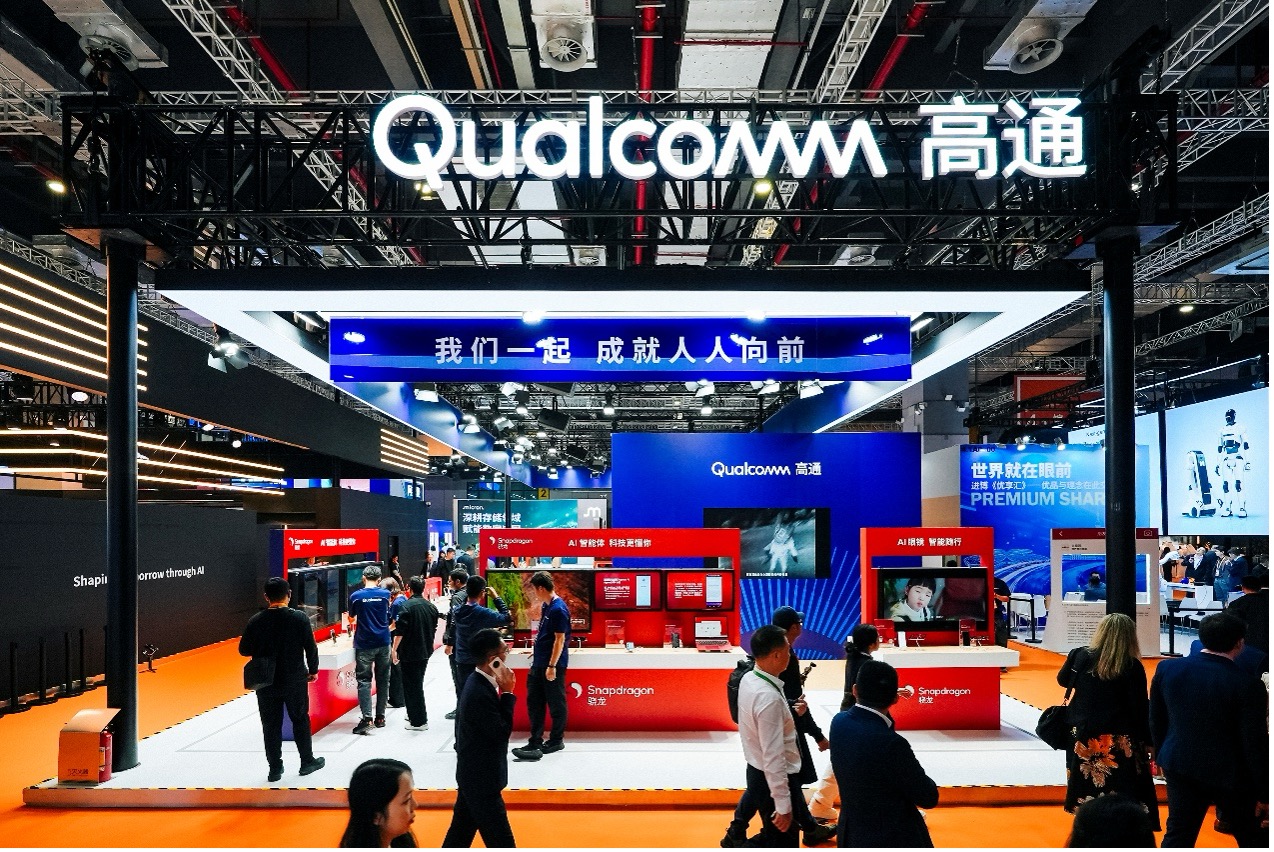
Core Insights - Qualcomm has participated in the China International Import Expo for eight consecutive years, showcasing its continuous innovation in technology and collaboration with Chinese industry partners [3][9] - The theme of Qualcomm's exhibition this year is "Together, We Achieve Progress for Everyone," highlighting its commitment to enhancing China's innovation ecosystem through technological advancements and partnerships [1][3] Group 1: Product Innovations - At the expo, Qualcomm displayed 12 flagship smartphones from Chinese manufacturers powered by the fifth-generation Snapdragon 8 Gen 2 mobile platform, marking the first large-scale offline exhibition of these products [3][5] - The rapid introduction of new products reflects Qualcomm's deep collaboration with leading Chinese smartphone brands such as Xiaomi, Honor, and OnePlus, showcasing breakthroughs in AI, imaging, gaming, and connectivity [3][5] Group 2: Expansion into New Markets - Qualcomm's collaboration with Chinese smart industries extends beyond smartphones to include AI PCs and tablets, with nearly 150 designs powered by the Snapdragon X series platform [5] - In the automotive sector, Qualcomm partnered with Chery to develop the Zongheng G700 model, integrating smart technologies and supporting over 210 models from Chinese automotive brands since 2023 [5] Group 3: AI and IoT Applications - Qualcomm introduced its new brand "Qualcomm Leap," focusing on industrial IoT and cellular infrastructure solutions, complementing its well-known Snapdragon brand [7] - The expo featured various applications of Qualcomm Leap, including humanoid robots and retail terminals, demonstrating the company's commitment to digital transformation in collaboration with over 90 Chinese partners [7] Group 4: Vision for the Future - Qualcomm emphasizes the importance of open collaboration and continuous innovation as core drivers for future development, aiming to unlock new opportunities for high-quality industrial growth [9] - The company is dedicated to promoting the deep integration of technology and industry, from edge intelligence to the future of 6G, and from personal AI to industrial intelligence [9]

Counterpoint Research:2025年Q3中国智能手机销量同比下降2.7%
智通财经网· 2025-11-06 07:29
Group 1: Market Overview - In Q3 2025, smartphone sales in China decreased by 2.7% year-on-year, influenced by ongoing economic factors related to summer vacations and the back-to-school season [1] - Despite a reduction in the impact of national subsidy policies after Q1, these policies continue to support the average selling price (ASP) of smartphones in China [1] - Overall smartphone sales in China showed a strong start in Q4 2025, with a year-on-year increase of 11% in the first two weeks of October [5] Group 2: Company Performance - Vivo's market share fell to 18.5% in Q3 2025, but it maintained a leading position due to a diverse product line across different price ranges, with models like S30, X200s, Y300, and the newly launched Y500 contributing significantly [1] - Huawei's high-end Mate 70 and Pura 80 series saw lower sales compared to previous generations, while the Nova 14 series performed well; however, challenges remain due to the new HarmonyOS NEXT lacking ecosystem support [1] - OPPO showed signs of recovery with a 2.1% year-on-year growth, driven by stable sales of the Reno 14 series and strong performance from its sub-brand OnePlus, particularly the Ace 5 and 13 series [4] - Honor's X70 series stood out in the entry-level market with features like an 8300mAh battery, but overall sales declined by 8.1% in the quarter; the brand is investing heavily in AI to transition into an AI-focused ecosystem company [4] Group 3: Apple Performance - The iPhone 17 series has performed exceptionally well since its launch in September 2025, with the base model's sales nearly doubling compared to the iPhone 16 during the same period last year [8] - The iPhone 17's entry-level model offers high value with a storage upgrade from 128GB to 256GB at a starting price of RMB 5999, putting pressure on competing high-end Android brands [5] - The iPhone 17 Pro has shown remarkable performance, with a year-on-year growth rate significantly higher than that of the iPhone 16 Pro [8]