
库卡

Search documents
伊之密(300415):注塑机出口加速 回购彰显公司发展信心
Xin Lang Cai Jing· 2025-04-29 02:50
事件描述 公司发布24 年报及25 年一季报,2024 年公司实现营收50.63 亿元,同比+23.61%;归母净利润6.08 亿 元,同比+27.42%;扣非归母净利润5.92 亿元,同比+29.85%。其中24Q4 营收13.90 亿元,同比 +20.21%;归母净利润1.27 亿元,同比+13.49%;扣非归母净利润1.24 亿元,同比+10.93%。 25Q1 营收11.87 亿元,同比+24.32%;归母净利润1.32 亿元,同比+14.29%;扣非归母净利润1.26 亿 元,同比+13.57%。 事件评论 携手库卡展出智能机器人+注塑生产线方案,布局智能制造。公司与库卡合作,依托智能开模技术与机 器人精准取件的无缝配合,在库卡开放日现场展示了注塑成型的高效稳定生产过程,不仅提升了生产效 率,更实现了零缺陷生产,为制造业智能化树立了新标杆。 回购股份拟用于股权激励或员工持股计划,彰显公司发展信心。25 年4 月8 日,公司控股股东提议以集 中竞价交易方式回购公司股份,回购金额不低于1500 万元且不超过2500万元,回购股权全部用于股权 激励计划或实施员工持股计划,彰显公司发展信心。 维持"买入"评 ...

美的公布人形机器人落地时间表:5月部署工厂,下半年进线下门店|钛媒体AGI
Tai Mei Ti A P P· 2025-04-27 00:39
美的人形机器人样机(图片来源:受访者提供) 距离上次披露不到40天,美的人形机器人即将进入商业化落地阶段。 4月27日消息,钛媒体AGI近日获悉,美的中央研究院智能技术与应用研究所所长、人形机器人创新中 心负责人奚伟向钛媒体AGI等透露,美的集团与库卡联合研发的类人形机器人将于今年5月进入工厂, 用于机器运维、设备检测和搬运等场景。同时,预计今年下半年,美的人形机器人将陆续进入线下门 店,主要用在展示、产品介绍、制作咖啡等场景。 奚伟表示,今年美的主要做全人形以及类人形机器人产品迭代。而在家电机器人化方向,美的结合机器 人和AI技术,将会打造差异化创新平台,并在空调、烤箱、洗地机等产品中进行落地和探索。 美的集团副总裁兼CTO卫昶曾对钛媒体AGI等表示,美的正加大力度布局人形机器人相关领域的研发。 美的要做人形机器人的整机不难,但产品要真正做到解决用户痛点、难点,需要深挖应用场景,目前还 没有具体的时间表。"人形机器人或者类人形机器人,最先的应用可能在工业或者商业应用场景;对于 家庭场景的应用,如家电机器人化,近期将有产品落地。" 据悉,早在2015年,美的就布局机器人产业。2022年,美的集团完成对库卡10 ...




美媒惊呼:中国在贸易战中有一只机器人大军!
Qi Lu Wan Bao· 2025-04-24 09:21
转自:央视新闻 "中国在贸易战中有一只机器人大军!" 文章注意到,不只汽车工厂这样的大工厂在使用工业机器人,许多小作坊也开始使用工业机器人。比如,一家位于广 州、有11名工人生产廉价烤箱和烧烤设备的小工厂的老板,准备向一家中国公司购买一个带有摄像头的机械臂。这一设 备可以通过人工智能自主学习如何焊接烤箱侧面,然后在最少的人工干预下重复该动作。 文章称,仅在四年前,同样的系统只能从外国机器人公司那里购买,费用是约14万美元——而中国公司的价格仅为约4 万美元。这位工厂主表示,此前从未想象过自己也能够投资自动化设备。 文章称,美国的汽车工厂也使用自动化,但其中许多设备来自中国。过去 20 年间建造的大多数汽车组装厂都是在中 国,围绕它们自动化产业逐渐发展起来。 《纽约时报》网站近期的一篇文章聚焦中国制造业领域的机器人大军,认为它们彻底改变了中国的制造业,使得中国工 厂有能力将其出口的许多产品价格保持在较低水平,并在应对特朗普的高关税、应对贸易战方面具有优势。 文章注意到,现在中国的工厂比美国、德国或日本的工厂自动化程度更高。 国际机器人联合会的数据显示,中国每万名制造业工人拥有的工业机器人数量仅次于韩国以及新加坡 ...
美的集团业绩会:美国收入占比很低 库卡中国在创新和产品开发上取得突破
Zheng Quan Shi Bao Wang· 2025-04-11 13:05
Core Viewpoint - Midea Group focuses on three key areas for 2025: prioritizing overseas self-owned brands, transforming to a direct-to-consumer (DTC) model, and developing its ToB (business and industrial solutions) business [1] Group 1: Financial Performance - In 2024, Midea Group achieved total revenue of 409.1 billion yuan, a year-on-year increase of 9.5%, and a net profit attributable to the parent company of 38.5 billion yuan, up 14.3% [1] - The net cash flow from operating activities reached 60.5 billion yuan, marking a historical high [1] Group 2: Business Segmentation - Domestic business revenue was 238.1 billion yuan, a year-on-year growth of 7.68%, while overseas business revenue reached 169 billion yuan, growing by 12.01% [2] - The ToB business revenue proportion increased from 18.5% in 2020 to 25.5% in 2024, with revenue exceeding 100 billion yuan for the first time [2] Group 3: Overseas Expansion - Midea Group operates in over 200 countries and regions, with a low revenue share from the U.S. and plans to expand overseas manufacturing and new factory construction [2] - The company has established 22 R&D centers and 23 major manufacturing bases across multiple continents [2] Group 4: Robotics Industry - Midea Group ranks among the top four global industrial robot companies following its acquisition of KUKA in 2017, and has since established a robotics and automation division [2] - In 2024, KUKA China launched 27 new products, achieving significant market performance, with a domestic market share of approximately 8.2% for industrial robots [3][4] Group 5: Industry Applications - KUKA China's industrial robot business has seen rapid growth in the 3C consumer electronics sector and strengthened partnerships in the new energy vehicle industry, achieving record order volumes [4] - The company has expanded applications in logistics, including stacker robots in new industries such as tobacco and tires, and has made breakthroughs in pharmaceuticals and chemicals [4]
美的集团(000333) - 2025年4月11日投资者关系活动记录表
2025-04-11 12:30
Group 1: Financial Performance - In 2024, Midea Group achieved total revenue of CNY 409.1 billion, a year-on-year increase of 9.5% [6] - The net profit attributable to the parent company reached CNY 38.5 billion, growing by 14.3% year-on-year [6] Group 2: Research and Development - From 2022 to 2024, Midea's total R&D investment exceeded CNY 43 billion, with over CNY 16 billion allocated in 2024 alone, marking a growth of over 10% [7] - Midea ranked 8th globally and 1st among private enterprises in China for the number of patent families in 2023 [7] Group 3: Business Matrix - Midea operates across various sectors including smart home, renewable energy, industrial technology, smart building technology, robotics and automation, health care, and smart logistics [3] - The company has established a dual business model focusing on both consumer (ToC) and business (ToB) markets [3] Group 4: Market Expansion - Midea's self-owned brand products achieved market share leadership in several countries, including refrigerators in Malaysia, Saudi Arabia, and Chile, and washing machines in Malaysia and Saudi Arabia [24] - The share of commercial and industrial solutions in total revenue increased from 18.5% in 2020 to 25.5% in 2024, with revenue surpassing CNY 100 billion for the first time [11] Group 5: Digital Transformation and E-commerce - In 2024, Midea's domestic e-commerce sales accounted for over 50% of total sales, maintaining the top position in the industry for 12 consecutive years during major sales events [26] - The overseas self-owned brand e-commerce sales grew by over 50% year-on-year, with significant improvements in profitability and market share [21] Group 6: Product Innovation - Midea launched the Eureka J15 Max Ultra smart vacuum cleaner, featuring advanced dual-vision recognition technology for improved cleaning efficiency [10] - The company introduced the COLMO high-end brand, which saw a retail sales growth of over 45% in 2024 [18] Group 7: Strategic Focus for 2025 - Midea will prioritize overseas OBM (Original Brand Manufacturer) expansion, deepen DTC (Direct to Consumer) model implementation, and promote ToB business transformation [8] - The company aims to enhance its global manufacturing capabilities and improve efficiency in overseas production [27]
布局全产业链发展,广东AI与机器人领域集中上新
Di Yi Cai Jing· 2025-04-09 13:22
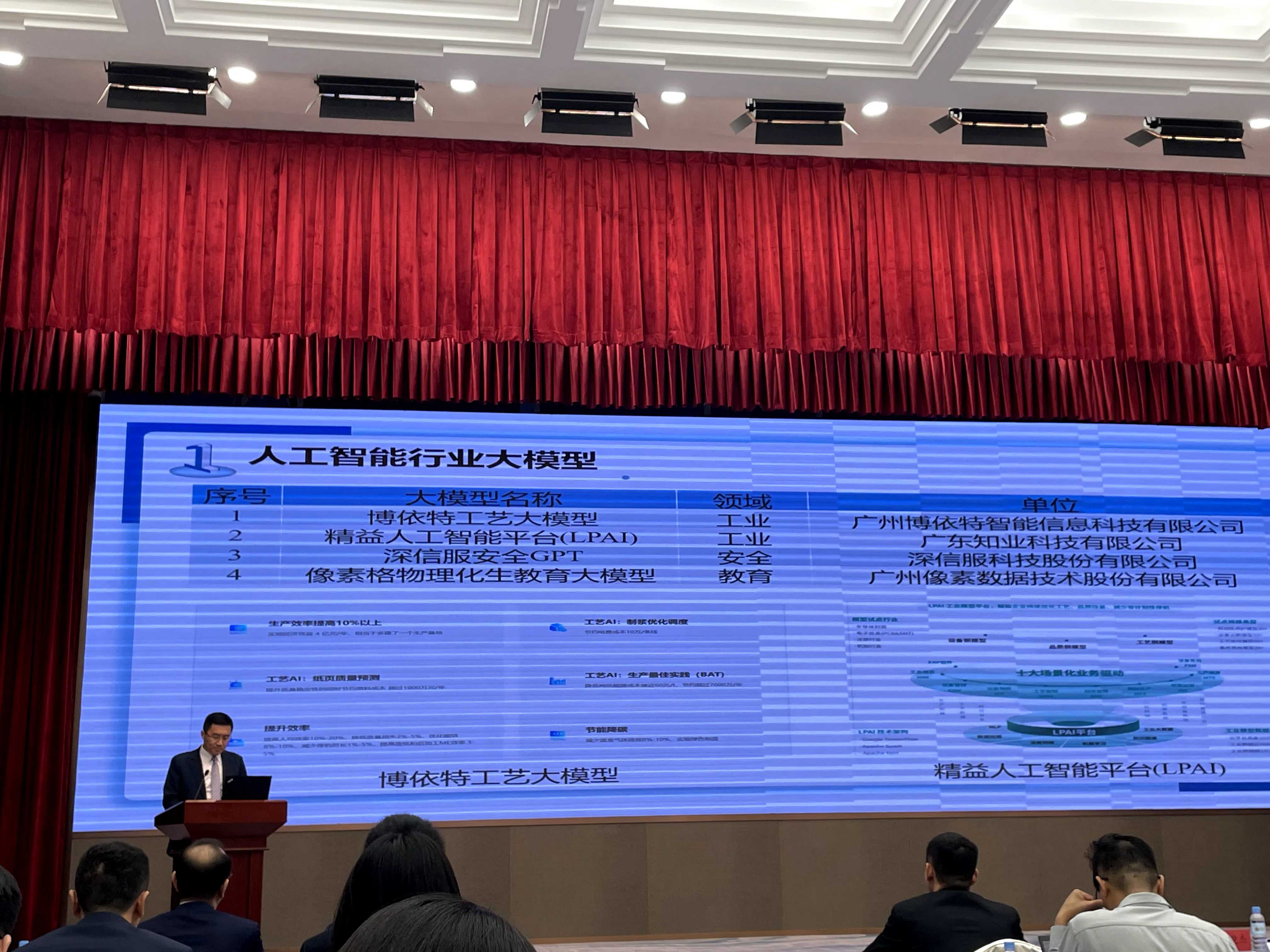
8个AI行业大模型、30个应用场景、29个应用解决方案和13个智能终端产品发布。 从行业大模型到应用场景,再到解决方案与终端产品,广东正布局人工智能与机器人全产业链发展。 4月9日,广东召开人工智能与机器人产业创新产品与服务新闻发布会,发布8个AI行业大模型、30个应用场景、29个应用解决方案和13个智能终端产品。华 为、腾讯、视源电子、TCL雷鸟、深开鸿、乐聚、美的库卡、拓斯达、广汽等9家企业代表参会并围绕前沿成果进行分享。 上 2 2 = ီಗ 傻 生产效車提高10 ICHINEWING 4 12,025 工艺AI: 無质质 12 / 21 / 2014 / 11:20 / 2017 / 2017 / 11:21 提升效率 国 A KEET BE LONG - 2019 IPA-10%, 其中得到国家 978 广东人工智能与机器人产业创新产品与服务新闻发布会 摄/宋婕 需求侧推出行业大模型与更多应用场景 广东省工业和信息化厅副厅长曲晓杰在发言中表示,8个行业大模型都已经在相关领域初步应用并取得了显著成效。 第一财经记者了解到,这8个行业大模型分别应用于工业、安全、教育、医疗、文旅、风控合规等领域。例如,视 ...



柏楚电子20250403
2025-04-06 14:36
Summary of Conference Call Company and Industry - The conference call primarily discusses the laser cutting and welding industry, focusing on the company's product lines including flat and pipe cutting systems, as well as their market dynamics and growth prospects. Key Points and Arguments Product Mix and Market Dynamics - The current product mix shows that flat cutting systems have a higher output ratio compared to pipe systems, with mid-low power systems around 30% and high power systems around 70% [1] - The overall output ratio for pipe systems is less than 20%, indicating a slower market penetration since its introduction last year [1] - The company sees long-term growth potential in pipe systems due to new applications, despite their current lower market base compared to flat systems [2] Export and Domestic Growth - Exports account for approximately 40% of the company's overall sales, with mid-low power systems making up about half of that and high power systems around 20% [3] - Domestic growth rates for flat systems are expected to be lower than overseas, particularly for mid-low power systems [3] Revenue and Profitability Outlook - The company maintains a revenue growth forecast of 20% for the upcoming year, with expectations that pipe systems will continue to expand their application range [6] - The profitability of individual business units is expected to remain stable, with no significant pricing adjustments anticipated [8] - The company aims to achieve a sales target of 1,300 units for the year, exceeding previous estimates [16] Market Potential and Competitive Landscape - The market potential for pipe systems is projected to grow significantly, potentially surpassing flat systems in revenue due to their broader application range [9] - The company emphasizes the importance of providing comprehensive solutions rather than just individual products to maintain competitive advantages [22] Future Growth Projections - Future growth rates are anticipated to be modest for flat systems (single-digit growth), while pipe systems could see 30-50% growth, and three-dimensional systems may experience triple-digit growth [13] - The company is exploring new applications in robotics and automation, indicating a strategic shift towards more integrated solutions [14] Challenges and Strategic Focus - The company acknowledges challenges in maintaining high profit margins due to competitive pressures and market dynamics, particularly in the context of rising operational costs [20] - There is a focus on enhancing customer value through innovative solutions and long-term partnerships, which is seen as crucial for sustaining growth [22] International Expansion - The company is cautiously expanding its international presence, particularly in markets like Russia and the US, while being mindful of service and support challenges [29] - The acceptance rate for new products in overseas markets is reported to be high, indicating a positive reception for the company's offerings [29] Other Important Content - The company is actively working on enhancing its product offerings and exploring new market segments, including the integration of smart technologies into their systems [36] - There is a clear emphasis on maintaining a balance between growth and operational efficiency, with a focus on strategic investments in technology and human resources [34] This summary encapsulates the key insights and strategic directions discussed during the conference call, highlighting the company's focus on growth, market dynamics, and competitive positioning within the laser cutting and welding industry.

科技赋能转型升级进行时:机械行业技术要素对信用质量的影响分析
新世纪资信评估· 2025-04-02 01:00
Investment Rating - The report indicates a positive outlook for the mechanical industry, highlighting the transition towards new productive forces and technological innovation as key drivers for growth and credit quality improvement. Core Insights - The development of new productive forces is driving technological innovation and structural upgrades in the mechanical industry, creating new market demands and business models [2][4][5]. - Key areas of growth include industrial humanoid robots, industrial 3D printing equipment, low-altitude economic industrial drones, AGV intelligent logistics, and high-precision military products, all of which exhibit high growth potential and are becoming new growth engines for the industry [2][4][12]. - The mechanical industry is accelerating its shift from traditional energy to new productive forces, with significant impacts on revenue and operational efficiency from technological investments [2][79]. Summary by Sections 1. Characteristics of the Mechanical Industry's Transformation - The mechanical industry is experiencing a comprehensive impact from the development of new productive forces, which is fostering technological innovation and structural upgrades [4][5]. - New productive forces are characterized by high technology, high efficiency, and high quality, leading to a systemic leap in production methods and significant improvements in overall productivity [5][6]. 2. Performance of New Productive Forces in the Mechanical Industry - The report identifies several key areas where new productive forces are manifesting, including the establishment of technology innovation platforms, the construction of intelligent factories, and the adoption of remanufacturing technologies [18][20][24]. - The intelligent factory projects have shown significant improvements in productivity and efficiency, with examples such as SANY Heavy Industry achieving a fourfold increase in per capita output [20][22]. 3. Representative Fields and Distribution of New Productive Forces - The report highlights the industrial humanoid robots, industrial 3D printers, low-altitude economic drones, AGV intelligent logistics, and high-precision military products as key sectors driving the mechanical industry's future growth [28][29][39]. - The market for industrial humanoid robots is expected to grow significantly, with projections indicating a global market size of $38 billion by 2030, driven by advancements in AI and robotics [38]. 4. Impact of Technological Factors on Credit Quality in the Mechanical Industry - Technological investments are expected to enhance credit quality in the long term, with pathways including improved market share, cash flow stability, and asset value enhancement [79][82]. - The report presents a quantitative analysis showing that the average total factor productivity (TFP) growth rate in the mechanical industry is 1.78%, indicating a shift towards new productive forces [82][84]. 5. Trends in Credit Quality in the Mechanical Industry - The overall credit quality of the mechanical industry is improving, with significant differentiation among companies during the transition period [91]. - New productive forces are associated with high growth and high added value, leading to enhanced credit quality through improvements in cost structure, profit margins, and market responsiveness [91].
未来五年机器人全产业链耗铜量分析及趋势解读
雪球· 2025-03-22 08:32
Core Viewpoint - The article discusses the rapid growth of the robotics industry driven by advancements in artificial intelligence, the Internet of Things, and precision manufacturing technologies, highlighting the critical role of copper in the robotics supply chain and projecting significant increases in copper demand over the next five years [2][39]. Group 1: Copper Consumption in Robotics Supply Chain - In the upstream segment, each industrial robot consumes approximately 6-12 kg of copper, while collaborative robots consume 12-15 kg due to their lightweight design [8]. - The midstream segment sees each industrial robot consuming about 4.7-8.3 kg of copper, primarily from wiring and mechanical components [13]. - In the downstream segment, the total copper consumption per robot is estimated at 8-14.5 kg, including energy modules and maintenance needs [18]. Group 2: Future Copper Demand Projections (2025-2030) - The total copper demand from the robotics industry is projected to increase from 214,000 tons in 2025 to 810,000 tons in 2030, reflecting a compound annual growth rate of 30.6% [39]. - The demand for humanoid robots alone could add an additional 250,000 to 400,000 tons of copper annually if production exceeds 5 million units by 2030 [22]. Group 3: Technological Trends Impacting Copper Demand - The rise of humanoid robots, such as Tesla's Optimus and Xiaomi's CyberOne, could lead to a copper consumption of 50-80 kg per unit due to increased motor requirements [21]. - Upgrades to high-frequency, high-precision motors are expected to increase copper consumption by an additional 30-50% in winding density, adding 3-5 tons of copper demand annually by 2030 [24]. - The limitations of aluminum and carbon fiber composites in terms of conductivity suggest that copper will remain irreplaceable in precision robotics applications [25]. Group 4: Regional Market Dynamics and Supply Chain Risks - China, as the largest robot manufacturer, is expected to drive copper demand to account for 45-50% of global needs by 2025, influenced by national policies [28]. - Supply chain risks are highlighted, with China's copper self-sufficiency below 30%, relying heavily on imports from politically sensitive regions [29]. - In Europe and the U.S., high-end manufacturing and environmental regulations may increase copper processing costs by 5-8% [31]. Group 5: Investment and Industry Recommendations - Companies involved in producing electromagnetic wire and copper alloys for high-end applications are expected to see significant demand growth [34][35]. - Monitoring copper price fluctuations is crucial, as prices exceeding $12,000 per ton could increase manufacturing costs by 8-12% [36]. - Keeping track of advancements in superconducting materials and composite metals is essential for anticipating potential threats to copper's dominance in the industry [37].

国内RV减速器龙头近况更新
-· 2024-08-12 05:57AI Processing
Financial Data and Key Metrics Changes - The company reported a sales volume of 42,000 units in the first half of the year, representing a year-on-year increase of 25%. The annual target is set at 80,000 units, aiming for a 30% year-on-year growth [21]. Business Line Data and Key Metrics Changes - The company’s RV reducer products are primarily used in industrial robots, accounting for over 90% of their application. The average price of these products ranges from 2,000 to 5,000 yuan, with an average around 3,500 yuan [16][18]. Market Data and Key Metrics Changes - The annual production capacity of RV reducers in the domestic market is approximately 700,000 units. The company’s current production capacity is 150,000 units, with a utilization rate of about 60% to 70% [9][21]. Company Strategy and Development Direction - The company is focusing on enhancing precision and lifespan of its products, aiming for breakthroughs in key technologies currently dominated by Japanese firms, particularly in large-tonnage robots [22][24]. - The company is also developing a new type of RV structure reducer in collaboration with Tesla, which may be used in Tesla's humanoid robot project [25][26]. Management's Comments on Operating Environment and Future Outlook - Management noted that while there is pressure in the second half of the year, the market has shown signs of recovery from July to August [21]. - The company is actively exploring new customer development in the European market and focusing on previously undeveloped smaller domestic companies [19]. Other Important Information - The company’s current yield rate is between 95% and 96%, slightly higher than competitors, with a goal to improve it to 98% or even 100% [9]. - The company has identified a gap in the market for large-tonnage RV reducers, which are currently dominated by Japanese manufacturers due to high investment costs and limited domestic production capabilities [11][13]. Q&A Session Summary Question: What are the key indicators to focus on when using RV reducers? - Key indicators include precision, lifespan, and quality performance, which directly affect the performance and reliability of the reducers [6]. Question: What is the current lifespan of RV reducers? - The lifespan of the company's RV reducers typically reaches 80,000 to 90,000 hours, with some projects achieving up to 100,000 hours [8]. Question: How does the company plan to address the gap with Japanese manufacturers? - The company aims to improve lifespan through better raw material purity and heat treatment processes, as well as enhancing assembly processes and detection capabilities [14].
