清陶能源

Search documents
固态电池行业深度报告解读
2025-06-26 14:09
固态电池行业深度报告解读 20250625 摘要 固态电池相较于传统液态锂电池在能量密度、安全性和温度适应性方面 具有显著优势,尤其在高能量密度方面,高端路线有望提升至 400 甚至 500 瓦时每公斤,更适合低空经济、人形机器人等复杂应用场景。 中国固态电池产业链企业已超过 280 家,总体产能规划超过 450GWh,实际投产超过 25GWh。半固态技术已具备较强规模化能力, 全固态技术正在快速进行规模化,但实现装车仍需时间,设备商在加工 难度提升的背景下具备明显优势。 近期发布的深度报告"动力源打造固态发展新引擎"指出,AI 赋能新场 景将带来千亿增量市场,高功率领域如飞行器储能、前端机器人将成为 快速增长板块,原材料和应用端不存在绝对瓶颈,关键在于工程量产。 半固态技术路线作为液态与固态之间的折中方案,兼具传统液态工艺设 备优势,并可节约 34%的成本,同时在 pack 层面节约 9%的成本,有 望率先实现产业化,成为未来产业发展的重要方向。 新国标将于 2026 年 7 月 1 日实施,对热扩散、底部撞击与快速循环的 安全性提出高要求,推动整车企业及锂电企业加速迭代,或将倒逼产业 链加速发展,以满足消 ...


机械2025年中投资策略:硬科技与低估值并驾齐驱
2025-06-23 02:09
Summary of Key Points from the Conference Call Industry Overview - The mechanical industry has seen significant growth in the first half of 2025, with a nearly 14% increase, ranking sixth among all A-share sectors [2] - The industry is influenced by themes such as robotics, reducers, and hard technology, with a focus on undervalued assets [1][5] Core Insights and Arguments - **Investment Trends**: The mechanical sector's investment opportunities are concentrated in hard technology (e.g., giant wheel intelligence, controllable nuclear fusion) and undervalued assets [1][5] - **Domestic Demand**: The recovery in domestic demand for engineering machinery is moderate, primarily driven by equipment upgrades. Excavator sales slowed in Q2, but large excavators continue to perform well [1][6][7] - **External Demand**: The external demand for engineering machinery is strong, particularly in Asia, Africa, and Latin America, with potential growth in the European and American markets [1][9] - **Industrial Control Sector**: The industrial control sector reversed its downward trend in Q1 2025, showing a 2.35% year-on-year growth, with rapid growth in HVAC and industrial robots [1][10] Important but Overlooked Content - **Overseas Expansion**: China's manufacturing direct investment abroad has grown from $19.108 billion in 2018 to $27.342 billion in 2023, with a CAGR of 7.43%. ASEAN's share in this investment is increasing [4] - **Market Dynamics**: The mechanical industry is closely tied to the performance of the manufacturing, real estate, and infrastructure sectors, which are currently showing signs of weakness [3] - **Future Outlook**: The second half of 2025 is expected to see a focus on hard technology and high-dividend, low-valuation stocks, particularly in the Hong Kong market due to ample supply and global capital inflow [5][52] Recommendations - **Key Companies**: Recommended companies in the mechanical sector include Haitan International, Sany International, and Jerry Holdings, among others, with a focus on hard technology firms like Aobi Zhongguang and Sikang Technology [53] - **Investment Opportunities**: Investors are advised to pay attention to the controllable nuclear fusion sector, which is expected to see significant investment opportunities in the latter half of 2025 [50][51]





硫化物固态电池:技术路线全解析与产业化前景展望
鑫椤锂电· 2025-06-16 06:11
Core Viewpoint - Sulfide solid-state batteries are leading a technological revolution in the global power battery industry, with significant potential for commercialization by 2030, despite challenges in electrolyte stability, mass production processes, and high costs [1][39]. Group 1: Technical Characteristics and Advantages - Sulfide solid electrolytes exhibit high ionic conductivity, typically reaching 10⁻² to 10⁻³ S/cm, enabling rapid charging capabilities, allowing electric vehicles to charge from 20% to 80% in 10-15 minutes [3][4]. - The wide operating temperature range of sulfide solid-state batteries, from -40℃ to 80℃, makes them suitable for cold climates, maintaining good ionic conductivity even at low temperatures [4]. - The energy density of sulfide solid-state batteries can reach 300-400 Wh/kg, which is 1.5-2 times that of traditional liquid batteries, with potential to exceed 500 Wh/kg when using lithium metal as the anode [4][11]. Group 2: Challenges and Solutions - The primary challenge is the poor chemical stability of sulfide electrolytes, which are sensitive to air and moisture, leading to safety risks [6][32]. - Solutions include the development of artificial solid electrolyte interphase (SEI) layers to enhance stability and suppress lithium dendrite growth, with research showing improved cycle life [6][9]. - The complexity of mass production processes is another challenge, with traditional methods being unsuitable for sulfide electrolytes; advancements in dry electrode technology are being explored to improve production efficiency [7][8]. Group 3: Market Outlook and Industry Layout - The commercialization timeline for sulfide solid-state batteries is projected to see small-scale production by 2025, vehicle testing from 2026-2027, and mass production by 2030 [14][28]. - Major automotive companies, including Toyota, Nissan, and domestic players like SAIC and BYD, are actively developing sulfide solid-state battery technologies, with specific production timelines set [15][17]. - The market for sulfide solid-state batteries is expected to grow significantly, with projections indicating a market size of approximately 220 GWh by 2030, primarily driven by the automotive sector [36][24]. Group 4: Cost Optimization and Investment Value - Current costs for sulfide electrolytes are around tens of millions per ton, significantly higher than traditional liquid electrolytes; efforts are underway to reduce costs to 2.5 million per ton by 2026 and 100,000-200,000 per ton by 2030 [8][22]. - Cost reduction strategies include material innovation, process simplification, and achieving economies of scale through increased production capacity [23][33]. - The investment value in the sulfide solid-state battery sector is high, with opportunities across the supply chain, including electrolyte materials, battery manufacturing, and equipment [35][36].

全固态电池上车,就差临门一脚了?
电动车公社· 2025-06-14 15:41
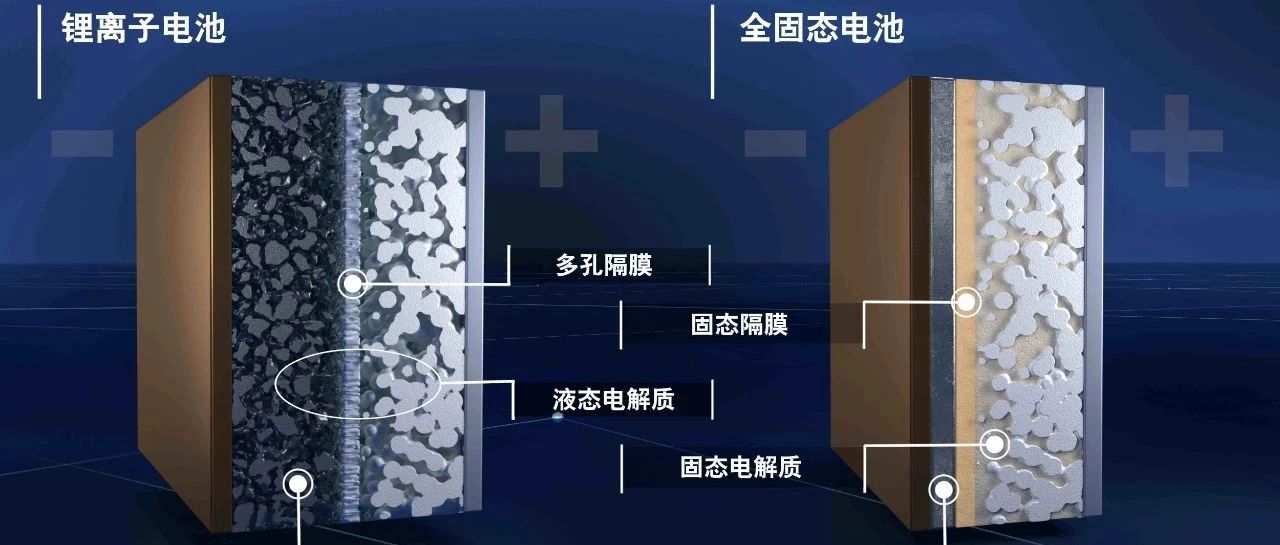
Core Viewpoint - The year 2026 is anticipated to be a breakthrough year for revolutionary technologies in the electric vehicle (EV) sector, particularly with the introduction of all-solid-state batteries by major automakers in China [1][2]. Group 1: All-Solid-State Battery Overview - Major Chinese automakers, including Changan, SAIC, GAC, Dongfeng, Geely, and Chery, have set 2026 as the target year for the deployment of all-solid-state batteries [2]. - All-solid-state batteries offer significantly higher energy density compared to traditional lithium batteries, with theoretical pure electric range reaching up to 2000 km [2][4]. - The non-flammable nature of the electrolyte in all-solid-state batteries eliminates the risk of thermal runaway and combustion [3][4]. Group 2: Industry Standards and Definitions - The China Society of Automotive Engineers has released the "All-Solid-State Battery Determination Method" (T/CSAE 434-2025), marking the first global standard defining what constitutes an all-solid-state battery [7][10]. - The standard aims to clarify the confusion between solid-state, semi-solid, and all-solid-state batteries, which has been a significant issue in the industry [11][10]. - The new standard specifies that the moisture content in the electrolyte of an all-solid-state battery must not exceed 1% [20]. Group 3: Technical Aspects and Testing - The testing method for determining all-solid-state batteries involves visual inspection for liquid leakage and a weight loss test under vacuum conditions [21][22][27]. - The method has been validated by over 50 companies, demonstrating a low error rate of less than 0.3% [27]. Group 4: Sulfide Electrolytes and Commercial Viability - Sulfide electrolytes are highlighted as the most commercially viable option for all-solid-state batteries, with several automakers announcing imminent production [35][38]. - Sulfide electrolytes exhibit high ionic conductivity, making them suitable for high charging rates and wide temperature ranges [38][41]. - The interface issue between the solid electrolyte and electrodes is a critical challenge that needs to be addressed for mass production [46]. Group 5: Challenges and Cost Considerations - Despite their advantages, sulfide solid-state batteries face challenges such as poor chemical stability and high production costs [52][67]. - The cost of materials, particularly germanium used in sulfide electrolytes, is significantly high, impacting overall battery production costs [68][70]. - Manufacturing processes for sulfide solid-state batteries require extremely dry conditions, leading to higher production costs compared to traditional batteries [74][76]. Group 6: Historical Context and Future Outlook - Japan initially led research in solid-state electrolytes but has fallen behind in commercializing these technologies due to a focus on hybrid and hydrogen fuel cell technologies [84][85]. - In contrast, Chinese battery manufacturers have made significant progress in the last decade, positioning themselves to lead in the all-solid-state battery market [87][88].
固态电池—未来能源的颠覆者,谁又是引领者?
雪球· 2025-06-12 07:51
Core Viewpoint - Solid-state batteries are regarded as the ultimate solution for next-generation batteries, with a commercial explosion expected between 2027 and 2030, potentially exceeding a global market size of 250 billion yuan, making it a key investment focus for investors [2]. Group 1: Technical Advantages of Solid-State Batteries - High safety due to the use of inert solid electrolytes, eliminating the flammability and explosion risks associated with traditional liquid batteries [3]. - Significant improvement in energy density, with examples like CATL's condensed battery reaching 500 Wh/kg, and future potential for even higher limits [4]. - Fast charging capabilities, with some technologies allowing for 80% charge in just 12 minutes, and cycle life reaching tens of thousands of times, far exceeding traditional batteries [4]. - Stability in extreme environments, operating between -40°C and 150°C, and supporting higher voltage cathode materials, suitable for applications in energy storage and aviation [5]. Group 2: Industry Advantages Driven by Policy and Market - Strong policy support from initiatives like the EU's "Battery 2030+" plan and China's "dual carbon" strategy, positioning solid-state batteries as a key development focus [6]. - Growing market demand in the electric vehicle and energy storage sectors, with expectations of double-digit growth in market size over the next five years. In Q1 2025, global investments in new solid-state battery projects exceeded 20 billion yuan, with a capacity planning of 50 GWh [7]. - Collaborative efforts across the entire industry chain, from materials to equipment and automotive companies, actively engaging in solid-state battery development [8]. Group 3: Competitive Landscape of Core Enterprises - CATL, as a global leader in lithium batteries, is at the forefront of sulfide and oxide solid-state battery technologies, planning to achieve mass production of all-solid-state batteries by 2027 [10]. - BYD leverages vertical integration and cost control advantages, aiming for demonstration vehicle deployment of all-solid-state batteries by 2027 and large-scale production by 2030 [11]. - Weilan New Energy (unlisted) has achieved mass production of semi-solid batteries for NIO vehicles and aims to capture 30% of the energy storage market by 2025 [12]. - Qingtao Energy (unlisted) has developed quasi-solid-state batteries with an energy density of 400 Wh/kg, achieving a production yield rate exceeding 95% [13]. Group 4: Impact of Solid-State Batteries on the Industry Chain - The transition to solid-state batteries is driving a restructuring of material systems, with a shift towards high-nickel ternary cathodes and lithium metal anodes, while sulfide electrolytes become core materials [15]. - New production equipment is required for solid-state battery manufacturing, such as dry electrode equipment and laser devices, creating a growth market for equipment manufacturers [16]. - Companies like Guoxuan High-Tech and Qingtao Energy are planning large-scale solid-state battery production, accelerating the industrialization process through collaboration [17]. Group 5: Challenges and Outlook - Technical challenges remain, including solid-solid interface impedance and lithium dendrite suppression, with actual energy density still lagging behind laboratory data [18]. - Initial high costs of all-solid-state batteries are expected to lead to a gradual market introduction of semi-solid forms, with a projected penetration rate of 10% for all-solid-state batteries by 2030 [19]. - The industry is anticipated to undergo price wars and comprehensive technical competition as technology matures and capacity is released, with 2027-2030 being a critical period for all-solid-state battery deployment [20].


固态电池—未来能源的颠覆者,谁又是引领者?
雪球· 2025-06-12 07:50
Core Viewpoint - Solid-state batteries are regarded as the ultimate solution for next-generation batteries, with a commercial explosion expected between 2027 and 2030, potentially exceeding a global market size of 250 billion yuan, making it a key investment focus in sectors like new energy vehicles, energy storage, and low-altitude economy [2] Group 1: Technical Advantages of Solid-State Batteries - High safety due to the use of inert solid electrolytes, eliminating the flammability and explosion risks associated with traditional liquid batteries [3] - Significant improvement in energy density, with examples like CATL's condensed battery reaching 500 Wh/kg, and future potential for even higher limits [4] - Fast charging capabilities, with some technologies allowing for 80% charge in just 12 minutes, and cycle life reaching tens of thousands of times, far exceeding traditional batteries [4] - Stability in extreme environments, operating between -40°C to 150°C, and supporting higher voltage cathode materials, suitable for applications in energy storage and aviation [5] Group 2: Industry Advantages Driven by Policy and Market - Strong policy support from initiatives like the EU's "Battery 2030+" plan and China's "dual carbon" strategy, positioning solid-state batteries as a key development focus [6] - Growing market demand in new energy vehicles and energy storage sectors, with expectations for double-digit growth in market size over the next five years; over 20 billion yuan invested in new solid-state battery projects in Q1 2025, with a capacity planning of 50 GWh [7] - Full industry chain engagement, with companies actively developing solid-state battery technologies, such as Rongbai Technology's ultra-high nickel cathode materials and Weilan New Energy's mass production of 280Ah energy storage cells [8] Group 3: Competitive Landscape of Core Enterprises - CATL, as a global leader in lithium batteries, is at the forefront of sulfide and oxide solid-state battery technologies, aiming for mass production by 2027 [10] - BYD leverages vertical integration and cost control, planning for demonstration vehicle deployment of solid-state batteries by 2027 and large-scale production by 2030 [11] - Weilan New Energy has achieved mass production of semi-solid batteries for NIO vehicles and aims for a 30% market share in energy storage by 2025 [12] - Qingtao Energy has developed quasi-solid-state batteries with an energy density of 400 Wh/kg, achieving a production yield rate exceeding 95% [13] Group 4: Impact of Solid-State Batteries on the Industry Chain - The material system is being restructured, with solid-state batteries driving the development of high-nickel ternary cathodes and lithium metal anodes, with sulfide electrolytes becoming core materials [15] - New equipment is required for solid-state battery production, such as dry electrode equipment and laser devices, creating a growth market for equipment manufacturers [16] - Companies like Guoxuan High-Tech and Qingtao Energy are planning large-scale solid-state battery production, accelerating the industrialization process through supply chain collaboration [17] Group 5: Challenges and Outlook - Technical bottlenecks remain, including solid-solid interface impedance and lithium dendrite suppression, with actual energy density still lagging behind laboratory data [18] - Initial high costs of all-solid-state batteries are expected to transition to semi-solid forms for market entry, with a projected 10% penetration rate for all-solid-state batteries by 2030 [19] - The industry is anticipated to undergo price wars and comprehensive technical competition as technology matures and capacity is released, with 2027-2030 being a critical period for all-solid-state battery deployment [20]

固态电池:驱动因素、市场现状、产业链及相关公司
材料汇· 2025-06-10 15:13
点击 最 下方 关注《材料汇》 , 点击"❤"和" "并分享 添加 小编微信 ,寻 志同道合 的你 正文 行业|深度|研究报告 2025年6月9日 固 态 电 池 行 业 深 度: 驱 动 因 素、 市场 现 状 、 产业链及相关公司深度梳理 随着全球能源转型加速和高性能电池需求增长,固态电池技术正成为新能源领域焦点。其凭借高能量密 度、卓越安全性和广阔应用前景,被视为下一代锂电池重要技术路线。近年来,固态电池应用场景从新 能源汽车拓展到低空经济、消费电子和人形机器人等领域,市场需求日益旺盛。同时,政策支持、技术 突破和产业链完善为其产业化发展提供了有力保障。然而,固态电池技术发展还面临诸多挑战,未来, 行业需着力攻克这些技术难题,推动固态电池迈向大规模商业化应用,从而进一步引领新能源产业的发 展潮流。 本报告将从行业概述、政策环境、技术路线、产业链分析、市场规模预测、相关公司等多个维度,全面 剖析固态电池行业的发展态势。通过对固态电池技术的深入研究,结合政策导向、市场需求以及企业布 局,我们旨在为读者呈现一个清晰、全面的固态电池行业全景图,以助力更好地把握行业脉络,洞察未 来发展方向。 目录 | 一、行业概 ...
H1新签约固态电池产能超50GWh,无人机、储能驱动加速
高工锂电· 2025-06-07 08:30
6月会议预告 2025高工钠电 产业峰会 会议地点: 苏州香格里拉大酒店(苏州虎丘区塔园路168号) 2025高工固态电池 技术与应用峰会 主办单位: 高工锂电、高工储能、高工产业研究院(GGII) 总冠名: 利元亨 会议时间: 6月10日 会议地点: 苏州香格里拉大酒店(苏州虎丘区塔园路168号) 2025 年以来,固态电池的商业化进程正从 远景 走向现实。其发展的加速,表现为市场需求与制 造技术两方面的共同驱动。 进程的拉力首先来自具体应用场景的落地。 无人机领域 正 成为一个 鲜明 的突破口, 海内外 多 家企业获得订单并实现交付 ,使其成为 固态 电池 企业 竞相争夺的 " 第一 口 蛋糕 " 。 主办单位: 高工钠电、高工产业研究院(GGII) 总冠名: 众钠能源 会议时间: 6月9日 2024 年,公司参与的浙江龙泉半固态磷酸铁锂储能电站项目,成为全球首套采用原位固态化电池 的电网侧大规模储能电站。自 2022 年推出 HyperSafe 系列固态电池储能系统以来,海博思创 持续推动该技术在储能领域的商业化进程。 同时,应用于机器人、 eVTOL 及储能电站的 固态电池 产品,也从 反复的 实测验 ...

清陶能源、山东创鲁等4个固态电池项目加速落地
鑫椤锂电· 2025-05-29 08:03
-广告- 关注公众号,点击公众号主页右上角" ··· ",设置星标 "⭐" ,关注 鑫椤锂电 资讯~ 本文来源:综合报道 近日,清陶能源、山东创鲁等4个固态电池项目相继传来新进展。 清陶15GWh固态电池项目开启审批 5月26日,成都市郫都生态环境局发布公示,拟对清陶固态电池西南产业基地项目环境影响评价文件作 出审批意见。 该项目由成都清陶新能源科技有限公司投资建设,位于成都市郫都区友爱镇弥陀村及何家场社区,总投 资45亿元,其中环保投资6300万元,占比1.4%。 项目选址于郫都区工业港新经济产业园,规划建筑面积约41.77万平方米,涵盖电芯制造中心、PACK 制造中心及固态锂电池储能技术研发中心,拟配备电极制造、装配、检测及PACK等设备约1452台 套,力争实现15GWh固态电池及系统的年产能目标。 2022年6月,清陶能源与成都市郫都区达成投资意向,规划布局固态电池储能产业基地,计划分两期 建设。一期工厂面积约2万平方米,首条生产线设计产能为1GWh。2023年2月,项目正式签约落地, 总投资达100亿元。 山东创鲁成立于2020年,注册资本约2.16亿元,位于山东省济南市,专注于锂电池的研发与制造, ...
三大固态电池项目最新进展
DT新材料· 2025-05-28 15:00
Group 1 - The solid-state battery sector is experiencing significant advancements with three major projects recently announced [2][3][4] - The Qingtao Energy project in Chengdu aims for an annual production capacity of 15GWh, with a total investment of 45 billion yuan [2] - The Suining New Quality Transportation Intelligent Manufacturing Industrial Park project in Sichuan has a total investment of 52 billion yuan and will enhance the local lithium battery industry chain [3] Group 2 - The Shandong Dayao Special Materials project has been approved for the production of high-purity lithium sulfide solid-state battery materials, with a total investment of approximately 220 million yuan [4] - The project will be constructed in two phases, with the first phase expected to start in May 2025 and achieve an annual production capacity of 13,000 tons [4] - The second phase will add 63 sets of equipment, also targeting an annual production capacity of 13,000 tons, leading to a total capacity of 26,000 tons [4] Group 3 - The 2025 Solid-State Battery Conference and Silicon-Based Anode Innovation Conference is scheduled for July 3-5 in Ningbo, Zhejiang [7][8] - The conference will cover topics such as the industrialization and application status of solid-state batteries, advancements in solid-state sodium batteries, and key material development [7]