ASML

Search documents
2026-2032年DDR4内存颗粒行业专项研究及投资战略咨询报告
Xin Lang Cai Jing· 2025-12-09 13:41
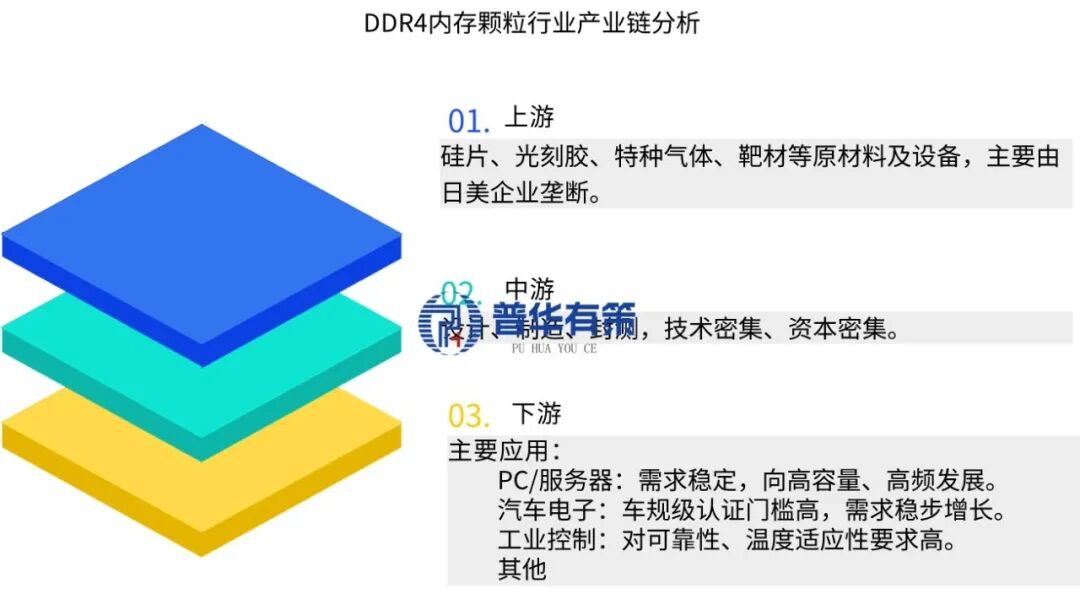
Core Insights - The DDR4 memory chip industry is facing challenges due to the rise of DDR5 technology, which is expected to dominate high-end markets, while DDR4 will retreat to mid-low-end and specific legacy markets [6][22][27] - Despite the decline in traditional PC and server markets, emerging applications such as AI edge computing and smart vehicles are creating new, differentiated long-tail demand for DDR4 [6][22][25] Industry Overview - DDR4 memory chips are critical components in computers, servers, and various electronic devices, directly influencing system performance through their specifications such as frequency, capacity, and power consumption [1][6] - The DDR4 industry is characterized by a high degree of technological barriers, with upstream suppliers primarily from Japan, the US, and the Netherlands, leading to a concentrated market structure [3][19] Supply Chain Analysis - Upstream components include silicon wafers, photoresists, specialty gases, and semiconductor manufacturing equipment, which are crucial for the production of DDR4 chips [3][19] - Downstream applications for DDR4 are diverse, including servers, personal computers, industrial control, automotive electronics, and consumer electronics, each with varying performance and reliability requirements [3][19] Policy Environment - The industry is influenced by various policies, including China's "14th Five-Year Plan" which emphasizes self-sufficiency in semiconductor manufacturing and aims to increase the domestic production rate of DRAM [4][20] Development Trends - The market is expected to shift from general growth to structural differentiation, with DDR4 maintaining a long-tail demand cycle of 5-8 years in low-end consumer electronics and traditional industrial control [6][22] - The focus for DDR4 technology will shift towards optimizing existing processes rather than pursuing new nodes, emphasizing reliability and specific application adaptations [6][23] Domestic Industry Restructuring - The Chinese DDR4 industry is undergoing a restructuring process driven by the need for self-sufficiency, with a focus on localizing materials and equipment supply chains [6][24] - Geopolitical risks are accelerating the push for domestic DDR4 chip penetration in critical infrastructure and industrial sectors [6][24] Emerging Applications - The rise of AI and IoT is creating unexpected opportunities for DDR4, particularly in edge devices where cost, power consumption, and reliability are more critical than peak performance [6][25] - The demand for low-power DDR4 (LPDDR4) is expected to grow in mobile devices and energy-sensitive data centers, aligning with global sustainability goals [6][26] Market Outlook - The DDR4 market is projected to experience a decline in the long term due to the encroachment of DDR5, but short-term demand is supported by existing inventory and specific market needs [6][27] - The competitive landscape is shifting, with international giants focusing on DDR5 while domestic players target mid-low-end markets [6][27]

Here’s What Drove Shopify’s (SHOP) Strong Performance
Yahoo Finance· 2025-12-09 12:43
Group 1: Polen International Growth Strategy Performance - The Polen International Growth Strategy returned -4.23% gross and -4.53% net of fees in Q3 2025, underperforming the MSCI ACWI (ex-USA) which gained 6.89% [1] - The strategy's concentrated approach to quality investing did not match the index performance during the quarter [1] Group 2: Shopify Inc. Performance - Shopify Inc. (NASDAQ:SHOP) had a one-month return of -0.33% and a 52-week gain of 39.63%, closing at $158.41 per share with a market capitalization of $206.225 billion on December 08, 2025 [2] - Shopify was the top contributor to both relative and absolute performance in the Polen portfolio for Q3 2025, showcasing strong results with accelerating revenue and gross merchandise volume growth [3] - Shopify's revenue increased by 32% year-over-year in Q3 2025, with 91 hedge fund portfolios holding its stock at the end of the quarter, up from 69 in the previous quarter [4]

MKS Instruments (NasdaqGS:MKSI) FY Conference Transcript
2025-12-09 12:02
Summary of MKS Instruments FY Conference Call Company Overview - **Company**: MKS Instruments (NasdaqGS: MKSI) - **Industry**: Semiconductor Equipment and Advanced Electronics - **History**: Founded 65 years ago, initially focused on vacuum pressure measurement, expanded into semiconductor equipment, and has maintained a leading market share in vacuum equipment for semiconductors for over 55 years [2][56] Key Points and Arguments Market Position and Strategy - MKS has developed a comprehensive strategy surrounding semiconductor equipment, acquiring Newport Corporation in 2015, which added critical components like lithography, metrology, and inspection, allowing MKS to address 85% of equipment in semiconductor fabs globally [3][56] - The company has expanded into new markets, including laser applications for PCB manufacturing through acquisitions like Electro Scientific Industries and Atotech, aiming to be foundational to advanced electronics beyond just semiconductors [4][57] Growth Drivers - **Electronics and Packaging (E&P)**: MKS expects about 20% growth for the full year, driven by strong demand for chemistry products in the PCB industry, particularly from AI applications [8][61] - **Chemistry and Equipment**: The E&P segment consists of two-thirds chemistry and one-third equipment, with chemistry growing at approximately 10% year-over-year, supported by increased complexity in AI server PCBs [12][65] - **Equipment Orders**: MKS has seen strong bookings for chemistry equipment, with orders booked through the first half of 2026, indicating robust growth potential [16][69] Financial Performance - **Gross Margins**: Current gross margins are impacted by a mix of equipment sales and tariffs, with a target to return to over 47% as the mix normalizes and operational efficiencies improve [19][71] - **Tariff Impact**: Tariffs have negatively affected gross margins by approximately 50 basis points, but MKS is confident in offsetting this through operational excellence [36][71] Semiconductor Market Outlook - MKS anticipates a 10% growth in the semiconductor segment for the year, driven by inventory burn-off in NAND and upgrades in logic, DRAM, and HBM [22][75] - The company is addressing concerns about cleanroom capacity, which could constrain growth, but sees potential upside from NAND upgrades and new greenfield projects [26][78] R&D and Competitive Advantage - MKS emphasizes the importance of R&D investment to maintain a competitive edge, particularly in complex technologies like atomic layer deposition (ALD) and RF power systems [28][32] - The company has doubled its revenue in the optics segment from $150 million to $300 million over five years, indicating successful growth in this area [20][72] Future Expectations - MKS is optimistic about 2026, expecting continued growth driven by strong demand across various semiconductor applications, with a focus on maintaining close communication with major customers to anticipate needs [24][77] - The company aims to achieve a net leverage of 2 to 2.5 times in the next couple of years, focusing on debt repayment and capital allocation strategies [42][43] Additional Important Insights - MKS's unique position in the market allows it to benefit from various semiconductor trends, including the shift towards more complex chip packaging and the integration of AI technologies [5][6] - The company’s strategy of managing a broad portfolio of critical subsystems positions it well to adapt to changing market demands and technological advancements [30][31]

Broadcom (AVGO) Forecast: AI Revenue Beyond This Year’s 50–60% Surge
Yahoo Finance· 2025-12-05 13:35
分组1 - Harding Loevner's Global Equity Strategy reported a gross return of 2.62% and a net return of 2.52% for Q3 2025, underperforming the MSCI All Country World Index and MSCI World Index, which returned 7.74% and 7.36% respectively [1] - Year-to-date, the strategy rose 10.61% net, compared to 18.86% and 17.83% for the indexes, indicating a significant gap in performance [1] - The last six months have been characterized as one of the strongest momentum phases in over 70 years, with high-momentum stocks outperforming low-momentum stocks by 45 percentage points, largely driven by advancements in AI [1] 分组2 - Broadcom Inc. (NASDAQ:AVGO) was highlighted as a key stock, with a one-month return of 9.04% and a 52-week gain of 112.24%, closing at $381.03 per share with a market capitalization of $1.799 trillion [2] - In the third quarter of 2025, Broadcom reported record revenue of $16 billion, reflecting a 22% year-over-year increase [4] - The company raised its outlook for the next year, predicting that AI revenue growth will accelerate from the current rate of 50-60%, indicating a positive growth trajectory [3]

Why Policy Goals Will Make 2026 a Breakout Year for IONQ, RGTI, QBTS
ZACKS· 2025-12-02 21:01
Core Insights - The National Quantum Initiative (NQI) has seen a significant increase in federal investment, with approximately $1 billion allocated annually for quantum information science in FY 2025, up from about $456 million in 2019 [1][3] - The upcoming reauthorization of the NQI for 2025-2029 is expected to further enhance funding, with proposals of $1.8 billion from the House and $2.7 billion from the Senate, focusing on applied projects and public-private partnerships [3][9] - Companies like IonQ, Rigetti, and D-Wave are benefiting from government contracts, which are crucial for their growth narratives despite their current low revenues and operating losses [4][6] Federal Investment and Support - Federal agencies are collectively investing around $1 billion annually in quantum information science, indicating a strategic focus on this technology [1] - The NQI reauthorization plans aim to scale funding significantly, with the House proposing $1.8 billion and the Senate proposing $2.7 billion over five years [3] - DARPA's selection of quantum firms for contracts signals government confidence in their technologies, which can represent a substantial portion of these companies' revenues [4][5] Market Dynamics and Valuations - Despite being in early stages with low revenues, quantum companies have seen their valuations rise, largely driven by expectations of government spending rather than immediate commercial demand [6][9] - Defense contracts, even in the range of $5-10 million, can significantly impact stock prices, highlighting the importance of government as a primary customer for quantum technologies [7][9] Investment Strategy and Future Outlook - Investors should focus on policy and procurement as key factors in valuing quantum companies, rather than traditional product cycles [13][16] - The recent example of xLight illustrates the potential for government equity-like investments in critical technology sectors, which could extend to quantum firms [11][17] - The trajectory of quantum stocks will be influenced more by government funding and support than by the timing of technology mainstreaming [18][19]



光刻机概念午后崛起,华融化学20%涨停,容大感光等大涨
Zheng Quan Shi Bao Wang· 2025-12-01 07:19
Core Viewpoint - The domestic photolithography machine sector is experiencing significant growth, driven by increasing localization efforts and technological advancements in China [1] Group 1: Market Performance - Photolithography-related stocks surged, with Huarong Chemical hitting a 20% limit up, Rongda Photosensitive rising nearly 18%, and several other companies also reaching their daily limits [1] - The overall market sentiment indicates strong investor confidence in the photolithography industry [1] Group 2: Industry Development - The localization rate of photolithography machines in China was less than 1% in 2022, marking it as the lowest among semiconductor equipment segments [1] - Under the support of the 02 Special Project and policy guidance, domestic companies in the photolithography machine and component sectors are making significant progress [1] - Key milestones include the shipment of the 90nm ArF photolithography machine by Shanghai Microelectronics in 2016, the mass production of dual-stage worktables by Huazhuo Precision in 2020, and the successful development of a 13.5nm EUV light source by Harbin Institute of Technology in 2025 [1] - These advancements indicate an acceleration in the iteration of domestic photolithography machines and core components, with expectations for continued improvement in the overall capabilities of the domestic supply chain [1]

中国晶圆厂设备进口追踪(2025 年 10 月)-10 月累计同比增长 7%_ China WFE Import Tracker (Oct 2025)_ Oct YTD YoY +7%
2025-12-01 00:49
Summary of Key Points from the Conference Call on Global Semiconductor Capital Equipment Industry Overview - The focus is on the **Wafer Fabrication Equipment (WFE)** market, particularly imports to **China**. - The data indicates a **year-to-date (YTD)** increase of **7%** in WFE imports to China as of October 2025, reflecting strong demand in the region [2][34]. Import Data Highlights - **October 2025** WFE imports to China totaled **USD 3.23 billion**, showing a **month-over-month (MoM)** decrease of **35%** but a **year-over-year (YoY)** increase of **11%** [2][23]. - The **YTD total** for WFE imports reached **USD 32.2 billion**, maintaining a **YoY growth of 7%** [24]. - The largest segment of imports in October was **Lithography**, accounting for **USD 1.03 billion** (32% of total imports), with a **YoY increase of 90%** [24][57]. Equipment Type Performance - **Lithography**: MoM decrease of **25%**, YTD YoY decrease of **10%** [3][24]. - **Deposition**: MoM decrease of **42%**, YTD YoY increase of **13%** [3][24]. - **Dry Etch**: MoM decrease of **27%**, YTD YoY increase of **58%** [3][24]. - **Process Control**: MoM decrease of **66%**, YTD YoY increase of **11%** [3][24]. Regional Insights - The share of imports from **US, Malaysia, and Singapore** increased to **38%** YTD, up from **33%** last year, while Japan's share decreased to **23%** from **26%** [3][42]. - **Shanghai** and **Guangdong** accounted for **58%** of total imports YTD [3]. Company-Specific Insights - **ASML**: Expected to see **China sales** reach **EUR 2.55 billion** in Q4, up **9% sequentially** and **33% YoY**, driven by strong lithography imports [4][68]. - **LRCX**: Anticipated **China revenues** to decrease by **28% QoQ** in December, with China exposure at **32%** of total revenues [5][87]. - **AMAT**: Reported a **23% QoQ decline** in China revenues, with actual exposure at **29%**, lower than regression estimates [6][90]. - **TEL**: Projected a **17% YoY decline** in China revenue [8]. - **Screen**: Expected a significant **84% YoY decline** in China revenue [9]. Investment Implications - **NAURA**: Rated **Outperform** with a target price of **CNY 480.00**, benefiting from domestic WFE substitution in China [12]. - **AMEC**: Rated **Outperform** with a target price of **CNY 380.00**, recognized for its technology and market share gains [13]. - **Piotech**: Rated **Outperform** with a target price of **CNY 375.00**, noted for product innovation [14]. - **Tokyo Electron**: Rated **Outperform** with a target price of **¥39,400**, expected to gain market share [15]. - **Advantest**: Rated **Market-Perform** with a target price of **¥20,400**, benefiting from increased testing intensity [16]. Conclusion - The WFE market in China shows robust demand despite some month-over-month declines, with significant implications for major players in the semiconductor equipment sector. The data suggests a complex landscape with varying performance across different equipment types and companies, highlighting both opportunities and challenges in the market.



半导体基石系列之六:AI重塑Capex预期,国产链迎来新起点
Changjiang Securities· 2025-11-29 09:08
Investment Rating - The report gives a "Positive" investment rating for the semiconductor industry, marking it as the first rating of its kind [11]. Core Insights - Since early 2025, the semiconductor sector has experienced a surge driven by AI, followed by a brief adjustment period due to geopolitical tensions, slowing AI technology iterations, and macroeconomic uncertainties, leading to weakened growth expectations [4][19]. - The demand for inference computing power has rapidly increased with the proliferation of generative AI and large models, alongside strengthened localization strategies, resulting in a sustained rise in the prosperity of semiconductor hardware resources, particularly AI chips and storage chips [4][19]. - The valuation of the semiconductor sector has significantly recovered under the influence of AI, with the dynamic price-to-earnings ratios for semiconductor equipment and materials currently at the 85.2% and 95.9% percentiles, respectively [7][19]. - The report emphasizes the importance of the domestic AI industry chain upgrade logic, suggesting that the deep integration of technology and applications is expected to create greater commercial value and accelerate industry growth [4][19]. Industry Overview - The global demand for semiconductors is driven by AI, with structural opportunities emerging domestically [8][29]. - In the first three quarters of 2025, revenue growth rates for major semiconductor equipment companies such as ASML, AMAT, LAM, TEL, and KLA were 20.8%, 3.6%, 28.6%, 10.0%, and 21.6%, respectively, indicating a continuation of a positive growth trend [8][29]. - The demand for storage devices has notably rebounded, with significant revenue growth in storage business segments for these companies [29]. - The report forecasts that global capital expenditures for 300mm wafer fab equipment will increase from $100 billion in 2025 to $138 billion in 2028, driven by AI computing clusters and advanced packaging demands [8][47]. Company-Specific Insights - In the equipment sector, companies with a high proportion of storage equipment, such as Tuojing Technology and Zhongwei Company, are expected to benefit from the expansion trend due to strong demand for storage chips [9]. - Long-term growth is anticipated for platform companies like North Huachuang, which have a significant leading advantage in the domestic market and can quickly strengthen their capabilities through mergers and acquisitions [9]. - In the materials sector, companies like Anji Technology and Xingfu Electronics have successfully achieved product substitution in the domestic market and are expected to further expand into overseas markets [9]. Market Demand - The report highlights a shift in market demand, with AI's share of semiconductor demand increasing significantly [29][55]. - AI semiconductor demand is projected to grow rapidly, with AMD estimating that the total market size for AI data centers will increase from $200 billion in 2025 to over $1 trillion by 2030, reflecting a compound annual growth rate of over 40% [55][62]. Future Outlook - The semiconductor industry is expected to see a structural expansion in demand, particularly in AI data centers, which will significantly drive the need for advanced memory technologies like HBM [55][59]. - The report notes that the transition to HBM4 technology will begin in 2026, further increasing the demand for wafers and memory capacity in AI servers [59].
Stock Market Today: Dow Positive For November, But Nvidia Slides; Delayed Inflation Data Looms (Live Coverage)
Investors· 2025-11-28 19:08
Group 1 - The Dow Jones Industrial Average and other major indexes showed an upward trend early on Black Friday before a trading halt occurred at CME [1] - Alphabet (GOOGL) continued to lead the market, while Nvidia (NVDA), Tesla (TSLA), Robinhood Markets (HOOD), and GE Vernova (GEV) aimed to regain key support levels [1] - China's DeepSeek released a new open-source AI model, which impacted Nvidia's stock negatively in early 2025 [2] Group 2 - The stock market experienced a rally with significant gains for companies like Google, Broadcom, and Kohl's [4] - Tesla launched a free trial for its Full Self-Driving (FSD) version 14 in North America, indicating a push in its autonomous vehicle technology [4] - The Dow Jones signaled further gains post-holiday, with ASML leading five stocks that flashed buy signals [4]





CME Group outage hits U.S. futures trading
Youtube· 2025-11-28 08:15
Market Overview - US markets are facing a futures trading outage due to a cooling issue at CME Group, impacting equities, treasuries, and commodities trading [2][4] - November has been a volatile month for equities, with significant moves in European tech, healthcare, and defense sectors, as fears of an AI bubble have emerged [5][6] - The European stock market managed to achieve gains in November, marking the fifth consecutive positive month for the stock 600 index [6] Sector Performance - The healthcare sector performed best in November, with notable gains from companies like Roche and Bayer, driven by strong trial data [6][7] - Roche's stock rose nearly 20% after a successful breast cancer drug trial, while Bayer had its best day since 2009 due to an anticoagulant drug study [7] - Conversely, tech stocks faced declines, with ASML down over 15% amid a broader selloff in AI-related stocks [8] AI and Investment Outlook - AI is expected to remain a structural growth theme through 2026, although concerns about overinvestment and electricity shortages could temper expectations [10][15] - Investment in data centers and the entire AI value chain is crucial, with approximately 35% of S&P 500 earnings being allocated to this area [14] - The market is anticipated to experience volatility in AI trends, but setbacks may present buying opportunities [15] Economic and Fiscal Policy - The US economy is projected to benefit from fiscal policies and central bank rate cuts, which are generally positive for market conditions [18][22] - Germany's growth forecast for 2026 is estimated at 1.3% to 1.5%, with expectations of improved market sentiment if fiscal policies are effectively implemented [27][30] Emerging Markets - The Indian stock market is showing strong growth potential, while China's growth is cooling but remains above 4% [43] - Asia is expected to attract substantial investment, with potential for better performance than Europe and the US in the coming year [45] Gold Market - Gold prices are forecasted to rise to $4,500, driven by demand from central banks and retail investors, as well as concerns over currency diversification [40][41]