
Advantest

Search documents
半导体_SPE_从 SPE 制造商视角看中国晶圆厂设备(WFE)前景-Semiconductor_SPE_ Chinese WFE outlook from SPE manufacturers‘ perspective
2025-08-31 16:21
Summary of J.P. Morgan Semiconductor/SPE Conference Call Industry Overview - The focus is on the semiconductor production equipment (SPE) industry, particularly regarding the wafer fabrication equipment (WFE) market in China. - The outlook for WFE demand in China for calendar year 2025 is expected to show flat to single-digit growth year-over-year, which is more optimistic than the broader market expectations [1]. Key Insights - **Local SPE Growth**: The rise of local SPE manufacturers in China is gradually progressing, impacting non-Chinese SPEs depending on the type of equipment [1]. - **Demand Consistency**: There is a lack of strong consensus among SPE manufacturers regarding the outlook for Chinese demand, likely due to varying competitive environments across different equipment types [1]. - **Front-End Companies**: Demand from front-end companies in China has not declined as much as previously anticipated, indicating resilience in the market [1]. - **Investment Expectations**: Major players' investments, particularly in NAND technology, are expected to remain solid, with strong demand anticipated in areas with high exposure to major players and less competition from local SPEs [1]. Company-Specific Insights - **Disco (6146)**: Sales to China accounted for 30% of total sales in April–June, up 3 percentage points quarter-over-quarter. Memory demand from China has been robust since last year, although shipments have stabilized somewhat [5]. - **ULVAC (6728)**: Sales to China represented 34% of total sales in FY6/25, down 1 percentage point year-over-year. The company anticipates a recovery in investments in 8-inch SiC from major device manufacturers [5]. - **Advantest (6857)**: Sales to China accounted for 15% of total sales in April–June, down 4 percentage points quarter-over-quarter. The company aims to increase market share in high-end testing systems despite local competition in low-end products [5]. - **SCREEN Holdings (7735)**: Sales to China accounted for 33% of April–June SPE sales, down 5 percentage points quarter-over-quarter. The company expects demand growth for DRAM and anticipates a sales weighting of 54% in July–September [5]. - **Tokyo Electron (8035)**: Sales to China accounted for 39% of total sales in April–June, up 5 percentage points quarter-over-quarter. The company revised down its FY2025 guidance due to cautious investment from emerging manufacturers in legacy nodes [6]. - **Kokusai Electric (6525)**: Sales to China accounted for 45% of total sales in April–June, remaining flat quarter-over-quarter. The company expects demand growth in NAND technology to continue until FY2026 [6]. - **Applied Materials (AMAT)**: Sales to China accounted for 35% of total sales in May–July, down 8 percentage points quarter-over-quarter. The company expects a decline in China sales weighting due to uncertainties [8]. - **ASML**: The China sales weighting was 27% in April–June, remaining flat quarter-over-quarter, with healthy demand expected [8]. - **Lam Research (LRCX)**: Sales to China accounted for 35% of total sales in April–June, up 4 percentage points quarter-over-quarter, driven by investments in leading-edge processes [8]. - **KLA (KLAC)**: Sales to China accounted for 30% of total sales in April–June, up 4 percentage points quarter-over-quarter. The company anticipates a lean period for Chinese investments in CY2025 and CY2026 [8]. - **Teradyne (TER)**: Sales to China accounted for 16% of total sales in April–June, down 3 percentage points quarter-over-quarter, affected by export restrictions [8]. Additional Observations - The competitive landscape is evolving, with local manufacturers gaining strength in memory and power applications, although they currently do not pose a significant threat in advanced technology areas [5][6]. - The overall sentiment indicates cautious optimism regarding the Chinese semiconductor market, with expectations of continued investment and demand growth in specific segments [1][6].
亚洲芯片股走低 此前英伟达公布的营收展望平淡
Xin Lang Cai Jing· 2025-08-28 00:52
Group 1 - Asian chip stocks experienced a decline in early trading on August 28, with notable drops in the South Korean market [1] - SK Hynix fell by 2.7%, Samsung decreased by 1%, Hanmi Semiconductor dropped by 2.8%, Wonik IPS declined by 1.5%, and DB HiTek was down by 0.9% [1] - In the Japanese market, Advantest saw a decrease of 3.6%, Lasertec fell by 2.5%, and Disco dropped by 2.4% [1]

全球半导体资本设备:中国 7 月进口追踪(2025 年 7 月),年度月度新高,需求仍具韧性,年初至今进口增长 2%
2025-08-25 01:39
Summary of Key Points from the Conference Call Industry Overview - The conference call focuses on the **Global Semiconductor Capital Equipment** industry, specifically the **Wafer Fabrication Equipment (WFE)** imports to China for July 2025, which reached a record high for the year at **USD 3,761 million**, reflecting a **10% year-over-year (YoY)** and **11% month-over-month (MoM)** increase, with year-to-date (YTD) imports up **2% YoY** [2][27][26]. Core Insights and Arguments - **Dry Etch Segment Performance**: The Dry Etch segment showed significant growth, with imports totaling **USD 755 million**, marking a **30% MoM** and **232% YoY** increase. Notably, imports from Malaysia nearly doubled MoM to **USD 300 million** [3][28]. - **Lithography Weakness**: The Lithography segment continues to exhibit weakness, potentially indicating a normalization after previous strong demand. However, fluctuations suggest that this may be temporary, with expectations for a rebound in the second half of 2025 [3][34]. - **Regional Import Dynamics**: The import share by region indicates that the U.S. and Singapore combined account for **42%**, while Japan's share has decreased to **22%** from an average of **26%** last year. This decline is attributed to the lack of favorable foreign exchange conditions for Japanese vendors and a shift in purchasing priorities towards U.S. equipment [4][39]. - **Provincial Import Trends**: The largest buyers of WFE have shifted from Guangdong (21%) to Shanghai (32%) in July, suggesting a potential for sustained strength in these regions into the second half of 2025 and beyond [5][27]. Company-Specific Insights - **ASML**: Projected sales in China for Q3CY25 are estimated at **EUR 1.51 billion**, reflecting a **46% YoY decline** but flat compared to the previous quarter. The monthly import data is noted to be quite variable [6][65]. - **LRCX (Lam Research)**: Expected to see a **14% QoQ increase** in China revenues for the September quarter, with China exposure estimated to be in the high 30s percentage of total revenues [7][81]. - **AMAT (Applied Materials)**: Reported a **44% QoQ increase** in China revenues, aligning with regression analysis predictions of a **53% increase** [8][90]. - **Kokusai**: Anticipated to see a **41% YoY** and **37% QoQ increase** in China revenue, with a significant contribution expected in the September quarter [12]. - **Advantest**: Projected to experience a **38% YoY** and **32% QoQ decline** in China revenue, indicating potential challenges ahead [13]. Additional Important Insights - **Market Dynamics**: The overall WFE market in China is becoming increasingly significant, with global vendors still capturing approximately **84%** of the market share in 2024. The data on imports provides critical insights into demand trends [23]. - **Investment Implications**: Companies like NAURA, AMEC, and Piotech are positioned favorably due to their broad product portfolios and domestic market leadership, benefiting from the ongoing WFE domestic substitution in China [15][16][17]. - **Long-term Outlook**: The overall sentiment suggests that while there may be short-term fluctuations, the long-term growth trajectory for the WFE market in China remains positive, driven by domestic demand and technological advancements [20][22]. This summary encapsulates the key points discussed in the conference call, highlighting the current state and future outlook of the semiconductor capital equipment industry, particularly in relation to WFE imports to China.





芯片设备公司,冰火两重天
半导体行业观察· 2025-08-19 01:24
Core Insights - The profitability of top chip equipment manufacturers is diverging, with some losing momentum due to declining sales in China, while others are capitalizing on the demand for AI chips [2][5] - Among ten manufacturers from Japan, the US, and Europe, five reported a year-on-year decline in net profit or lower growth compared to the previous year [2] - The combined net profit of these manufacturers has remained robust, growing approximately 40% for the fifth consecutive quarter, reaching $9.4 billion [2] Group 1: Company Performance - Lam Research's net profit surged by 69%, driven by strong sales of deposition and etching equipment for high-bandwidth memory and advanced logic chips [2] - KLA's net profit increased by 44%, benefiting from growth in inspection and measurement equipment for advanced packaging [2] - ASML Holding, ASM International, and Advantest also reported higher profit growth compared to the same period in 2024 [2] Group 2: Challenges Faced - Tokyo Electron, Screen Holdings, and Teradyne experienced declines in net profit after significant growth of over 50% to 90% in the previous year [5] - A major factor for the decline is the slowdown in sales to China, with nine companies reporting a combined sales drop of 5% to $9.3 billion, accounting for 30% of total sales, down from approximately 40% at the end of 2023 [5] - Tokyo Electron's sales from China accounted for 39%, a decrease of 11 percentage points from the previous year, and growth in its Taiwan business could not compensate for this loss [5] Group 3: Market Outlook - Despite the challenges, five US and European companies expect sales growth in the upcoming quarter, with four Japanese companies also projected to achieve revenue growth [6] - The industry faces uncertainty as Washington considers imposing new semiconductor tariffs and restricting AI semiconductor exports [6] - The total market capitalization of the top ten semiconductor equipment manufacturers is approximately $910 billion, down about 20% from the latest peak in July 2024 [7]


日本股市牛市重燃,交易员左手加码AI、右手买回汽车
第一财经· 2025-08-13 05:01
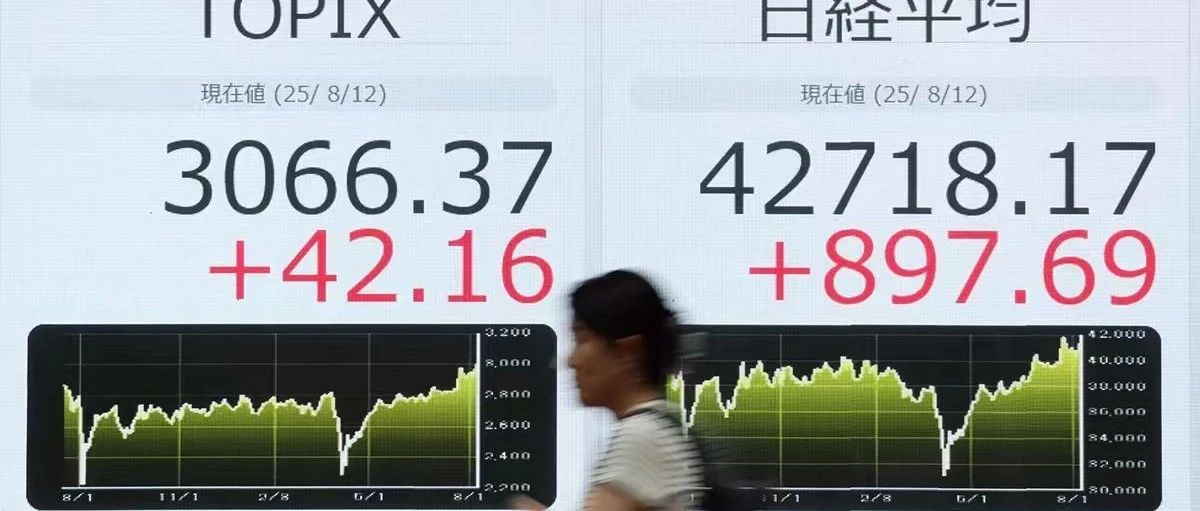
2025.08. 13 本文字数:2484,阅读时长大约4分钟 作者 | 第一财经 周艾琳 前有关税大棒,后有日本首相石破茂在参议院选举的历史性惨败,日本股市近期竟然连续刷新历史新 高,涨势之凌厉让一众机构投资人瞠目。 8月12日,日经225指数收盘上涨约2.2%,创下历史新高,最高曾触及约42999点,最终收于约 42718点;东证指数(TOPIX)同步走强,上涨约1.4%至3066~3067点,也刷新历史高位。这也意味 着日本股市"四日连涨",带动在中国境内上市的跨境日本股市ETF飙升,日经225ETF(513880)自8 月4日来的7个交易日大涨近6%,净值为1.484。 事实上,业内并未料到日本股市能如此强劲。资深全球宏观基金经理袁玉玮对第一财经记者表示,这波 反弹可能主要有三个原因——美、日关税低于预期,整体刺激日本资产;同由科技巨头驱动的美股牛市 类似,日本聚集了很多AI芯片产业链,比如美国的Stargate(星际之门)是软银(权重股)主导,而日 本的半导体设备龙头Advantest亦受益于美日AI产业链和市场情绪的联动;此外,日本军工支出在加 大,而且为澳大利亚生产军备,四方安全对话合作伙伴关系 ...
史上首次升破43000点,日经225指数再创新高
Feng Huang Wang· 2025-08-13 02:30
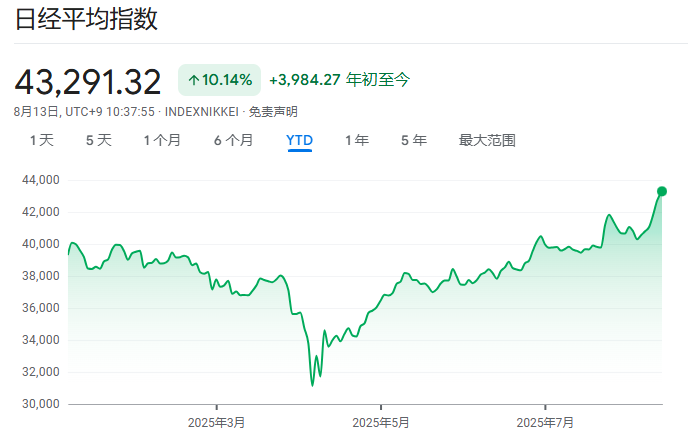
Core Viewpoint - The Nikkei 225 index has reached a historic high, surpassing 43,000 points for the first time, driven by optimism over trade and expectations of interest rate cuts in the U.S. [1][4] Group 1: Market Performance - The Nikkei 225 index opened with a jump of over 1% and reached a peak of 43,289.20 points during the day, marking a new historical high [1] - The index has recorded five consecutive days of gains, reflecting a recovery from previous concerns over tariffs and interest rates [4] - The Tokyo Stock Exchange index also hit a record high, with an increase of 0.8% to 3,092.05 points [1] Group 2: Trade Agreements and Economic Factors - The rise in the Nikkei 225 is attributed to a partial consensus on the execution of a trade agreement between Japan and the U.S., which was reached on July 22 [4] - The U.S. has agreed to amend an executive order regarding tariffs, allowing for a lower effective tax rate for Japanese goods [5] - Analysts suggest that the easing of tariff impacts has contributed to the positive performance of Japanese stocks [4][5] Group 3: Sector Performance - The electronics and automotive sectors led the gains, with Advantest rising by 3.5% and Subaru increasing by 2.2% [4] - The Nikkei 225 index primarily focuses on export-oriented companies, particularly in the automotive and technology sectors [6] Group 4: Market Sentiment and Future Outlook - Analysts express optimism about the potential for further increases in the Nikkei 225, citing improved clarity on tariffs and positive corporate outlooks [7] - The weak yen is seen as a favorable factor for Japanese companies, potentially enhancing their competitiveness [7] - Despite the recent rapid gains, there are indications that the market may be overheating, suggesting caution moving forward [8]
日股再创纪录新高,日经225指数首破43,000点
Sou Hu Cai Jing· 2025-08-13 00:33
Core Viewpoint - US inflation is lower than expected, maintaining market expectations for a Federal Reserve interest rate cut, while Japanese stock markets follow the rise of US stocks [1] Group 1: Market Performance - The Nikkei 225 index rose by 1.2% in the first few minutes of trading, surpassing the 43,000-point mark for the first time in history, reaching a high of 43,241.27 points [1] - The Topix index also hit a record high, with an intraday increase of 0.8%, reaching 3,092.05 points [1] Group 2: Sector Performance - Electronic and automotive stocks led the gains, with Advantest increasing by 3.5% and Subaru rising by 2.2% [1] Group 3: Investor Sentiment - Investors are closely monitoring US tariff news and domestic political developments [1]
投资者推介-TMT:半导体关税更新及关键股票思路-Investor Presentation Asia Pacific-Tuesday TMT Webcast Semis Tariff Updates and Key Stock Ideas
2025-08-12 02:34
Summary of Key Points from the Conference Call Industry Overview - **Industry Focus**: Greater China Technology Semiconductors and Technology Hardware [4][8] - **Market Sentiment**: The semiconductor industry in Greater China is viewed as attractive, with potential growth opportunities driven by new policies and technological advancements [4][8] Core Insights - **Semiconductor Tariffs**: Discussion on the implications of Section 232 tariffs and how they may impact companies within the semiconductor sector [6] - **Company Exposure**: - TSMC has a 75% revenue exposure to US customers and plans a US$165 billion capital expenditure for its US operations by 2030 [7] - GlobalWafers has a 30-40% exposure and has initiated operations in Texas with an additional US$4 billion investment planned [7] - ASE and UMC have varying levels of exposure, with ASE at 50% and UMC at 20% [7] - **Investment Plans**: Companies like ASE and its subsidiary SPIL are planning investments in the US, although details are yet to be announced [7] Financial Performance Highlights - **Lenovo's Financials**: - Projected net sales for FY-1Q26E are US$18.081 billion, reflecting a 6% quarter-over-quarter increase and a 17% year-over-year increase [15] - Operating income is expected to rise significantly by 97% year-over-year to US$653 million [15] - Net income is projected to increase by 327% year-over-year to US$384 million [15] - **Margins**: Lenovo's gross margin is expected to be 16.1%, with operating margin at 3.6% [15] Emerging Trends - **AI Demand**: There is a notable increase in demand for AI-related device testers, with firms like Advantest expecting continued growth in System on Chip (SoC) tester demand [10] - **E-Paper Growth**: E Ink is projected to experience a 19% revenue CAGR from 2024 to 2026, driven by opportunities in signage and consumer electronics [18][22] Risks and Considerations - **Market Risks**: - Potential oversupply issues in mature node foundries could impact companies like UMC and Powerchip [7] - The semiconductor market faces uncertainties due to fluctuating demand and geopolitical factors [35][38] - **Investment Risks**: Risks to upside include stronger-than-expected recovery in semiconductor demand, while risks to downside involve potential market share loss and declining gross margins [37][38] Additional Insights - **Strategic Acquisitions**: Lenovo is in the process of acquiring Infinidat Ltd., indicating a strategic move to enhance its capabilities [31] - **Buyback Programs**: Companies like Ushio are implementing share buyback programs, reflecting confidence in their financial health [11] This summary encapsulates the key points discussed in the conference call, highlighting the current state and future outlook of the semiconductor and technology hardware industries in Greater China.
Advantest Is The Best Bargain In AI
Seeking Alpha· 2025-08-11 21:42
Core Insights - The article emphasizes the importance of fundamental analysis in identifying undervalued, high-quality companies, drawing parallels to the investment strategies of renowned investors like Warren Buffett and Peter Lynch [1]. Group 1 - The author has over 30 years of experience as a financial analyst and portfolio manager, achieving a 5 Star TipRanks rating within the top 3% [1]. - The focus is on finding great, undervalued companies that are considered best-in-class [1]. Group 2 - The author holds a beneficial long position in shares of ATEYY, TSM, NVDA, and AAPL through various financial instruments [2]. - The article expresses the author's personal opinions and does not involve compensation from any mentioned companies [2].
PDF Solutions(PDFS) - 2025 Q2 - Earnings Call Transcript
2025-08-07 22:00
Financial Data and Key Metrics Changes - The company achieved record revenues of $51.7 million for Q2, representing a 24% year-over-year increase and an 8% increase compared to the previous quarter [13][81]. - For the first half of the year, revenues grew by 20% year-over-year, meeting the long-term target of 20% revenue growth [14][82]. - Gross margins for Q2 were reported at 76%, exceeding the long-term target of 75% [15][84]. - The operating margin improved to 19% for Q2, up from the previous year [16][84]. - Earnings per share (EPS) for the quarter was $0.19, reflecting an 18% year-over-year growth for the first half of the year [17][85]. Business Line Data and Key Metrics Changes - Analytics revenue reached a record $48.8 million, up 28% from the same quarter last year, driven by characterization deals and the first full quarter of SecureWise revenues [14][82]. - Revenue contribution from integrated yield ramp decreased to $2.9 million from $3.5 million in the same quarter last year, attributed to the completion of fixed fee engagements [15][83]. - The backlog at the end of the quarter was $233 million, indicating growth momentum in bookings [15][83]. Market Data and Key Metrics Changes - Characterization bookings were particularly strong in Asia, with significant demand for solutions related to new node development [5][73]. - The company noted that a sizable fraction of revenue from China is derived from royalties and gain share from past deployments, which is expected to continue despite geopolitical tensions [40][108]. Company Strategy and Development Direction - The company anticipates revenue growth of 21% to 23% for the full year 2025, reaffirming prior guidance [4][18]. - The integration of SecureWise is progressing well, with expectations to complete system transitions by September [28][95]. - The company is focusing on enhancing supply chain orchestration through products like SecureWise and Sapient, which connect manufacturing operations to ERP systems [6][75]. Management's Comments on Operating Environment and Future Outlook - Management expressed confidence in the company's position to capitalize on trends in AI and advanced manufacturing processes [4][11]. - The company is optimistic about the growth opportunities in the semiconductor industry, particularly with the increasing demand for analytics and AI solutions [4][10]. - Management acknowledged the importance of the Chinese market while emphasizing a bifurcated operational strategy to mitigate risks [39][108]. Other Important Information - The company has consistently grown revenue, gross margins, and EPS from 2020 to 2024, with a 20% compound annual growth rate (CAGR) for revenue [12][80]. - The upcoming user conference and Analyst Day in December will showcase the impact of the PDF platform on the industry [11][79]. Q&A Session Summary Question: Can you provide more details on the traction with Sapient? - The recent contract was with an existing customer, focusing on the product side of an IDM, highlighting the need for visibility in supply chain management [22][92]. Question: How is the integration of SecureWise progressing? - The integration is on track for completion in September, with ongoing cross-training of sales teams and initial installations at OSATs [28][95]. Question: What is the expected run rate for CapEx spending? - The company anticipates managing CapEx at current levels or slightly below, depending on new opportunities that arise [32][101]. Question: How is the company positioned regarding potential disruptions in China? - The company has maintained a bifurcated operational strategy in China, allowing for continued revenue streams from past deployments despite geopolitical tensions [40][108]. Question: What is the outlook for the partnership with Intel? - Intel is expected to become a more significant customer, with the technology provided by the company becoming increasingly important as Intel opens its manufacturing to others [46][47].
