Gucci

Search documents
LV吞不下的两块硬骨头,Gucci和爱马仕的反收购战
Hu Xiu· 2025-08-21 03:02
Core Viewpoint - LVMH has faced unexpected setbacks in its acquisition attempts within the luxury goods sector, particularly in its battles for Gucci and Hermès, highlighting the intense competition in the luxury market [1] Group 1: Acquisition Challenges - LVMH's attempts to acquire Gucci and Hermès have not been successful, marking significant challenges in its expansion strategy [1] - The luxury goods sector is characterized by fierce competition, with major players like LVMH vying for dominance [1] Group 2: Market Dynamics - The luxury market is described as a thrilling game of predator and prey, indicating the high stakes involved in acquisitions [1] - The ongoing rivalry among luxury brands suggests a complex landscape where strategic moves can lead to significant shifts in market power [1]

2025年第33周:美妆行业周度市场观察
艾瑞咨询· 2025-08-20 00:05
Group 1: Industry Environment - The children's cosmetics market is rapidly growing, with over 20,000 products expected to be registered by 2025 in China, driven by strong consumer demand and increasing parental acceptance [2] - The luxury goods sector is facing significant challenges, with a global market experiencing zero growth for two consecutive years, leading to a loss of $5.7 billion, particularly in the Chinese market which saw an 18% decline [6] - The beauty market is undergoing a brutal reshuffle, with many high-growth startups closing within four years due to capital pressures and high customer acquisition costs [7][8] Group 2: Market Trends - The beauty and skincare market in July saw a rise of domestic brands, with 16 out of the top 20 on Douyin being local brands, highlighting the success of niche makeup brands [4] - A new addictive sales model combining "blind boxes" and "matching games" is gaining popularity on Douyin, stimulating consumer spending but raising concerns about product quality and after-sales service [5] - The "economic upturn beauty" trend is emerging, characterized by bold makeup styles reminiscent of past economic booms, reflecting a nostalgic consumer sentiment [9] Group 3: Brand Dynamics - L'Oréal is adjusting its strategy in China, focusing on reducing reliance on duty-free sales as the market undergoes structural changes [15][16] - Jinbo Bio is experiencing rapid growth in the medical beauty sector, with revenue projected to rise from 233 million yuan to 1.443 billion yuan from 2021 to 2025, driven by its unique product offerings [17] - Pizhou Pharmaceutical is innovating in the beauty space with its "snow skin factor," promoting a new paradigm of health-oriented whitening products [18] Group 4: Marketing Insights - Brands are increasingly focusing on women's narratives and social issues, with campaigns that resonate with women's self-identity and gender equality [10] - The top Douyin influencers in the beauty sector are showing stable performance, with brands adapting their collaboration strategies based on market positioning [14]


Swatch道歉,谁在定义东方?
3 6 Ke· 2025-08-18 01:58
Core Viewpoint - The Swatch brand faced significant backlash after releasing an advertisement that featured a model making a gesture perceived as racially insensitive, leading to widespread criticism and a rapid apology from the company [1][8][10]. Group 1: Cultural Sensitivity and Brand Perception - The backlash against Swatch highlights the importance of understanding cultural context in advertising, as gestures or symbols can carry historical weight and be interpreted differently depending on the audience [4][7][12]. - The incident reflects a broader issue where brands often fail to grasp the cultural implications of their marketing strategies, leading to missteps that can damage consumer trust [19][20]. - The Swatch case is not isolated; it is part of a pattern where international brands repeatedly misinterpret cultural symbols, resulting in public outrage and calls for accountability [11][18]. Group 2: Financial Impact and Market Trends - Swatch reported a 23.7% decline in revenue in the Chinese market, significantly worse than the global average decline of 8.9%, with net profit plummeting by 88% [19][20]. - The luxury goods market in China is experiencing a downturn, with a projected overall decline of 20% to 22% in 2024, as consumers increasingly shift their luxury spending to overseas markets [20][21]. - In contrast, other luxury brands like LVMH are facing less severe financial impacts, indicating that Swatch's issues are more about lost consumer trust than broader market trends [23][24]. Group 3: Future Implications for Luxury Brands - The rise of Generation Z in China is changing the dynamics of the luxury market, with predictions that Chinese consumers will contribute nearly 40% of global luxury market growth in the coming years [24]. - There is a shift from a narrative where other markets passively accept representations to one where Chinese consumers demand authentic representation in advertising [24]. - Brands must adapt to this new reality by respecting cultural nuances and engaging with local contexts to avoid missteps that could lead to significant financial repercussions [24][25].
Super League Enterprise(SLE) - 2025 Q2 - Earnings Call Transcript
2025-08-14 22:00
Financial Data and Key Metrics Changes - In Q2 2025, the company's revenues grew sequentially by 10% but decreased by 27% year-over-year due to macro headwinds and structural shifts in the Roblox ad ecosystem [13][14] - The gross margin improved to 44% in Q2 2025, up from 40% in Q2 2024 and 38% in fiscal year 2024 [14] - Operating expenses decreased by 23% year-over-year in Q2 2025, reflecting cost reduction efforts [14][16] Business Line Data and Key Metrics Changes - Non-immersive platform revenue remained approximately 15% of total revenue in Q2 2025, consistent with Q1 2025 [9] - Mobile gaming revenue, which was negligible in 2024, is expected to grow significantly, targeting 25% of total revenue for 2025 [9][21] - The company launched a subscription product, Roadtrends Pro, aimed at providing trend insights for Roblox, which is expected to contribute to revenue growth [10] Market Data and Key Metrics Changes - The company has access to over 190 million mobile gamers in the U.S., representing more than 56% of the population [9] - The East Coast sales revenue increased by 150% through June 30, 2025, compared to 2024, indicating a successful expansion into this market [15] Company Strategy and Development Direction - The company is focused on revenue diversification and has formed new partnerships, including an expansion with Meta Stadiums to enter the TikTok ecosystem [9][10] - The strategic divestment of the Minecraft property to Mindvill LLC allows the company to focus on brand partnerships and advertising sales while expanding access to Minecraft audiences [16] - The company is exploring opportunities in the cryptocurrency space, particularly in relation to the recently passed Genius Act, which could enhance consumer engagement [17][32] Management's Comments on Operating Environment and Future Outlook - Management noted that the initial budget cuts observed in late Q1 and early Q2 were merely pauses, and budgets have since opened up, leading to stronger signs of activity [29] - The company aims to achieve adjusted EBITDA positive results in Q4 2025, supported by ongoing revenue diversification and gross margin expansion [17] Other Important Information - The company has secured $6.6 million in new capital since early May 2025, significantly reducing its debt service obligations from $5.7 million to $600,000 [16] - The company has established a $20 million equity line of credit to enhance operational flexibility [16] Q&A Session Summary Question: Can you touch a little bit on the new revenue lines? - Management indicated that mobile revenue is expected to grow to about 25% of total revenue this year, with the subscription product and TikTok partnership starting to contribute but not as materially [21][22] Question: Do you expect operating expenses to remain stable? - Management stated there are no plans to increase the expense footprint, aiming to maintain a quarterly run rate of $1.7 million to $2 million [23][24] Question: Has customer hesitation started to abate? - Management confirmed that budgets were paused but have since opened up, leading to stronger activity in Q3 [28][29] Question: What is the expected cadence for new sales team members? - Management noted it typically takes about six months for new sales team members to reach full productivity, and the current team is beginning to solidify [30][31] Question: Are there plans for partnerships or acquisitions related to the Genius Act? - Management expressed interest in exploring business opportunities related to the Genius Act and is surrounding itself with the right expertise [32][33]

2025欧美葡萄酒铝罐开始大流行,贺兰山东麓还有未来吗?
Sou Hu Cai Jing· 2025-08-11 11:47
Group 1: Airline Industry - In early 2025, there were many empty seats on flights to Europe, even during the peak travel season, indicating a decrease in business travel due to a sluggish global economy [2][4] - The number of flights landing at Beijing's T3 terminal has significantly decreased, with the once-busy Frankfurt route not being restored by Lufthansa, likely due to unprofitability from reduced business passenger traffic [4][5] Group 2: Wine and Spirits Industry - LVMH's wine and spirits division saw an 8% decline in revenue and a 33% drop in operating profit in the first half of 2025, marking it as the worst-performing segment of the group [5] - Many Chinese-owned wineries in France are struggling to sell their products, with Bordeaux classified growth wines being offered at discounts of over 30%, a rare occurrence in previous years [5][7] - The trend of selling wineries at lower prices is expected to continue, as many are currently on the market at attractive prices [7] Group 3: Luxury Goods Market - In early 2025, nearly 20 luxury brands closed stores in China, with Beijing being particularly affected, as foot traffic at high-end shopping locations like SKP decreased significantly [9] - LVMH reported a 4% decline in revenue in the first half of 2025, with its fashion and leather goods segment experiencing a 7% organic revenue drop and an 18% profit decline [9] Group 4: Consumer Behavior Trends - The consumption of luxury goods, including high-end wines, is no longer seen as essential, leading to decreased sales in these categories [11] - There is a growing trend in Europe towards smaller, more affordable wine packaging, such as mini bottles and aluminum cans, reflecting a shift in consumer preferences towards cost-effective options [12][15] - The market for low-alcohol and zero-alcohol wines is expanding rapidly in Europe, while Chinese wineries lag behind in adapting to these trends [17][19] Group 5: Market Adaptation - Wineries in the Helan Mountain East region need to embrace market changes and innovate to remain competitive, as seen in successful low-cost, high-value products in other markets [21]

国泰海通|纺服:奢侈品行业2025年中报总结
国泰海通证券研究· 2025-08-07 14:15
Macro Environment - In Q2 2025, global macroeconomic pressures increased, with the IMF lowering global economic growth forecasts in April. Luxury consumption in North America saw a narrowing decline in April-May, followed by an expanded decline in June [1] - Swiss watch exports to the US accelerated in Q2 2025, while exports to China decreased, and Japan and Europe experienced a decline [1] - The strengthening Euro impacted luxury companies' revenue, while the depreciation of the Renminbi against the Euro and Yen may affect overseas consumption [1] Mid-Year Performance - In Q2 2025, luxury companies' revenues generally fell short of expectations, with profit realization showing divergence [1] - Most companies experienced a slowdown or negative growth in revenue, with a majority seeing a decline in net profit margins [1] - By region, the Americas showed acceleration, while tourism consumption in Europe and Japan was affected by high base effects, and Greater China remained under pressure, although some brands showed signs of recovery [1] - By brand, Miu Miu led with a 40% increase, while Canada Goose saw significant acceleration [1] Growth Drivers Assessment - The impact of European tourism is expected to continue into Q3's peak season, while North America faces high base effects in Q4, leading to ongoing uncertainty for the year [1] - Price increases have been implemented by Hermès, Kering, and Prada in H1 2025, with single-digit growth rates. Some brands plan to expand price ranges by increasing accessory products (LVMH) and lowering entry-level product prices (Prada) [1] - Companies continue to invest in expenses, with a high direct sales ratio, indicating that positive operating leverage remains a key driver for margin improvement [1] Industry Trend Outlook - Brands such as Gucci, BV, Dior, and Miu Miu plan to launch significant new products for the autumn-winter season [1] - It is anticipated that luxury consumer segments may further differentiate, with high-net-worth customers showing strong brand loyalty, while aspirational customers may shift their preferences from brand-driven to product and cultural value-driven [1] - In Q2 2025, Miu Miu topped the Lyst rankings again, with the top five brands remaining consistent with Q1, although there were changes in rankings, and Burberry and Birkenstock entered the top 20 [1] Stock Prices and Valuation - Year-to-date in 2025, most luxury companies have underperformed compared to the major stock indices, with Burberry and Tapestry significantly outperforming (by 20 percentage points and 59 percentage points, respectively) [2] - The consensus forecast for luxury companies in 2025 indicates an expected revenue growth rate of approximately 1.8% and a net profit growth rate of -2.3%, suggesting that operational leverage impacts will persist in the short term [2]

奢侈品遇冷,Gucci业绩下滑,年轻人消费观念转变引关注
Sou Hu Cai Jing· 2025-08-04 17:05
Core Insights - Gucci and its parent company Kering Group reported significant declines in their financial performance for the first half of the year, with Gucci's revenue dropping by 26% to €3.027 billion and operating profit halving to €486 million [1][2] - Kering Group's total revenue fell by 16% to €7.587 billion, and net profit plummeted by 46% to €474 million [1] Group 1: Financial Performance - Gucci's revenue has declined for six consecutive quarters, with a double-digit percentage drop each quarter since 2024, returning to levels seen in the first half of 2017 [2] - The Asia-Pacific region, including China, saw a comparable revenue decrease of 21%, while the Japanese market experienced a 20% decline [3] - Kering Group closed 18 Gucci stores globally in the first half, with 7 located in the Asia-Pacific region due to the challenging market conditions [3] Group 2: Market Comparison - Other luxury brands are also facing challenges, with LVMH reporting a 22% decline in net profit, although some brands like Hermès saw an 8% revenue increase [5] - Miu Miu, a younger brand under Prada Group, achieved a remarkable 49.2% growth, indicating a successful strategy targeting younger consumers [5] Group 3: Consumer Behavior - The decline in Gucci's performance reflects a shift in preferences among younger consumers, who are moving away from luxury brands towards investment items like gold [5][6] - The changing economic environment has impacted the middle class, affecting brands like Gucci that do not position themselves as ultra-luxury [5][6]
X @Bloomberg
Bloomberg· 2025-07-31 15:43
Kering is set to award a €20 million sign-on bonus to Luca de Meo when he takes over as CEO of the Gucci parent company in mid-September https://t.co/SDqpeRgnwS ...
Is The Luxury Industry Facing An Identity Crisis?
Forbes· 2025-07-30 15:55
Core Insights - The luxury industry is experiencing a significant downturn, with LVMH's profits dropping 15% in the first half of 2025 and organic growth down 3% [3] - Kering's revenue has decreased by 18% in Q2, with Gucci's sales falling by 25% and overall sales in Asia and Japan down by 29% in the first half of the year [3] - The current challenges are attributed to a need for a reset in the luxury sector, moving away from hyper-scaling growth strategies that have led to overexposure and loss of brand essence [4][5] Company Performance - LVMH's shares have declined by 15% since the start of 2025, indicating investor concerns about the company's performance [2] - Hermès, in contrast, reported a 9% revenue increase to 3.9 billion in Q2, demonstrating strong brand equity and customer loyalty [5][6] - Gucci's decline in sales and consumer loyalty highlights the risks of overexposure and trend-chasing strategies [7] Market Trends - Luxury consumers are becoming more selective, valuing emotional connections and long-term worth over short-lived trends [8][10] - The industry is witnessing a shift towards authenticity, craftsmanship, and storytelling as key drivers of desirability [9] - Brands are encouraged to return to their roots, focusing on intention and intimacy rather than mass visibility [9]

Gucci继续滞销 上半年收入同比下跌26%!拖累开云集团净利润骤降46%
Mei Ri Jing Ji Xin Wen· 2025-07-30 15:03
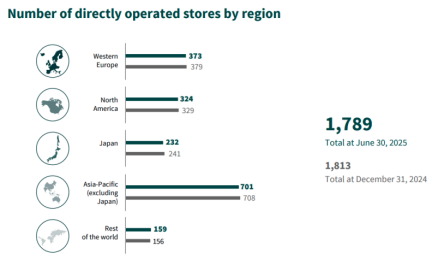
Core Viewpoint - Kering Group, a major player in the luxury goods sector, reported a significant decline in both revenue and profit for the second quarter and first half of 2025, indicating ongoing struggles in the luxury market, particularly for its flagship brand Gucci [1][2][3] Financial Performance - Kering Group's revenue for Q2 2025 decreased by 15% to €3.7 billion, with Gucci's revenue dropping by 27% to €1.46 billion, marking six consecutive quarters of sales decline for Gucci [1][2] - For the first half of 2025, Kering's total revenue was €7.587 billion, down 16% year-on-year, while recurring operating profit fell by 39% to €969 million, and net profit decreased by 46% to €474 million [1][2] - Gucci's revenue for the first half was approximately €3.027 billion, reflecting a year-on-year decline of about 26% [1][2] Brand Performance - Gucci and YSL (Saint Laurent) continue to show declining sales, with Gucci's revenue for the first half down 26% and YSL's down 11% [2][3] - BV (Bottega Veneta) experienced a slight growth of 1% in revenue for the first half, but its growth rate has slowed, with a 1% decline in Q2 [2] Regional Market Analysis - No regional market achieved year-on-year growth, with the largest declines in the Asia-Pacific region and Japan, down 21% and 20% respectively [3] - Sales in Western Europe and North America decreased by 13% and 12% respectively, with overall sales from the Asia-Pacific region dropping by 3 percentage points to 29% of Kering's total revenue [3] Store Operations - Kering closed a net total of 24 stores in the first half of the year, including 18 Gucci stores, 1 YSL store, and 5 BV stores, bringing the total number of global stores to 1,789 [3] Leadership Changes - Kering appointed Luca de Meo as the new CEO, effective September 2025, who previously helped Renault recover from a crisis in the automotive sector [2][8] - The industry is skeptical about whether de Meo can effectively revitalize Kering's performance in the luxury goods market [8] Industry Trends - Experts suggest that luxury brands need to focus on digital transformation and innovative retail models rather than merely closing stores [6] - The luxury market in China remains a significant opportunity, but brands must adapt to changing consumer preferences and invest in product innovation and customization [7][8]