Piper Sandler

Search documents
Clearside Biomedical Announces Plan to Explore Strategic Alternatives to Advance its Proprietary Suprachoroidal Space (SCS®) Delivery Platform and Promising Ophthalmology Pipeline
Globenewswire· 2025-07-17 11:05
Core Insights - Clearside Biomedical, Inc. is exploring a range of strategic alternatives to enhance its SCS platform and drug development pipeline, aiming to maximize stockholder value [1][2][3] - The company has retained Piper Sandler to assist in the strategic evaluation process, considering options such as asset sales, licensing, collaborations, and mergers [1][2] - Clearside's SCS Microinjector is a validated delivery platform for therapies targeting serious retinal diseases, with five commercial and late-stage development collaborations [1][4][10] Company Highlights - The SCS Microinjector enables a non-surgical, repeatable procedure for targeted delivery of therapies to the macula, retina, and choroid, potentially preserving and improving vision in patients with sight-threatening eye diseases [4][10] - Clearside's lead program, CLS-AX, is in development for the treatment of wet age-related macular degeneration (AMD) and has shown positive Phase 2b clinical data [2][8][10] - The company has successfully navigated the FDA regulatory pathway for its first product, XIPERE, which is approved for suprachoroidal use [8][10] Internal Pipeline - CLS-AX is a proprietary axitinib injectable suspension being developed for wet AMD, with a Phase 3 program planned to maximize its commercial potential [8][10] - The company is also evaluating small molecules for treating geographic atrophy (GA) and diabetic macular edema (DME), addressing high unmet medical needs in retinal diseases [8][10] External Collaborations - Clearside has established partnerships with various companies utilizing its SCS injection platform for other ophthalmic therapeutic innovations, including gene therapies and anti-tumor agents [10][13]



Piper Sandler Companies (PIPR) Stock Jumps 4.4%: Will It Continue to Soar?
ZACKS· 2025-07-11 09:46
Company Performance - Piper Sandler Companies (PIPR) shares increased by 4.4% to close at $302.62, supported by solid trading volume, and have gained 11.5% over the past four weeks [1][2] - The stock has seen a price increase for two consecutive trading sessions, driven by growing investor optimism regarding investment banks due to a rebound in deal-making activities linked to clarity on Trump's tariff plans [2] Earnings Expectations - The company is expected to report quarterly earnings of $1.99 per share, reflecting a year-over-year decline of 21%, while revenues are projected to be $344.7 million, an increase of 1.6% from the previous year [3] - The consensus EPS estimate for Piper Sandler has remained unchanged over the last 30 days, indicating that stock price movements may not sustain without trends in earnings estimate revisions [4] Industry Context - Piper Sandler belongs to the Zacks Financial - Investment Bank industry, which includes other companies like Citigroup (C), that closed 1.5% higher at $87.08, with a 9.5% return over the past month [5] - Citigroup's consensus EPS estimate has increased by 0.6% to $1.62, representing a year-over-year change of 6.6% [6]


Piper Sandler Companies (PIPR) Earnings Call Presentation
2025-06-19 10:11
Company Overview and Financial Performance - Piper Sandler Companies is a leading investment bank with over 60 offices and 1,800 employees[13] - The company's adjusted net revenues for the last twelve months (LTM) ending in the first quarter of 2025 were $1.6 billion[14] - Investment banking contributed $1.0 billion to the LTM 1Q 2025 adjusted net revenues[15] - Public finance generated $150 million in LTM 1Q 2025 adjusted net revenues[16] - Equity brokerage and fixed income contributed $220 million and $189 million respectively to the LTM 1Q 2025 adjusted net revenues[17] Strategic Investments and Growth - The company has consistently grown its platform through strategic investments, increasing adjusted net revenues from $599 million in 2015 to $1.59 billion in LTM 1Q 2025[22] - The average adjusted net revenues for 2023-2025* is $1.487 billion[26] - The average adjusted operating margin for 2023-2025* is 18.5%[28] - The average adjusted diluted EPS for 2023-2025* is $11.99[32] Market Position and Valuation - Piper Sandler is a top-ranked M&A advisor, having advised on over 1,030 M&A transactions worth more than $545 billion in the past 5 years[50] - The company's LTM revenue multiple is 2.9x, compared to an average of 4.3x for its peers[36] - Piper Sandler's public finance par value market share is 5.7% for LTM 1Q 2025[75]
Piper Sandler: Liberation Day Should Lift Brokerage In Q2
Seeking Alpha· 2025-06-07 14:14
Group 1 - The Value Lab focuses on long-only value investment ideas, targeting international mispriced equities with a portfolio yield of approximately 4% [1][2] - Piper Sandler reported a decent quarter, with Q1 benefiting from volatility in the brokerage business, and Q2 expected to continue this trend [2] - The Valkyrie Trading Society consists of analysts sharing high conviction investment ideas that are downside limited and likely to yield non-correlated and outsized returns in the current economic environment [3]

特朗普税收法案大幅削减光伏补贴,美国太阳能股集体崩盘
Di Yi Cai Jing· 2025-05-23 11:11
Core Viewpoint - The recent tax bill passed by the U.S. House of Representatives imposes harsher cuts to tax credits for the clean energy sector than anticipated, leading to a significant decline in the stock prices of renewable energy companies [1][3]. Group 1: Impact on Renewable Energy Companies - NextEra Energy, the largest renewable energy developer in the U.S., saw its stock price drop by 6.4% following the announcement of the tax bill [1]. - Enphase Energy, which produces solar systems and battery technologies, experienced a stock loss of 19.6% [1]. - SolarEdge, an inverter and battery supplier, saw its stock shrink by approximately 25% [1]. - Sunrun, a residential solar company, faced a dramatic stock decline of 37% [1]. Group 2: Changes to Tax Credits - The new bill significantly reduces tax incentives for clean energy compared to the Biden administration's Inflation Reduction Act, with residential solar tax credits set to be eliminated by the end of 2025 and commercial solar tax credits gradually decreasing starting in 2029 [3][4]. - The residential solar tax credit, which currently offers a 30% federal tax credit, will be fully phased out by 2032, while commercial tax credits will drop to 80% in 2029, 60% in 2030, 40% in 2031, and be eliminated by 2032 [3][4]. Group 3: Implications for Solar Leasing - A critical new provision in the bill prohibits solar leasing companies from applying for commercial investment tax credits (ITC), which could have catastrophic effects on the rooftop solar industry, where approximately 70% of installations use leasing models [4]. - Analysts have indicated that this change could signify the end of the residential solar business in the U.S. [4]. Group 4: Changes in Project Qualification Standards - The qualification criteria for commercial project tax credits have shifted from a "construction begins" standard with a four-year safe harbor to a "placed in service" standard, eliminating the grace period [5]. - This adjustment particularly impacts utility-scale projects, which require longer construction timelines, leading to declines in related solar stocks [5]. Group 5: Market Reactions and Future Outlook - The Invesco Solar ETF, which tracks U.S. solar companies, saw a net asset value decline of 7.45% following the announcement [5]. - Analysts have warned that green energy stocks may continue to decline as the implications of the tax bill unfold [5]. - The overall sentiment among analysts is that there is currently no compelling reason to hold U.S. solar company stocks due to the government's focus on eliminating green subsidies [6].


4月“死给特朗普看”之后,市场马上又要演一遍?
Hua Er Jie Jian Wen· 2025-05-22 03:05
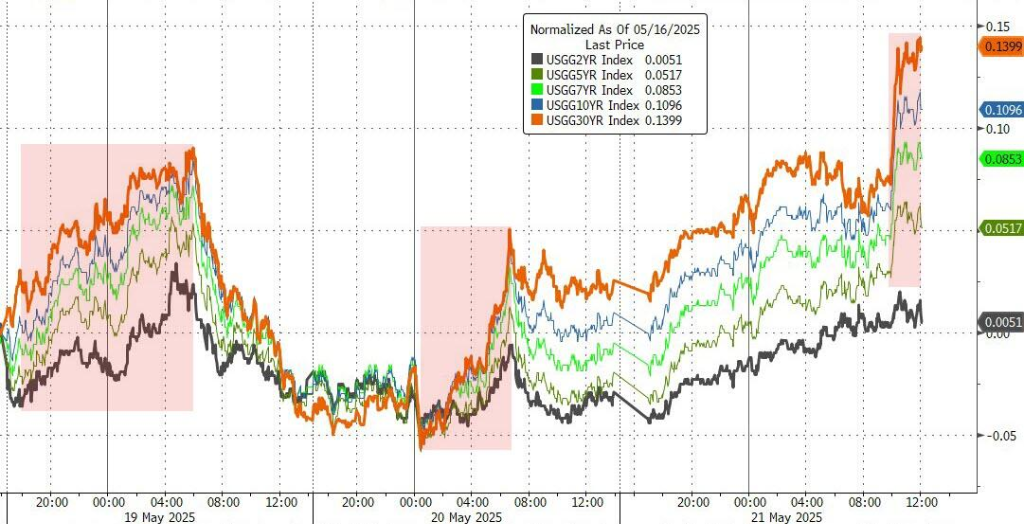
Core Viewpoint - The U.S. economy is facing new challenges as rising government borrowing costs and a potential increase in the deficit threaten to impact fiscal sustainability and economic growth [1][3]. Group 1: Economic Impact - The recent downgrade of the U.S. credit rating by Moody's and the challenges in passing the Republican tax bill have led to a sell-off in U.S. Treasuries, causing yields to rise sharply [1]. - The 30-year Treasury yield reached 5.089%, the highest level since October 2023, while the 10-year Treasury yield rose to 4.595%, marking its peak since February 2023 [1]. - The Congressional Budget Office (CBO) predicts that the Republican tax plan could increase the deficit to about 7% of GDP, an unprecedented level for a low-unemployment economy [3]. Group 2: Fiscal Policy Concerns - The rising interest rates mean the government will need to allocate more funds to cover interest payments on nearly $29 trillion in debt, potentially leading to higher taxes or reduced government services for citizens [4]. - The high-interest environment not only affects government finances but also increases borrowing costs for consumers and businesses, which could suppress economic activity [4]. Group 3: Political Dynamics - There is skepticism regarding whether the Trump administration will make significant fiscal adjustments, as Republican leaders believe that economic growth from tariffs and deregulation will offset revenue losses from tax cuts [5]. - Analysts suggest that there will be no substantial fiscal consolidation in the foreseeable future, and the U.S. is likely to continue running large deficits [5]. - The Trump administration's previous promises to address the deficit through significant spending cuts have been scaled back, with current Republican sentiment showing less concern for fiscal deficits compared to a decade ago [5].
周五过后,美股“隐形护盘手”撤离!
Jin Shi Shu Ju· 2025-05-16 06:23
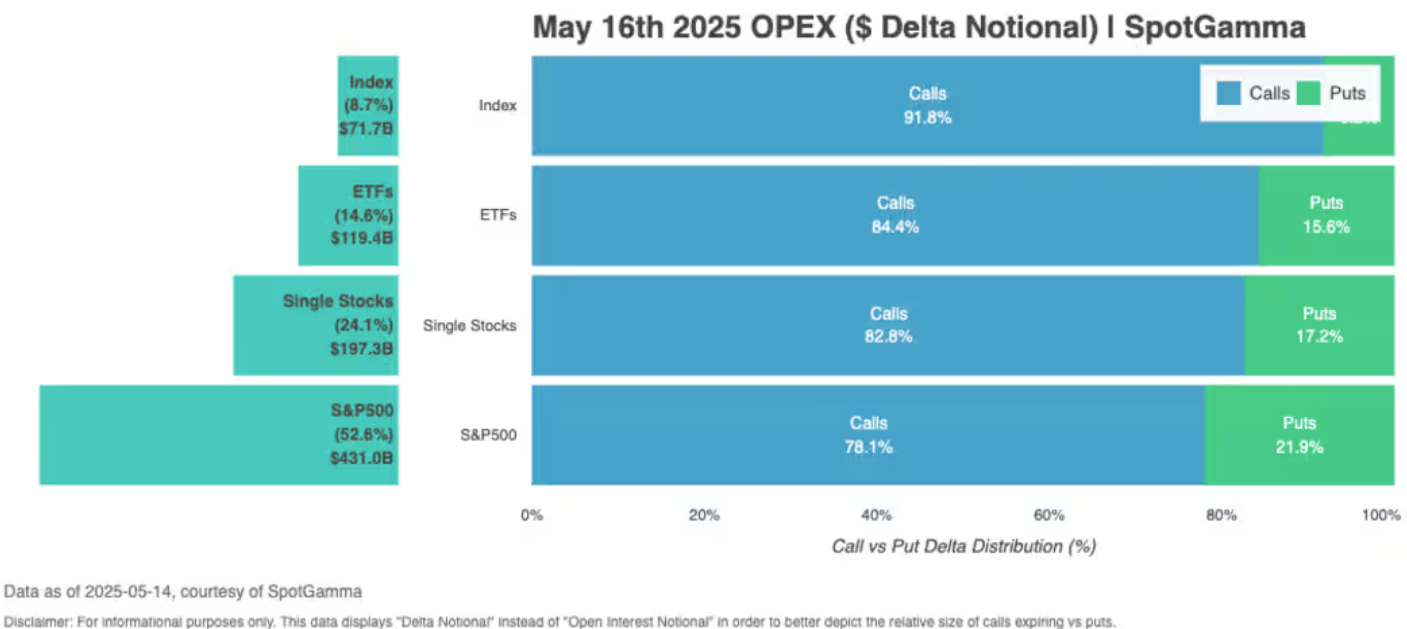
Group 1 - Investors are holding a significant amount of call options, which are set to expire on Friday, potentially leading to a halt in the market's upward momentum as these positions are closed [1][3] - The total value of the options expiring this week is approximately $3.4 trillion, which is considered normal for a monthly expiration [3] - The Cboe put-call ratio has dropped to 0.7, the lowest since February 14, indicating a strong preference for call options among investors [3] Group 2 - As the stock market continues to rise, the preference for call options has become increasingly evident over the past two weeks [3] - Option market makers typically need to buy stocks or index futures to hedge their risk exposure when investors heavily purchase call options [3] - Market volatility is expected to increase next week as market makers will no longer need to hedge large long positions [3]
Darling Ingredients (DAR) M&A Announcement Transcript
2025-05-12 14:00
Summary of Darling Ingredients Inc. Conference Call Company and Industry - **Company**: Darling Ingredients Inc. - **Industry**: Collagen and Gelatin Production, Health and Wellness Sector Key Points and Arguments 1. **Joint Venture Announcement**: Darling Ingredients announced a nonbinding term sheet with the Centrelo Group to form a new joint venture called NexTita, with Darling holding an 85% stake and Centrelo holding 15% [4][5][21] 2. **Revenue Expectations**: The new company is projected to generate annual revenue of approximately $1.5 billion, with significant growth potential and attractive margins [5][21] 3. **Production Capacity**: NexTita will have gelatin and collagen production capacity of around 200,000 metric tons annually across 23 facilities in nine countries [5][6] 4. **Market Position**: The joint venture aims to create a leading company in the collagen-based health, wellness, and nutrition market, which is still in its early stages of development [6][7] 5. **Focus on Innovation**: Darling Ingredients has nearly a dozen product concepts in development, emphasizing science and innovation in the health and wellness sector [7][8] 6. **Financial Strategy**: The merger is designed to optimize shareholder value without leveraging debt, potentially leading to deleveraging [9][21] 7. **Market Dynamics**: The food segment's contribution to margins and growth potential has not been fully recognized, and the merger aims to highlight this value [8][9] 8. **Supply Chain Management**: The combined entity will enhance supply chain management capabilities, which is crucial for maintaining consistent margins [13][14] 9. **Future Growth**: The joint venture is expected to diversify the portfolio and enhance growth in hydrolyzed collagen, which has seen significant demand [39][41] 10. **Regulatory Considerations**: The joint venture will undergo regulatory approvals, and the companies believe they will not dominate the market share significantly [58][59] Additional Important Content 1. **Market Size**: The global collagen market is estimated to be between $60 billion, with the joint venture representing a minor player in this space [59][60] 2. **Capital Allocation**: There are no expected significant changes in capital allocation for the joint venture, as both companies have maintained their assets well [41][61] 3. **Potential IPO**: There is a possibility of taking the joint venture public in the future, depending on market conditions and growth [24][62] 4. **Raw Material Sourcing**: The joint venture will benefit from diversified sourcing of raw materials, reducing risks associated with supply chain bottlenecks [68][71] 5. **Strategic Relationships**: The merger will leverage existing relationships and technologies from both companies to enhance market reach and product development [66][67] This summary encapsulates the key discussions and insights from the Darling Ingredients Inc. conference call, focusing on the formation of the joint venture and its implications for the company and the industry.

Why Nearly 20 Analysts Raised Meta Price Targets Post-Earnings
MarketBeat· 2025-05-09 14:47
Core Insights - Meta Platforms has consistently exceeded Wall Street's sales estimates for 11 consecutive quarters, with shares rising over 4% post-earnings on May 1 [1][4] - The company has also surpassed expectations for adjusted earnings per share (EPS) for nine consecutive quarters, with an average post-earnings gain of over 5% in the last 10 quarters [4] Analyst Sentiment - Nearly 20 Wall Street analysts have raised their price targets for Meta, with three times as many increasing their targets compared to those who lowered them [4][5] - Analysts at JPMorgan and Stifel highlight Meta's increased capital expenditure (CapEx) for AI infrastructure as a key driver for future growth, indicating confidence in the company's long-term goals [5][6][7] AI Strategy and Performance - Meta's AI initiatives have led to a 26% increase in ad impressions and a 17% rise in the price paid per ad from Q1 2023 to Q1 2025, demonstrating strong demand and effective execution [7] - Citigroup analysts noted that Meta's structured explanation of its five major growth opportunities through AI has strengthened confidence in its growth trajectory [8][9] Price Target Updates - Recent updates from Wall Street analysts suggest a potential upside of over 18% for Meta shares based on the price targets following the May 1 earnings release [10] - The average 12-month stock price forecast for Meta is $696.45, indicating a 17.08% upside from the current price [8]


美联储议息会议前,投资者买了什么?
Sou Hu Cai Jing· 2025-05-08 02:24
Group 1 - The S&P 500 and Nasdaq have recovered from the declines following the U.S. tariff announcement on April 2, with investors focusing on the upcoming Federal Reserve decision [1] - The probability of the Federal Reserve maintaining the current interest rate range of 4.25%-4.5% is over 95%, but Wall Street is more concerned about Chairman Powell's comments for future policy direction [1] - Many market strategists are adopting a more defensive stance ahead of the Federal Reserve meeting due to uncertainties regarding Fed policy and trade tariffs [3] Group 2 - The utilities sector has been the best-performing sector in the S&P 500 this year, with a gain of over 6%, while the financial sector has risen by 2% and the communication services sector has declined by 2% [5] - Large technology companies are expected to perform well even in an economic slowdown, with AI spending likely to continue, making tech stocks a defensive choice [5] - Piper Sandler's analysis suggests that software companies are more attractive than semiconductor companies, with specific recommendations for stocks like Twilio and Monday.com [6] Group 3 - Short-term bonds are viewed as a good investment opportunity, with a recommendation to lock in current interest rates before the Federal Reserve meeting [7] - As of Tuesday, the yield on the 2-year U.S. Treasury bond was reported at 3.797% [7]