2年期美国国债

Search documents
格林大华期货黄金白银继续大幅回落
Ge Lin Qi Huo· 2026-03-23 09:02
1. Report Industry Investment Rating - No relevant information provided 2. Core Viewpoints - After consecutive sharp declines, the short - selling force of gold and silver has been vented to some extent, and the internal rebound force is brewing. COMEX gold has strong support at the 4000 - point level. The evolution of the Iranian situation should be continuously monitored, and investors should control positions and prevent risks due to short - term market volatility [3] 3. Summary by Related Content Market Performance - On March 23, the main contract of Shanghai gold futures fell 8.62% to 940.00 yuan/gram, and the main contract of Shanghai silver futures fell 11.67% to 15411 yuan/kilogram. COMEX gold futures fell below 4200 US dollars/ounce, and COMEX silver futures fell below 63 US dollars/ounce [3] - Last Friday, US stocks fell, and the VIX index closed up 26.78. On March 23, Asian stock markets in China, Japan, and South Korea all fell sharply during the day [3] Central Bank Policies and Yield Changes - Last week, the Fed's March meeting kept interest rates unchanged, pointed out the uncertainty of the Middle East impact, and raised the inflation forecast. The European Central Bank announced that interest rates remained unchanged and raised the inflation forecast [3] - The warnings on inflation from major central banks led to a sharp rise in short - term Treasury yields. Traders no longer expect the Fed to cut interest rates in 2026, and the probability of the Fed raising interest rates by 25 basis points by June is over 20%, with a 50% chance of a rate hike by the end of October [3] - Last week, the 2 - year US Treasury yield broke through 3.75%, exceeding the upper limit of the federal funds rate target range, and closed at about 3.89% last Friday. On March 23, the 2 - year US Treasury yield continued to rise by about 6 basis points to around 3.95%, and US Treasuries continued to fall significantly [3] Reasons for Gold and Silver Declines - The financial market's sharp decline in stocks and bonds led to investment institutions' need for replenishment and increased margin, and market liquidity pressure also pushed down gold and silver prices [3]
摩根大通策略师建议将抛售2年期美国国债作为一项“战术性”交易,理由是经济增长前景稳健将使美联储难以大幅降息。
Sou Hu Cai Jing· 2026-02-13 04:26
Core Viewpoint - JPMorgan strategists recommend selling 2-year U.S. Treasury bonds as a "tactical" trade due to a robust economic growth outlook that will make it difficult for the Federal Reserve to implement significant rate cuts [1] Group 1 - The recommendation to sell 2-year U.S. Treasury bonds is based on the expectation of steady economic growth [1] - The strong economic growth outlook is anticipated to limit the Federal Reserve's ability to lower interest rates substantially [1]
摩根大通建议抛售2年期美债 料美联储难以大幅降息
Xin Lang Cai Jing· 2026-02-13 04:13
Core Viewpoint - Morgan Stanley strategists recommend selling 2-year U.S. Treasury bonds as a "tactical" trade due to a robust economic growth outlook, which will make it difficult for the Federal Reserve to implement significant rate cuts [1][4]. Economic Outlook - The economic foundation is solid, and even if Kevin Walsh is confirmed as the Federal Reserve Chair, he will face challenges in influencing the Federal Open Market Committee's decisions [1][4]. - The report was released ahead of a key U.S. inflation report that could provide new clues for the Fed's next actions [1][4]. Market Reactions - Any signs of easing price pressures could stimulate demand for short-term, policy-sensitive bonds [1][4]. - U.S. Treasury yields have been volatile this week, influenced by a tech stock sell-off and strong U.S. employment data, which has sparked discussions about how Walsh would handle policy [1][4]. Interest Rate Expectations - Traders currently expect the Federal Reserve to cut rates by 25 basis points in July and to implement another cut by the end of the year [1][4]. - Prior to the release of stronger-than-expected employment data earlier this week, the market was almost certain that the Fed would cut rates in June [1][4]. - As of Friday's Asian trading session, the 2-year Treasury yield rose slightly by 2 basis points to 3.47%, following a drop of about 5 basis points the previous trading day [1][4]. Diverging Opinions - Some individuals disagree with Morgan Stanley's viewpoint, including hedge fund manager David Einhorn, who bets that Walsh's leadership will result in larger-than-expected rate cuts [5]. - Einhorn has purchased overnight secured financing rate futures, betting that if the Fed lowers borrowing costs more aggressively, the related contracts will rise [5]. - Morgan Stanley anticipates that the core CPI, excluding food and energy, will "stabilize" with a rise of 0.39% in January, influenced by the easing of price pressures and the lingering effects of the government shutdown [5].

10-year Treasury yield dips as investors await final economic data of 2025
CNBC· 2025-12-31 09:23
Core Viewpoint - The U.S. 10-year Treasury yield has slightly decreased as investors are awaiting economic data and assessing the market ahead of the New Year [1] Group 1: Treasury Yields - The yield on the 10-year Treasury dipped by 2 basis points to 4.108% [1] - The yield on the 2-year Treasury was last seen more than 1 basis point lower at 3.442% [1] - Yields and prices move in opposite directions, with one basis point equating to 0.01% [1]


资深商品交易员:美国“第二波”通胀隐忧浮现,70年代通胀浪潮或将重演
美股IPO· 2025-12-23 00:51
Core Viewpoint - A former commodity trader warns of a potential "second wave" of inflation reminiscent of the 1970s, driven by fiscal expansion, de-globalization, and ongoing supply constraints, which could impact markets even if it does not reach the extreme highs of 2021 [1][3]. Group 1: Inflation Dynamics - The current inflation environment may not mirror the 1970s exactly, as the U.S. faces a relative oversupply of crude oil, unlike the oil supply shocks of the past [3][4]. - The U.S. budget deficit is projected to reach 6.5% of GDP this year, while Germany is considering a spending plan close to €1 trillion (approximately $1.2 trillion), contributing to inflationary pressures [4]. Group 2: Investment Strategies - Long-term bonds are viewed as the worst-performing asset class in an inflationary environment, while short-duration bonds, such as the 2-year U.S. Treasury yielding around 3.5%, are more attractive [6]. - Stocks are considered a decent safe haven, particularly commodity producers, infrastructure, and industrial sectors, but valuations must be reasonable [7]. - Real estate is highlighted as a crucial asset class, with its price movements closely correlated to official inflation metrics, often compensating for underreported inflation [8]. Group 3: Commodity Focus - Commodities are identified as the best inflation hedge, with a recommendation to diversify beyond just oil and precious metals to include industrial metals (like copper) and agricultural products [9]. - The Bloomberg Commodity Index has an annual roll cost of approximately 2.9%, which investors should consider when holding typical commodity funds [9]. - The current investment portfolio allocation includes 65% in stocks (with 5% hedged through one-year put options), 20% in cash and short-term bonds, and 20% in commodities, with an effective commodity exposure of nearly 35% due to stock holdings related to commodities [9].

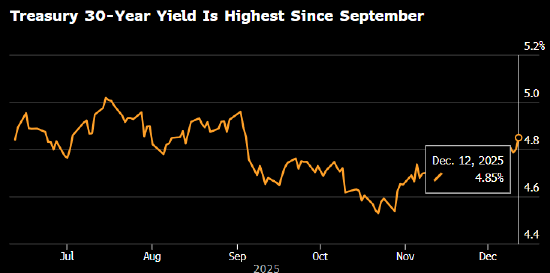
30年期美债收益率升至9月以来最高 几名美联储官员提及通胀担忧
Xin Lang Cai Jing· 2025-12-12 16:00
Core Viewpoint - Long-term U.S. Treasury bonds have declined, with the 30-year yield rising to its highest level since early September, reflecting the gradual impact of the Federal Reserve's recent interest rate cut on the bond market [1][6]. Group 1: Treasury Yield Movements - The 30-year Treasury yield increased by 6 basis points to 4.86%, marking the highest level since September 5, with a cumulative rise of approximately 5 basis points for the week [1][6]. - The 2-year Treasury yield remained relatively stable, showing a slight decline compared to the previous week [1][6]. Group 2: Federal Reserve's Stance - Federal Reserve Chairman Jerome Powell indicated the possibility of further rate cuts, which surprised the market and was termed an "unexpected dovish cut" by economists at Bank of America [3][8]. - Expectations for additional rate cuts next year have led to a decrease in short-term Treasury yields, while long-term bonds reflect high inflation expectations [3][8]. Group 3: Inflation Concerns - Chicago Fed President Austan Goolsbee and Kansas City Fed President Jeff Schmid expressed concerns about inflation, which influenced their opposition to the recent rate cut and support for maintaining rates [3][8]. - Macro strategist Edward Harrison noted that Goolsbee's comments suggest downside risks for Treasury bonds, as traders anticipate two rate cuts of 25 basis points in 2026 [3][8]. Group 4: Market Dynamics - The recent auction results for the 30-year Treasury bond were strong, but there may still be upward pressure on yields, attracting buyers [4][9]. - Expectations for rate cuts are bolstered by the anticipated aggressive easing policies from Powell's successor and a decline in oil prices, which may alleviate inflationary pressures [4][9]. - Philadelphia Fed President Anna Paulson expressed that concerns about a weak labor market outweigh worries about rising inflation risks [4][9].
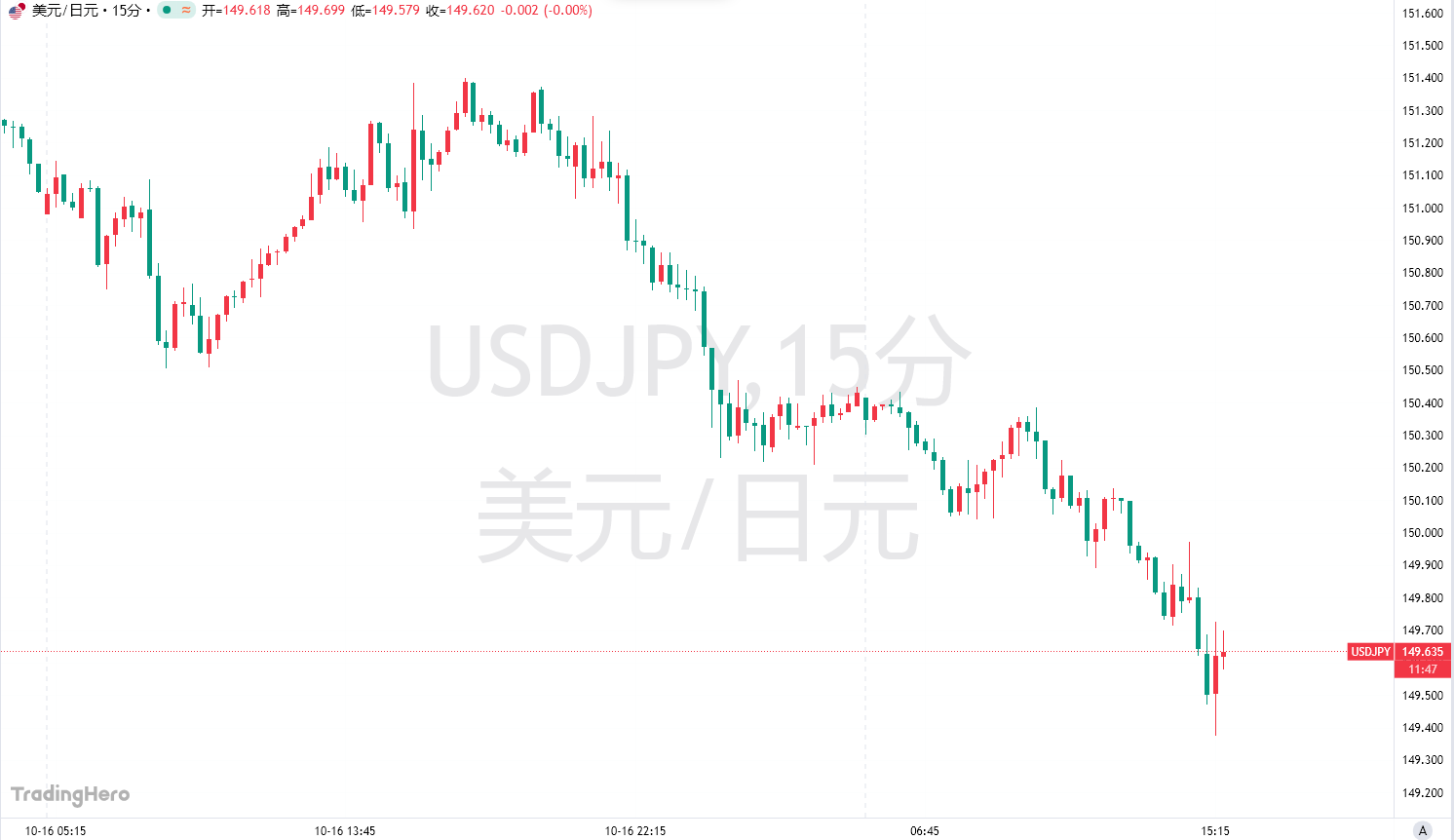
美银行坏账引爆避险潮,美日跌破150大关
Jin Shi Shu Ju· 2025-10-17 07:52
Group 1 - The Japanese yen strengthened against the US dollar, causing the dollar to fall below the 150 mark, driven by increased demand for safe-haven assets due to bad loans at two US banks [1] - The dollar-yen exchange rate dropped over 0.5% to around 149.63, marking the lowest level since October 6 [1] - The Swiss franc also appreciated, while the US dollar and US Treasury yields declined amid a sell-off in regional bank stocks [1] Group 2 - A week prior, the yen had fallen to its lowest level since February after the election of a new leader for the Liberal Democratic Party and subsequent political instability in Japan [2] - Market focus is on the formation of Japan's coalition government, particularly the potential agreement between the Liberal Democratic Party and the Japan Innovation Party [3] - Political uncertainty has diminished expectations for a rate hike by the Bank of Japan this month, although the Bank's governor indicated a willingness to tighten policy if economic confidence improves [3]
【UNFX数评】CPI数据巩固降息预期:通胀降温趋势确立,政策转向在即
Sou Hu Cai Jing· 2025-09-12 03:53
Group 1: Inflation Data Insights - The overall inflation rate has reached a significant milestone with a year-on-year increase of 2.9%, marking the first time in 2023 that it has fallen into the "2 range," indicating a decisive victory in the fight against inflation [1][3] - Core CPI shows a year-on-year increase of 3.1%, but its downward trajectory is becoming increasingly clear, suggesting that the true real-time core inflation level is much lower than reported [1][3] Group 2: Federal Reserve Policy Outlook - The CPI report enhances the likelihood of further interest rate cuts by the Federal Reserve, opening the door for potential rate cuts as early as next week [1][2] - The focus of the Federal Reserve is shifting from combating inflation to maintaining economic growth, as the risks to economic growth are now greater than those posed by inflation [3] Group 3: Market Reactions and Investment Strategies - The August CPI report is viewed as a positive turning point, confirming the diminishing threat of inflation and pushing the Federal Reserve towards a policy shift [2][3] - The stock market is expected to see a significant boost in risk appetite, particularly for interest-sensitive sectors like technology, as the anticipation of rate cuts creates a window for valuation recovery [2][3] - The bond market is likely to experience a decline in U.S. Treasury yields, especially for the 2-year Treasury, as investor enthusiasm for bonds is rekindled [2][3] - The dollar index may face downward pressure as the interest rate differential narrows with rising expectations of rate cuts [2][3]
高美债收益率可能吸引买家,但国债拍卖将受到密切关注
news flash· 2025-06-09 12:39
Core Viewpoint - The rising yields on U.S. Treasury bonds may attract buyers, but upcoming bond auctions will be closely monitored due to concerns over U.S. fiscal issues [1] Group 1 - The 30-year, 10-year, and 2-year U.S. Treasury yields are currently around 5%, 4.5%, and 4.0% respectively, which are seen as attractive levels for low-end buyers [1] - Recent weeks have shown that these yield levels have been appealing to certain investors [1] - Despite the attractive yields, investors are adopting a cautious stance ahead of the U.S. Treasury bond auction this week due to ongoing fiscal concerns [1]
美国220亿美元30年期国债标售成焦点 收益率触及20年高点投资者抵制加剧
Sou Hu Cai Jing· 2025-06-09 01:29
Group 1 - The U.S. Treasury will auction $22 billion in 30-year bonds this Thursday, which has become a focal point for Wall Street due to increasing global investor resistance to long-term government debt [1] - The 30-year U.S. Treasury bond has become the least favored bond type, with its yield reaching a nearly 20-year high of 5.15% last month and hovering around 4.98% at the start of the week [3] - Demand for long-term bonds has been persistently weak, with rising yields prompting investors to seek higher risk premiums for government loans, leading to increased financing pressure as U.S. borrowing continues to rise [4] Group 2 - Concerns over the fiscal situation have intensified, with predictions that recent tax and spending legislation could increase the U.S. budget deficit by trillions in the coming years, and Moody's has downgraded the U.S. sovereign credit rating from Aaa to Aa1 [5] - The total U.S. federal debt has surpassed $36 trillion, accounting for 124% of GDP, with interest payments projected to exceed $1 trillion for the fiscal year 2024 [5] - Due to severe sell-offs, there are speculations that the U.S. Treasury may reduce or suspend the issuance of 30-year bonds, as the current trading situation for long-term U.S. Treasuries no longer aligns with the traditional view of them as "risk-free assets" [5]