
宇树科技

Search documents
创世纪:公司已与比亚迪电子等诸多品牌客户展开合作

Zheng Quan Ri Bao Zhi Sheng· 2026-01-08 10:07
(编辑 袁冠琳) 证券日报网讯 1月8日,创世纪在互动平台回答投资者提问时表示,公司已与比亚迪电子、富士康、立 讯精密、领益智造、长盈精密、宇树科技、中国中车、上汽通用、中航工业等诸多知名品牌客户展开合 作,并获得客户高度认可。其他客户信息请以公司在指定信息披露媒体发布的定期报告及相关公告为 准。 ...
同韩国总统握手、回旋踢爆西瓜、拉斯维加斯“站C位”......中国机器人,开年集体“秀肌肉”
Hua Xia Shi Bao· 2026-01-08 08:59
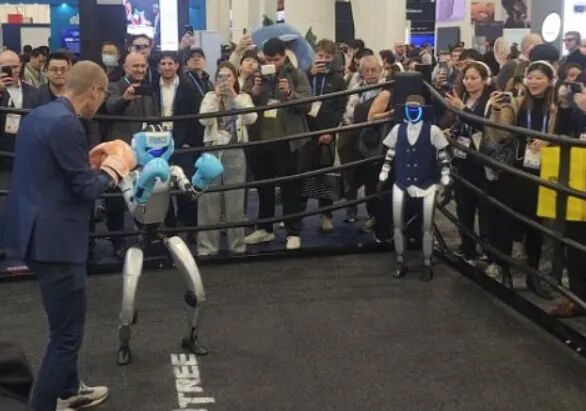
Core Insights - The Chinese humanoid robot industry is experiencing significant advancements, showcasing strong competitiveness and potential for industrial applications [19]. Group 1: Industry Developments - China is the world's largest robot producer, holding over 190,000 effective patents related to robotics, accounting for approximately two-thirds of the global total [1]. - The humanoid robot sector in China has achieved breakthroughs in motion control, which is considered one of the most challenging issues in robotics [19]. - The Solactive China Humanoid Robotics Index has seen a cumulative increase of 60% from January to October, indicating a surge in stock prices related to the humanoid robot sector [19]. Group 2: Market Trends - The CES 2026 showcased over 10 Chinese companies specializing in embodied intelligence, marking a significant collective presence in the robotics industry [3]. - The launch of the humanoid robot H2 by Yushu Technology has attracted considerable attention, demonstrating advanced capabilities such as flying kicks and flips [9]. - The consumer market for robots is thriving, with robots actively participating in retail and entertainment, enhancing the overall shopping experience [15][17]. Group 3: Consumer Engagement - Yushu Technology opened its first offline store, where customers can purchase robots, indicating a shift towards consumer-oriented robotics [11]. - Robots are increasingly being utilized in various sectors, including retail, where they assist in service and product delivery, significantly reducing customer wait times [15]. - The rental market for robots is booming, with a newly established rental company in Shanghai receiving thousands of registrations within days, expanding its network across over 50 cities [19].


张江高科(600895.SH):公司及自管基金未直接投资或持有宇树科技
Ge Long Hui· 2026-01-08 08:12
格隆汇1月8日丨张江高科(600895.SH)在投资者互动平台表示,公司及自管基金未直接投资或持有宇树 科技,关于宇树科技具体信息请以其官方渠道信息披露为准。 ...

2026年美国消费电子展开幕 中国企业表现抢眼
Ren Min Wang· 2026-01-08 06:37
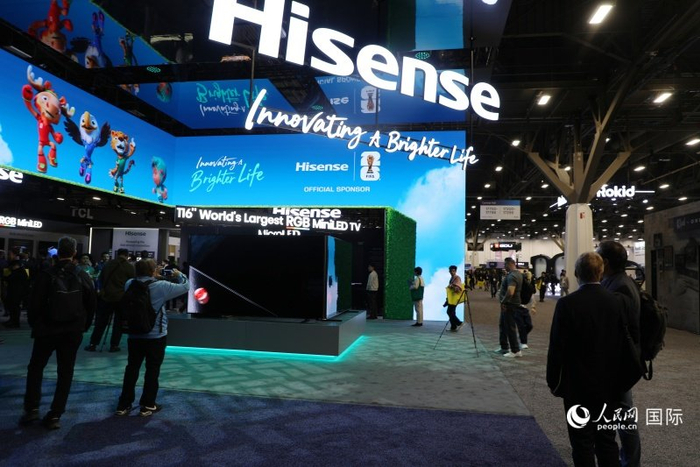
人民网拉斯维加斯1月7日电 (记者李志伟)当地时间1月6日,2026年美国拉斯维加斯消费电子展开幕。此 次展会于1月6日至9日举行。今年,930多家中国企业参展,规模庞大,表现亮眼。 在主会场,中国企业的展台随处可见,TCL、海信、追觅等企业占据了主会场中心位置的展台,观众络 绎不绝。中国企业在本次展会上不但有较大的规模,更展现出旺盛的创新活力,在新型显示技术、人工 智能、机器人技术、汽车科技、智能出行等领域推出创新产品,吸引了来自世界各地观众的目光。 图 中国企业的亮点是人工智能与产品的深度融合。宇树科技等中国企业展示了许多人形机器人产品。 本届展会吸引超过155个国家和地区的数千家企业参展,重点展示人工智能、数字健康、未来能源、机 器人技术、汽车科技、智能出行等领域的最新进展。展会期间还将举行400多场主题演讲和论坛活动。 作为全球规模最大的消费技术产业盛会之一,拉斯维加斯消费电子展一直是科技领域的开年重头戏,被 视为国际消费电子领域的"风向标"。 在 为消费电子展上的海信展台。人民网记者 李志伟摄 TCL展台,观众在了解创新技术情况。人民网记者 李志伟摄 ...
四大芯片巨头掌门人罕见同台发声
2 1 Shi Ji Jing Ji Bao Dao· 2026-01-08 05:57
Core Insights - The CES 2026 highlighted the significant advancements in AI technology, particularly in the context of increasing computational power and the emergence of new applications across various sectors [1][2][8] - Chinese companies are playing an increasingly vital role in the global tech landscape, showcasing innovative AI hardware and solutions that attract considerable attention at international events [1][4][9] Group 1: AI and Computational Power - NVIDIA's CEO Jensen Huang emphasized the arrival of the "ChatGPT moment," indicating that machines are beginning to understand and act in the real world, with autonomous taxis being one of the first applications to benefit [2] - Huang introduced the new Rubin architecture, which includes a comprehensive stack solution with six core components, addressing the exponential growth in AI computational demands, projected to increase tenfold annually [2] - AMD's CEO Lisa Su noted that the computational power is transitioning from Zetta to Yotta Scale, with AI model training floating-point computation power increasing fourfold each year and inference token consumption rising by 100 times over the past two years [2] Group 2: Emerging AI Applications - Qualcomm's CEO Cristiano Amon highlighted the potential of next-generation personal AI devices, predicting a market size of 100 million units in the coming years, driven by edge AI and situational awareness capabilities [3] - The CES showcased a variety of AI-native products, with a notable increase in the capabilities of robots, moving beyond simple demonstrations to more complex functionalities [4][6] - The development of humanoid robots is progressing towards commercialization, with companies achieving significant advancements in motion control and operational precision, indicating a clear path for deployment in sectors like manufacturing and logistics [6][7] Group 3: Chinese Companies and Global Impact - Chinese firms are increasingly recognized as key players in the global tech ecosystem, leveraging their supply chain and R&D capabilities to drive innovation and efficiency [1][8][9] - The ability of Chinese companies to rapidly iterate on products, with a typical development cycle of about one year compared to two to three years for European counterparts, is enhancing their competitive edge [8][9] - The CES 2026 served as a platform for showcasing how AI technologies are set to permeate everyday life, with a focus on transforming concepts into tangible value through collaborative global efforts [9]


四大芯片巨头掌门人罕见同台发声
21世纪经济报道· 2026-01-08 05:49
Core Insights - The CES 2026 highlighted the significant role of chip giants like NVIDIA, Intel, AMD, and Qualcomm in the AI era, emphasizing the need for hundreds of times more computing power and the expansion of AI applications from cloud to edge [2] - Chinese manufacturers showcased their advancements in AI hardware, gaining international attention and marking China's evolution into a key player in global tech innovation [2][9] - The rapid evolution of foundational computing infrastructure is crucial for the development of AI large models, with chip leaders stressing the accelerating demand for computing power and new application opportunities [2][4] Group 1: AI and Computing Power - NVIDIA's CEO Jensen Huang announced the arrival of the "ChatGPT moment" in AI, highlighting the capabilities of machines to understand and act in the real world, with autonomous taxis being a primary application [3] - Huang introduced the new Rubin architecture, which includes a comprehensive stack solution with multiple core components to address the exponential growth in AI computing demands [4] - AMD's CEO Lisa Su noted that AI model training requires floating-point computing power to grow fourfold annually, with inference token consumption increasing by 100 times over the past two years [4] Group 2: Emerging AI Applications - Qualcomm's CEO Cristiano Amon emphasized the potential of next-generation personal AI devices, predicting a market size of 100 million units in the coming years, driven by edge AI and situational awareness capabilities [5] - The integration of edge data is seen as critical for providing personalized services, with Amon predicting that those who can leverage edge data will lead in the AI competition [5] Group 3: Robotics and Automation - Chinese companies showcased advanced robots at CES 2026, demonstrating improved capabilities compared to previous years, indicating a shift from simple demonstrations to more complex functionalities [6][7] - The development of humanoid robots is progressing towards commercialization, with companies achieving significant advancements in motion control and operational precision [7][9] - The demand for robotics is increasing due to global aging populations and rising labor costs, with exoskeleton robots gaining traction in various markets [7][9] Group 4: Supply Chain and Innovation - Chinese manufacturers are leveraging their supply chain advantages to accelerate product iterations, achieving faster development cycles compared to European counterparts [9][10] - The efficiency of China's industrial chain is enabling rapid technological breakthroughs and cost optimizations, distinguishing "Chinese manufacturing" from "Chinese innovation" [10] - The CES 2026 served as a platform for showcasing how AI is set to permeate everyday life, with a focus on transforming concepts into tangible value through collaborative efforts across the industry [10]

宇树科技“朋友圈”,多了腾讯
新华网财经· 2026-01-08 04:27
Group 1 - Tencent's Robotics X Lab has formed a strategic partnership with Yushu Technology to enhance the application of Yushu's robots in various scenarios such as cultural tourism sites, shopping malls, and corporate exhibition halls [2] - The collaboration will leverage Tencent's Tairos embodied intelligent model to support Yushu's robots in providing user-friendly tour guide and shopping services, aiming to set industry benchmarks [2] - Tencent participated in Yushu Technology's Series C financing, which was completed in June 2025, with major investors including China Mobile's fund, Tencent, Alibaba, Ant Group, and Geely Capital [2] Group 2 - The robot tour guide solution developed by both companies has been piloted at the Dunhuang Mogao Caves Digital Exhibition Center and the Shanghai Guoling Law Firm global headquarters [3] - The Yushu G1 AI tour guide robot, equipped with the Tairos model, has started its internship as a guide at the Dunhuang site, providing visitors with cultural insights [3] - At the Shanghai Guoling Law Firm, the G1 robot serves as a guide, offering information about the firm's history and allowing clients to engage in Q&A sessions [3] Group 3 - Other companies have also disclosed collaborations with Yushu Technology, focusing on models, hardware, and ecosystem development [4] - iFlytek announced its partnership with Yushu Technology, providing AI services based on its Super Brain 2030 platform, covering over 500 intelligent robot manufacturers [4] - JD.com launched its first offline store in collaboration with Yushu Technology, featuring products like the Go2 robotic dog and G1 humanoid robot, marking an expansion of the robot ecosystem into offline scenarios [4] - Rockchip has reported a high market share for its flagship product RK3588 in the robotics sector, collaborating with Yushu Technology and other notable clients on various robot forms [4]


光合创投蔡伟:智谱是国内大模型的「争气机」,盼持续引领全球AGI产业发展
IPO早知道· 2026-01-08 02:18
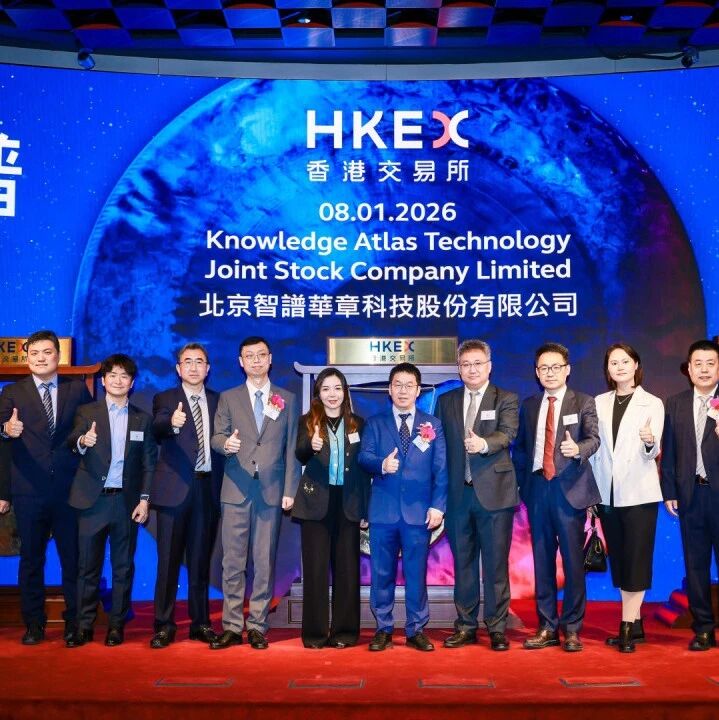
Core Viewpoint - Beijing Zhipu Huazhang Technology Co., Ltd. (referred to as "Zhipu") officially listed on the Hong Kong Stock Exchange on January 8, 2026, becoming the "first global large model stock" [3] Group 1: Company Overview - Zhipu has received support from numerous well-known institutions, industrial capital, and local government state-owned assets since its establishment [3] - The company has demonstrated its independent innovation in the underlying technology of artificial intelligence and its global competitiveness in model performance over six years [3] Group 2: Investment Insights - The initial investment interest in the new generation of AI began with the emergence of the Transformer architecture, leading to a shift from traditional "small model + tuning paradigm" to a new paradigm based on massive data [4] - The investment team conducted systematic research and comparisons with all emerging large model teams, finding Zhipu's model capabilities to be at a leading level during their evaluations [4] Group 3: Strategic Decisions - A key decision for Zhipu is to build an open-source ecosystem, allowing more developers to use their models and establish their own ecosystem [5] - The company’s extreme pursuit of technology and strategic layout in the open-source ecosystem have created a competitive moat in a fiercely competitive industry [5] Group 4: Broader Industry Context - The AI sector is entering a new round of industrial transformation, which is viewed as a long-term track [5] - The investment firm has also invested in leading companies in AI and hard technology, as well as various AI application fields, indicating a comprehensive approach to capturing development opportunities during the technological paradigm shift [5]
宇树科技“朋友圈” 多了腾讯
Shang Hai Zheng Quan Bao· 2026-01-08 00:29
Group 1 - Tencent's Robotics X Lab has formed a strategic partnership with Yushu Technology to enhance the application of Yushu's robots in various scenarios such as cultural tourism sites, shopping malls, and corporate exhibition halls [1] - The collaboration will leverage Tencent's Tairos embodied intelligent model to provide user-friendly tour guide and shopping services through Yushu's robots, aiming to set industry benchmarks [1] - Tencent participated in Yushu Technology's Series C financing, which was completed in June 2025, with major investors including China Mobile's fund, Tencent, Alibaba, Ant Group, and Geely Capital [1] Group 2 - The Tairos embodied model has been deployed in Yushu's G1 AI guide robot, named "Xiao Mo," which began its internship as a tour guide at the Dunhuang Mogao Grottoes Digital Exhibition Center on New Year's Day 2026 [2] - In Shanghai, the G1 robot also serves as a guide at the global headquarters of Guoling Law Firm, providing information about the firm's history and allowing clients to interact with the robot for inquiries [2] Group 3 - Other companies have also announced collaborations with Yushu Technology, including iFlytek, which offers AI services based on its Super Brain 2030 platform, covering over 500 smart robot manufacturers [3] - JD.com launched its first offline store in partnership with Yushu Technology, featuring products like the Go2 robotic dog and G1 humanoid robot, marking an expansion of the robot ecosystem into offline scenarios [3] - Rockchip has reported a high market share for its flagship product RK3588 in the robotics sector, collaborating with Yushu Technology and other notable clients on various types of robots [3]
CES 2026见证AI生态变局 中国厂商跻身全球核心阵营
2 1 Shi Ji Jing Ji Bao Dao· 2026-01-07 23:14
Core Insights - The competition among major chip manufacturers is intensifying around the foundational computing power for AI, with native AI hardware accelerating its large-scale implementation, transitioning from laboratory settings to consumer and industrial applications [1][2] - Chinese manufacturers are playing an increasingly significant role at global tech events, showcasing their advancements in AI hardware and capabilities, which are supported by their supply chain and R&D strengths [2][11] Group 1: Computing Power and AI Development - The rapid evolution of underlying computing infrastructure is crucial for the accelerated development of AI large models, with chip leaders emphasizing the exponential growth of computing power and the new application opportunities it creates [3][4] - NVIDIA's CEO highlighted the arrival of the "ChatGPT moment" for physical AI, indicating that machines are beginning to understand and act in the real world, with autonomous taxis being one of the first applications to benefit [3] - AMD's CEO noted that the floating-point computing power for training AI models is growing fourfold annually, with inference token consumption increasing by 100 times over the past two years, necessitating new product offerings to meet Yotta-scale infrastructure demands [4] Group 2: Emerging AI Applications - The potential of edge AI is significant, with advancements in smart wearable devices being highlighted as a new category of mobile terminals that will coexist with smartphones [5][6] - Qualcomm's CEO projected that the market for personal AI devices could reach 100 million units in the coming years, emphasizing the importance of edge data for providing highly relevant user services [6] Group 3: Robotics and Physical AI - The maturity of physical AI was showcased at CES, with Chinese manufacturers presenting advanced robots that demonstrate improved capabilities compared to previous years [7][8] - The introduction of humanoid robots and their increasing commercial viability was noted, with companies achieving substantial progress in motion control and operational precision [9][10] - The integration of hardware, sensors, and environmental perception into scalable systems is seen as essential for advancing physical AI applications across various industries [10] Group 4: Chinese Manufacturers' Competitive Edge - Chinese companies are leveraging their supply chain efficiencies and R&D capabilities to drive rapid iterations and cost optimization in the robotics sector, significantly outpacing European competitors in product development cycles [11][12] - The shift from simple manufacturing to innovative solutions reflects a broader transformation in the perception of "Made in China" to "Created in China," highlighting the technological advancements and better solutions being offered [12]