
邮储银行

Search documents
活跃度显著提升 今年以来A股市场 定增融资超7800亿元
Zhong Guo Zheng Quan Bao· 2025-12-25 21:52
Core Insights - The A-share market has seen significant activity in private placements this year, with 148 companies completing placements, raising a total of 788.895 billion yuan, a year-on-year increase of 455.31% [1][2][3] Group 1: Market Activity - As of December 24, 2023, 438 companies announced private placement plans, with 148 successfully completed, totaling 1,010.20 million shares issued [2] - In comparison to the same period in 2024, the number of companies completing placements increased by 20, and the total amount raised surged from 142.064 billion yuan to 788.895 billion yuan [2] - Major banks such as China Bank, Postal Savings Bank, and others raised over 1 billion yuan each, primarily for liquidity support [2] Group 2: Policy Impact - Analysts attribute the surge in private placements to a series of supportive policies aimed at guiding long-term capital into the market and optimizing financing directions [3] - Policies have broadened the channels for long-term capital and encouraged investments in technology innovation and industrial upgrades, establishing a solid foundation for the private placement market [3][8] Group 3: Industry Focus - The electronics, basic chemicals, and power equipment sectors are leading in the number of companies engaging in private placements, with 23, 17, and 15 companies respectively [4] - The technology sector, particularly in areas like semiconductors and AI, has become a focal point for private placement funding due to high demand for capital to overcome technological bottlenecks and expand production capacity [4][5] Group 4: Future Outlook - The private placement market is expected to remain active in 2026, with a focus on mergers and acquisitions, driven by industry consolidation and state-owned enterprise reforms [7] - The market is anticipated to evolve towards higher quality development, with a shift from discount-driven to profit-supported and value-exploration strategies [7] - Continued participation from institutional investors and the positive cycle of profitability from private placements are likely to attract more capital into the market [7][8]
今年以来A股市场定增融资超7800亿元
Zhong Guo Zheng Quan Bao· 2025-12-25 21:11
Core Insights - The A-share market has seen significant activity in private placements this year, with 148 companies completing placements, raising a total of 788.9 billion yuan, a year-on-year increase of 455.31% [1][2] Group 1: Market Activity - As of December 24, 2023, 438 companies announced private placement plans, with 148 successfully completed, totaling 1,010.2 million shares issued [1][2] - In comparison to the same period in 2024, the number of companies completing placements increased by 20, and the total amount raised surged from 142.1 billion yuan to 788.9 billion yuan [1][2] Group 2: Sector Focus - The electronics, basic chemicals, and power equipment sectors led the number of companies engaging in private placements, with 23, 17, and 15 companies respectively [3] - The technology sector has been a major focus, with companies seeking funds to address urgent needs for technological upgrades and capacity expansion [3][4] Group 3: Institutional Participation - Major banks such as Bank of China, Postal Savings Bank, and others raised over 1 billion yuan each, primarily for liquidity support, while the majority of other companies raised less than 30 billion yuan for various purposes [2] - The active participation of institutional investors has been driven by favorable policies and the attractive pricing of private placements, enhancing the appeal of investments in the technology sector [4][5] Group 4: Future Outlook - The private placement market is expected to remain active in 2026, with a focus on mergers and acquisitions, and an increasing concentration in sectors like semiconductors, AI, and high-end manufacturing [5][6] - The market is anticipated to evolve towards a more institutionalized and long-term focus, with a potential narrowing of discount rates on popular projects due to high investor enthusiasm [5][6]



中邮北证50成份指数增强型发起式证券投资基金基金合同生效公告
Shang Hai Zheng Quan Bao· 2025-12-25 18:26
Group 1 - The announcement states that from December 26, 2025, China Postal Savings Bank will act as a sales agent for the Zhongyou Health and Entertainment Flexible Allocation Mixed Securities Investment Fund [1] - The fund manager will bear the costs related to information disclosure, accounting, and legal fees during the fundraising period, which will not be paid from the fund's assets [1] - The fund manager's senior management and heads of investment and research departments will subscribe to a total of 500,000 to 1,000,000 fund shares, while the fund manager has not subscribed to any shares [1] Group 2 - Investors can conduct account opening, subscription, redemption, and regular investment through Postal Savings Bank starting from December 26, 2025 [3] - The initial subscription and additional subscription amounts have been adjusted to a minimum of 0.01 yuan, subject to Postal Savings Bank's regulations [3] - The fee rate for subscription and regular investment will not have discount limits, and if the original fee rate is a fixed fee, it will be executed at the original rate without discounts [3]
年内券商斥资超107亿元参与定增
Zheng Quan Ri Bao Zhi Sheng· 2025-12-25 16:34
Core Insights - The capital market has shown positive trends this year, with active investment and financing, particularly through private placements (定增) which have become a significant fundraising method for listed companies [1] - The total amount raised through private placements in A-shares has increased by over 375% year-on-year, providing more business opportunities for securities firms [1][2] Group 1: Market Performance - As of December 25, 153 listed companies have implemented private placements, raising a total of 814.25 billion yuan, marking a year-on-year increase of 375.14% [2] - Major banks such as China Bank, Postal Savings Bank, and others have led the market in fundraising, collectively raising 520 billion yuan [2] - The surge in the private placement market is attributed to multiple factors, including policy support, macroeconomic recovery, and strong investor confidence [2] Group 2: Securities Firms' Involvement - A total of 33 securities firms have participated in private placements this year, with CITIC Securities sponsoring 17 companies and earning 209 million yuan in underwriting and advisory fees [2] - Securities firms have engaged in 141 instances of private placements, with a total investment of 10.742 billion yuan, reflecting a year-on-year growth of 69.65% [3] - Leading firms like GF Securities and Guotai Junan have been actively involved, with GF participating in 38 placements and investing 2.735 billion yuan [3] Group 3: Investment Trends and Outcomes - The private placements have attracted significant interest from securities firms, which have utilized their research capabilities to select quality investment targets, thereby boosting market confidence [3] - Among the 69 companies that received investments, several have seen their stock prices double compared to their placement prices, indicating strong market performance post-placement [4] - The semiconductor industry has been a focal point, with 9 companies in this sector participating in private placements, reflecting the industry's growth potential [4]



5角纸币的拒收困局
Bei Jing Shang Bao· 2025-12-25 16:02
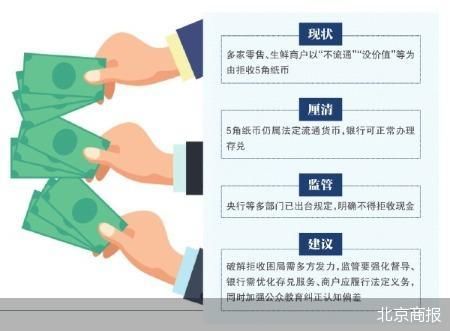
Core Viewpoint - The increasing rejection of 50-cent banknotes by merchants highlights a significant issue regarding cash payment rights and consumer protection in the context of growing mobile payment adoption [1][3][4] Group 1: Merchant Behavior - A survey of 15 merchants revealed that only 5 were willing to accept 50-cent banknotes, while 10 either outright refused or provided excuses such as "not in circulation" or "no one wants it" [3][4] - Many merchants, particularly individual business owners, lack awareness of regulations prohibiting the refusal of cash payments, leading to widespread rejection of small denomination banknotes [4][5] - The perception that small denomination banknotes are no longer valuable or in circulation is prevalent among merchants, which conflicts with their legal obligation to accept them [4][5] Group 2: Consumer Impact - The refusal to accept 50-cent banknotes disproportionately affects vulnerable groups, such as the elderly and rural residents, who rely on cash for transactions [5][6] - Consumers report accumulating 50-cent banknotes but facing difficulties spending them, as many merchants claim they are not accepted [4][5] Group 3: Regulatory Response - The People's Bank of China, along with other regulatory bodies, has issued new regulations to ensure cash payment rights, which will take effect on February 1, 2026 [9][10] - The regulations mandate that businesses maintain adequate cash reserves and cannot refuse cash payments, emphasizing the legal status of cash as a medium of exchange [9][10] - Regulatory measures will include penalties for businesses that refuse cash and initiatives to improve public awareness of cash payment rights [9][10] Group 4: Recommendations for Improvement - Experts suggest that banks should enhance the supply and circulation of small denomination cash, while community organizations should educate merchants about the legal status of cash [8][10] - A multi-faceted approach involving regulatory oversight, banking services, and merchant compliance is necessary to resolve the cash rejection issue and ensure the smooth circulation of small denomination banknotes [10]

数字金融创新提速:让技术监管技术 让数据“可用不可见”
Mei Ri Jing Ji Xin Wen· 2025-12-25 14:57
Core Insights - Digital finance is rapidly transforming the financial system and is becoming a key driver for high-quality economic development, but data security risks must be addressed [1] - The application of AI and other technologies in financial services is reshaping the industry, with a focus on customer-centric innovations and personalized financial products [2][3] - Regulatory bodies emphasize the importance of balancing innovation with risk management to ensure market stability [4] Digital Finance Development - Digital finance is a core pillar of the digital economy, leading to innovations such as digital wallets and facial recognition payments [1] - Financial institutions are increasingly adopting AI technologies to enhance service delivery and operational efficiency, with examples including ICBC's "AI+" initiative and the deployment of AI assistants at China Merchants Bank [2] Data Security Challenges - The integration of advanced technologies like generative AI, blockchain, and quantum computing presents multifaceted security challenges, including data privacy risks and potential vulnerabilities in AI systems [5][6] - The unique nature of financial data means that breaches can lead to significant systemic risks, necessitating robust security measures [5][6] Expert Recommendations for Risk Mitigation - Experts suggest a multi-faceted approach to data security, including enhancing protective measures, developing regulatory technology, and establishing comprehensive data governance frameworks [8] - The implementation of privacy-enhancing technologies and the establishment of unified data security standards are critical for safeguarding sensitive information [9]
数字金融狂奔下的创新与风险博弈:让技术监管技术,让数据可用不可见
Mei Ri Jing Ji Xin Wen· 2025-12-25 14:57
Group 1 - The concept of "digital finance" is becoming a core pillar of the digital economy, rapidly restructuring the financial system and driving high-quality economic development [1] - Data security risks in digital finance are a significant concern, as the leakage of core financial data can threaten the stability of the financial system and public interests [1] - Small and medium-sized financial institutions often lack robust security measures, complicating risk prevention and posing challenges to the industry's security governance [1] Group 2 - The development of digital finance is a key national strategy, with recent policies emphasizing the importance of digital finance in enhancing China's digital economy [2] - Financial institutions are undergoing digital transformation, focusing on customer-centric business model innovations and personalized financial products [2] - By mid-2025, major banks like ICBC are implementing AI initiatives to enhance various business areas, showcasing the integration of technology in financial services [2] Group 3 - AI applications in retail banking are expanding, with banks like China Merchants Bank and Postal Savings Bank utilizing AI to enhance customer service and operational efficiency [3] - The use of generative AI and other advanced technologies presents multifaceted security challenges, including data privacy risks and potential vulnerabilities in AI systems [5][6] - Experts suggest that the risks associated with generative AI and blockchain can be managed through improved technology and regulatory frameworks [7][8] Group 4 - Financial institutions are encouraged to adopt new technologies for risk management while ensuring market stability [5] - The integration of privacy-enhancing technologies and robust data governance frameworks is essential for addressing data security risks [8][9] - Industry-wide collaboration on data security standards and threat intelligence sharing is necessary to prevent isolated security challenges among institutions [9]
数字金融创新提速:让技术监管技术,让数据“可用不可见”
Mei Ri Jing Ji Xin Wen· 2025-12-25 14:49
Core Insights - Digital finance is rapidly transforming the financial system and is becoming a key driver for high-quality economic development, but it also brings significant data security risks [1][4] - The application of technologies like AI, blockchain, and quantum computing in finance presents complex security challenges that require comprehensive risk management strategies [5][6] Group 1: Digital Finance Development - Digital finance is a core pillar of the digital economy, reshaping financial services such as digital wallets and face recognition payments [1] - Financial institutions are innovating business models to be customer-centric, offering personalized financial products and integrating services into various life scenarios [2] - Major banks like ICBC and China Merchants Bank are leveraging AI to enhance customer service and operational efficiency, with ICBC launching over 100 AI applications [2][3] Group 2: Data Security Risks - Data security risks in digital finance are characterized by high concentration, rapid cross-industry transmission, and strong concealment of technical means [1] - The application of generative AI and other technologies can lead to dual risks, including unauthorized data scraping and potential leaks of sensitive financial information [5][6] - The financial sector faces challenges from API misuse, third-party cooperation vulnerabilities, and the inherent risks of emerging technologies like blockchain and quantum computing [6][7] Group 3: Regulatory and Risk Management - Regulatory bodies emphasize the importance of balancing innovation with risk control, ensuring that financial markets remain stable and orderly [4] - Experts suggest that financial institutions should enhance their data protection measures, develop regulatory technology, and establish comprehensive data governance frameworks [8][9] - There is a call for the establishment of unified data security standards and collaborative capabilities across the industry to avoid security silos [9]
这家总资产规模近19万亿的国有大行将迎来领导人员调整
Bei Ke Cai Jing· 2025-12-25 12:06
新京报贝壳财经讯(记者黄鑫宇)中国邮政集团有限公司(下称"邮政集团")近日在官方微信公众号披 露,在2025年12月23日召开的党组会议上,该集团宣布了中共中央组织部关于芦苇、刘建军的职务任免 决定。芦苇将出任邮政集团副总经理、党组成员,同时免去刘建军的邮政集团副总经理、党组成员职 务。相关职务任免按有关法律规定办理。 四年半前(即2021年6月1日),邮政集团党组召开会议,宣布了中共中央组织部关于刘建军任职的通 知:经研究,刘建军任邮政集团党组成员、副总经理。此后的2021年8月,他出任邮储银行行长。 刘建军现任邮储银行党委书记、行长。同样根据公开信息,他1965年8月出生,目前已年满60周岁。 Wind显示,截至2025年9月末,邮储银行总资产规模约为18.61万亿元,同比增长11.10%。 编辑 岳彩周 校对 柳宝庆 公开信息显示,芦苇系"70后"、出生于1971年10月,今年54周岁。1994年7月至1997年1月,他就职于北 京青年实业集团公司。1997年1月,芦苇加入中信银行,历任总行计划财务部(现财务会计部)副总经 理、总经理,资产负债部总经理,香港分行筹备组副组长,中信银行董事会秘书,深圳分行 ...
从追赶到领跑,邮储手机银行做对了什么?
Zhong Guo Zheng Quan Bao· 2025-12-25 11:21
Core Insights - The article emphasizes that mobile banking has evolved from being merely an online channel for financial services to a benchmark for assessing a bank's technological strength, user-centric thinking, and strategic foresight [1] - Postal Savings Bank of China (PSBC) has maintained the top position in user experience for mobile banking for three consecutive years, indicating its continuous evolution and responsiveness to user needs in the digital service sector [1][2] - The launch of the "AI2ALL" digital ecosystem and the mobile banking version 11.0 marks a significant transformation for PSBC, aiming to redefine digital financial services as a "smart partner" that understands user needs in the AI era [1][2] Digital Transformation - PSBC initiated a comprehensive reconstruction of its core system in 2022 to address service demands from its vast customer base, aiming to create a secure, agile, and self-controlled digital foundation [2] - The bank's digital strategy focuses on integrating AI applications across its operations, with plans for nearly 260 AI application scenarios to enhance customer service and operational management [2][3] Operational Efficiency - The bank has achieved a significant increase in its mobile banking user base, reaching 386 million personal mobile banking customers and nearly 86 million monthly active users as of June 2025 [4] - The operational model has shifted from one-way information push to a comprehensive customer engagement approach, enhancing user experience through a full-link intelligent operation system [7] Ecosystem Integration - PSBC has developed an ecological collaborative platform that allows for seamless integration of various financial services, providing a one-stop view for users to manage different types of benefits and services [8] - The bank's strategy includes creating localized service areas that cater to specific regional needs, enhancing the relevance of its offerings to everyday life [8] Service Innovation - The mobile banking version 11.0 introduces an AI-driven interaction model that simplifies complex financial operations into conversational commands, enhancing user experience [10][11] - The new version also features personalized service recommendations based on user behavior, aiming to make financial services more intuitive and accessible [11] Security Enhancements - Version 11.0 incorporates a multi-layered security system that includes a "social trust" dimension, allowing for collaborative protection against high-risk transactions [12] - New identity verification methods, such as voice verification through phone calls, have been introduced to strengthen account security [12]