君逸数码

Search documents
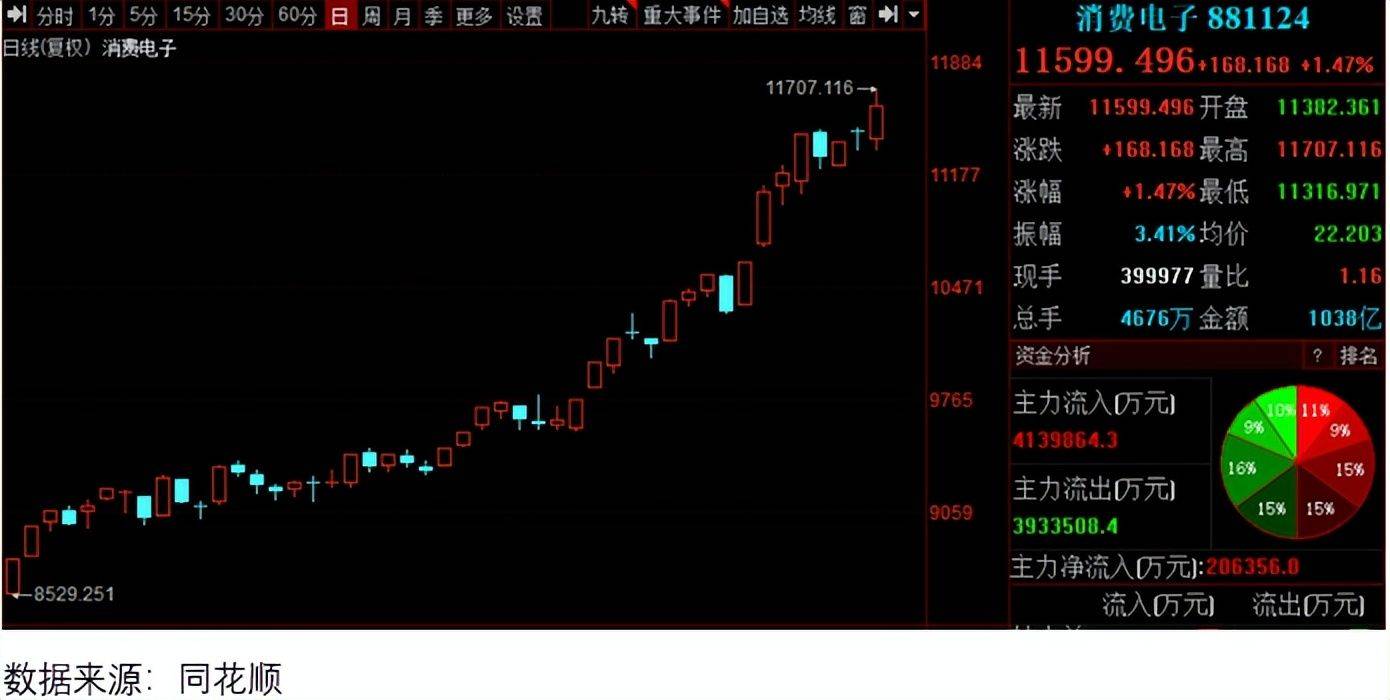
消费电子突然爆发,这套路很多板块都在用!
Sou Hu Cai Jing· 2025-08-28 02:16
Group 1 - The consumer electronics sector has recently surged, particularly driven by Huawei-related stocks, indicating a potential underlying trend rather than just news-driven excitement [1][4] - The performance of Huawei-related stocks, such as Junyi Digital and Aerospace Hongtu, suggests that their rise is not solely due to upcoming product launches but reflects deeper market dynamics [4][6] - Institutional investors have been quietly accumulating these stocks during periods of consolidation, which often leads to ordinary investors missing out on the subsequent rallies [6][10] Group 2 - The key to profiting in a bull market lies in the efficient use of capital, as some investors significantly outperform the market while others struggle to keep pace [7][9] - Many investors mistakenly believe that simply holding stocks during a bull market is sufficient, but this can lead to idle capital during long periods of price stagnation [9][10] - Recognizing institutional trading behaviors and timing entry points can enhance capital utilization and improve investment outcomes [10][12] Group 3 - Quantitative data analysis can reveal patterns in institutional trading, providing insights into when institutions are likely to start accumulating positions [10][12] - For instance, the "institutional inventory" data indicates the level of institutional activity, and a rise in this data often signals significant institutional buying [12][14] - Stocks like Silicon Treasure and Changchun Yidong have shown similar patterns of institutional accumulation prior to price increases, highlighting a consistent trend across different sectors [14][16][18] Group 4 - The recent activity in the consumer electronics sector is likely a result of prior institutional positioning, suggesting that the current market movements may be part of a longer-term trend rather than short-lived reactions to news [18]

创业板两融余额增加39.06亿元
Zheng Quan Shi Bao Wang· 2025-08-28 01:57
Group 1 - The latest financing balance of the ChiNext market is 455.76 billion yuan, with a week-on-week increase of 3.91 billion yuan, and 36 stocks have seen financing balances increase by over 10% [1] - The total margin balance of ChiNext stocks reached 457.22 billion yuan, marking a continuous increase for 13 trading days [1] - The stock with the largest increase in financing balance is Junyi Digital, which saw a 50.82% increase, despite a 6.90% drop in its stock price on the same day [1][3] Group 2 - Among the stocks with significant financing balance increases, 24 stocks experienced net inflows of main funds, with Longchuan Technology and Keda Intelligent leading with net inflows of 977 million yuan and 535 million yuan respectively [2] - Conversely, 12 stocks saw net outflows, with Shenghong Technology experiencing the largest outflow of 819 million yuan [2] - A total of 497 stocks experienced a decrease in financing balance, with 27 stocks seeing a decline of over 10%, led by Guangdong Construction Technology with a decrease of 29.82% [4][5] Group 3 - The stocks with the largest financing balance increases include Junyi Digital, Jiaheng Home, and Changchuan Technology, with increases of 50.82%, 42.74%, and 30.97% respectively [3][4] - The stocks with the largest financing balance decreases include Guangdong Construction Technology, Ruichen Environmental Protection, and Meihua Medical, with decreases of 29.82%, 29.19%, and 26.39% respectively [4][5] - The average performance of stocks with financing balance increases was a slight decline of 0.09%, with 12 stocks rising, including Keda Intelligent and Changchuan Technology, which rose by 19.19% and 16.98% respectively [1][3]

522股融资余额增幅超5%
Zheng Quan Shi Bao Wang· 2025-08-28 01:35
Market Overview - On August 27, the Shanghai Composite Index fell by 1.76%, while the total margin balance in the market reached 22,274.97 billion yuan, an increase of 198.85 billion yuan compared to the previous trading day [1] - The margin balance in the Shanghai Stock Exchange was 11,338.53 billion yuan, up by 113.06 billion yuan; in the Shenzhen Stock Exchange, it was 10,861.70 billion yuan, up by 84.86 billion yuan; and in the Beijing Stock Exchange, it was 74.73 billion yuan, up by 0.93 billion yuan [1] Industry Analysis - Among the industries tracked by Shenwan, 26 sectors saw an increase in margin balances, with the electronics sector leading with an increase of 42.81 billion yuan, followed by the power equipment and non-bank financial sectors, which increased by 21.46 billion yuan and 21.11 billion yuan, respectively [1] Individual Stock Performance - A total of 1,948 stocks experienced an increase in margin balances, accounting for 52.39% of the total, with 522 stocks seeing an increase of over 5% [1] - The stock with the largest increase in margin balance was Nengzhiguang, with a latest margin balance of 10.50 million yuan, reflecting a 166.02% increase, although its stock price fell by 7.36% on the same day [1] - Other notable stocks with significant increases in margin balances included Tianrun Technology and Junyi Digital, with increases of 60.53% and 50.82%, respectively [1] Top Gainers and Losers - Among the top 20 stocks with the largest increase in margin balances, the average price change was an increase of 0.76%, with Longchuan Technology, Jishi Media, and Qiming Information leading with increases of 16.98%, 10.14%, and 10.02%, respectively [2] - Conversely, Tianrun Technology, Nengzhiguang, and Junyi Digital were among the biggest losers, with declines of 8.28%, 7.36%, and 6.90%, respectively [2] Margin Balance Decrease - In contrast, 1,770 stocks saw a decrease in margin balances, with 418 stocks experiencing a decline of over 5% [4] - The stock with the largest decrease in margin balance was Patier, with a latest margin balance of 3.75 million yuan, down by 35.61% compared to the previous trading day [5] - Other stocks with significant decreases included Yifang Bio and Guangdong Jianke, with declines of 29.85% and 29.82%, respectively [5]
研判2025!中国数字城管(数字化城市管理)行业发展历程、产业链、市场规模、竞争格局及发展趋势分析:城市化进程加快,数字化城市管理需求不断提高[图]
Chan Ye Xin Xi Wang· 2025-08-28 01:15
Core Viewpoint - The rapid urbanization in China has led to an increased complexity in urban management, necessitating digital solutions like digital urban management, which is projected to reach a market size of 9.69 trillion yuan by 2024, reflecting a year-on-year growth of 13.73% [1][7]. Group 1: Industry Overview - Digital urban management refers to the integration of information technology and mobile communication to transform administrative processes, creating a centralized management and command center for efficient urban governance [3][5]. - The digital urban management model has evolved since 2003, transitioning from a rudimentary to a sophisticated system that enhances urban management efficiency [5][6]. Group 2: Market Size and Growth - By the end of 2024, China's urbanization rate is expected to reach 67%, a significant increase from 11% in 1949, marking the fastest urbanization process globally [1][7]. - The digital urban management industry is projected to grow to a market size of 9.69 trillion yuan in 2024, with a year-on-year increase of 13.73% [1][7]. Group 3: Industry Chain - The industry chain consists of upstream suppliers of hardware and software, midstream digital urban management services, and downstream applications in urban governance, including urban planning, traffic management, and public safety [6][7]. Group 4: Competitive Landscape - The industry is characterized by a "leading enterprises dominate + vertical field deep cultivation" structure, with major companies providing comprehensive solutions while niche players focus on specific areas like smart traffic and security [9][10]. Group 5: Development Trends - The industry is driven by supportive government policies aimed at enhancing urban infrastructure and management efficiency, with a focus on data sharing and integration [11]. - Technological advancements, including AI and IoT, are expected to enhance the effectiveness of digital urban management, leading to more intelligent and integrated systems [11][12]. - The shift towards collaborative governance will break down traditional departmental barriers, enabling seamless information sharing and coordinated responses to urban challenges [12].


IT服务板块8月27日跌0.64%,博汇科技领跌,主力资金净流出39.95亿元
Zheng Xing Xing Ye Ri Bao· 2025-08-27 08:46
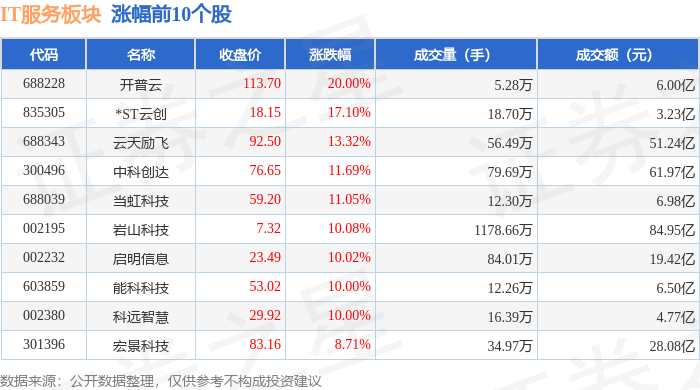
Market Overview - On August 27, the IT services sector declined by 0.64%, with Bohui Technology leading the drop [1] - The Shanghai Composite Index closed at 3800.35, down 1.76%, while the Shenzhen Component Index closed at 12295.07, down 1.43% [1] Top Performers - Key gainers in the IT services sector included: - Kaiyin Cloud (688228) with a closing price of 113.70, up 20.00% [1] - *ST Yunchuang (835305) at 18.15, up 17.10% [1] - Yuntian Lifi (688343) at 92.50, up 13.32% [1] - Zhongke Chuangda (300496) at 76.65, up 11.69% [1] - Other notable gainers included Danghong Technology (688039), Yanshan Technology (002195), and Qiming Information (002232) with increases ranging from 10.00% to 11.69% [1] Underperformers - Major decliners included: - Bohui Technology (688004) at 23.98, down 8.61% [2] - Tianrun Technology (430564) at 27.47, down 8.28% [2] - Junyi Digital (301172) at 25.76, down 6.90% [2] - Other significant losers included Aerospace Hongtu (688066) and Zhuoyi Information (688258) with declines of 6.67% and 6.42% respectively [2] Capital Flow - The IT services sector experienced a net outflow of 39.95 billion yuan from institutional investors and 7.92 billion yuan from retail investors, while retail investors saw a net inflow of 47.87 billion yuan [2][3] - Notable capital flows included: - Yanshan Technology (002195) with a net inflow of 23.84 million yuan from institutional investors [3] - Other companies like Dazhi Technology (600589) and Donghua Software (002065) also saw varying degrees of net inflows and outflows [3]


君逸数码股价跌5.02%,金鹰基金旗下1只基金位居十大流通股东,持有96.71万股浮亏损失134.43万元
Xin Lang Cai Jing· 2025-08-27 03:15
Group 1 - The core point of the news is that Junyi Digital's stock price has dropped by 5.02%, currently trading at 26.28 CNY per share, with a total market capitalization of 4.533 billion CNY [1] - Junyi Digital, established on May 16, 2002, is located in the Chengdu High-tech Zone of the China (Sichuan) Pilot Free Trade Zone and was listed on July 26, 2023. The company specializes in providing system integration services, operation and maintenance services, and self-developed product sales for smart city clients [1] - The trading volume for Junyi Digital reached 454 million CNY, with a turnover rate of 17.04% [1] Group 2 - Among the top ten circulating shareholders of Junyi Digital, the Jin Ying Fund has a new entry with the Jin Ying Reform Dividend Mixed Fund (001951), holding 967,100 shares, which accounts for 0.98% of the circulating shares. The estimated floating loss today is approximately 1.3443 million CNY [2] - The Jin Ying Reform Dividend Mixed Fund was established on December 2, 2015, with a latest scale of 966 million CNY. Year-to-date returns are 5.15%, ranking 6699 out of 8194 in its category, while the one-year return is 18.79%, ranking 5778 out of 7963 [2]
沪指、创指收跌 猪肉概念股持续强势
Mei Ri Shang Bao· 2025-08-27 01:01
Market Overview - A-shares experienced a volatile trading day following a significant increase on August 25, with the Shanghai Composite Index closing down 0.39% at 3868.38 points, while the Shenzhen Component Index rose 0.26% [1] - The market saw strong performance in sectors such as poultry, pork, gaming, chemicals, and consumer electronics, while sectors like medical services and rare earth permanent magnets faced declines [1] Sector Performance - The pork concept stocks remained strong, with Aonong Bio (603363) hitting the daily limit [1] - The gaming sector was active, with 37 Interactive Entertainment (002555) also reaching the daily limit [1] - The chemical sector showed continued activity, with Baiao Chemical (603360), Yuntu Holdings (002539), and Haiyang Technology (603382) all hitting the daily limit [1] - Consumer electronics stocks were lively, with companies like GoerTek (002241) reaching the daily limit [1] - In contrast, the medical services sector led the declines, with Sunlight Nuohuo and Hite Bio (300683) among the biggest losers [1] - The rare earth permanent magnet sector also faced downward pressure, with AVIC TianDa and Baosteel (600010) leading the declines [1] Huawei Concept Stocks - Huawei concept stocks collectively rose, with the Huawei Kunpeng Index and Huawei Harmony Index both increasing over 2% [2] - Notable performers included Junyi Digital (301172) which achieved a 20% limit up, and Aerospace Hongtu which surged over 10% [2] - The Harmony Index saw stocks like Tuwei Information (002261) hitting the daily limit, along with other companies such as Runhe Software (300339) and Changshan Beiming (000158) following suit [2] Upcoming Developments - On August 25, during the Harmony Intelligent Travel autumn product launch, SAIC and Huawei announced the pre-sale of their first model under the "Shangjie" brand, the H5 [2] - Huawei is set to release a new AI SSD product on August 27, which may significantly impact the existing landscape of China's AI storage market [2]


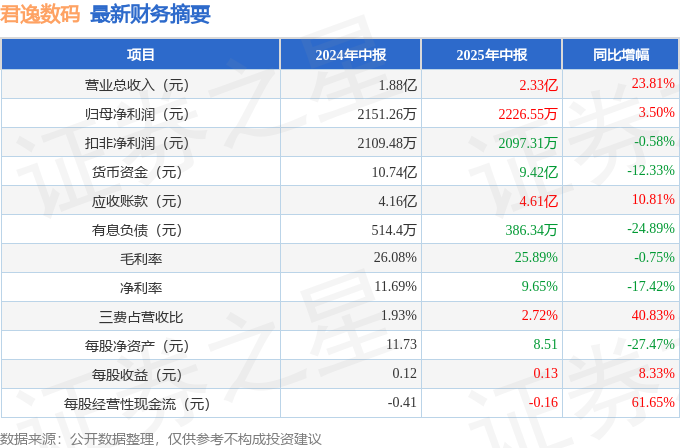
君逸数码2025年中报简析:营收净利润同比双双增长,公司应收账款体量较大
Zheng Quan Zhi Xing· 2025-08-26 23:08
Core Insights - The company reported a total revenue of 233 million yuan for the first half of 2025, representing a year-on-year increase of 23.81% [1] - The net profit attributable to shareholders reached 22.27 million yuan, up 3.5% year-on-year [1] - The second quarter showed significant growth, with total revenue of 211 million yuan, a 58.67% increase year-on-year, and a net profit of 20.45 million yuan, up 65.4% [1] Financial Performance - Total revenue for 2025 was 233 million yuan compared to 188 million yuan in 2024, a growth of 23.81% [1] - Net profit for 2025 was 22.27 million yuan, slightly up from 21.51 million yuan in 2024, marking a 3.5% increase [1] - Gross margin decreased to 25.89%, down 0.75% from the previous year, while net margin fell to 9.65%, a decrease of 17.42% [1] - Total receivables increased to 46.1 million yuan, a rise of 10.81% from 41.6 million yuan in 2024 [1] Cash Flow Analysis - Net cash flow from operating activities increased by 46.31% due to improved collection management [2] - Cash flow from investing activities saw a significant decrease of 73.97% as the company had fewer bank deposits maturing [2] - Cash flow from financing activities decreased by 54.86% due to reduced dividend payments [2] Asset and Liability Management - The company reported a significant increase in tax expenses by 34.49% due to higher profits [3] - The company’s cash and cash equivalents saw a net increase of 62.79%, attributed to reduced investment expenditures [2] - The company’s receivables to profit ratio reached 999.88%, indicating a high level of receivables relative to net profit [4] Investment Returns - The company's return on invested capital (ROIC) was reported at 1.83%, indicating weak capital returns [4] - Historical data shows a median ROIC of 14.18% since the company went public, suggesting better investment returns in the past [4] - The company’s financial health is indicated by a healthy cash asset position, although attention is needed on cash flow and receivables management [4]
20%涨停!A股国产软件概念股全线大涨 超级赛道迎来重磅催化
Cai Jing Wang· 2025-08-26 13:18
Core Viewpoint - The launch of the new generation of the Chinese operating system, Galaxy Kirin V11, has catalyzed a significant surge in domestic software stocks, indicating a robust growth potential in the domestic operating system market driven by supportive policies [1][2][6]. Market Performance - On August 26, A-share domestic software concept stocks experienced a collective surge, with the domestic software index reaching a nearly 10-year high. Notable stocks such as Kaipu Cloud, Zhengyuan Wisdom, and Junyi Digital achieved a 20% limit-up, while several others rose over 10% [2][6]. - The "2025 China Operating System Industry Conference" showcased the latest applications of Chinese operating systems across various sectors, including energy, finance, and healthcare [2]. Product Highlights - Galaxy Kirin V11 is the first domestic operating system to exceed one million ecosystems, demonstrating compatibility with major domestic CPUs, GPUs, and boards, and has been deployed in over 16 million sets [3][4]. - Key features of Galaxy Kirin V11 include: 1. Based on Linux Kernel 6.6, accelerating updates for domestic operating systems [4]. 2. Enhanced security measures to protect user privacy [4]. 3. Improved user experience with faster response times and AI upgrades [4]. 4. Collaborative ecosystem development with partners [4]. 5. User-driven product development [4]. Industry Growth Potential - The Chinese operating system market is projected to reach 58.6 billion yuan by 2025, with the software industry expected to maintain a compound annual growth rate of 12%-15% over the next 5-10 years [1][6]. - The software industry in China is anticipated to exceed 15 trillion yuan by 2025 and 20 trillion yuan by 2028 [6]. - The industrial software sector is crucial for the high-quality development of intelligent manufacturing and is expected to experience rapid growth as core technologies advance [6][7]. Policy Support - The Chinese government has emphasized the importance of self-controlled operating systems in national information and cybersecurity strategies, with policies encouraging the procurement of domestic software and hardware [5][6][7]. - The State-owned Assets Supervision and Administration Commission has mandated that by 2027, state-owned enterprises must achieve 100% domestic replacement across the entire industry chain, including chips and operating systems [6].

【太平洋科技-每日观点&资讯】(2025-08-27)
远峰电子· 2025-08-26 11:09
Market Overview - The main board led the gains with notable increases in stocks such as Helitai (+10.06%), Zhongdian Xilong (+10.05%), and Lingyi Zhi Zao (+10.03%) [1] - The ChiNext board saw significant growth with Zhengyuan Zhihui (+20.02%) and Junyi Shumao (+19.99%) leading the charge [1] - The Sci-Tech Innovation board also performed well, with Kaipu Yun (+20.00%) and Haitan Ruisheng (+14.54%) among the top gainers [1] - Active sub-industries included SW LED (+2.53%) and SW Consumer Electronics Components and Assembly (+2.28%) [1] Domestic News - Jingsheng Co. announced plans to acquire controlling interest in Beijing Weizhun through a share issuance and cash payment, along with raising matching funds [1] - Sairisi Group reported that its subsidiary Sairisi Automotive acquired 48.54% of Jinkang Power from a minority shareholder for 663 million yuan [1] - Xiaopeng Motors and Chip Alliance announced the successful mass production of China's first hybrid silicon carbide power product, combining high-cost SiC MOSFETs with mature IGBT technology [1] - Sanan Optoelectronics revealed that its 8-inch silicon carbide chip production line in Hunan has commenced operations, with a monthly capacity of 1,000 pieces for 8-inch substrates and 16,000 pieces for 6-inch substrates [1] Company Announcements - Nanda Optoelectronics reported total revenue of 1.229 billion yuan for H1 2025, a year-on-year increase of 9.48%, with a net profit of 208 million yuan, up 16.3% [3] - Benchuan Intelligent announced H1 2025 revenue of 380 million yuan, reflecting a 36.91% year-on-year growth, and a net profit of 21 million yuan, up 37.33% [3] - Haoshanghao reported H1 2025 revenue of 3.884 billion yuan, a 16.13% increase year-on-year, with a net profit of 34 million yuan, up 71.05% [3] - Yinxin Technology disclosed H1 2025 revenue of 838 million yuan, a 7.36% increase year-on-year, with a net profit of 49 million yuan, up 20.89% [3] International News - Nvidia launched the Jetson AGX Thor developer kit and production module, designed for robotics applications, offering up to 2070 FP4 TFLOPS of AI computing performance [4] - Meta developed a new ultra-thin flat laser display screen, promising lighter and more immersive AR glasses, with a thickness of only 2mm and a color gamut coverage of 211% [4] - Samsung's sixth-generation high-bandwidth memory HBM4 samples have passed Nvidia's validation, with mass production expected by the end of the year [4] - Imec and Ghent University announced successful epitaxial growth of 120 layers of Si/SiGe on 300mm silicon wafers, paving the way for commercial 3D DRAM [4]