
宁波银行

Search documents
每日报告精选(2026-02-11 09:00——2026-02-12 15:00)
GUOTAI HAITONG SECURITIES· 2026-02-12 07:45
Macroeconomic Insights - January non-farm employment data exceeded expectations with an increase of 130,000 jobs, significantly higher than the anticipated 65,000[2] - The unemployment rate unexpectedly dropped to 4.3%, despite a rise in labor participation rate[2] - The Federal Reserve may pause interest rate cuts until June, with market expectations for a rate cut probability of less than 6% in March[3] Inflation and Economic Trends - The U.S. economy is transitioning from a "K-shaped" recovery to a "re-inflation" phase, with high-net-worth individuals stabilizing the economy through refinancing[6] - Inflation expectations are self-reinforcing, with actual mortgage rates at a three-year low, contributing to a recovery in the housing sector[8] - The housing affordability index remains above 100, indicating that median-income households can still afford homes despite high prices[21] Industry-Specific Developments - The traditional electronic fabric market is experiencing accelerated price increases due to supply shortages, with prices rising by 0.5-0.6 RMB/m[43] - The AI electronic fabric sector is expected to see significant growth in 2026, driven by demand from AI chips and consumer electronics[46] - The coal industry is projected to benefit from a resurgence in coal power in the U.S., with companies like Peabody Energy and China Shenhua expected to gain[51]



双融日报-20260212
Huaxin Securities· 2026-02-12 01:31
Core Insights - The report indicates a neutral market sentiment with a score of 47, suggesting a balanced outlook for investors [2][9] - Key investment themes identified include power grid equipment, banking, and consumer sectors, each with specific growth drivers and investment opportunities [6] Group 1: Power Grid Equipment - The global demand for high-power and high-stability transformers is driven by the significant energy consumption of AI data centers, leading to a supply-demand imbalance, particularly in the U.S. where delivery times have reached 127 weeks [6] - China's State Grid is set to invest 4 trillion yuan during the 14th Five-Year Plan, focusing on ultra-high voltage and smart distribution networks, providing long-term order support for the industry [6] - Relevant stocks in this sector include China Western Power (601179) and TBEA Co., Ltd. (600089) [6] Group 2: Banking Sector - Bank stocks are characterized by high dividend yields, with the China Securities Bank Index yielding 6.02%, significantly above the 10-year government bond yield [6] - In a slowing economy with increased market volatility, bank stocks are becoming important investment targets for long-term funds such as insurance and social security [6] - Key banking stocks mentioned are Agricultural Bank of China (601288) and Ningbo Bank (002142) [6] Group 3: Consumer Sector - The macro policy for 2026 emphasizes expanding domestic demand and promoting consumption, which is expected to positively influence market sentiment [6] - The consumer market is undergoing significant changes, characterized by three new trends: "emotional value" in self-consumption (e.g., gold and jewelry), "extreme value-for-money" in bulk snacks and discount stores, and "efficiency innovation" in AI e-commerce and brand expansion [6] - Notable consumer stocks include Yonghui Superstores (601933) and Wangfujing (600859) [6]
银行开卷春节新钞,有的还能“送钞上门”!10元、20元小面额紧俏
Xin Lang Cai Jing· 2026-02-12 00:48
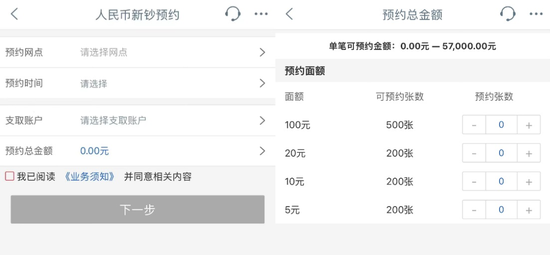
Core Viewpoint - The demand for new banknotes is increasing as the Spring Festival approaches, with many banks offering convenient online reservation services for new currency, making it easier for the public to obtain cash without long queues [1][2][4]. Group 1: Online Reservation Services - Multiple banks, including major state-owned and joint-stock banks, provide online reservation services for new banknotes through their apps, allowing users to select the branch, time, and amount for pickup [1][2]. - For example, the Industrial and Commercial Bank of China (ICBC) app allows users in Beijing to reserve up to 57,000 yuan in a single transaction, with specific limits on the number of banknotes for different denominations [2][3]. - The Agricultural Bank of China has introduced a "door-to-door" delivery service for new banknotes in Shenzhen, where users can reserve up to 20,000 yuan and receive the cash at home [6]. Group 2: Demand for Small Denominations - There is a notable shortage of small denomination banknotes, particularly 10 yuan and 20 yuan notes, while 100 yuan notes are relatively more available [4][8]. - Bank staff have indicated that while larger denominations are sufficient, smaller ones are in high demand, prompting recommendations for customers to reserve in advance through mobile banking [8]. Group 3: Special Products for the Spring Festival - Several banks are launching special products and services themed around "lucky money" for the Spring Festival, such as the "Freedom Card" from Guangfa Bank, which aims to help manage and allocate "lucky money" effectively [9]. - Beijing Rural Commercial Bank has introduced a dedicated savings product for children, offering various fixed-term savings options with competitive interest rates [10]. - Many banks are also targeting year-end bonuses with tailored financial products, including wealth management services and promotional activities to attract customers [11][12].

“揽储大战”明暗线: 中小行加息送礼,大行向AUM要增长
Zhong Guo Zheng Quan Bao· 2026-02-12 00:25
Core Viewpoint - The banking sector is experiencing a renewed wave of deposit attraction strategies as the Spring Festival approaches, with many small and medium-sized banks raising deposit rates and introducing innovative products to enhance their asset management scale in response to the upcoming maturity of fixed deposits in 2026 [1][4]. Group 1: Deposit Rate Adjustments - Several banks have raised their deposit rates, with some offering rates as high as 1.95% for three-year fixed deposits, reflecting a 10 basis point increase from previous rates [2]. - Banks are implementing differentiated adjustments for various term deposits, with some offering rates up to 30 basis points above the listed rates for large deposits [2]. - The trend of increasing deposit rates is particularly pronounced among city commercial banks, rural commercial banks, and village banks, while larger state-owned banks maintain stable rates [4]. Group 2: Innovative Deposit Incentives - In addition to raising rates, banks are launching promotional activities such as offering gifts like rice, oil, and shopping vouchers to attract depositors [3]. - A notable initiative includes a "Deposit for Travel Expenses" program, where depositors can receive reimbursements for travel costs when making fixed deposits above a certain amount [3]. Group 3: Asset Management Focus - Some banks are shifting their focus from merely attracting deposits to increasing their overall asset management scale (AUM) by offering rewards for maintaining or increasing financial assets [5][6]. - The financial assets include a range of products such as deposits, wealth management, funds, and insurance, indicating a broader strategy to enhance customer engagement and retention [6]. Group 4: Future Trends in Deposits - The impending maturity of deposits in 2026 is expected to lead to a significant shift in where these funds will be allocated, with potential movements towards short-term savings, low-risk asset management products, and a small portion into equity markets [6][7]. - The growth of asset management products is seen as a response to the market's evolving dynamics, with a notable increase in the total assets of these products reaching 120 trillion yuan, a 13.1% year-on-year growth [7][8]. Group 5: Implications for Banking Sector - The shift in deposit flows towards asset management products is not expected to create a liquidity gap but rather reflects a rebalancing of the liability structure within the banking system [8]. - Different banks may experience varying impacts on their funding costs and stability due to their unique customer structures and the effects of wealth management product alternatives [8].

中欧稳健添悦债券型证券投资基金 开放日常申购、赎回、转换、定期定额 投资业务的公告
Zhong Guo Zheng Quan Bao - Zhong Zheng Wang· 2026-02-11 22:40
登录新浪财经APP 搜索【信披】查看更多考评等级 公告送出日期:2026年2月12日 1.公告基本信息 ■ 2.日常申购、赎回、转换业务的办理时间 根据中欧稳健添悦债券型证券投资基金(以下简称"本基金")《基金合同》、《招募说明书》的规定, 基金管理人可根据实际情况依法决定本基金开始办理申购的具体日期,具体业务办理时间在申购开始公 告中规定。 基金管理人自基金合同生效之日起不超过3个月开始办理赎回,具体业务办理时间在赎回开始公告中规 定。 在确定申购开始与赎回开始时间后,基金管理人应在申购、赎回开放日前依照《信息披露办法》的有关 规定在规定媒介上公告申购与赎回的开始时间。基金管理人不得在基金合同约定之外的日期或者时间办 理基金份额的申购、赎回或者转换。投资人在基金合同约定之外的日期和时间提出申购、赎回或转换申 请且登记机构确认接受的,其基金份额申购、赎回价格为下一开放日该类基金份额申购、赎回的价格。 其他销售机构的销售网点每个账户首次申购本基金任一类别基金份额的最低金额为1.00元(含申购费, 下同),追加申购的最低金额为单笔0.01元,在不违反前述规定的前提下,各销售机构对本基金最低申 购金额及交易级差有其 ...
黄金大消息!又一国有大行宣布,上调起购金额
Zhong Guo Ji Jin Bao· 2026-02-11 22:38
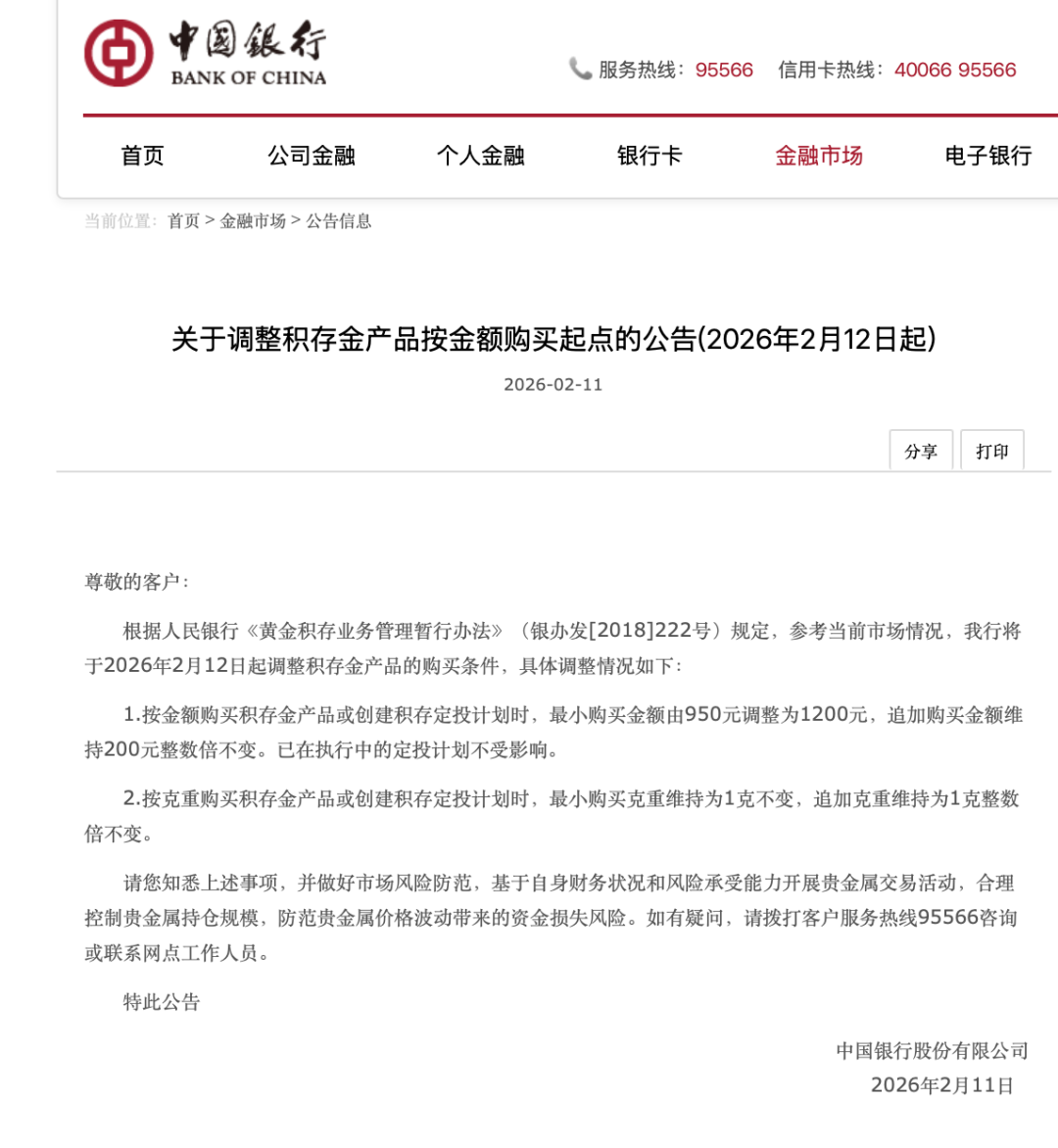
Group 1 - The core point of the article is that China Bank has adjusted the minimum purchase amount for its accumulation gold products from 950 yuan to 1200 yuan, effective February 12, 2026 [1][2] - The adjustment in purchase conditions includes maintaining the additional purchase amount at 200 yuan and keeping the minimum weight for purchasing gold at 1 gram unchanged [2] - This change follows a trend among several banks, including Industrial and Commercial Bank of China and Agricultural Bank of China, which have also raised their minimum purchase amounts for accumulation gold products in early 2026 [5] Group 2 - In 2025, China Bank raised the minimum purchase amount for accumulation gold products four times, starting from 650 yuan in February and reaching 950 yuan by October [4] - The overall trend in the banking industry shows a tightening of access to accumulation gold business, with banks responding to regulatory requirements and market conditions to protect investors from irrational short-term trading [5] - The gold prices have shown significant volatility, with recent trends indicating a rebound above 5000 USD per ounce, which may influence banks' strategies regarding gold accumulation products [6][9]
建信睿丰纯债定期开放债券型发起式证券投资基金 基金开放日常申购、赎回业务公告
Zhong Guo Zheng Quan Bao - Zhong Zheng Wang· 2026-02-11 22:33
Group 1 - The fund is a bond-type securities investment fund managed by CCB Fund Management Co., Ltd. and will operate in a periodic open manner, alternating between closed and open periods [1][2] - The upcoming open period for the fund is from February 24, 2026, to March 23, 2026, which marks the 27th open period since the fund's inception [1][3] - The fund's closed period lasts for three months following the effective date of the fund contract or the day after each open period ends [2] Group 2 - During the open period, investors can process subscription and redemption transactions on normal trading days of the Shanghai and Shenzhen Stock Exchanges [3] - The minimum subscription amount for the fund is set at 1 RMB for both initial and additional subscriptions [4] - The fund management may adjust subscription limits and fees in accordance with legal regulations and will announce such changes in advance [8][9] Group 3 - Redemption requests must be for at least one fund share, and if the remaining balance is less than one share, the entire amount must be redeemed [10] - The redemption fee decreases based on the holding period, with a fee of 1.5% for holdings of less than 7 days and no fee for holdings over one closed period [11] - The fund management can implement a swing pricing mechanism during large redemptions to ensure fair valuation [12] Group 4 - The fund is sold through various sales institutions, including direct sales by CCB Fund Management and other non-direct sales institutions [14] - The fund's net asset value and cumulative net value will be disclosed the day after each open day [14] - Investors must follow the sales institution's procedures and submit applications within the specified business hours during the open period [15][16]
“揽储大战”明暗线: 中小行加息送礼 大行向AUM要增长
Zhong Guo Zheng Quan Bao· 2026-02-11 21:05
Core Viewpoint - The banking sector is experiencing a renewed wave of deposit acquisition strategies as the Spring Festival approaches, with many small and medium-sized banks raising deposit rates and introducing innovative products to attract customers, in response to the upcoming 2026 deposit maturity wave [1][4]. Group 1: Deposit Rate Adjustments - Several banks have raised their deposit rates, with some offering rates as high as 1.95% for three-year fixed deposits, reflecting a 10 basis point increase from previous rates [2]. - Banks are implementing differentiated adjustments for various term deposits, with increases ranging from 5 to 30 basis points depending on the amount and term [2]. - The trend of raising deposit rates is particularly pronounced among city commercial banks, rural commercial banks, and village banks, while larger state-owned banks maintain stable rates [4]. Group 2: Innovative Deposit Incentives - In addition to raising rates, banks are launching promotional activities such as offering gifts like rice, cooking oil, and shopping vouchers to attract depositors [3]. - A notable initiative includes a "Deposit for Travel Expenses" program, where depositors can receive reimbursements for travel costs when making fixed deposits above a certain amount [3]. Group 3: Asset Under Management (AUM) Focus - Some banks are shifting their focus from merely acquiring deposits to increasing their overall asset management scale (AUM) by offering incentives for customers to grow their financial assets [5]. - Programs that reward customers for increasing their average financial assets are being introduced, indicating a strategic pivot towards comprehensive wealth management [5]. Group 4: Future Deposit Trends - Analysts predict a significant wave of deposit maturities in 2026, with potential shifts in where these funds will be allocated, including a movement towards low-risk asset management products and possibly equities [6]. - The People's Bank of China notes that while there may be a perception of deposit "loss," these funds are likely to return to the banking system through various channels, including asset management products [7][8].
“揽储大战”明暗线:中小行加息送礼 大行向AUM要增长
Zhong Guo Zheng Quan Bao· 2026-02-11 20:23
Core Viewpoint - The banking sector is experiencing a new wave of deposit acquisition strategies as the Spring Festival approaches, with many small and medium-sized banks raising deposit rates and introducing innovative products to attract customers. This is a response to the upcoming maturity of fixed-term deposits in 2026, prompting banks to enhance their wealth management offerings and optimize their liability structures [1][5]. Group 1: Deposit Rate Adjustments - Several banks have raised deposit rates, with some offering rates as high as 1.95% for three-year fixed deposits, reflecting a 10 basis point increase from previous rates [1]. - Banks are implementing differentiated adjustments for various term deposits, with some products seeing rate increases of 5 to 30 basis points depending on the deposit amount and term [2]. - The trend of increasing deposit rates is primarily observed in city commercial banks, rural commercial banks, and village banks, while larger state-owned banks maintain stable rates [3]. Group 2: Innovative Deposit Acquisition Strategies - Some banks are offering additional benefits such as gifts and reimbursement for travel expenses to attract depositors, with initiatives like "Deposit for Travel Expenses" aimed at migrant workers returning home for the New Year [2][3]. - The reimbursement scheme allows customers to claim back a percentage of their deposit amount for travel expenses, with specific conditions on the types of receipts accepted [3]. Group 3: Asset Under Management (AUM) Focus - Many banks are shifting their focus from merely acquiring deposits to increasing their overall asset management scale (AUM) through diversified financial products and customer incentives [4]. - Banks are implementing programs that reward customers for increasing their average financial assets, indicating a strategic move towards enhancing customer engagement and loyalty [4]. Group 4: Future Trends in Deposit Flows - Analysts predict a significant outflow of deposits in 2026, with potential shifts towards short-term savings, low-risk asset management products, and a small portion moving into equity markets [5][6]. - The growth of asset management products is expected to continue, with a notable increase in total assets reaching 120 trillion yuan by year-end, reflecting a 13.1% year-on-year growth [6]. Group 5: Implications for Banking Sector - The changes in deposit flows and the rise of asset management products are seen as a rebalancing of the banking sector's liability structure, which may impact banks' funding costs and interest margin management [7]. - The differentiation in banks' liability costs and stability is likely to become more pronounced, affecting their competitive positioning in the market [7].

长江证券(上海)资产管理有限公司关于长江乐鑫纯债定期开放债券型发起式证券投资基金第二十七个开放期开放申购与赎回业务的公告
Shang Hai Zheng Quan Bao· 2026-02-11 18:46
Group 1 - The fund "Changjiang Lexin Pure Bond Regular Open-End Fund" will have its 27th open period from February 24, 2026, to March 9, 2026, during which investors can apply for subscription and redemption [1][2] - The fund operates on a regular open-end basis, with a closed period of three months between open periods, and will enter its 28th closed period starting March 10, 2026 [1][2] - The minimum subscription amount for the fund is set at RMB 10 for the first subscription and RMB 1 for additional subscriptions through sales institutions, while the minimum for direct sales is RMB 1 [4][5] Group 2 - The fund's subscription fee is structured to decrease as the subscription amount increases, and it is charged on a front-end basis [6] - Investors must submit their subscription applications during the specified business hours on open days, and the confirmation of successful subscriptions will occur on the next business day [7][10] - The fund allows a minimum redemption of 10 fund shares per transaction, and if the balance falls below this threshold, the sales institution may process a full redemption [8][9] Group 3 - The fund management company is responsible for disclosing the fund's net asset value at least weekly during the closed period and daily during the open period [12] - Investors are encouraged to refer to the fund's prospectus and other legal documents for detailed information regarding the fund's operations and regulations [14] - The fund allows a single investor to hold more than 50% of the fund shares and is not available for individual investors [15]
