沪农商行

Search documents
1月20日贷款财政贴息四项政策点评:“一揽子”贷款财政贴息政策影响几何?
EBSCN· 2026-01-21 11:17
Investment Rating - The report maintains a "Buy" rating for the banking industry, indicating an expected investment return exceeding the market benchmark index by more than 15% over the next 6-12 months [29] Core Insights - The "package" loan interest subsidy policies aim to stimulate consumption and investment, focusing on enhancing effective domestic demand through financial and fiscal collaboration [2][7] - The new policies are expected to significantly increase the scale of interest subsidies compared to previous measures, with a projected subsidy scale of approximately 1000 to 2000 billion yuan for 2026 [17][19] Summary by Sections Loan Subsidy Policies - The policies include four main areas: subsidies for small and micro enterprises, equipment updates, service industry operators, and personal consumption loans, with a focus on key industries such as new energy vehicles and medical equipment [4][6] - The subsidy rate for small and micro enterprise loans is set at 1.5 percentage points, with a maximum loan amount of 50 million yuan per entity, potentially providing up to 150,000 yuan in subsidies [4][6] - The equipment update loan subsidy has been increased from 1% to 1.5%, expanding the scope to include technology innovation loans and related fields [4][6] - The personal consumption loan subsidy has removed previous restrictions, allowing for broader eligibility and a maintained subsidy rate of 1% [5][6] Economic Impact - The policies are designed to alleviate financial burdens on small and micro enterprises, encouraging investment and job stability, particularly in high-tech and essential service sectors [7][8] - The expected increase in loan demand from these sectors is anticipated to support the overall credit recovery in the economy, particularly for retail and service industries [7][8] Market Outlook - The report suggests that the coordinated fiscal and monetary policies will positively impact the banking sector's loan volume and pricing, particularly benefiting banks focused on small and micro enterprises and retail finance [23] - The banking sector has seen a decline in stock performance, and the new policies are expected to act as a catalyst for recovery, especially in the context of the "opening red" period for banks [23]
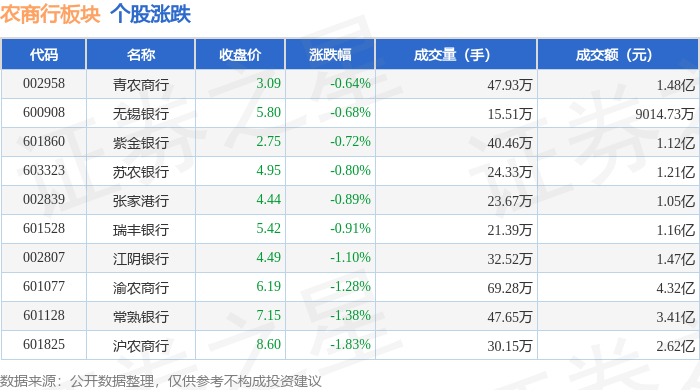
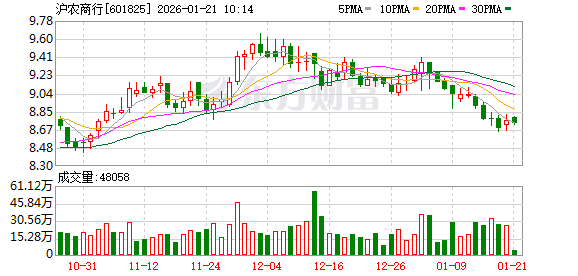
农商行板块1月21日跌1.32%,沪农商行领跌,主力资金净流入1.07亿元
Zheng Xing Xing Ye Ri Bao· 2026-01-21 08:55
Core Viewpoint - The rural commercial bank sector experienced a decline of 1.32% on January 21, with the Shanghai Rural Commercial Bank leading the drop, while the overall Shanghai Composite Index rose by 0.08% [1] Group 1: Market Performance - The Shanghai Composite Index closed at 4116.94, up 0.08%, and the Shenzhen Component Index closed at 14255.12, up 0.7% [1] - The rural commercial bank sector saw various individual stock performances, with the following notable declines: - Shanghai Rural Commercial Bank: -1.83% - Changshu Bank: -1.38% - Chongqing Rural Commercial Bank: -1.28% [1] Group 2: Trading Volume and Capital Flow - The total trading volume for the rural commercial bank sector was significant, with the following notable figures: - Jiangyin Bank: 32.52 million shares traded - Yunnan Bank: 69.28 million shares traded [1] - The net capital flow for the rural commercial bank sector showed a net inflow of 107 million yuan from institutional investors and a net inflow of 109 million yuan from retail investors, while retail investors had a net outflow of 217 million yuan [1] Group 3: Individual Stock Capital Flow - The following stocks had notable capital flows: - Shanghai Rural Commercial Bank: 34.33 million yuan net inflow from institutional investors, but a net outflow of 62.48 million yuan from retail investors [2] - Chongqing Rural Commercial Bank: 29.51 million yuan net inflow from institutional investors, with a net outflow of 38.80 million yuan from retail investors [2] - Zhangjiagang Bank: 18.05 million yuan net inflow from institutional investors, but a net outflow of 24.22 million yuan from retail investors [2]





太猛了!6700亿半导体巨头飙涨超13%!成交额A股第一!贵金属集体暴动,板块都要涨停了...
雪球· 2026-01-21 08:34
Market Overview - A-shares experienced a high and then a pullback, with the Shanghai Composite Index closing up 0.08%, the Shenzhen Component Index up 0.7%, and the ChiNext Index up 0.54%. The STAR Market 50 Index surged by 3.53%. The total trading volume in the Shanghai and Shenzhen markets was 2.6 trillion yuan, a decrease of 177.1 billion yuan from the previous trading day, with over 3,000 stocks in the green [2]. Semiconductor Sector - The semiconductor sector saw a significant rebound, with the 670 billion yuan giant Haiguang Information rising over 13%, becoming the top traded stock in A-shares. Other stocks like Longxin Zhongke and Zhishang Technology hit the 20% limit up, while Huahong Semiconductor and SMIC rose over 4% [4][5]. - Multiple factors have driven the semiconductor sector's strength, including TSMC's announcement of record revenue and profit growth due to AI chip demand, and a major technological breakthrough in domestic semiconductor equipment [8]. Precious Metals - The precious metals sector experienced a collective surge, nearing limit up, with stocks like Hunan Silver, Sichuan Gold, and Zhaojin Gold hitting the limit up, while others like Zhongjin Gold and Shandong Gold rose over 8% [10]. - Gold prices reached a high of 4,888 USD per ounce before retreating slightly but remained above 4,850 USD. Domestic gold jewelry prices are generally above 1,440 yuan per gram [12]. Banking Sector - The banking sector faced declines, with major state-owned banks like China Construction Bank and Industrial and Commercial Bank of China dropping over 2%. The overall banking index fell by 1.18% [15][16]. - Factors contributing to the banking sector's underperformance include a shift in capital towards high-growth sectors and pressure on interest margins. However, some banks like Shanghai Pudong Development Bank reported positive earnings, indicating potential recovery [17].

撬动需求,激活场景,上海农商银行多维助推服务业发展与消费提振
Jin Rong Jie· 2026-01-21 03:27
Core Viewpoint - Shanghai Rural Commercial Bank actively responds to the recently released measures aimed at enhancing service quality and boosting consumption in Shanghai, focusing on enriching personal financial services, activating diverse consumption scenarios, and strengthening support for business entities [1] Group 1: Enriching Financial Services for Diverse Consumer Groups - Shanghai Rural Commercial Bank serves over 24 million individual customers and manages more than 800 billion yuan in personal financial assets, effectively leveraging financial resources to promote consumption [2] - The bank has launched the "Happiness Express" initiative in collaboration with the Shanghai Federation of Trade Unions to enhance the utility of the Union Membership Service Card, which has over 6 million cardholders, by providing financial services and consumer discounts [2] - The bank has partnered with merchants to offer consumption discounts and incentives through various payment platforms, aiming to drive quality offline consumption [2] Group 2: Expanding Services for the Elderly Population - Shanghai Rural Commercial Bank provides pension distribution services to over 1.2 million elderly clients, establishing 114 specialized financial service outlets for seniors [3] - The bank has introduced a "six-special" service system and the first "Elderly Life Experience Center" in the city, offering various subsidies and discounts on essential goods and services for the elderly [3] - The bank has also enhanced personal consumption loan offerings, particularly in the automotive sector, to stimulate quality consumption [3] Group 3: Expanding Service Boundaries through Diverse Consumption Scenarios - The bank is creating a "Finance + Life" ecosystem by integrating financial services with various consumption scenarios, including travel, culture, and health [4] - In the travel sector, the bank collaborates with airlines and travel agencies to offer travel consumption rights products and optimize services for seniors [4] - The bank promotes cultural consumption through partnerships with local media and cultural institutions, providing family-friendly cultural experiences [4] - In health services, the bank offers a range of health-related services through its online platforms [4] Group 4: Strengthening Financing Support for Business Entities - The bank has provided approximately 80 billion yuan in credit support to 24,000 small and micro enterprises, addressing their financial pressures [5] - It has issued over 2.9 billion yuan in entrepreneurial guarantee loans, ranking first in the city, to support employment stability [6] - The bank has pioneered various intellectual property financing products and actively engages businesses in intellectual property financial services [6] Group 5: Commitment to Inclusive Finance - By 2026, Shanghai Rural Commercial Bank aims to enhance its role as a service-oriented bank, focusing on high-quality service supply to meet and activate high-quality consumption demand [7]
撬动需求激活场景 上海农商银行多维助推服务业发展与消费提振
Xin Hua Cai Jing· 2026-01-21 02:14
作为上海市大城养老命题的"答题人",上海农商银行服务全市近八成老年人口,为120余万客户提供养 老金代发服务。为满足银龄群体品质、实惠的消费需求,上海农商银行充分发挥网点密集、贴近社区的 独特优势,打造114家养老金融特色网点,推出"六专"服务体系,推出全市首家"适老生活体验馆",构 建"养老金融网点+民政适老化+辅具租赁体验+促银发消费"服务新模式,围绕"健康养老、日常生活、 便捷出行、文化体验"等核心场景,提供适老辅具、健康监测设备等品牌康养用品满减、老字号生活必 需品折扣、社区食堂及连锁药店立减、家电清洗及上门洗衣等补贴,切实提升养老品质、助力消费扩 容。 此外,上海农商银行还推出了丰富的个人消费贷款优惠,进一步优化汽车消费贷款服务流程、提供更多 汽车消费贴息贷款产品等,更好发挥个人贷款产品的品质消费促进作用。 聚焦多维消费场景,拓展服务边界 近日,《上海市促进服务业提质增效和消费提振扩容联动发展的若干措施》(简称《若干措施》)发 布,上海农商银行积极响应政策要求,从丰富个人金融服务、激活多元消费场景、强化经营主体支持等 维度,进一步优供给、促消费、稳增长、惠民生。 聚焦多元消费人群,丰富金融服务 作为 ...
A股银行年度盘点:2025告别普涨,2026拥抱分化
3 6 Ke· 2026-01-21 00:59
Core Insights - In 2025, A-share listed banks in China experienced a significant shift in development logic, moving from scale competition to value creation, focusing on core business and providing precise financial services to support high-quality economic development [1][2] Group 1: Market Performance - The A-share banking sector showed notable structural differentiation in 2025, with the Shanghai Composite Index and Shenzhen Component Index rising by 18.41% and 29.87% respectively, while the banking sector index increased by 12.04% [1] - By the end of 2025, the total market capitalization of A-share banks reached 14.65 trillion yuan, with 35 out of 42 listed banks seeing their stock prices rise, and 19 banks experiencing gains exceeding 10% [1] - In contrast to the broad market rally in 2024, where the banking sector index rose by 43.56%, 2025 marked a transition to a more selective investment environment [1] Group 2: Performance of Major Banks - Agricultural Bank of China led the sector with a stock price increase of 52.66% in 2025, while other major banks like Industrial Bank, China Construction Bank, and Bank of China saw increases of 21.54%, 12.87%, and 10.75% respectively [4] - The total market capitalization of the four major state-owned banks remains dominant, with Industrial Bank at 2.63 trillion yuan and Agricultural Bank at 2.61 trillion yuan [4] - The performance of other major banks was hindered by large capital increases, as several banks announced plans to raise a total of 520 billion yuan through stock issuance [4][5] Group 3: Performance of Joint-Stock Banks - Joint-stock banks exhibited further performance differentiation in 2025, with Shanghai Pudong Development Bank leading with a 24.56% increase, while banks like Huaxia Bank, Everbright Bank, and Minsheng Bank saw declines of 9.82%, 5.59%, and 3.09% respectively [6][7] - The decline in stock prices for these banks can be attributed to poor operating performance, with Huaxia Bank and Everbright Bank reporting revenue and profit declines [8] - Regulatory penalties also impacted these banks, with Huaxia Bank facing over 120 million yuan in fines, indicating ongoing compliance pressures [10][12] Group 4: Regional and Cooperative Banks - City and rural commercial banks showed mixed performance, with Xiamen Bank rising by 35.78%, while others like Zhengzhou Bank and Beijing Bank experienced declines [11] - Regulatory penalties for city commercial banks were significant, with Shanghai Bank and Beijing Bank facing fines exceeding 3.8 million yuan and 3.6 million yuan respectively [12] Group 5: Investment Outlook for 2026 - The investment logic for bank stocks is expected to evolve towards value reassessment, with a focus on performance growth and compliance levels becoming critical for individual stock performance [19] - The banking sector is anticipated to transition from a "growth weak cycle" to a "reform deep water zone," suggesting a dual strategy of holding stable, high-dividend large banks while selectively investing in high-potential regional banks [18][19] - The average price-to-book ratio for the banking sector was approximately 0.73, indicating a structural recovery, with Agricultural Bank exceeding 1.0, while others remained below this threshold [13]






上海北特科技集团股份有限公司 关于2025年度以简易程序向特定对象发行A股股票发行情况报告书披露的提示性公告
Zhong Guo Zheng Quan Bao - Zhong Zheng Wang· 2026-01-20 23:28
Core Viewpoint - Shanghai Beite Technology Group Co., Ltd. has successfully completed the issuance of A-shares to specific investors for the year 2025, raising approximately RMB 300 million, with net proceeds amounting to approximately RMB 293.84 million after deducting issuance costs [4]. Group 1: Issuance Details - The company issued a total of 7,980,845 shares at a price of RMB 37.59 per share, resulting in a total fundraising amount of RMB 299,999,963.55 [4]. - The net proceeds from the fundraising, after deducting issuance expenses of RMB 6,160,704.11, amounted to RMB 293,839,259.44 [4]. - The funds were fully received by January 14, 2026, and the accounting firm Zhonghui CPA has verified the receipt of these funds [4]. Group 2: Fund Management and Supervision - The company has established a special account for the management and storage of the raised funds, in compliance with relevant regulations [5][6]. - A tripartite supervision agreement has been signed between the company, the sponsor China Galaxy Securities, and the bank where the special account is held, ensuring oversight of the fund's usage [6][12]. - The special account for the funds related to the Thailand screw production base project has a balance of RMB 295.80 million as of January 14, 2026, and is strictly designated for this project [7][12]. Group 3: Regulatory Compliance - The company is required to comply with various laws and regulations, including the Securities Issuance and Listing Sponsorship Business Management Measures and the Shanghai Stock Exchange's self-regulatory guidelines [6][12]. - The sponsor has the right to supervise the fund usage and can conduct on-site investigations at least semi-annually [7][12]. - Any significant withdrawals from the special account must be reported to the sponsor, ensuring transparency and accountability in fund management [9][14].

多家银行卫星,近期集中上天
3 6 Ke· 2026-01-20 13:43
Core Viewpoint - The recent surge in commercial aerospace has prompted banks to actively participate in satellite launches to enhance their risk control capabilities, utilizing satellite remote sensing technology for real-time monitoring of loan projects and collateral status [1][2]. Group 1: Satellite Launches by Banks - Multiple leading banks, including China Merchants Bank and Shanghai Pudong Development Bank, have successfully launched satellites, with the latest being "Zhaoyin Jinkui" and "Puyin Shuzhi" satellites, part of China's first global low-orbit satellite IoT constellation, "Tianqi Constellation" [2][3]. - The satellites are aimed at improving smart risk control and comprehensive service systems, especially in extreme scenarios like natural disasters, enabling rapid recovery and provision of essential financial services [2][3]. Group 2: Applications of Satellite Technology - The satellite technology is being utilized for post-loan monitoring, with China Merchants Bank achieving over 95% accuracy in monitoring construction progress of mortgage properties through high-resolution satellite imagery [2][3]. - The integration of satellite data is expected to enhance risk management and provide more precise financial products and services to clients [3]. Group 3: Industry Trends and Future Outlook - The use of satellite remote sensing technology is becoming an integral part of banks' digital risk control systems, with major banks like ICBC and Bank of China highlighting its role in enhancing credit risk management in their 2025 semi-annual reports [4]. - Smaller banks are also beginning to adopt satellite technology, with institutions like Shanghai Rural Commercial Bank integrating satellite remote sensing with big data and AI to improve risk control capabilities [5]. - As the costs of satellite launches and data procurement decrease, the penetration of satellite remote sensing technology in the banking sector is expected to increase, benefiting larger banks with complex business scenarios [5].


多家银行卫星,近期集中上天
财联社· 2026-01-20 11:47
Core Viewpoint - The recent surge in commercial aerospace has prompted banks to actively participate in satellite launches to enhance their risk control capabilities, utilizing satellite remote sensing technology for real-time monitoring of loan projects and collateral status [1][2]. Group 1: Satellite Launches by Banks - Multiple leading banks, including China Merchants Bank and Shanghai Pudong Development Bank, have successfully launched satellites as part of the "Tianqi Constellation," China's first global low-orbit satellite IoT network [2]. - The satellites are aimed at improving smart risk control and comprehensive service systems, particularly in extreme scenarios like natural disasters, enabling rapid recovery and provision of essential financial services [2][3]. - China Merchants Bank's "Zhaoyin Jinkui" satellite is designed for post-loan monitoring, achieving over 95% accuracy in construction progress monitoring through high-resolution satellite imagery [2][3]. Group 2: Industry Trends and Applications - The use of satellite remote sensing technology is becoming increasingly common among banks, with several major banks already implementing it to optimize their business and risk management [3][4]. - The integration of satellite data is seen as a significant upgrade in risk control methods, particularly beneficial in areas like rural revitalization, green finance, and supply chain finance, addressing information asymmetry and reducing credit risks [4]. - Major banks, such as ICBC and Bank of China, have reported plans to enhance their credit risk management through satellite technology in their 2025 semi-annual reports [4]. Group 3: Future Prospects and Challenges - Smaller regional banks are also beginning to engage in satellite technology, with institutions like Shanghai Rural Commercial Bank enhancing their smart supply chain platforms through the integration of satellite remote sensing and other technologies [5]. - Analysts suggest that while the costs associated with satellite launches and data integration are currently high, larger banks are better positioned to adopt these technologies, whereas smaller banks may need to collaborate or procure data services [5]. - As the deployment of low-orbit satellite networks accelerates and data costs decrease, the penetration of satellite remote sensing technology in the banking sector is expected to increase [5].

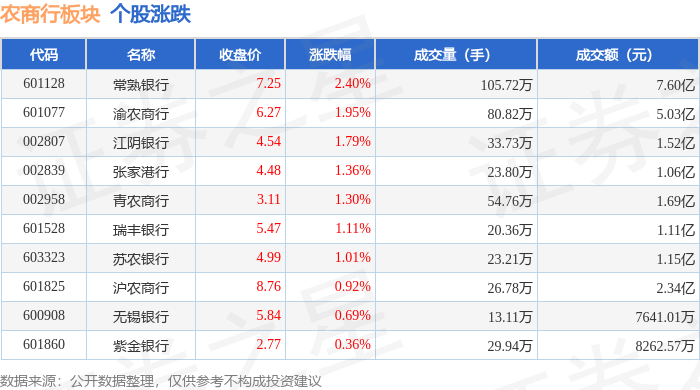
农商行板块1月20日涨1.37%,常熟银行领涨,主力资金净流入1201.4万元
Zheng Xing Xing Ye Ri Bao· 2026-01-20 08:56
Group 1 - The agricultural commercial bank sector increased by 1.37% on January 20, with Changshu Bank leading the gains [1] - The Shanghai Composite Index closed at 4113.65, down 0.01%, while the Shenzhen Component Index closed at 14155.63, down 0.97% [1] - The trading volume and turnover for Changshu Bank were 1.0572 million shares and 760 million yuan, respectively, with a price increase of 2.40% [1] Group 2 - The net inflow of main funds in the agricultural commercial bank sector was 12.014 million yuan, while retail investors experienced a net outflow of 47.1263 million yuan [1] - The net inflow of speculative funds was 35.1124 million yuan [1] - Specific banks like Chongqing Rural Commercial Bank saw a main fund net inflow of 44.9272 million yuan, while Changshu Bank had a significant net outflow of 61.4796 million yuan [2]