苏州银行

Search documents
城商行板块1月16日跌1.27%,江苏银行领跌,主力资金净流出2.29亿元
Zheng Xing Xing Ye Ri Bao· 2026-01-16 08:56
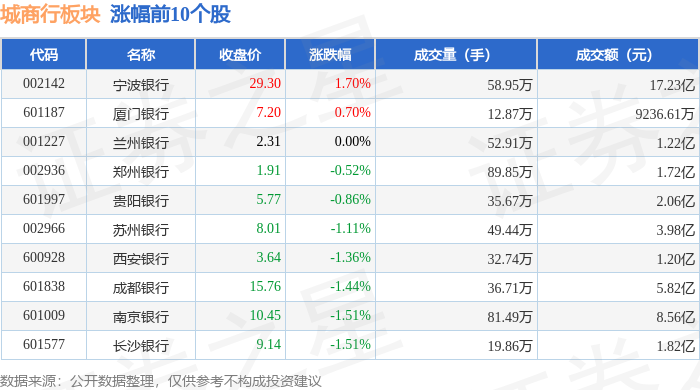
Core Viewpoint - The city commercial bank sector experienced a decline of 1.27% on January 16, with Jiangsu Bank leading the drop. The Shanghai Composite Index closed at 4101.91, down 0.26%, while the Shenzhen Component Index closed at 14281.08, down 0.18% [1]. Group 1: Stock Performance - Ningbo Bank closed at 29.30, up 1.70% with a trading volume of 589,500 shares and a transaction value of 1.723 billion [1]. - Xiamen Bank closed at 7.20, up 0.70% with a trading volume of 128,700 shares and a transaction value of 92.3661 million [1]. - Jiangsu Bank closed at 9.76, down 2.69% with a trading volume of 2,061,300 shares and a transaction value of 2.033 billion [2]. - Shanghai Bank closed at 9.64, down 2.43% with a trading volume of 961,200 shares and a transaction value of 933.3 million [2]. Group 2: Capital Flow - The city commercial bank sector saw a net outflow of 229 million from main funds, while speculative funds had a net inflow of 716 million, and retail investors experienced a net outflow of 487 million [2]. - Hangzhou Bank had a main fund net inflow of 153 million, while retail investors saw a net outflow of 113 million [3]. - Nanjing Bank recorded a main fund net inflow of 70.5 million and a retail net outflow of 131 million [3].




银行财富管理架构变阵 抢滩300万亿居民资产
2 1 Shi Ji Jing Ji Bao Dao· 2026-01-15 15:07
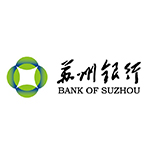
Core Insights - The wealth management market is heating up, with banks accelerating the integration of their wealth management departments to capture this promising market [1][2] - By June 2025, China's investable assets are expected to exceed 300 trillion yuan, indicating significant growth potential in wealth management as many assets remain "asleep" [1] - Major banks are restructuring their organizational frameworks to enhance their wealth management strategies and business layouts [1] Group 1: Bank Actions and Adjustments - In 2025, several major banks, including Bank of Communications and Postal Savings Bank, announced the establishment of wealth management departments at the head office level [3] - As of June 2025, 19 listed banks have established or adjusted their wealth management-related departments, including 2 state-owned banks, 7 joint-stock banks, 8 city commercial banks, and 2 rural commercial banks [3][4] - The establishment of these departments is seen as a key move for state-owned banks to deepen their wealth management strategies and promote digital transformation [3] Group 2: Strategic Focus and Market Dynamics - Different banks are focusing on various aspects of wealth management, with some emphasizing the establishment of wealth management departments as a core strategy [5] - The restructuring of wealth management departments signals a strategic shift in response to narrowing interest margins and evolving customer demands for diversified asset allocation [6][7] - The actions of major state-owned banks serve as a bellwether for the industry, indicating a shift from incremental competition to in-depth management of existing clients [8] Group 3: Wealth Management Market Landscape - As of June 2025, the retail asset management scale (AUM) among 42 listed banks shows a clear tiered structure, with state-owned banks leading the market [11] - The first tier includes major state-owned banks like ICBC, ABC, and CCB, with AUMs of 24 trillion yuan, 23.68 trillion yuan, and 22 trillion yuan respectively [11] - The second tier consists mainly of joint-stock banks, while the third tier includes city commercial banks and rural commercial banks, which are crucial for local wealth management ecosystems [11] Group 4: Future Competition and Technological Integration - Future competition in wealth management will focus on service quality, technological capabilities, and comprehensive financial ecosystems [13] - The establishment of wealth management departments aims to shift banks from product-driven to customer-driven models, enhancing service consistency and customer loyalty [13] - Financial technology is expected to play a critical role in enhancing service depth and breadth, with AI being utilized for investment advisory and customer experience management [14][15]
苏州银行(002966) - 2026年1月15日投资者关系活动记录表
2026-01-15 11:28
Group 1: Business Strategies - The bank is focusing on expanding its middle-income sources by enhancing wealth management services and diversifying asset allocation for clients [1] - The bank is actively pursuing new business growth points in government bond sales, non-financial corporate bond underwriting, and custody services [1] Group 2: Market Outlook - The bank plans to strengthen its investment research capabilities and improve market trend analysis to enhance returns amidst fluctuations in the bond market [2] - The bank will closely monitor changes in the internal and external operating environment to adapt its strategies accordingly [2] Group 3: Risk Management - The bank is committed to maintaining a comprehensive risk management system that covers all aspects and processes, aiming to keep asset quality stable throughout the year [2] - Continuous optimization of credit policies and approval strategies is being implemented to prevent and mitigate risks effectively [2] Group 4: Communication and Compliance - During the investor relations activity, there was thorough communication between the company representatives and investors, adhering to regulations without disclosing any undisclosed significant information [2]
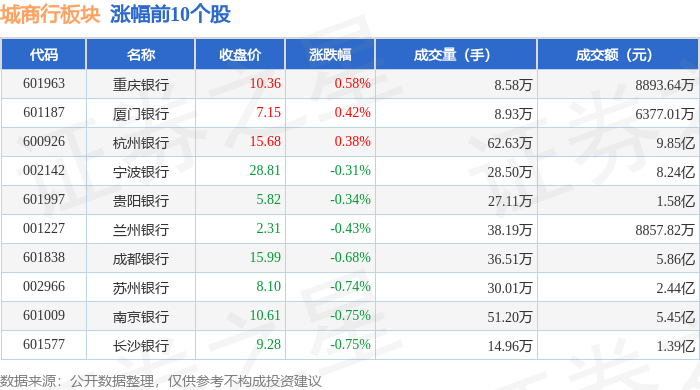
城商行板块1月15日跌0.59%,青岛银行领跌,主力资金净流入2.21亿元
Zheng Xing Xing Ye Ri Bao· 2026-01-15 08:59
Market Performance - The city commercial bank sector declined by 0.59% on January 15, with Qingdao Bank leading the decline [1] - The Shanghai Composite Index closed at 4112.6, down 0.33%, while the Shenzhen Component Index closed at 14306.73, up 0.41% [1] Individual Stock Performance - Chongqing Bank closed at 10.36, up 0.58% with a trading volume of 85,800 shares and a transaction value of 88.94 million [1] - Xiamen Bank closed at 7.15, up 0.42% with a trading volume of 89,300 shares and a transaction value of 63.77 million [1] - Hangzhou Bank closed at 15.68, up 0.38% with a trading volume of 626,300 shares and a transaction value of 9.85 billion [1] - Ningbo Bank closed at 28.81, down 0.31% with a trading volume of 285,000 shares and a transaction value of 824 million [1] - Chengdu Bank closed at 15.99, down 0.68% with a trading volume of 365,100 shares and a transaction value of 586 million [1] Capital Flow Analysis - The city commercial bank sector saw a net inflow of 221 million from institutional investors and a net inflow of 296 million from speculative funds, while retail investors experienced a net outflow of 517 million [2] - Hangzhou Bank had a net inflow of 123 million from institutional investors, accounting for 12.51% of its total [3] - Shanghai Bank had a net inflow of 97.02 million from institutional investors, representing 20.87% of its total [3] - Nanjing Bank had a net inflow of 37.40 million from institutional investors, making up 6.86% of its total [3]

对近期重要经济金融新闻、行业事件、公司公告等进行点评:晨会纪要-20260115
Xiangcai Securities· 2026-01-15 07:26
Industry Overview - The report highlights the ongoing upward trend in copper prices, although there is a temporary backwardation in the spot market, indicating a potential short-term adjustment rather than a definitive price reversal [3] - Supply growth for copper is maintained, but the cumulative growth rate has decreased month-on-month, while demand is affected by the reduction of national subsidies, particularly in the white goods sector [3] - The report maintains a bullish outlook on copper prices due to persistent supply-demand tightness, despite concerns over tariffs and geopolitical tensions [3][4] Aluminum Market Insights - Aluminum prices continue to rise, accompanied by a temporary backwardation, with the price spread between electrolytic aluminum and alumina widening [4] - The demand for aluminum remains stable, particularly in the automotive sector, although growth rates are slowing in new energy vehicles and photovoltaic installations [5] - The report anticipates that aluminum prices will remain high in 2026, with a bullish outlook on electrolytic aluminum prices and a bearish view on alumina prices [5] Platinum and Palladium Analysis - Platinum prices surged in December, with futures exceeding 700 RMB per gram, driven by strong demand from the automotive sector [6] - The supply of platinum is concentrated in South Africa, leading to a tight balance between supply and demand, with a cautious bullish outlook for 2026 [6] - Palladium prices also rose sharply, but the demand is weakening due to the decline in gasoline vehicle markets, leading to a neutral to bearish outlook for palladium prices [6][7] Investment Recommendations - The report suggests a bullish stance on copper and aluminum prices, a cautious bullish view on platinum, and a neutral to bearish outlook on palladium [9] - Investment targets include upstream leaders in the copper sector, particularly those engaged in copper mine acquisitions, and companies in the electrolytic aluminum segment [9] - The report maintains an "overweight" rating for the non-ferrous metals industry [9] Banking Sector Insights - The central bank's recent meeting emphasized maintaining a moderately loose monetary policy, focusing on optimizing financial services for high-quality economic development [11] - The report indicates a stabilization of credit market interest rates, with a shift from quantity growth to quality improvement in bank credit [12] - The banking sector is expected to benefit from stable interest margins and high dividend yields in a low-interest-rate environment, with recommendations for state-owned banks and regional banks [13]
城商行板块1月14日跌2.11%,北京银行领跌,主力资金净流出7.29亿元
Zheng Xing Xing Ye Ri Bao· 2026-01-14 08:58
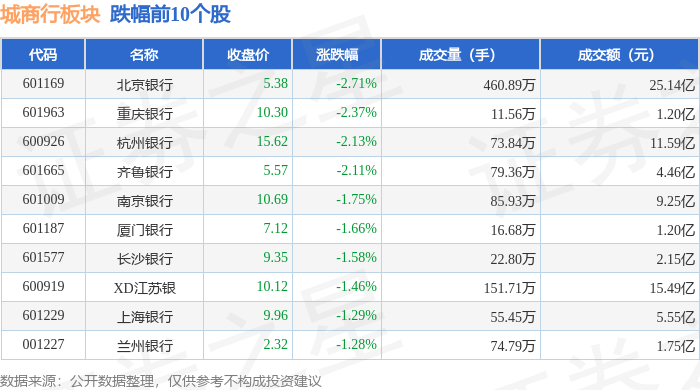
Core Viewpoint - The city commercial bank sector experienced a decline of 2.11% on January 14, with Beijing Bank leading the drop, while the overall market showed mixed results with the Shanghai Composite Index down 0.31% and the Shenzhen Component Index up 0.56% [1] Group 1: Market Performance - The closing price of Beijing Bank was 5.38, down 2.71%, with a trading volume of 4.6089 million shares and a transaction value of 2.514 billion [1] - Other notable declines included Chongqing Bank at 10.30 (-2.37%), Hangzhou Bank at 15.62 (-2.13%), and Qilu Bank at 5.57 (-2.11%) [1] - The city commercial bank sector saw a net outflow of 729 million in main funds, while retail investors contributed a net inflow of 53.1975 million [1] Group 2: Fund Flow Analysis - Hangzhou Bank had a main fund net inflow of 1.20 billion, but a net outflow from retail investors of 92.9469 million [2] - Suzhou Bank recorded a net inflow of 52.503 million from main funds, while retail investors had a net outflow of 54.0558 million [2] - Shanghai Bank experienced a main fund net inflow of 45.3249 million, with a retail net outflow of 46.6735 million [2]
城商行板块1月13日涨1.55%,宁波银行领涨,主力资金净流入2.38亿元
Zheng Xing Xing Ye Ri Bao· 2026-01-13 09:06
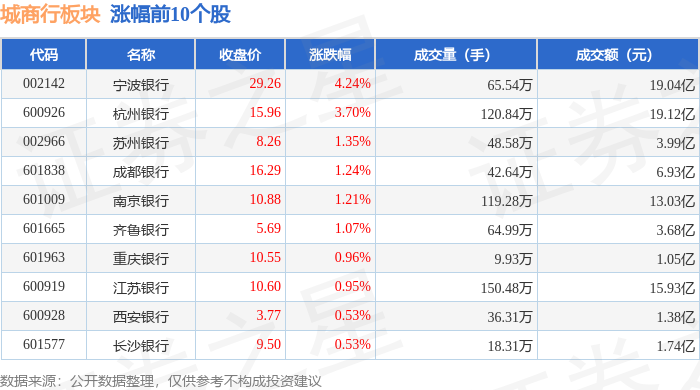
Core Insights - The city commercial bank sector experienced a rise of 1.55% on January 13, with Ningbo Bank leading the gains [1] - The Shanghai Composite Index closed at 4138.76, down 0.64%, while the Shenzhen Component Index closed at 14169.4, down 1.37% [1] Stock Performance - Ningbo Bank (002142) closed at 29.26, up 4.24%, with a trading volume of 655,400 shares and a transaction value of 1.904 billion [1] - Hangzhou Bank (600926) closed at 15.96, up 3.70%, with a trading volume of 1,208,400 shares and a transaction value of 1.912 billion [1] - Suzhou Bank (002966) closed at 8.26, up 1.35%, with a trading volume of 485,800 shares [1] - Chengdu Bank (601838) closed at 16.29, up 1.24%, with a trading volume of 426,400 shares and a transaction value of 693 million [1] - Nanjing Bank (600109) closed at 10.88, up 1.21%, with a trading volume of 1,192,800 shares and a transaction value of 1.303 billion [1] - Qilu Bank (601665) closed at 5.69, up 1.07%, with a trading volume of 649,900 shares and a transaction value of 368 million [1] - Chongqing Bank (601963) closed at 10.55, up 0.96%, with a trading volume of 99,300 shares and a transaction value of 10.5 million [1] - Jiangsu Bank (616009) closed at 10.60, up 0.95%, with a trading volume of 1,504,800 shares and a transaction value of 1.593 billion [1] - Xi'an Bank (600928) closed at 3.77, up 0.53%, with a trading volume of 363,100 shares and a transaction value of 13.8 million [1] - Changsha Bank (601577) closed at 9.50, up 0.53%, with a trading volume of 183,100 shares and a transaction value of 174 million [1] Capital Flow - The city commercial bank sector saw a net inflow of 238 million from institutional investors, while retail investors contributed a net inflow of 199 million [2] - The sector experienced a net outflow of 437 million from speculative funds [2] Individual Stock Capital Flow - Hangzhou Bank (600926) had a net inflow of 70.42 million from institutional investors, while it faced a net outflow of 12.4 million from speculative funds [3] - Shanghai Bank (601229) saw a net inflow of 66.71 million from institutional investors, with a net outflow of 33.15 million from speculative funds [3] - Ningbo Bank (002142) had a net inflow of 37.18 million from institutional investors, with a net outflow of 1.4 million from speculative funds [3] - Suzhou Bank (002966) experienced a net inflow of 34.87 million from institutional investors, while facing a net outflow of 24.25 million from speculative funds [3] - Jiangsu Bank (601577) had a net inflow of 20.83 million from institutional investors, with a net outflow of 15.24 million from speculative funds [3]

200万元、叠加补贴最低2%!消费贷利率低位运行
Zhong Guo Jing Ying Bao· 2026-01-13 06:04
Core Viewpoint - In January 2026, consumer loan products are being offered at historically low annual interest rates, with some banks providing rates as low as 2.00% when subsidies are applied, and loan amounts reaching up to 2 million yuan [1][4]. Group 1: Consumer Loan Products - Several banks have introduced promotional policies for consumer loans in January 2026, with one bank announcing a maximum loan amount of 2 million yuan and a minimum annual interest rate of 3.00% [2]. - A city commercial bank has set a minimum interest rate of 3.00% for new customers, with a maximum loan amount of 300,000 yuan, and interest rates ranging from 3.00% to 19.80% based on actual approval results [2][3]. - The minimum annual interest rate for consumer loans is currently at 3.00%, which is the lowest level mandated by regulatory requirements, down from a previous low of 2.60% [2][3]. Group 2: Subsidy Policies - With the addition of consumer loan subsidies, the effective annual interest rate can be reduced to as low as 2.00%, although the subsidy process requires specific conditions such as having a consumption scenario and relevant documentation [4]. - The Chinese government is continuing its consumer loan subsidy policies into 2026, as outlined in a recent State Council meeting aimed at promoting domestic demand through coordinated fiscal and financial policies [4]. - The subsidy policy includes a 1% annual interest rate subsidy for loans under 50,000 yuan and up to 50% of the loan contract interest rate for larger loans in key consumption areas such as home appliances, education, and healthcare [4].

城商行板块1月12日涨0.25%,厦门银行领涨,主力资金净流出6140.56万元
Zheng Xing Xing Ye Ri Bao· 2026-01-12 09:10
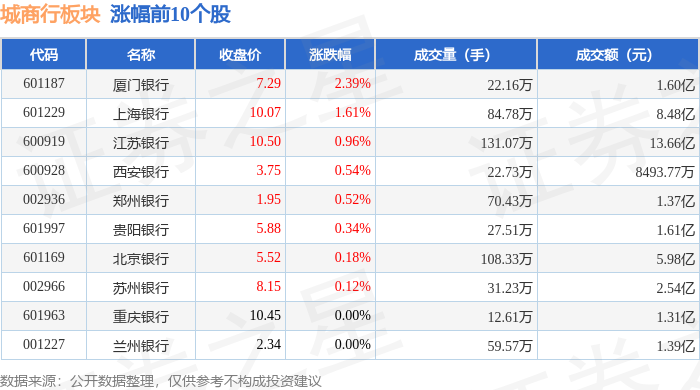
Market Performance - The city commercial bank sector increased by 0.25% compared to the previous trading day, with Xiamen Bank leading the gains [1] - The Shanghai Composite Index closed at 4165.29, up 1.09%, while the Shenzhen Component Index closed at 14366.91, up 1.75% [1] Individual Bank Performance - Xiamen Bank (601187) closed at 7.29, up 2.39% with a trading volume of 221,600 shares and a transaction value of 160 million yuan [1] - Shanghai Bank (601229) closed at 10.07, up 1.61% with a trading volume of 847,800 shares and a transaction value of 848 million yuan [1] - Jiangsu Bank (616009) closed at 10.50, up 0.96% with a trading volume of 1,310,700 shares and a transaction value of 1.366 billion yuan [1] - Other banks such as Xi'an Bank, Zhengzhou Bank, and Beijing Bank also showed minor increases in their stock prices [1] Capital Flow Analysis - The city commercial bank sector experienced a net outflow of 61.41 million yuan from institutional investors, while retail investors saw a net inflow of 66.54 million yuan [2] - The individual capital flow for Jiangsu Bank showed a net inflow of 47.88 million yuan from institutional investors, while retail investors had a net outflow of 51.39 million yuan [3] - Xiamen Bank had a net inflow of 17.18 million yuan from institutional investors, but retail investors experienced a net outflow of 8.30 million yuan [3]
息差稳定预期加强
Xiangcai Securities· 2026-01-11 13:46
Investment Rating - The industry rating is maintained at "Overweight" [10][37] Core Insights - The central bank's 2026 work meeting emphasized a stable interest margin expectation, indicating a shift in focus from reducing financing costs to maintaining them at low levels [7][34] - The meeting highlighted the importance of enhancing financial services for high-quality economic development, directing funds towards key areas such as technological innovation and small and medium enterprises [7][34] - The credit market is showing signs of stabilization, with a shift from quantity to quality in credit issuance, and a reduction in the pace of loan rate declines [8][34] Summary by Sections Market Review - The banking index fell by 1.90%, underperforming the CSI 300 index by 4.69 percentage points [12] - The performance of various banking sectors showed declines, with large banks down by 2.94% and regional banks performing relatively better [12] Monetary Policy - The central bank's monetary policy will remain moderately accommodative, focusing on both counter-cyclical and cross-cyclical adjustments [7][34] - The emphasis will be on stabilizing corporate financing cost expectations and preventing significant interest rate fluctuations [7][34] Investment Recommendations - The report suggests focusing on state-owned banks with stable asset deployment and regional banks with growth potential, recommending specific banks such as ICBC, Bank of China, and others [10][37]