
天弘基金

Search documents
基金分红:天弘纯享一年定开基金8月12日分红
Sou Hu Cai Jing· 2025-08-09 15:27
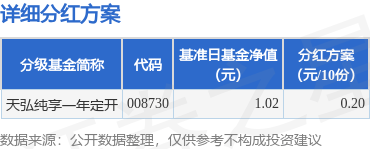
证券之星消息,8月8日发布《天弘纯享一年定期开放债券型发起式证券投资基金分红公告》。本次分红 为2025年度的第2次分红。公告显示,本次分红的收益分配基准日为7月7日,详细分红方案如下: | 分级基金筒称 | 代码 | 夏使日夏金海值 | 分红方案 | | | --- | --- | --- | --- | --- | | | | (元) | (元/10份) | | | 天弘纯享-年定开 008730 | | | 1.02 | 0.20 | 本次分红对象为权益登记日在基金注册登记机构登记在册的本基金全体基金份额持有人。,权益登记日 为8月11日,现金红利发放日为8月12日。选择红利再投资方式的投资者,其红利按2025年08月11日除息 后的基金份额净值转换为基金份额,转换后的基金份额将于2025年08月12日直接计入其基金账户,2025 年08月13日起可以查询。根据相关法律法规规定,基金向投资者分配的基金收益,暂免征收所得税。本 基金本次分红免收分红手续费;选择红利再投资方式的投资者其红利再投资所得的基金份额免收申购费 用。 以上内容为证券之星据公开信息整理,由AI算法生成(网信算备310104345710 ...

沪指行情分析:延续震荡上行态势!
Sou Hu Cai Jing· 2025-08-08 08:42
Core Viewpoint - The A-share market is currently experiencing a correction phase after significant gains in June and July, with the Shanghai Composite Index standing above 3600 points [3]. Group 1: Current Market Adjustment - The current adjustment in the market is characterized as healthy, with anti-involution policies being implemented across various industries, which are expected to optimize the market environment and improve overall industry profitability [4]. - Key economic indicators such as the Producer Price Index (PPI) are anticipated to improve, indicating enhanced profitability for industrial enterprises, which will support the performance growth of related listed companies [4]. Group 2: Mid-term Upward Drivers - The global monetary policy easing cycle is ongoing, with major central banks, including the Federal Reserve, likely to continue interest rate cuts into 2025, providing liquidity support for the market [5]. - China's central bank has already initiated a combination of reserve requirement ratio cuts and interest rate reductions, with further easing expected, which will benefit equity assets and push up risk asset valuations [5]. - The macroeconomic environment is gradually moving towards recovery, supported by proactive fiscal policies and moderate monetary policies, which aim to lower financing costs and enhance policy effectiveness [5]. Group 3: Technology Sector as a Core Investment Line - The technology sector remains a core investment focus for the medium to long term, with significant advancements expected in areas such as artificial intelligence and robotics by 2025 [6]. - Recent policies from the government aim to support technological innovation through various financial measures, encouraging investment in early-stage and hard technology sectors [7]. - The State Council has approved initiatives to promote the large-scale commercialization of artificial intelligence, leveraging China's comprehensive industrial system and market advantages [7].

浮动管理费收取机制 提升投资者获得感
Jin Rong Shi Bao· 2025-08-08 08:00
Core Viewpoint - The China Securities Regulatory Commission (CSRC) is focusing on promoting long-term capital inflow and advancing public fund reforms, achieving significant breakthroughs in key reforms this year [1] Group 1: Public Fund Reform - The net asset value of public funds in China exceeded 34.39 trillion yuan as of June, marking a record high and the ninth increase since 2024 [2] - The CSRC has introduced a plan to optimize the fee structure for actively managed equity funds, linking management fees to fund performance and reducing fees for underperforming funds [2] - The "Action Plan for Promoting High-Quality Development of Public Funds" includes 25 measures addressing issues like operational philosophy, functionality, and investor satisfaction [2] Group 2: Market Response and Implementation - The first batch of 26 innovative floating fee rate products was approved and raised a total of 25.9 billion yuan, significantly outperforming the average fundraising of 4.4 million yuan per fund for the year [3] - The second batch of 11 innovative floating fee rate products was approved, expanding into thematic strategies such as pharmaceuticals and high-end manufacturing [4] - Fund management companies are actively responding to the new fee structure, emphasizing the importance of investor returns and long-term investment [5][6] Group 3: Future Outlook - The CSRC plans to promote the floating management fee model for newly established actively managed equity funds, aiming for at least 60% of the issuance from leading firms to adopt this model within a year [6] - The ongoing positive market performance and proactive responses from fund companies are expected to lead to more innovative floating fee rate products, further deepening public fund reforms [6]
可转债市场超调后或迎估值修复
Zheng Quan Ri Bao· 2025-08-08 07:28
Group 1 - The convertible bond market has experienced volatility, with the China Securities Convertible Bond Index declining for four consecutive days until June 24, but showing signs of stabilization with a 0.41% increase on June 25 and a further 1.40% increase on June 26 [1] - As of the end of Q1, there were 140 funds with over 50% allocation in convertible bonds, many of which faced significant net value declines during the market's downturn, leading to some funds turning from profit to loss [1] - A significant portion of funds, 51, reported floating profits as of June 26, while 94 funds had floating profits as of June 18, indicating a recovery trend in the market [1] Group 2 - The performance of convertible bond funds has shown a stark divergence, with the top and bottom products differing by over 20 percentage points in year-to-date returns, with Anxin Minwen Growth A leading at 9.74% [2] - Despite recent volatility, historical data suggests that convertible bonds have a higher Sharpe ratio compared to stock indices and equity funds, indicating better risk-adjusted returns [2] - The current valuation of convertible bonds is considered low, providing strong cost-effectiveness compared to pure bonds, and there is an expectation for valuation recovery as the market stabilizes [2]
公募基金行业2024年业绩全景透视: 头部机构韧性凸显
Zheng Quan Ri Bao· 2025-08-08 07:19
Core Insights - The public fund industry in China has shown a strong growth trajectory, with total assets reaching 32.83 trillion yuan by the end of 2024, marking an increase of 5.23 trillion yuan or 18.95% year-on-year [1] - The number of public fund products has risen to 12,367, an increase of 839 from the end of 2023, indicating a diversification in offerings [1] Group 1: Performance of Leading Institutions - Leading public fund institutions demonstrated resilience, with seven top firms, including E Fund, Tianhong Fund, and Southern Fund, collectively contributing 43% of the net profit for the industry, despite facing pressure from fee reductions [2] - E Fund led the industry with a revenue of 12.11 billion yuan and a net profit of 3.9 billion yuan, achieving a net profit growth of 15.33% year-on-year [2] - Tianhong Fund and Southern Fund also reported significant net profit growths of 19.29% and 16.92%, respectively, with Tianhong Fund's total management scale reaching 1.20 trillion yuan by the end of 2024 [2][3] Group 2: Strategies of Small and Medium Institutions - Smaller public funds, such as Dongwu Fund and Zhongjin Fund, achieved remarkable growth, with net profit increases exceeding 45%, driven by differentiated strategies [4] - Dongwu Fund's net profit surged by 274.84% through a "fixed income + equity" dual-drive strategy, while Zhongjin Fund's focus on public REITs led to a 170.17% increase in net profit [4] - The growth of index funds and the inclusion of these products in personal pension plans have provided additional opportunities for smaller institutions [4][5] Group 3: Pathways to High-Quality Development - The public fund industry is increasingly focusing on high-quality development, with institutions enhancing their core investment research capabilities and asset allocation skills [6] - Institutions like Huaxia Fund are investing in digital transformation and customer service optimization to improve investor experience [6] - The industry is at a crossroads, with leading firms needing to leverage their scale for innovation while smaller firms must focus on niche differentiation to survive [6] Group 4: Strategic Recommendations - Public fund institutions are advised to focus on product innovation, particularly in index-based investments and fixed income products, while also exploring green finance and ESG investments [7] - Enhancing research capabilities and investor engagement are critical for creating long-term value and improving investor satisfaction [7] - Institutions should implement refined management practices to counteract the pressures from fee reforms and maintain profitability [7]
最新一批浮动费率基金发行定档
Zhong Guo Zheng Quan Bao· 2025-08-08 07:18
Core Viewpoint - The approval of the first batch of 26 floating-rate funds marks a significant step in the implementation of the "Action Plan for Promoting the High-Quality Development of Public Funds," aiming to align the interests of fund managers and investors more closely [1][4][7]. Fund Management Fee Structure - The new floating-rate funds will charge management fees based on performance relative to a benchmark, with a tiered structure: 0.60% if underperforming by 3% or more, 1.50% if outperforming by 6% or more, and 1.20% for other scenarios [1][3][4]. - This fee structure represents a shift from traditional fixed-rate funds, emphasizing a performance-based approach that encourages long-term investment [5][8]. Industry Trends - The floating-rate model is expected to become a standard practice for actively managed equity funds in the future, as indicated by industry experts [2][4]. - The regulatory framework encourages leading asset management firms to issue floating-rate funds, aiming for at least 60% of their actively managed equity fund issuance to be in this format within a year [4][7]. Operational Requirements - The implementation of floating-rate funds necessitates enhanced operational management capabilities and robust data processing systems from fund companies [5][8]. - Companies like Huaxia Fund have prepared comprehensive management guidelines and risk control measures to ensure efficient operation during the issuance and management of these funds [5]. Investor Benefits - The floating-rate funds are designed to create a mechanism for shared risks and rewards, promoting a healthier ecosystem where investor interests align with fund performance [6][8]. - The focus on performance relative to benchmarks is expected to improve investment behavior stability and enhance the overall investment experience for investors [7][8].
吸引多策略玩家入场 四只信用债ETF跻身百亿俱乐部
Zhong Guo Zheng Quan Bao· 2025-08-08 07:17
Core Insights - The recent inclusion of credit bond ETFs in the pledged repo trading has significantly boosted trading activity, with two benchmark market-making credit bond ETFs exceeding transaction volumes of 10 billion yuan on June 11 [1][2] - The rapid influx of capital has led to four credit bond ETFs, established for less than six months, joining the "100 billion club" [1][2] Trading Activity - On June 11, the Southern CSI Benchmark Market-Making Corporate Bond ETF recorded a transaction volume exceeding 15.5 billion yuan, marking an increase of over 7 billion yuan from the previous trading day and setting a new single-day transaction record [2] - Other ETFs, such as the E Fund CSI Benchmark Market-Making Corporate Bond ETF, also saw significant trading volumes, with over 9 billion yuan, while several others surpassed 6 billion yuan [2] Fund Inflows - In the past month, four major credit bond ETFs have seen net inflows exceeding 5 billion yuan, with the E Fund and Southern ETFs leading the way [3] - The inclusion of credit bond ETFs in the pledged repo has enhanced liquidity and provided a tool for liquidity management, allowing investors to use these ETFs for financing during tight liquidity periods [3] Investment Strategies - The inclusion of credit bond ETFs in pledged repo trading is viewed as a key measure to address developmental shortcomings, significantly enhancing their investment appeal [4] - Investors can utilize a "buy ETF - pledge financing - reinvest" leverage strategy to increase returns, improving overall capital efficiency for institutional investors [4] - Various investment strategies, including pure bond strategies, multi-asset strategies, and structured investment strategies, can benefit from leveraging credit bond ETFs [4]
国内发起式基金规模达3.1万亿元
Shen Zhen Shang Bao· 2025-08-08 07:17
Core Insights - The first initiated fund in China will celebrate its 13th anniversary in August 2023, with the total scale of initiated funds reaching 3.1 trillion yuan, accounting for approximately 10% of the total public fund scale [1][2] - In 2023, 146 initiated funds have been established, with a total issuance scale of 32.481 billion yuan, representing about 7.47% of the total public fund issuance [2] - Several initiated funds have shown impressive returns this year, with some funds achieving net value increases exceeding 70% [2] Fund Growth and Performance - The number of initiated funds in China has surpassed 2,200, with a total management scale of 3.1 trillion yuan [1] - Notable funds include the E Fund CSI 300 ETF with a scale of 235.02 billion yuan, and several others exceeding 100 billion yuan in scale [1] - Performance highlights include funds like the Great Wall Medical Industry Selected Mixed Fund A and others with net value increases over 70%, while some funds have achieved returns over 200% since inception [2] Market Dynamics and Investor Considerations - Initiated funds are viewed as both an "emergency tool" during market downturns and an "innovation testing ground" for future sectors [3] - The core value of initiated funds lies in the interest alignment mechanism and flexible strategies, with investors advised to consider management capabilities and long-term performance [3]
天弘基金聂挺进: 科学化叠加数字化 开创投研新范式
Zhong Guo Zheng Quan Bao· 2025-08-08 07:15
Core Viewpoint - The article discusses the transformation of Tianhong Fund's investment research system through the TIRD platform, which aims to address the pain points in the public fund industry and enhance investor returns by leveraging technology and systematic processes [1][3][4]. Group 1: Industry Pain Points - The public fund industry faces five major pain points: reliance on individual fund managers, lack of systematic and refined research management, management challenges after star managers transition to leadership roles, misalignment of talent assessment mechanisms, and insufficient training for digital research talent [2][3]. - The traditional cycle of "relying on luck - concentrated bets - high expansion - performance decline - investors trapped" negatively impacts investor experience and the industry's long-term health [2]. Group 2: Regulatory Changes - The issuance of the "Action Plan" in May 2023 marks a systemic reform in the public fund industry, emphasizing a shift from "scale" to "investor returns" [3][4]. - The plan introduces three key linkages: fund performance must align with both shareholder interests and investors' actual profit experiences, equity fund operations must be measured against relevant benchmarks, and the evaluation of fund management companies should consider the overall development of equity funds [3]. Group 3: TIRD Platform Development - The TIRD platform is designed to create a "process-oriented, platform-based, and intelligent" investment research system, addressing the industry's challenges and enhancing the investment experience for clients [5][6]. - The platform integrates standardized workflows, quantitative stock selection systems, and end-to-end portfolio management systems to ensure rigorous quality control and risk management [6][7]. Group 4: Future Directions - The TIRD platform aims to expand its asset coverage and deepen AI applications, including the development of intelligent financial models and research assistants [8][9]. - The platform's evolution will also focus on modular data governance and extending its services to wealth management, ensuring continuous client support and education [8][9]. Group 5: Investment Philosophy - The company emphasizes a "knowing when to stop" mentality and a "craftsmanship spirit," advocating for responsible management in wealth management and a focus on long-term investment strategies rather than short-term gains [9][10]. - The integration of modern technology with traditional investment practices is seen as essential for breaking the industry's reliance on luck and achieving high-quality development [10].
QDII基金密集发行 引发投资者踊跃认购
Zheng Quan Shi Bao Wang· 2025-08-08 06:59
Group 1 - The overseas market volatility has increased, prompting many funds to seek opportunities for bottom-fishing globally, with fund companies actively launching suitable products [1][2] - Currently, there are 4 QDII funds available for sale, with 6 QDII funds established this year and several more awaiting approval [1][2] - The first ETF investing in the French market, the Huaan France CAC40 ETF, has begun issuance, with a cap of 300 million RMB due to QDII quota limitations [1] Group 2 - The investment focus of QDII funds has primarily been on the US and Hong Kong markets, making tools for investing in the European market relatively scarce [1] - The average return of QDII funds this year is -13.4%, with many funds targeting Germany, the US, and Japan experiencing net value declines exceeding 20% [2] - Despite some QDII funds showing losses, fund companies remain optimistic about product deployment at the current market conditions [3]