迈瑞医疗

Search documents
招银证券:看好迈瑞医疗流水化业务成长,IVD流水线装机引领高端突破
Jiang Nan Shi Bao· 2025-09-30 04:12
Group 1 - The core trend in the medical device industry is the shift from single product sales to comprehensive solutions, with streamlined operations becoming a key driver for sustainable growth [1] - Mindray Medical (300760) leverages its strong R&D integration capabilities and full industry chain layout to deeply expand its streamlined operations in areas such as in vitro diagnostics (IVD), interventional treatment, and minimally invasive treatment [1][2] - The IVD business is central to Mindray's streamlined strategy, with plans to install over 200 new automated lines globally in 2024, and an expected increase to approximately 300 lines by 2025 [1][2] Group 2 - Mindray's core advantage lies in achieving comprehensive in-house production of multi-disciplinary assembly lines, significantly outperforming competitors in cost control and rapid iteration [2] - The company plans to launch iterative versions of the MT 8000 assembly line and compact assembly lines for grassroots hospitals and emergency scenarios between 2025 and 2026, further expanding market coverage [2] - Mindray aims to accelerate its catch-up with imported brands by adding at least 15 new chemiluminescence detection projects annually, focusing on key areas such as cardiac markers and hormone testing [2] Group 3 - In the interventional treatment sector, Mindray successfully replicates its streamlined model, expanding its business beyond cardiovascular intervention to include respiratory and urological departments, creating a comprehensive solution that includes treatment devices, navigation equipment, and consumables [2] - This "equipment + consumables" closed-loop model enhances customer value and strengthens business stability and sustainability [2] Group 4 - In the minimally invasive treatment field, Mindray is actively developing surgical robotics, aiming for world-class standards, which will enhance its comprehensive solution capabilities in high-end surgical areas [3] - The company's streamlined operations create a three-dimensional structure with IVD automation lines as the spearhead and interventional and minimally invasive treatments as the wings, generating stable revenue streams and smoothing out the cyclical fluctuations of single device sales [3] Group 5 - According to CMB Securities, Mindray has successfully built a resilient and growth-oriented business model through forward-looking layouts in streamlined operations, with rapid installations in IVD lines and ecosystem construction in interventional and minimally invasive fields expected to drive sustainable revenue growth [3] - Based on the positive momentum of the streamlined business, CMB Securities has slightly raised the company's profit expectations and maintained a "buy" rating [3]

华安基金:锂电景气度高增,创业板50指数周涨2.50%
Xin Lang Ji Jin· 2025-09-30 02:50
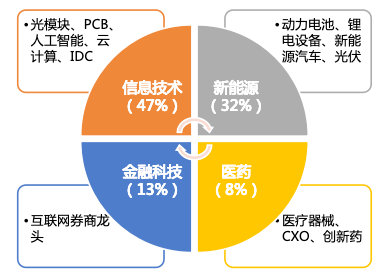
Market Overview - The A-share market showed an overall upward trend last week, with major indices rising: CSI 300 up 0.2%, CSI 500 up 1.1%, ChiNext 50 up 2.5%, and Sci-Tech 50 up 6.5% [1] - The average daily trading volume in the A-share market was around 2.3 trillion yuan, indicating sustained high market investment enthusiasm [1] - Market hotspots were mainly concentrated in the chip industry chain, robotics, AI applications, and energy storage, while consumer electronics and precious metals weakened after initial strength [1] Sector Focus - **Technology and AI**: The ChiNext 50 index covers 47% of the information technology sector, with 19% weight in optical modules. Key drivers include Nvidia's $100 billion investment in AI data centers and Alibaba's 380 billion yuan AI infrastructure plan, which are expected to accelerate demand for optical modules [5] - **Energy Storage and Lithium Batteries**: The energy storage and lithium battery sectors have seen a continuous increase in demand this year, driven by the expansion of renewable energy and new pricing policies. The core issue is whether sustained energy storage demand can maintain a projected 20% growth rate through 2026 [5] - **Pharmaceuticals and Biotech**: The pharmaceutical sector experienced an overall decline last week, with a cautious funding sentiment. Key drivers include new policies aimed at optimizing procurement rules and a recovery in medical device tenders, which are expected to accelerate revenue recognition [7] Investment Vehicle - The ChiNext 50 ETF (159949) focuses on leading companies in high-potential sectors such as new energy vehicles, biomedicine, electronics, photovoltaic, and internet finance. It reflects the performance of the top 50 companies in the ChiNext market, which are known for their liquidity and market capitalization [8] - The ChiNext 50 ETF had a recent valuation of 45.34 times, placing it in the 50.34% percentile over the past decade [4] Performance Metrics - The ChiNext 50 ETF had an average daily trading volume of 1.637 billion yuan over the past year, ranking it among the top ETFs on the Shenzhen Stock Exchange [8] - The top ten weighted stocks in the ChiNext 50 index showed varied performance, with Ningde Times (21.20% weight) increasing by 3.23%, while other stocks like Shenghong Technology (4.40% weight) decreased by 10.26% [9]



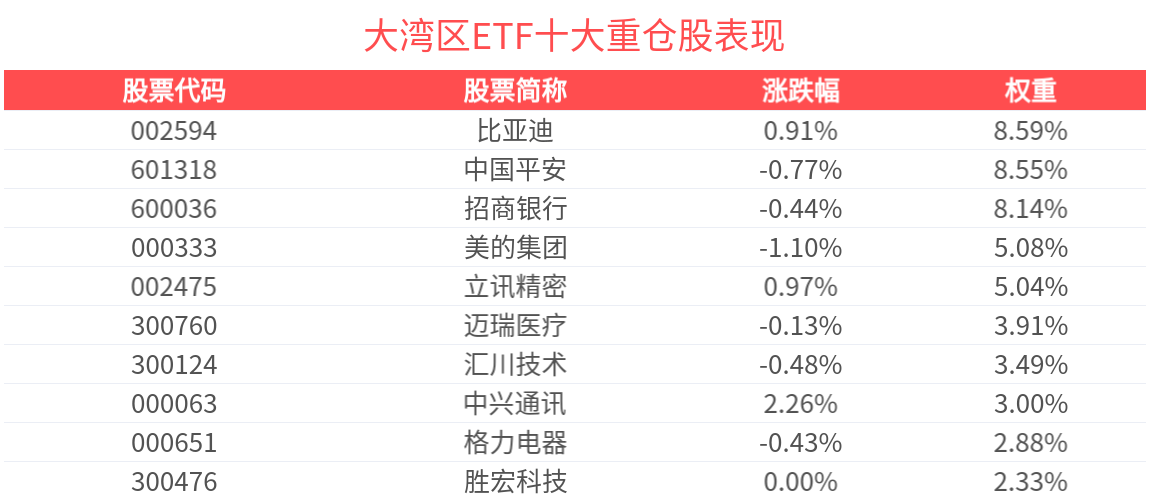
有色电子领涨,大湾区ETF(512970)投资机会备受关注
Xin Lang Cai Jing· 2025-09-30 02:29
Core Viewpoint - The performance of the China Securities Guangdong-Hong Kong-Macao Greater Bay Area Development Theme Index and its related ETF shows positive growth, indicating a favorable investment environment in the region [1][2]. Group 1: Index Performance - As of September 30, 2025, the China Securities Guangdong-Hong Kong-Macao Greater Bay Area Development Theme Index (931000) increased by 0.68% [1]. - The top-performing constituent stocks include Jiangbolong (301308) with a rise of 14.89%, Deep Technology (000021) up by 9.98%, and Baiwei Storage (688525) up by 8.09% [1]. - Over the past two years, the net value of the Greater Bay Area ETF has increased by 41.12% [1]. Group 2: ETF Performance Metrics - The Greater Bay Area ETF (512970) rose by 0.72% to a latest price of 1.54 yuan [1]. - The ETF's average monthly return since inception is 5.38%, with the highest single-month return recorded at 21.99% [1]. - The ETF's annualized excess return over the benchmark for the past three months is 6.94% [1]. Group 3: Liquidity and Trading Activity - The trading volume for the Greater Bay Area ETF was 5,531.50 yuan with a turnover rate of 0.01% [1]. - The average daily trading volume over the past week was 541,400 yuan [1]. Group 4: Risk and Fee Structure - The management fee for the Greater Bay Area ETF is 0.15%, and the custody fee is 0.05% [2]. - The tracking error for the ETF over the past month was 0.027% [2]. Group 5: Top Holdings - As of August 29, 2025, the top ten weighted stocks in the index account for 49.06% of the total index weight, with China Ping An (601318) and BYD (002594) being the top two [3].
创业50ETF(159682)开盘涨0.13%,重仓股宁德时代跌0.34%,东方财富跌0.98%
Xin Lang Cai Jing· 2025-09-30 01:38
Core Viewpoint - The article discusses the performance of the Chuangye 50 ETF (159682) and its major holdings, highlighting the recent market movements and returns since its inception [1]. Group 1: ETF Performance - On September 30, the Chuangye 50 ETF (159682) opened with a slight increase of 0.13%, priced at 1.494 yuan [1]. - Since its establishment on December 23, 2022, the fund has achieved a return of 49.19%, with a monthly return of 14.50% [1]. Group 2: Major Holdings - Key stocks in the Chuangye 50 ETF include: - Ningde Times: down 0.34% - Dongfang Wealth: down 0.98% - Huichuan Technology: down 0.42% - Zhongji Xuchuang: up 0.42% - Mindray Medical: down 0.09% - Xinyi Sheng: up 0.19% - Sunshine Power: unchanged - Shenghong Technology: up 0.41% - Yiwei Lithium Energy: down 0.81% - Tonghuashun: down 1.21% [1].




机构调研、股东增持与公司回购策略周报(20250922-20250926)-20250929
Yuan Da Xin Xi· 2025-09-29 09:49
Group 1: Institutional Research on Popular Companies - The top twenty companies with the highest number of institutional research visits in the past 30 days include Mindray Medical, Huichuan Technology, United Imaging Healthcare, Shenzhen South Circuit, and Aibo Medical [11][13] - In the last five days, the most popular companies for institutional research include Jepu Tech, Ganli Pharmaceutical, Shiji Information, Guangri Co., and Nenghui Technology [11][12] - Among the top twenty companies in the past 30 days, 12 companies had 10 or more rating agencies involved, with significant profit growth expected for Lankai Technology, Huichuan Technology, and Sanhua Intelligent Control in their 2025 mid-year reports compared to 2024 [11][12] Group 2: Shareholder Increase and Buyback Strategies - From September 22 to September 26, 2025, four listed companies announced significant shareholder increases [18] - A total of 71 companies announced buyback progress during the same period, with 22 of them having 10 or more rating agencies involved [24] - From January 1 to September 26, 2025, 274 companies announced shareholder increases, with 86 of them having 10 or more rating agencies involved [20] Group 3: Buyback Situation - From January 1 to September 26, 2025, 1,747 companies announced buyback progress, with 414 of them having 10 or more rating agencies involved [26] - Among these, 108 companies had a buyback amount that exceeded 1% of their market value on the announcement date [26][27] - Specific companies in the buyback phase include Chengde Lulu, Liugong, Shantui, Huaming Equipment, Jian Sheng Group, Ruoyu Chen, and China Jushi [27]


医药生物行业资金流出榜:恒瑞医药、广生堂等净流出资金居前
Zheng Quan Shi Bao Wang· 2025-09-29 08:51
Market Overview - The Shanghai Composite Index rose by 0.90% on September 29, with 26 out of 28 sectors experiencing gains, led by non-bank financials and non-ferrous metals, which increased by 3.84% and 3.78% respectively [1] - The pharmaceutical and biological sector saw a modest increase of 0.17% [1] - The coal and banking sectors were the biggest losers, declining by 0.84% and 0.46% respectively [1] Capital Flow Analysis - The net inflow of capital in the two markets was 9.527 billion yuan, with 13 sectors receiving net inflows [1] - The non-bank financial sector had the highest net inflow of 12.348 billion yuan, corresponding to its 3.84% increase [1] - The non-ferrous metals sector followed with a net inflow of 2.986 billion yuan and a daily increase of 3.78% [1] - Conversely, 18 sectors experienced net outflows, with the electronics sector leading at a net outflow of 2.811 billion yuan, followed by the defense and military sector with 1.882 billion yuan [1] Pharmaceutical and Biological Sector - The pharmaceutical and biological sector had a net outflow of 1.640 billion yuan, with 285 out of 475 stocks in the sector rising, while 169 fell, including 2 hitting the daily limit down [2] - Notable stocks with significant net inflows included Jilin Aodong (10.565 million yuan), Sino Medical (10.067 million yuan), and Mindray Medical (9.186 million yuan) [2] - Major stocks with significant net outflows included Hengrui Medicine (-333.586 million yuan), Guangsheng Tang (-160.353 million yuan), and Hanyu Pharmaceutical (-138.282 million yuan) [4] Top Gainers in Pharmaceutical Sector - Jilin Aodong saw a price increase of 6.69% with a turnover rate of 4.00% and a net inflow of 10.565 million yuan [2] - Sino Medical increased by 4.82% with a turnover rate of 7.00% and a net inflow of 10.067 million yuan [2] - Mindray Medical had a slight increase of 0.19% with a turnover rate of 0.68% and a net inflow of 9.186 million yuan [2] Top Losers in Pharmaceutical Sector - Hengrui Medicine decreased by 1.26% with a turnover rate of 1.02% and a net outflow of 333.586 million yuan [4] - Guangsheng Tang experienced a decline of 6.18% with a turnover rate of 11.07% and a net outflow of 160.353 million yuan [4] - Hanyu Pharmaceutical had a minor increase of 0.24% but still faced a net outflow of 138.282 million yuan [4]



医疗器械 ETF(562600)收涨0.53%,机构称高值耗材走出集采影响
Mei Ri Jing Ji Xin Wen· 2025-09-29 08:33
Group 1 - The A-share market saw a collective rise in the three major indices, with the Shanghai Composite Index increasing by 0.9%, the Shenzhen Component Index by 2.05%, and the ChiNext Index by 2.74% as of September 29 [1] - The Medical Device ETF (562600) experienced a late surge, rising by 0.53%, with its top holdings, Tianzhihang-U and Jimin Health, gaining 7.7% and 5.51% respectively [1] - The Medical Device ETF attracted 5.65 million yuan in capital over the past five days, indicating strong investor interest [1] Group 2 - The 92nd China International Medical Equipment Fair (CMEF) was held from September 26 to 29 in Guangzhou, covering nearly 160,000 square meters and attracting around 3,000 companies from nearly 20 countries and regions, with expectations of over 120,000 professional visitors [1] - CMEF serves as a global barometer for the medical industry, showcasing the latest achievements and trends in the medical device sector, with significant participation from regions like Guangdong, Jiangsu, and Zhejiang, as well as international exhibitors from Germany, the USA, and Japan [1] Group 3 - Huazhong Securities noted that high-value consumables have moved past the impact of centralized procurement, with leading companies in various segments increasing their market share and gaining recognition from high-level hospitals and doctors [2] - The Medical Device ETF (562600) tracks the CSI All-Share Medical Device Index, selecting 100 representative listed companies in core medical fields, with the medical device sector accounting for 89.34% of the index [2] - As of September 17, the top ten holdings of the Medical Device ETF included Mindray Medical and United Imaging Healthcare, which together accounted for 22.9% of the ETF [2]
附下载|业内首份企业级智能体产业落地研究报告:从场景试点到规模化应用实践
腾讯研究院· 2025-09-29 08:03
Core Viewpoint - The report highlights the transformative shift of AI from being an "auxiliary tool" to becoming an "autonomous productivity" driver through the emergence of AI agents, which can independently understand goals, plan paths, and interact with both physical and digital worlds [4][6][20]. Group 1: Definition and Capabilities of AI Agents - AI agents are defined as digital employees capable of autonomous planning and execution, moving beyond simple task execution to complex decision-making and interaction [6][9]. - The core structure of AI agents consists of a "brain" for autonomous planning and "hands" for tool invocation, enabling them to complete tasks in a closed-loop manner [8][9]. Group 2: Application Scenarios of AI Agents - The report identifies a wide range of application scenarios for AI agents across various industries, including finance, retail, healthcare, education, manufacturing, transportation, and government [19]. - A "scene compass" is introduced to help enterprises assess the maturity of AI agent applications based on task complexity and autonomy, categorizing them into four quadrants: efficient assistants, execution experts, decision experts, and all-round experts [19]. Group 3: Challenges in Implementation - The report outlines six major challenges in the large-scale implementation of AI agents: high training costs, model hallucination and generalization issues, security and data governance, complex document understanding, and integration with business systems [19]. - Companies are encouraged to utilize the strategic framework provided by Tencent Cloud to build reliable AI agents that understand customers, make decisions, and execute tasks effectively [19]. Group 4: Case Studies and Practical Applications - The report includes several pioneering case studies demonstrating the successful integration of AI agents into business operations, such as: - Huazhu Group's 24/7 "all-round hotel butler" that can respond to guest requests and manage logistics autonomously [20]. - Juewei Food's AI marketing agent that significantly outperformed human teams in sales performance [20]. - The establishment of a digital counter by Handan's provident fund, which streamlined service processes and reduced processing time by over 80% [20]. - These examples illustrate how AI agents are creating value as efficient digital employees and business partners [20].


研报掘金丨华安证券:维持迈瑞医疗“买入”评级 Q3有望迎来业绩拐点
Ge Long Hui A P P· 2025-09-29 06:35
Core Viewpoint - Mindray Medical's net profit for H1 2025 reached 5.069 billion yuan, a year-on-year decline of 32.96%, with Q2 net profit at 2.440 billion yuan, down 44.55% [1] Group 1: Financial Performance - The domestic market is under pressure, leading to a decline in performance in the first half of the year [1] - EPS estimates for 2025, 2026, and 2027 are approximately 10.08 yuan, 11.99 yuan, and 14.25 yuan, respectively [1] - Corresponding PE valuations for these years are 24x, 20x, and 17x [1] Group 2: Market Outlook - The medical equipment bidding activities are expected to recover in H1 2025 as industry restructuring normalizes and equipment upgrade projects gradually commence [1] - A significant improvement in the domestic market is anticipated in Q3 2025 [1] Group 3: International Expansion - Mindray Medical has established localized production projects in 14 countries, with 11 already in production, primarily focusing on in vitro diagnostic products [1] - The product integration progress from DiaSys's original factory is proceeding smoothly [1]

GE医疗中国区集中调整!业务、人事与股权三线齐动
思宇MedTech· 2025-09-29 06:28
Core Viewpoint - GE Healthcare is undergoing significant organizational changes in its China operations, including personnel adjustments and leadership changes, while exploring strategic options such as the potential sale of its China stake, amidst a challenging market environment [2][17]. Group 1: Organizational Changes - GE Healthcare China has initiated an organizational restructuring in its core CT and MR business lines, affecting hundreds of positions, although the company denies any large-scale layoffs, emphasizing efficiency and optimization [4][5]. - The company maintains a stable workforce of approximately 7,000 employees in China, with ongoing recruitment in various business lines [4]. - The restructuring reflects a reassessment of business structure and a potential shift of resources towards high-end CT and MR localization [4]. Group 2: Leadership Changes - Jennifer Lu has been appointed as the new CFO for GE Healthcare China, succeeding Richard Li, who is leaving for family reasons after six years in the role [5][6]. - Eric Yu, a millennial executive with extensive experience in multinational management, has been appointed as the General Manager for the ultrasound business line in China [7][9]. Group 3: Financial Performance - In 2024, GE Healthcare's revenue in China is projected to be $2.4 billion, accounting for 12% of global revenue, while the first half of 2025 shows a slight decline of approximately 2% year-on-year [15]. - The company faces challenges from a medical anti-corruption campaign and new tariff policies, which could result in a revenue loss of up to $500 million in 2025 [15]. - Local competitors have increased their market share in the high-end imaging sector, reducing growth opportunities for foreign brands [15]. Group 4: Strategic Context - The adjustments at GE Healthcare are part of a broader trend among foreign companies in the medical device sector, facing local policy, technological competition, and compliance challenges [16][17]. - The company is still committed to its ultrasound headquarters project in Wuxi, which is crucial for its manufacturing capabilities, despite rumors of divestment [10][12].