
中国人民银行

Search documents
央行多措并举深化内地香港金融互联互通 强固香港离岸人民币枢纽地位
智通财经网· 2025-09-25 10:01
Core Viewpoint - The People's Bank of China announced measures to deepen the financial market connectivity between mainland China and Hong Kong, enhancing opportunities for offshore investors and optimizing trading mechanisms [1][2]. Group 1: Measures Announced - The People's Bank of China will support offshore institutions in conducting repurchase transactions in the mainland bond market [1]. - The daily quota for northbound trading will be increased more than double to 45 billion RMB [1]. - There will be an expansion of the swap market participants and optimization of management mechanisms [1]. Group 2: Hong Kong Government's Response - The Hong Kong government welcomed the measures, emphasizing the growing importance of Hong Kong as a hub for offshore RMB business and risk management [2]. - The government aims to deepen and expand financial market connectivity with the mainland, enhancing RMB-denominated investment products and risk management tools [2]. - The measures announced by the People's Bank of China provide strong support for the Hong Kong government's efforts to promote the coordinated development of the fixed income markets [2]. Group 3: Market Developments - The issuance of RMB bonds in Hong Kong is expected to exceed 1 trillion RMB in 2024 [3]. - Since the implementation of the swap mechanism in 2023, the business volume has steadily increased, with the average daily nominal principal reaching 20 billion RMB by August 2025, more than five times the volume in the first month of its launch [3]. - The optimization of the swap mechanism will facilitate overseas investors in hedging risks associated with mainland assets, aiding in better portfolio management [3].
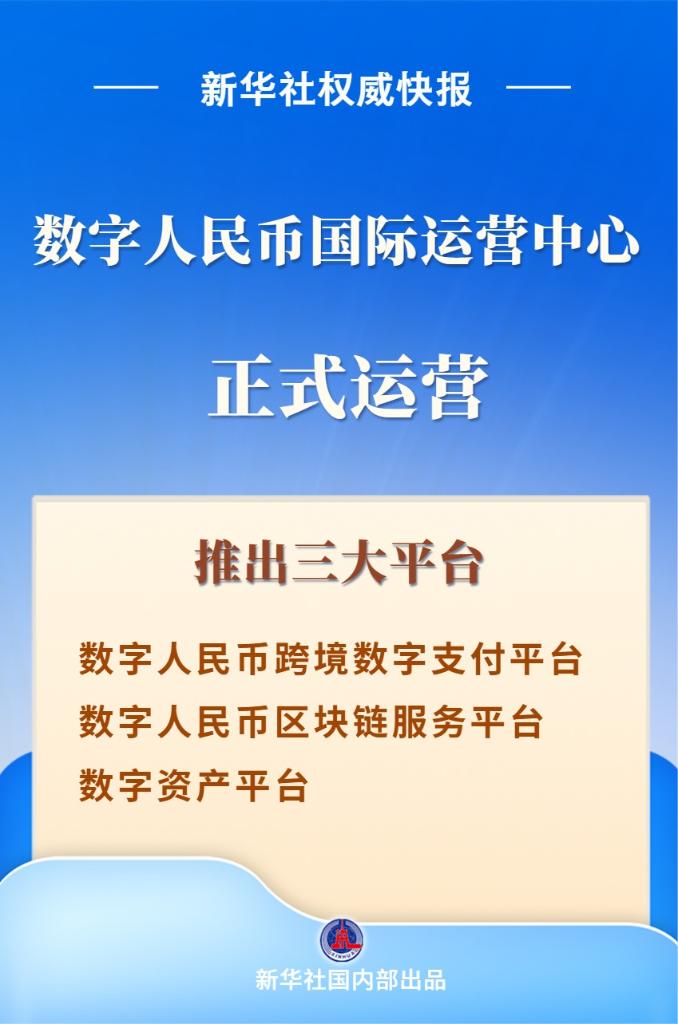
新华社权威快报丨数字人民币国际运营中心正式运营
Xin Hua Wang· 2025-09-25 09:57
Core Viewpoint - The Digital Renminbi International Operation Center has officially commenced operations in Shanghai, introducing three major platforms aimed at enhancing the internationalization of the digital renminbi and supporting financial market development [4]. Group 1: Platforms Introduced - The Digital Renminbi Cross-Border Payment Platform aims to address pain points in traditional cross-border payment systems using legal digital currency [4]. - The Digital Renminbi Blockchain Service Platform provides standardized cross-chain transaction information transfer and on-chain digital renminbi payment services for various scenarios and industries [4]. - The Digital Asset Platform offers standardized, ready-to-use financial-grade digital asset services, enabling existing financial infrastructure to expand their operations onto the blockchain [4]. Group 2: Strategic Goals - The establishment of the Digital Renminbi International Operation Center was announced by the Governor of the People's Bank of China, Pan Gongsheng, at the 2025 Lujiazui Forum, with a focus on promoting the internationalization of the digital renminbi and fostering digital financial innovation [4].


央行再次优化流动性调控工具|政策与监管
清华金融评论· 2025-09-25 09:51
Core Viewpoint - The People's Bank of China (PBOC) has made a significant adjustment to the 14-day reverse repurchase operation mechanism, introducing a new model of "fixed quantity, interest rate bidding, and multiple price bidding," marking a key step in the transition to a price-oriented monetary policy framework [2][3]. Summary by Sections Adjustment of Reverse Repo Operations - The PBOC's announcement on September 19, 2025, states that the 14-day reverse repo operation will now be conducted using a fixed quantity, interest rate bidding, and multiple price bidding method to better meet the differentiated funding needs of various participating institutions [3]. - This adjustment enhances the policy signaling function of the 14-day reverse repo rate, which previously had limited practical implications as it was typically priced at the 7-day repo rate plus 15 basis points [3]. Flexibility in Liquidity Management - The new rules increase the flexibility of the 14-day reverse repo operation, allowing the PBOC to make more precise arrangements regarding the timing and scale of operations based on liquidity management needs, rather than only using it before long holidays [4]. Continuous Optimization of Monetary Policy Framework - The PBOC has been continuously optimizing its monetary policy operation framework, introducing several important reforms since 2024, including new tools like government bond trading and various types of repos, which enhance its liquidity management capabilities [5]. - Future efforts should focus on improving the price-oriented monetary policy framework, ensuring the core position of policy rates in monetary policy transmission, and enhancing the market-oriented pricing ability of short-term interest rates [5].
数字人民币国际运营中心正式运营
Xin Hua Wang· 2025-09-25 07:28
(文章来源:新华网) 24日,中国人民银行副行长陆磊在数字人民币国际运营中心业务平台推介会上表示,中国人民银行提出 的"无损、合规和互通"三原则,已成为法定数字货币跨境基础设施建设的基本准则,目前已初步构建数 字人民币跨境金融基础设施体系。未来,中国人民银行将继续支持数字人民币国际运营中心行稳致远, 为跨境贸易与投融资便利化提供坚实助力。 记者了解到,数字人民币国际运营中心由中国人民银行数字货币研究所筹建和管理,负责建设运营数字 人民币跨境和区块链基础设施,推进与境内外金融基础设施的跨境互联互通。 记者25日从中国人民银行获悉,数字人民币国际运营中心已在上海正式运营,并推出三大业务平台—— 数字人民币跨境数字支付平台、数字人民币区块链服务平台及数字资产平台。 据介绍,数字人民币跨境数字支付平台探索运用法定数字货币解决传统跨境支付中存在的痛点;数字人 民币区块链服务平台为各场景和行业类区块链提供标准化的跨链交易信息转接和链上数字人民币支付服 务;数字资产平台可提供标准、即用的金融级数字资产服务,支持现有金融基础设施将业务拓展至链 上。 今年6月,中国人民银行行长潘功胜在2025陆家嘴论坛上宣布,将在上海设立数字 ...
南华期货2025年度外汇四季度展望:路阻且长,波动暗流或涌关键位
Nan Hua Qi Huo· 2025-09-25 06:16
1. Report Industry Investment Rating There is no information about the report industry investment rating in the provided content. 2. Core View of the Report - The probability of the USD/CNY spot exchange rate returning to the "6 era" within the year is still low, but it has increased compared to the previous expectation. The operating range is likely to be between 6.90 - 7.25, with the core fluctuation range more concentrated between 7.00 - 7.20. The overall appreciation space is relatively limited, but the depreciation momentum is accumulating [1]. - The USD/CNY spot exchange rate in Q4 2025 may have potential conditions for upward - fluctuating, but the actual increase depends on the central bank's policy attitude and regulatory signals, as well as the verification of the Chinese economy [2][19]. - The potential capital inflow can provide phased support for the RMB, but its sustainability and actual impact scale should not be linearly extrapolated. The Q4 2025 operating environment of the USD/CNY spot exchange rate will probably be in the cycle combination of "loose money and weak broad credit", which provides a core operating basis for "slowing down the appreciation rhythm" [3]. - The US dollar index is expected to be volatile and weak, with an operating range of 95 - 102 [6]. - The potential "US dollar settlement wave" has increased the probability of the USD/CNY spot exchange rate falling to the "6 era" within the year, although its formation is still restricted by multiple factors [7][90]. 3. Summary According to Relevant Catalogs 3.1 Main Views - **Strategy Suggestions** - **Arbitrage Strategy**: Given the expected increase in the volatility of the USD/CNY spot exchange rate in Q4 compared to Q3 but still in a historically low range, a short straddle option strategy can be adopted, selling both out - of - the - money call and put options [1]. - **Hedging Strategy** - **For Purchasing Foreign Exchange**: Prioritize forward exchange locking. Start at the low - middle level (7.00 - 7.10) of the core exchange rate range, and lock 60% - 80% of the positions in batches. If the exchange rate briefly falls to 6.90 - 7.00, an additional 20% - 30% can be locked. For those with non - fixed payment cycles, a combination of "forward exchange locking + optional transaction" can be used [1]. - **For Settling Foreign Exchange**: Anchor at the upper limit of the range. When the exchange rate reaches 7.18 - 7.20, settle 30% - 40% of the US dollars. If it breaks through 7.20, an additional 20% - 30% can be settled [1]. 3.2 Market Conditions and Core Concerns 3.2.1 Market Volatility Conditions - The USD/CNY spot exchange rate maintained a low - volatility operation in Q3 2025. Whether it can increase volatility in Q4 depends on factors such as macro - narrative changes, market trading volume, and the central bank's policy [10][19]. - **Macro - Narrative Perspective**: The shift from low - to high - volatility of the USD/CNY spot exchange rate is related to major macro - narrative changes, following a cycle of "narrative turning - divergence intensifying - volatility rising - cognition converging - volatility converging - new narrative starting". The next potential macro - narrative that may drive volatility is the "Fed's monetary policy shift (substantial and high - rhythm interest rate cuts)" [20]. - **Market Driving Force Perspective**: The inquiry trading volume of the USD/CNY spot exchange rate is positively correlated with its implied volatility. An increase in trading volume may indicate an increase in volatility. Currently, the three indicators (offshore - onshore spread, risk - reversal option, and RMB non - deliverable forward) show relatively stable market expectations for the RMB's appreciation and depreciation. If the trading volume remains above $35 billion, the market may accumulate upward volatility momentum [22][31]. - **Central Bank's Policy Perspective**: The central bank's exchange - rate management in Q4 focuses on the "dynamic balance between enhancing flexibility and preventing risks". It will adopt a "discretionary" approach, adjusting policy tools according to market dynamics. The RMB exchange rate is difficult to form a smooth appreciation or depreciation trend [34][38]. 3.2.2 Stock - Exchange Linkage - The stock market and the foreign - exchange market are related through capital flow and market expectation. The recent "residential deposit migration" to the stock market has provided incremental funds for the A - share market, which is driven by the decline in bank deposit interest rates and the increase in the attractiveness of equity assets [43][49]. - However, the "residential deposit/ total market value" chart has three core flaws and cannot be used as direct evidence of "residential deposit migration". The potential capital inflow can provide phased support for the RMB, but its sustainability and scale depend on the long - term investment attractiveness of the stock market and the domestic economic fundamentals [53][55]. - The Q4 2025 operating environment of the USD/CNY spot exchange rate is likely to be in the cycle of "loose money supply and weak credit expansion", with the appreciation rhythm slowing down. The probability of the RMB forming a trend - based appreciation against the US dollar within the year is still low, but the probability of the RMB exchange rate returning to the "6 era" has increased [63][64]. 3.2.3 External Weak US Dollar Environment - The Fed's interest - rate cut amplitude and rhythm depend on the evolution path of the US economic fundamentals. The September 2025 25 - basis - point interest - rate cut and the weak non - farm employment data have made the issue of "whether the US economy is facing a recession" a key concern [66]. - **Economic Level**: The current US employment market has slowed down but not stalled. Inflation pressure and real - estate market risks restrict the Fed from implementing substantial interest - rate cuts within the year [71][72]. - **Policy Level**: Politically, the short - term policy is likely to remain on the "gradual adjustment" track. If the Fed's independence is interfered with, it may lead to more and larger - scale interest - rate cuts. Overall, the US dollar index is expected to operate in the range of 95 - 102 [73][76]. 3.2.4 US Dollar Settlement Wave - The formation of the US dollar settlement wave has a solid capital foundation, but it also depends on the effective cooperation of enterprise settlement willingness. The factors affecting the RMB exchange rate returning to the "6 era" include the central bank's exchange - rate intermediate - price control, the attractiveness of the domestic equity market, the trend of the US dollar index, and the behavior of enterprises in foreign - exchange transactions [7][85]. 3.3 Q4 Exchange - Rate Trend Judgment - **Benchmark Scenario**: In the context of the Fed's cautious interest - rate cut and the weak recovery of the domestic economy, the USD/CNY spot exchange rate is expected to fluctuate in the range of 7.00 - 7.20, with the depreciation momentum gradually accumulating. There are uncertainties in the domestic economic recovery process and the Fed's interest - rate cut rhythm [91]. - **Upward Risk**: Factors such as the unexpected rebound of US inflation, strong US economic data, a change in global risk preference, and uncertainties in the domestic economic recovery may cause the RMB to face short - term depreciation pressure and may briefly break through the 7.20 mark [91][92]. - **Downward Risk**: If the US inflation continues to fall, the domestic economic recovery exceeds expectations, and domestic policies are actively implemented, the RMB may appreciate, and the USD/CNY spot exchange rate may fall below 7.0 [92]. 3.4 Strategy Suggestions - **Arbitrage Strategy**: In a low - volatility environment, a short straddle option strategy can be adopted, selling both out - of - the - money call and put options. Attention can also be paid to volatility surface arbitrage opportunities, such as constructing a position of "selling near - month straddle combinations + buying far - month straddle combinations" when the near - month implied volatility is significantly higher than the far - month [94]. - **Hedging Strategy** - **For Purchasing Foreign Exchange**: Prioritize forward exchange locking. Start at the low - middle level (7.00 - 7.10) of the core exchange - rate range, and lock 60% - 80% of the positions in batches. For those with non - fixed payment cycles, a combination of "forward exchange locking + optional transaction" can be used [95]. - **For Settling Foreign Exchange**: Anchor at the upper limit of the range. When the exchange rate reaches 7.18 - 7.20, settle 30% - 40% of the US dollars. If it breaks through 7.20, an additional 20% - 30% can be settled, leaving 20% - 30% for subsequent fluctuations [96]. - **Common Risk Warnings** - Avoid excessive speculation and adhere to the "risk - neutral" principle, with the hedging scale matching the actual trade volume [97]. - Dynamically track policies and the market. Adjust hedging positions in time if the USD/CNY spot exchange rate breaks through 7.25 or falls below 7.0 [99]. - Select appropriate tools. Small and medium - sized enterprises should give priority to simple tools such as forwards and options, while large enterprises can combine futures and other tools to optimize strategies but need to be equipped with a professional foreign - exchange management team [99].
养老机构责任险迈向“应保尽保”
21世纪经济报道· 2025-09-25 04:17
Core Viewpoint - The article emphasizes the urgent need for diversified and multi-layered elderly care insurance products in response to China's aging population, highlighting recent policy developments aimed at enhancing the insurance framework for elderly care institutions [1][5]. Group 1: Policy Developments - The Beijing Civil Affairs Bureau issued guidelines to improve comprehensive liability insurance for elderly care institutions, covering various liabilities such as accidental injury, legal fees, and third-party responsibilities [1][3]. - The implementation of these guidelines is seen as a move towards ensuring comprehensive insurance coverage for elderly care facilities, with similar initiatives reported in regions like Xinjiang, Hebei, and Shanghai [1][5]. Group 2: Insurance Products - Elderly care liability insurance is designed to compensate for economic liabilities incurred by care institutions due to accidents involving residents, including personal injury and legal costs [3]. - The development of long-term care insurance (LTCI) is crucial, especially as the population of elderly individuals requiring long-term care grows, with over 1.8 billion people expected to be insured by the end of 2024 [5]. Group 3: Challenges and Innovations - Despite advancements, LTCI faces challenges such as low coordination levels, inconsistent benefits, and insufficient coverage for rural areas and dementia patients [6]. - The market is witnessing innovations like dedicated commercial elderly insurance products and inclusive health insurance options that cater to the needs of the elderly population [8]. Group 4: Future Outlook - The Chinese government is pushing for the development of a robust elderly care financial system, emphasizing the need for innovation in pension insurance products and improved financial services for the elderly [8][9]. - Experts suggest leveraging financial technology to reconstruct the elderly care ecosystem, focusing on personalized asset allocation and integrating AI and big data for better service delivery [9].

央行今日净回笼35亿元人民币
Jing Ji Guan Cha Wang· 2025-09-25 01:59
Core Viewpoint - The People's Bank of China conducted a reverse repurchase operation amounting to 483.5 billion yuan with a fixed interest rate of 1.40% for a 7-day term, indicating a liquidity management strategy in the financial market [1] Group 1 - The operation was conducted on September 25, 2025, with a total bid amount of 483.5 billion yuan and a successful bid amount matching the total [1] - The reverse repurchase operation is set to mature in 7 days, with 487 billion yuan of reverse repos maturing today [1]
官宣:央行今作
Zhong Guo Ji Jin Bao· 2025-09-24 16:55
Core Viewpoint - The People's Bank of China (PBOC) announced a plan to conduct a 600 billion MLF operation to maintain ample liquidity in the banking system, scheduled for September 25, 2025, with a one-year term [1] Group 1 - The PBOC will implement the MLF operation using a fixed quantity and interest rate bidding method, allowing for multiple price bids [1] - The operation aims to ensure sufficient liquidity within the banking system, which is crucial for supporting economic stability [1]
官宣:央行今日操作
Zhong Guo Ji Jin Bao· 2025-09-24 16:20
来源:中国人民银行 中国人民银行官网9月24日发布消息,为保持银行体系流动性充裕,2025年9月25日(周四),中国人民银行将以固定数量、利率招 标、多重价位中标方式开展6000亿元MLF操作,期限为1年期。 | | 中国人民银行 THE PEOPLE'S BANK OF CHINA | | | | 货币政策司 Monetary Policy Department | | | | | | | --- | --- | --- | --- | --- | --- | --- | --- | --- | --- | --- | | 新闻发布 信息公开 | | 深集活船 | 货币政策 | 宏观审慎 | 信贷政策 | 金融市场 | 金融模定 | 调查统计 | 银行会计 | 支付体系 | | 金融科技 | | 人民币 | 经理国库 | 国际交往 | 人员招录 | 学术交流 | 征信管理 | 反洗钱 | 党建工作 | | | 政务公开 服务互动 | | 政策解读 | 公告信息 | 图文直播 | 央行研究 | 音频视频 | 市场动态 | 网上展厅 | 报告下载 | 报刊年签 | | 网送文告 | | 办事大厅 | 在线申报 ...
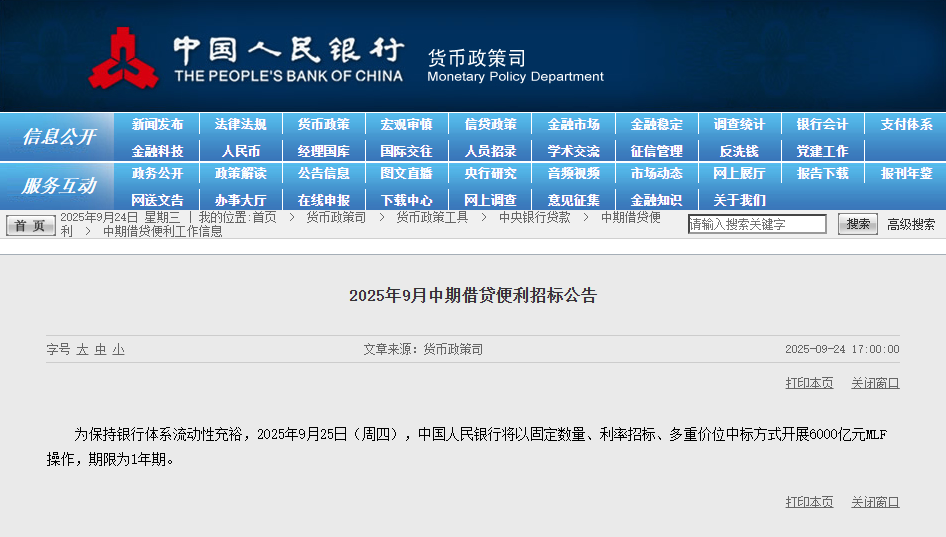
中国人民银行今日开展6000亿元MLF操作
Qi Huo Ri Bao· 2025-09-24 16:02
Core Viewpoint - The People's Bank of China (PBOC) is injecting liquidity into the banking system by conducting a 600 billion yuan Medium-term Lending Facility (MLF) operation, indicating a supportive monetary policy stance to meet credit financing needs [1] Group 1: Monetary Policy Actions - On September 25, the PBOC will conduct a 600 billion yuan MLF operation with a one-year term, using a fixed quantity, interest rate bidding, and multiple price bidding method [1] - With 300 billion yuan of MLF maturing in the same month, the net injection of MLF will amount to 300 billion yuan, marking the seventh consecutive month of increased operations [1] Group 2: Economic Implications - The continuous injection of medium-term liquidity signals a sustained supportive monetary policy, which is expected to facilitate the smooth issuance of government bonds [1] - This policy is also aimed at better meeting the credit financing demands of enterprises and households [1]