
京东方

Search documents
研报 | IT OLED面板大世代竞争升温,FMM阵营领跑、FMM-free阵营加速推进
TrendForce集邦· 2025-10-28 05:51
Core Insights - The article discusses the recent developments in the IT OLED panel industry, particularly the initiation of the 8.6-generation OLED production lines by various manufacturers, marking a competitive landscape in the market [2][7]. Group 1: Industry Developments - TCL CSOT has officially announced the commencement of its T8 project for the 8.6-generation OLED production line, joining other manufacturers in the investment race [2]. - Samsung Display Corporation (SDC) was the first to initiate the 8.6-generation OLED production line investment in 2023, utilizing traditional FMM evaporation technology and planning to introduce Tandem OLED technology to enhance screen longevity [5]. - BOE followed SDC's lead by announcing its own 8.6-generation OLED production line investment at the end of 2023, also employing FMM evaporation technology and Tandem OLED configuration, with production expected to start in the first half of 2026 [6]. Group 2: Technological Innovations - Visionox is developing its own technology, ViP (Visionox Intelligent Pixelization), which promises higher pixel density and aperture ratio compared to traditional FMM, with plans to complete its 8.6-generation OLED production line by the fourth quarter of 2025 [6]. - TCL CSOT is adopting inkjet printing (IJP) technology for its production line, which theoretically reduces material waste by approximately 30%, with mass production targeted for the fourth quarter of 2027 [6]. Group 3: Market Outlook - TrendForce indicates that the investment plans for both FMM and non-FMM production lines are proliferating, suggesting a future where the IT OLED panel supply chain will see a multitude of competitors [7]. - The FMM camp currently holds advantages such as established customer relationships and production experience, while the non-FMM camp is in its early development stage, facing challenges like lower yield rates and material development needs, but still has potential to catch up due to high market interest [7].


2025世界显示产业创新发展大会将于11月3日在成都开幕
Mei Ri Jing Ji Xin Wen· 2025-10-28 00:59
Core Insights - The new display industry is a crucial sector in the information age and digital economy, marking a transition from "scale leading" to "quality leading" in China, aiming for high-quality development [1] Group 1: Event Overview - The 2025 World Display Industry Innovation Development Conference will be held in Chengdu from November 3 to 4, 2025, featuring a structure of "1+10+1+N" activities, including an opening ceremony, ten industry chain docking events, one innovation achievement experience, and multiple supporting activities [1] - The conference aims to create an international platform for industry exchange, industrial aggregation, and business negotiations, allowing more countries to share in the benefits of China's new display industry [1] Group 2: Participant Companies - Major midstream panel module companies participating include BOE, TCL Huaxing, Tianma, Visionox, and others, while terminal application companies include Changhong, Xiaomi, Hisense, Samsung, and more [2] - Upstream material and equipment companies such as Corning, Applied Materials, and others will also be present, highlighting the comprehensive nature of the event [2] Group 3: Project and Activity Focus - The conference will facilitate the signing of significant projects in the new display industry, accelerating the transformation of innovative achievements and contributing to regional economic development [2] - Ten docking activities will adopt a "1+1+2+6" model, focusing on electronic paper, Micro-LED, and future display technologies, emphasizing upstream equipment materials and industry linkages [2]
超颖电子上交所主板上市 募资近9亿拓展汽车电子元件市场
Chang Jiang Shang Bao· 2025-10-27 23:52
Core Viewpoint - ChaoYing Electronics successfully listed on the Shanghai Stock Exchange, raising a total of 897 million yuan through the issuance of 52.5 million shares, with funds primarily allocated for the second phase of high-layer and high-density interconnect (HDI) PCB projects to enhance production capacity and technology levels in response to growing demand in the automotive electronics market [1][2][5] Company Overview - Established in 2015, ChaoYing Electronics specializes in the research, production, and sales of printed circuit boards (PCBs), with a focus on automotive electronics [2] - The company is one of the few in China capable of mass production of multi-layer HDI and arbitrary-layer interconnected HDI automotive electronic boards [2] Financial Performance - Revenue for ChaoYing Electronics is projected to grow from 35.14 billion yuan in 2022 to 41.24 billion yuan in 2024, with net profits increasing from 1.41 billion yuan to 2.76 billion yuan during the same period, indicating a steady growth in profitability [2] - In the first three quarters of 2023, the company achieved a revenue of 33.78 billion yuan, reflecting a year-on-year growth of 10.71% [2] IPO Details - The IPO involved the issuance of 52.5 million shares at a price of 17.08 yuan per share, with 30.79 million shares offered online and 14.68 million shares offered offline [3] - Strategic investors included Tianjin BOE Innovation Investment Co., Ltd. and Huangshi Guoxin New Energy Industry Investment Fund, among others [3] Market Position and Industry Trends - ChaoYing Electronics ranks 23rd among PCB companies in China and is among the top ten global suppliers of automotive electronic PCBs as of 2023 [4] - The shift towards electrification, intelligence, and connectivity in the global automotive industry is expanding the market for PCBs, with electronic components in new energy vehicles accounting for a significantly higher proportion of vehicle costs compared to traditional vehicles [4] Future Plans - The funds raised from the IPO will be used to enhance production capacity at the Huangshi production base, adding 360,000 square meters of annual capacity to meet increasing market demand [5] - The company aims to improve its operational efficiency and technological capabilities through automation, digitalization, and intelligent processes over the next three years [5]
深度 | 汽车玻璃行业专题-天幕之后,去向何方【国信汽车】
车中旭霞· 2025-10-27 14:38
Core Viewpoints - The automotive glass market is rapidly evolving, with a significant focus on panoramic roofs, which are expected to reach a penetration rate of 37% by 2030, representing a market space of 34 billion yuan [12][44]. - The development of automotive glass is driven by three main pain points: heat insulation, privacy, and interaction, leading to innovations in heat-insulating, dimmable, and display-grade glass [2][3][12]. Group 1: Heat Insulation - Heat-insulating glass is currently in the 1-N stage, with two main solutions: physical sunshades and chemical coatings. The latter, using silver ion LOW-E films, can block over 98% of UV rays and reduce interior temperatures by 7-8°C [4][50][63]. - The market for heat-insulating glass is expanding, with prices around 1500 yuan per vehicle, making it increasingly accessible even for lower-priced models [63][38]. Group 2: Dimmable Glass - Dimmable glass addresses privacy concerns and is in the 0-1 stage, with various technologies like PDLC, EC, and LC. PDLC is the most cost-effective and widely produced, while EC offers superior dimming capabilities [5][67][69]. - The market for dimmable glass is projected to grow significantly, with estimates reaching 14 billion yuan by 2030, driven by the adoption of high-cost-performance solutions like PDCLC [12][70]. Group 3: Display-Grade Glass - Display-grade glass is still in the early stages of mass production but holds great potential for future applications, integrating with vehicle screens and enhancing user interaction [6][40]. - Innovations in display-grade glass include transparent mini-LED and Micro LED technologies, which could transform the way information is presented within vehicles [6][40]. Group 4: Market Trends - The penetration rate of panoramic roofs in vehicles is increasing, with a notable rise in models priced above 100,000 yuan, where the configuration rate is significantly higher [24][27]. - The automotive glass market is expected to see a shift towards more integrated solutions, with companies like Fuyao Glass leading the way in technology and market share [12][44][63].


TCL华星、京东方、天马等面板厂卡位Micro LED车载显示
WitsView睿智显示· 2025-10-27 10:10
Core Viewpoint - The article discusses the evolution of Head-up Display (HUD) technology in smart cockpits, highlighting the increasing interest in Micro LED technology due to its high brightness and contrast, which meets the growing demands of automotive displays [2][3][4]. Group 1: Evolution of HUD Technology - HUD technology originated in military aircraft to provide pilots with critical information without looking down [3]. - The introduction of HUD in the automotive sector faced challenges due to high manufacturing costs and limited product maturity [3]. - Recent advancements in smart cockpits and ADAS have increased the need for HUDs to display various information, making them essential for safety and information access [3][4]. - The evolution of HUDs includes transitions from traditional C-HUD to W-HUD, AR-HUD, and P-HUD, with increasing requirements for brightness, contrast, and reliability [3][4]. Group 2: Micro LED Technology - Micro LED technology is characterized by high brightness, contrast, and transparency, making it suitable for AR-HUD and P-HUD applications in vehicles [4]. - The demand for Micro LED HUDs is driven by the need for better integration of virtual and real information in automotive settings [4]. Group 3: Panel Manufacturers' Involvement - Major panel manufacturers such as TCL, BOE, and others are rapidly entering the Micro LED HUD market, launching new products and technologies [5][15]. - The competition among panel manufacturers is intensifying as they aim to establish a foothold in the emerging HUD technology market [5][15]. Group 4: Product Highlights - TCL has introduced a 10.25-inch Micro LED HUD with a brightness of 20,000 nits in 2023 and plans to launch a 14.3-inch version by 2025 [6][7]. - BOE has launched a 6.2-inch RGB Micro LED HUD with a brightness of 30,000 nits and a monochrome version with a peak brightness of 300,000 nits [8]. - Other manufacturers like Deepinma and Innolux are also developing high-brightness Micro LED HUD products, emphasizing high resolution and contrast [10][13]. Group 5: Market Dynamics and Financial Performance - The automotive display market is seen as a stable and profitable sector compared to the volatile consumer electronics market, with high reliability and long certification cycles [15][16]. - Deepinma reported a revenue of 17.475 billion yuan in the first half of the year, with a 27% growth in automotive display revenue [16][17]. - BOE's automotive display business achieved a revenue of 6.245 billion HKD, reflecting a 9% increase year-on-year [16][17]. Group 6: Strategic Shifts in the Panel Industry - The panel industry is transitioning from traditional LCD technologies to advanced solutions like Micro LED, driven by the need for higher value-added products [18][20]. - The restructuring of the automotive supply chain allows panel manufacturers to engage directly with automakers, enhancing their competitive position [19][20]. - Manufacturers are investing in Micro LED production lines to prepare for future market demands [21]. Group 7: Future Outlook - Micro LED HUDs are expected to first appear in high-end vehicles before becoming more accessible in mid-range models as technology matures and costs decrease [22]. - The article emphasizes the importance of overcoming technical challenges in the Micro LED industry, such as high costs and yield rates, to succeed in the automotive display market [22].




背靠中国,虹吸首都:越南北宁,正成为“下一个东莞”?
3 6 Ke· 2025-10-27 08:08
Core Insights - The article discusses the transformation of Bắc Ninh Province in Vietnam, which has evolved from a small agricultural area into a significant hub for electronics manufacturing, drawing comparisons to Dongguan in China [1][24]. Group 1: Economic Development - Bắc Ninh Province has become a key player in Vietnam's electronics industry, largely due to the presence of major foreign investors like Samsung, which has invested a total of $23.2 billion in the region from 2008 to 2024 [5][24]. - The province's GDP is projected to reach approximately $9.2 billion in 2024, ranking it ninth among Vietnam's 63 provinces, despite its small geographical size [24][36]. - The industrial output of Bắc Ninh accounts for over 70% of its GDP, with the electronics manufacturing sector contributing 73% to Vietnam's total electronics production [24][25]. Group 2: Foreign Investment - Samsung's investment in Bắc Ninh has created over 45,000 jobs in the province, contributing significantly to the local economy [5][24]. - Other major companies, including GoerTek and Foxconn, have also established operations in Bắc Ninh, further enhancing its status as an electronics manufacturing hub [7][25]. - In 2024, Bắc Ninh attracted $5.12 billion in foreign investment, the highest in Vietnam, surpassing major cities like Ho Chi Minh City and Hanoi [31]. Group 3: Infrastructure and Location Advantages - Bắc Ninh's strategic location allows for easy access to major transportation routes, including a two-hour drive to Vietnam's largest deep-water port and a 30-minute drive to Nội Bài International Airport [16][14]. - The province has 22 industrial parks with a total area exceeding 5,000 hectares, indicating a growing demand for industrial land [25][26]. - The proximity to China facilitates the import of necessary components and materials, making it an attractive location for manufacturers [16][17]. Group 4: Labor Market Dynamics - The average monthly income in Bắc Ninh is estimated at approximately 9.5 million VND (~¥2,714), significantly higher than in Hanoi, driven by high demand for labor from foreign companies [32][31]. - The labor market is competitive, with companies frequently recruiting from each other, leading to a shortage of local workers [28][30]. - The influx of foreign companies has resulted in a vibrant local economy, attracting not only manufacturers but also service providers catering to the needs of expatriates and workers [33][35].
AI+AR眼镜显示核心:微显和光学模组的技术和市场演进 | 钛资本研究院
Tai Mei Ti A P P· 2025-10-27 07:44
Core Insights - The integration of AI and optical technology is accelerating the transition of AR glasses from product iteration to consumer market, positioning AI+AR glasses as the core interface for personal computing in the next generation [1] - The current trend of "display + AI + ecosystem" demands lightweight, high-brightness, and low-power solutions, making technological breakthroughs and collaborative evolution crucial to overcoming industry bottlenecks [1] XR Industry Overview - The XR industry is transitioning from the PC and mobile era to the XR era, with significant attention from national leadership [3] - The evolution of the XR industry can be divided into three phases: - 2010-2017: Emergence phase with AR and VR as niche markets, driven by Oculus, HTC, and Sony [3] - 2018-2021: Market differentiation phase with the Quest series leading in VR device sales, achieving a global installed base of approximately 20 million units [3] - 2022-present: New development phase with the introduction of Apple's Vision Pro, indicating new possibilities for information interaction [4] Market Trends and Device Types - The current market features four main types of XR devices: 1. VR/XR devices using LCD and Pancake solutions, with the highest shipment volume 2. Semi-immersive AR devices primarily using silicon-based OLED and BB optical solutions 3. AI+AR devices predominantly utilizing Micro LED technology, with significant orders for products like Rokid Glasses 4. Non-display AI devices, which include camera and audio types [4][5] Display Technology and Challenges - The XR market is currently dominated by Fast-LCD displays, accounting for 69% of the market, while silicon-based OLED is gaining share [7] - Key challenges in the industry include device weight and price, display quality, cost issues, and power consumption [9] - The industry consensus is that waveguide technology can achieve lightweight, all-day wearable AR glasses, but current display technologies and waveguide efficiencies need improvement [6][9] Technological Innovations - The introduction of Field Stack Lighting (FSL) technology by Yunlight Technology enhances display performance through digital driving methods, achieving higher refresh rates and better display quality [10][11] - Yunlight Technology has made significant advancements in micro-display technology, with plans for mass production of silicon-based OLED micro-displays [12] Future Outlook - The XR industry is expected to experience a significant breakthrough akin to the "iPhone moment," contingent on the readiness of the hardware supply chain and the availability of compelling content [23][24] - The next five years are critical for capacity planning and market growth, with expectations for increased device shipments and user engagement [25]
权重股兆易创新涨停,消费电子ETF(561600)涨超3%,近一周净流入同类第1
Xin Lang Cai Jing· 2025-10-27 06:23
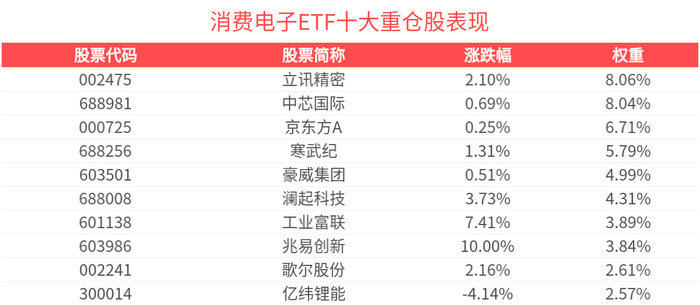
Core Insights - The China Securities Consumer Electronics Theme Index (931494) has seen a strong increase of 2.89% as of October 27, 2025, with significant gains in constituent stocks such as Jingwang Electronics (603228) and Zhaoyi Innovation (603986), both rising by 10.00% [1][2] - The Consumer Electronics ETF (561600) has also risen by 2.90%, with a recent price of 1.31 yuan, and has accumulated a 9.16% increase over the past week [1][2] Market Activity - The Consumer Electronics ETF experienced a turnover rate of 10.85% during trading, with a transaction volume of 46.21 million yuan, indicating active market participation [2] - Over the past week, the ETF's shares increased by 11 million, ranking it in the top fifth among comparable funds [2] Index Composition - The China Securities Consumer Electronics Theme Index includes 50 listed companies involved in component production and consumer electronics design and manufacturing, reflecting the overall performance of the sector [2] - As of September 30, 2025, the top ten weighted stocks in the index accounted for 55.93% of the total, with notable companies including Luxshare Precision (002475) and SMIC (688981) [2][4]





电竞装备持续热销
Jing Ji Ri Bao· 2025-10-26 21:53
Group 1: Industry Overview - The Chinese esports industry generated a revenue of 12.761 billion yuan in the first half of 2025, showing a year-on-year growth of 6.10% [1] - The user base for esports in China reached nearly 493 million, indicating a stable growth trend [1] - The esports industry is progressing towards standardization, mainstream acceptance, and internationalization, driven by favorable policies and technological advancements [1] Group 2: Equipment Consumption Trends - There has been a significant surge in esports equipment consumption, with laptops and wireless mice seeing over 150% year-on-year growth during the pre-"Double 11" shopping period [2] - The consumption of esports equipment is characterized by a younger and more professional demographic, with ordinary users increasingly becoming the main consumers [2] - The consumer-grade gaming laptop market in China is expected to grow by 24.3% year-on-year in Q2 2025, outpacing the overall consumer PC market [2] Group 3: Mobile Gaming and Hardware Development - The rise of mobile gaming and the popularity of live streaming and short videos have expanded the user base for esports games, leading to an upgrade in esports equipment [3] - Consumers are willing to pay for both esports game content and high-performance hardware that offers a professional experience [3] - A collaboration between a smartphone manufacturer and a technology group has resulted in the launch of a gaming phone with a 165Hz high refresh rate screen, enhancing the gaming experience [3] Group 4: Future Trends in Gaming Hardware - The gaming peripherals industry is undergoing a transformation from hardware performance competition to user experience enhancement [4] - There remains significant unmet demand in mobile performance and gaming experience, indicating opportunities for future breakthroughs in fluidity, graphics, eye care, and personalized experiences [4]
供应商官宣签订设备合同 维信诺8.6代OLED产线项目有新进展
Cai Jing Wang· 2025-10-26 10:33
Core Insights - Visionox (002387.SZ) is making significant progress with its 8.6-generation OLED production line, having signed an exclusive equipment supply contract with AP Systems for ELA (Excimer Laser Annealing) equipment [1] - ELA equipment is crucial in the TFT process, converting amorphous silicon (a-Si) into polycrystalline silicon (p-Si), which can enhance the electronic transmission speed of LTPS and LTPO OLEDs by over 100 times, impacting energy consumption and image quality of high-resolution OLED panels [1] - The global OLED industry is currently in a critical expansion phase towards medium and large-size applications, with major panel manufacturers like Visionox, TCL Huaxing, and BOE investing in 8.6-generation OLED production lines to gain a competitive edge [1] Company Developments - AP Systems aims to strengthen partnerships with major Chinese OLED panel manufacturers through this contract, marking a strategic move to establish a foothold in the 8.x generation OLED investment landscape [1] - The collaboration is expected to enhance Visionox's capabilities in high-end display manufacturing, which is essential for the production of TFT-LCD and OLED driver backplanes [1]
