翰森制药

Search documents
没想到现在二线城市,起势这么猛
虎嗅APP· 2025-04-28 13:35
以下文章来源于真叫卢俊 ,作者真叫卢俊团队 真叫卢俊 . 认认真真聊地产,实实在在谈买房。 本文来自微信公众号: 真叫卢俊 (ID:zhenjiaolujun0426) ,作者:余奔雷,题图来自:AI生成 世上唯一不变的就是变化,而年初到现在,国内一个最大的变局,就是一二线城市之间的疯狂博弈。 从杭州的超新星式爆发,到提问后迅速做出反应的南京,再到拼命抢人抢产业的深圳...... 可见随着这波二线城市的强势崛起,一线的宝座似乎也不那么稳当了。 之前我们写过杭州已经接近一线水平,但除了杭州,其实有更多强二线城市逐渐露头,评论区更是引发了一波讨论。 而当我们用脚走过这些二线城市,更能深刻感受到它们中有些真的不甘平庸,正努力站到台前聚光灯下。 不夸张地说,此时此刻的它们,也许未来某一天就是彼时彼刻的北上广们。 一、成都:全国楼市一次绝对的异 军突起 这两年我们走过最多的城市就是成都。 某种程度上,成都确实已经是国内楼市第一城了,数据就是最好证明。 3年前商品房成交量取代武汉,从此成为全国第一。去年一二手成交双双拿下全国销冠,超过了上海和北京。而今年一季度月均成交2.9万套,超过了 上海小阳春的2.3万。 无论对比一 ...
翰森制药(03692) - 2024 - 年度财报
2025-04-28 12:38
Financial Performance - The company's revenue for 2024 reached RMB 12,260,814, an increase of 21.4% compared to RMB 10,103,806 in 2023[9] - Gross profit for 2024 was RMB 11,155,406, reflecting a gross margin of approximately 91%[9] - The company reported a net profit of RMB 4,371,825 for 2024, up 33.4% from RMB 3,277,503 in 2023[9] - The company recorded a revenue of approximately RMB 12.261 billion for the year ending December 31, 2024, representing a year-on-year growth of about 21.3%[22] - Profit for the same period was approximately RMB 4.372 billion, an increase of about 33.4% compared to the previous year[22] - The company achieved a basic earnings per share of approximately RMB 0.74, reflecting a year-on-year increase of about 33.3%[22] Assets and Liabilities - Total assets as of 2024 amounted to RMB 31,657,849, while total liabilities decreased to RMB 2,977,935[9] - The asset-liability ratio was approximately 9.4% as of December 31, 2024, down from 21.9% the previous year[61] - The company maintained a cash and bank deposit balance of RMB 22.622 billion as of December 31, 2024, compared to RMB 22.435 billion a year earlier[61] Research and Development - Research and development expenses for 2024 were RMB 2,701,650, representing a significant investment in innovation[9] - The company is conducting over 60 clinical trials for innovative drugs, with 8 new candidates entering clinical research stages during the reporting period[38] - The company has established a robust R&D platform with over 1,800 researchers across multiple centers, focusing on innovative drug development[37] - The company plans to continue increasing R&D investments due to market changes and innovation efforts[141] Product Development and Approvals - The company received clinical trial approval for its new drug HS-10501, aimed at treating type 2 diabetes and adult obesity[11] - A licensing agreement was established with Pumis for the global development and commercialization of HS-20117, a bispecific ADC product[11] - The company has submitted multiple New Drug Applications (NDAs) for its innovative drug Amelior, targeting specific NSCLC patient populations[12] - The company received breakthrough therapy designation from the FDA for GSK5764227 (HS-20093) for the treatment of ES-SCLC patients[13] - The company’s innovative drug HS-20110 received clinical trial approval from NMPA for advanced solid tumors[14] - The company’s innovative drugs have all been included in the national medical insurance catalog as of December 31, 2024[24] Market Strategy and Partnerships - The company aims to expand its market presence through strategic partnerships and new product developments in the coming years[11] - The company will continue to focus on innovative drug development and internationalization strategies, particularly in oncology, central nervous system, metabolism, and autoimmune disease treatment areas[82] - The company plans to strengthen business development collaborations to optimize its global market layout[82] Corporate Governance - The board of directors consists of three executive directors and three independent non-executive directors as of December 31, 2024[87] - The company has established five specialized committees within the board to oversee various aspects of governance, including audit and remuneration[85] - The company has adopted a high standard of corporate governance to protect shareholder interests and enhance corporate value[84] Risk Management - The company identified major risks including industry competition and technological changes, emphasizing the need for continuous R&D investment to maintain product competitiveness[74] - Regulatory changes in the Chinese pharmaceutical industry may pose challenges to short-term business operations and cost structures, requiring the company to adapt to new regulations[75] - The company employs risk assessment tools such as risk matrices and sensitivity analysis to scientifically classify risks and implement corresponding control strategies[81] Employee and Talent Management - Attracting and retaining key talent is critical for enhancing organizational capabilities, with established mechanisms for talent retention and training[80] - The group’s employees are considered the most valuable asset, with compensation linked to performance and regular training provided to enhance productivity[153] Environmental, Social, and Governance (ESG) - The company maintained an MSCI ESG rating of AA and ranked first in the S&P Global Corporate Sustainability Assessment for the Chinese pharmaceutical industry[15][17] - The company is committed to identifying and mapping climate risks to its future strategies and business activities, focusing on carbon neutrality goals[81] - The group plans to publish an Environmental, Social, and Governance (ESG) report in conjunction with its annual report, as per listing rules[151] Shareholder Information - The company reported a proposed final dividend of HKD 0.1353 per share for the year ending December 31, 2024, compared to HKD 0.1422 in 2023, resulting in a total annual dividend of HKD 0.3363 per share[132] - As of December 31, 2024, major shareholders include Stellar Infinity and Sunrise Investment, each holding 3,900,000,000 shares, representing 65.70% of the total shares[170] Financial Management - The company has established a robust internal control system and conducted an annual review of its risk management and internal control systems, which the board believes are effective and adequate[121] - The company has adopted a dividend policy that considers its operating performance, cash flow, financial condition, and other relevant factors when declaring dividends[129]

暴涨!历史新高!
Zhong Guo Ji Jin Bao· 2025-04-28 10:27
Group 1: Market Overview - The Hang Seng Index slightly decreased by 0.04%, closing at 21,971.96 points, while the Hang Seng Tech Index rose by 0.12% to 4,988.94 points [2] - The total market turnover for the day was 169 billion HKD, with net purchases from southbound funds amounting to 2.03 billion HKD [2] - The performance of various sectors was mixed, with the telecommunications sector up by 0.73% and the healthcare sector down by 1.63% [4] Group 2: BYD Performance - BYD Electronics saw a significant drop of 8.49%, closing at 31.80 HKD, while BYD Company Limited fell by 3.98% to 381.20 HKD [3][12] - BYD Electronics reported a revenue of 36.88 billion RMB for Q1, a year-on-year increase of 1.1%, but a quarter-on-quarter decline of over 33% [16] - BYD Company Limited achieved a total revenue of 170.36 billion RMB in Q1, marking a year-on-year growth of 34.42% and a net profit increase of 100.38% to 9.15 billion RMB [19][20] Group 3: Pop Mart Performance - Pop Mart's new product LABUBU sparked a buying frenzy overseas, with the stock price reaching a historical high of 193.00 HKD, up 12.01% for the day [8] - According to Zheshang Securities, Pop Mart's revenue is projected to grow significantly, with estimates of 24.06 billion RMB, 32.69 billion RMB, and 40.86 billion RMB for 2025 to 2027 [11] - The company reported a staggering 475%-480% year-on-year revenue growth in overseas markets for Q1 2025, with the Americas seeing an increase of 895%-900% [11]

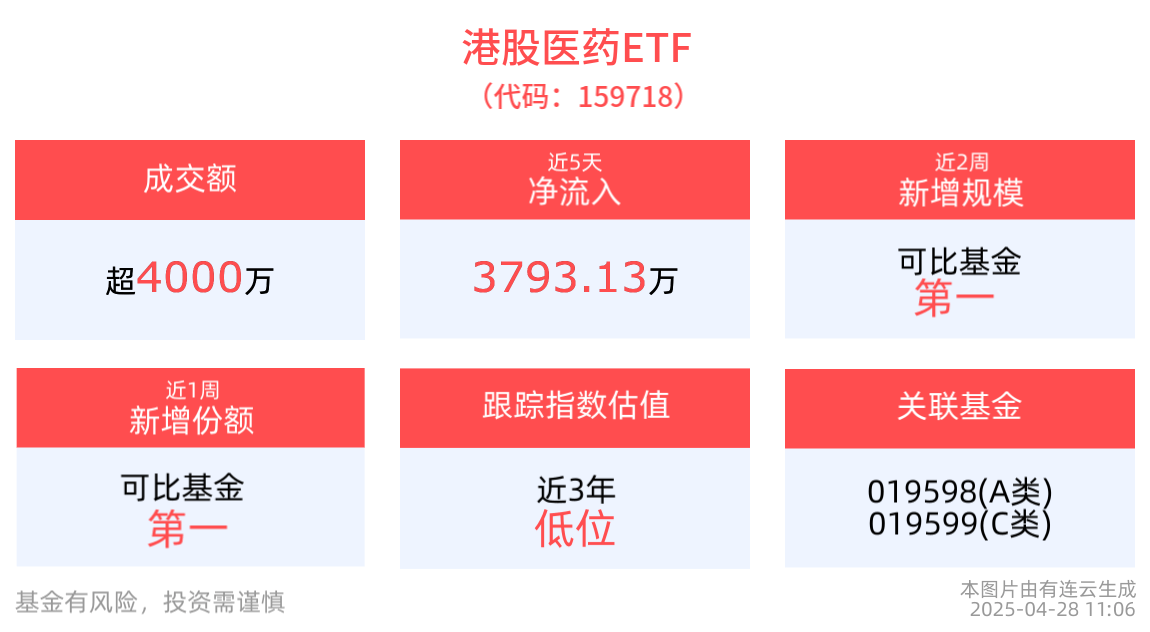
港股医药ETF(159718)近2周新增规模居同类第一,医疗创新ETF(516820)最新单日净流入超1300万元,机构:医药板块仍是值得重点配置方向
Sou Hu Cai Jing· 2025-04-28 03:31
Core Insights - The healthcare sector in Hong Kong is experiencing mixed performance, with the 中证港股通医药卫生综合指数 down by 2.09% as of April 28, 2025, while the 港股医药ETF has shown a weekly increase of 6.99% as of April 25, 2025 [1][4][7] Group 1: Market Performance - The 中证港股通医药卫生综合指数 has decreased by 2.09% as of April 28, 2025, with notable gainers including 心泰医疗 up 6.75% and 国药控股 up 3.79% [1] - The 港股医药ETF has a latest price of 0.7 yuan, reflecting a 2.09% decline, but has seen a 6.99% increase over the past week [1] - The 中证医药及医疗器械创新指数 has decreased by 0.52% as of April 28, 2025, with 百利天恒 leading gains at 4.77% [4] Group 2: Liquidity and Trading Activity - The 港股医药ETF had a turnover rate of 16.09% with a trading volume of 42.87 million yuan, indicating active market participation [1] - The 医疗创新ETF had a turnover rate of 1.2% and a trading volume of 19.80 million yuan [4] - The 港股医药ETF has seen a significant increase in scale, growing by 52.31 million yuan over the past two weeks [1] Group 3: Fund Flows and Investment Trends - The 港股医药ETF has attracted a total of 37.93 million yuan in net inflows over the last five trading days [1] - The 医疗创新ETF has recorded a net inflow of 13.66 million yuan, with a total of 14.22 million yuan over the last ten trading days [4] - Leverage funds are increasingly being utilized, with the 医疗创新ETF showing a financing buy amount of 4.79 million yuan [4] Group 4: Company Developments - Several innovative pharmaceutical companies in Shanghai have reported profitability driven by sales of innovative products, highlighting their full-chain innovation capabilities [7] - The trend of going global is common among these innovative drug companies, with products like 呋喹替尼 receiving approval in the U.S. market [7] - The integration of "R&D-production-sales" is accelerating, with leading pharmaceutical companies transitioning from biotech to biopharmaceutical firms [8]
智慧医疗迎政策利好,恒生医疗指数ETF(159557)有望受益
Sou Hu Cai Jing· 2025-04-28 03:27
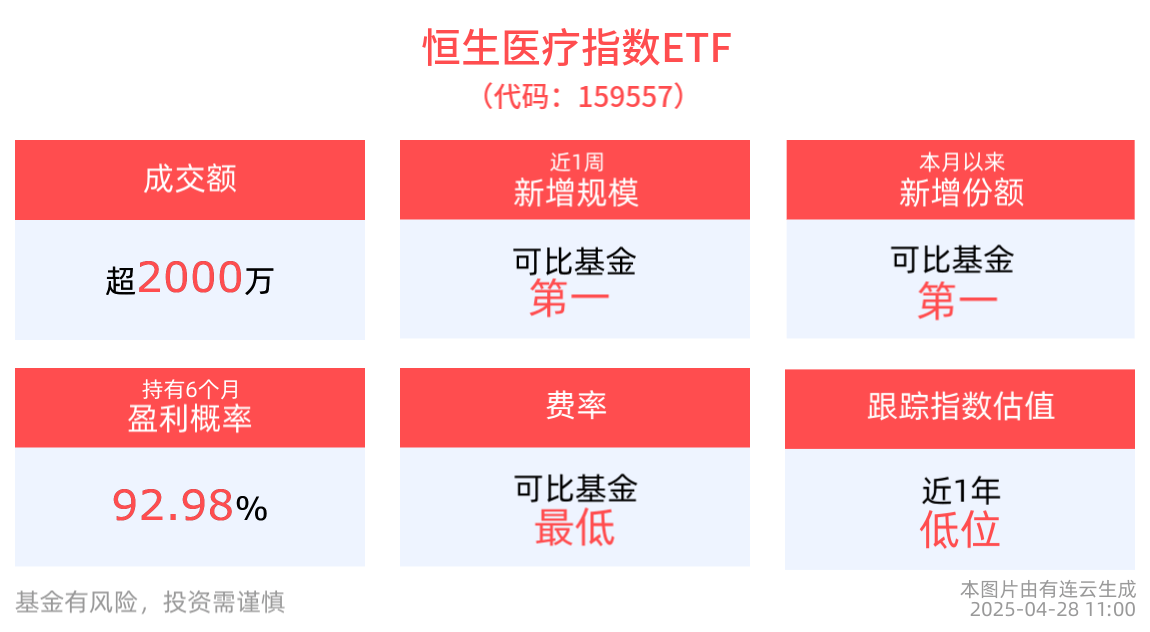
Group 1 - The Hang Seng Medical Index ETF experienced a turnover of 8.47% during the trading session, with a transaction volume of 21.38 million yuan [3] - The ETF's scale increased by 18.48 million yuan over the past week, indicating significant growth [3] - The ETF's shares grew by 10 million shares this month, reflecting substantial growth [3] Group 2 - The current price-to-earnings ratio (PE-TTM) of the Hang Seng Medical Index ETF is 24.86, which is at a historical low, being in the 6.5% percentile over the past year [3] - A joint implementation plan for the digital transformation of the pharmaceutical industry has been issued by seven government departments, aiming for significant progress by 2027 [3] Group 3 - Short-term AI medical themes are expected to continue being a focus, with market attention shifting towards Q1 performance and potential improvements in the pharmaceutical industry by Q2 2025 [4] - The top ten weighted stocks in the Hang Seng Medical Index account for 57.69% of the index, including companies like BeiGene, WuXi Biologics, and JD Health [4] - Investors without stock accounts can access the Hang Seng Medical Index ETF through a linked fund for investment opportunities in the Hong Kong medical sector [4]
中泰国际每日晨讯-20250428
ZHONGTAI INTERNATIONAL SECURITIES· 2025-04-28 02:16
Market Overview - The Hong Kong stock market continued its rebound, with the Hang Seng Index rising 2.7% to 21,980 points last week, although it did not stabilize above the 22,000-point mark. The average daily trading volume increased to HKD 238.9 billion, indicating a recovery in capital activity [1] - The Hang Seng Tech Index only increased by 2.0% and failed to break the psychological barrier of 5,000 points, reflecting insufficient recovery momentum in the technology sector [1] - The healthcare and information technology sectors saw significant gains of 8.4% and 6.0%, respectively, while essential consumer goods and telecommunications sectors declined, indicating a rebalancing of funds between policy expectations and risk aversion [1] Economic Policy Insights - The April Politburo meeting maintained policy consistency, emphasizing that "early policy implementation leads to early effects," including accelerated issuance of special bonds and the implementation of long-term special government bonds [2] - The market outlook will depend on two key variables: progress in US-China tariff negotiations and the pace of domestic special bond issuance along with adjustments in real estate policies [2] Industry Dynamics - The Hang Seng Healthcare Index surged 8.9%, significantly outperforming the Hang Seng Index, driven by innovative pharmaceutical companies such as Kangfang (9926 HK), Xinda (1801 HK), and Rongchang (9995 HK) [3] - Kangfang Biotech's (9926 HK) drug, Idataf, received approval for a broader indication in treating non-small cell lung cancer, which is expected to positively impact sales [3] - Rongchang Biotech (9995 HK) reported a good operational performance in Q1, with expectations of a reduction in sales expense ratio by 2025 and a decrease in net losses for shareholders [3] Strategic Recommendations - The report suggests focusing on defensive sectors and policy catalysts, including high-dividend assets from state-owned enterprises, infrastructure-related sectors, and essential consumer goods benefiting from policy stimuli [12] - Monthly stock recommendations include Alibaba-W (9988 HK), China Resources Beverage (2460 HK), and others, indicating a focus on companies with stable earnings and growth potential [12]
港股药品股集体下跌,三生制药(01530.HK)跌超8%,中国生物制药(01177.HK)跌超2%,翰森制药(03692.HK)、石药集团(01093.HK)跌超1%。
news flash· 2025-04-28 01:51
Group 1 - The Hong Kong pharmaceutical stocks experienced a collective decline, with notable drops in specific companies [1] - Three-Sixty Pharmaceuticals (01530.HK) fell over 8%, indicating significant market pressure [1] - China Biopharmaceutical (01177.HK) decreased by more than 2%, reflecting a broader trend in the sector [1] Group 2 - Hansoh Pharmaceutical (03692.HK) and CSPC Pharmaceutical Group (01093.HK) both saw declines exceeding 1%, contributing to the overall downturn in the industry [1]

2025 CSCO NSCLC指南更新 翰森制药创新药阿美乐新增Ⅰ级推荐
Zhong Guo Jing Ji Wang· 2025-04-27 05:56
Core Viewpoint - The 2025 CSCO Guidelines Conference has introduced the 2025 edition of the CSCO Guidelines for the Diagnosis and Treatment of Primary Non-Small Cell Lung Cancer (NSCLC), highlighting the inclusion of Hansoh Pharmaceutical's Amelot (Ametinib Mesylate Tablets) as the first Chinese original third-generation EGFR-TKI to receive a Class I recommendation for consolidation therapy in EGFR mutation-positive stage III unresectable NSCLC patients after chemoradiotherapy [1][2][3] Group 1 - The new recommendation is based on positive results from the POLESTAR study, a nationwide, multicenter, randomized, double-blind, controlled phase III clinical trial assessing the efficacy and safety of Amelot in consolidation therapy for stage III unresectable NSCLC patients with EGFR mutations after chemoradiotherapy [2] - The mid-term analysis of the POLESTAR study, presented at the 2024 World Lung Cancer Conference, showed a median progression-free survival (mPFS) of 30.4 months for the Amelot group, compared to 3.8 months for the placebo group, indicating an 8-fold improvement and an 85% reduction in the risk of disease progression or death [2] - The POLESTAR study exclusively included Chinese patients, demonstrating the significant efficacy of original EGFR-TKIs for domestic patients and providing high clinical relevance for China [2] Group 2 - NSCLC accounts for approximately 85% of all lung cancer cases in China, with nearly one-third being locally advanced (stage III) NSCLC, highlighting the urgent need for more precise and effective treatment options [2] - The rapid development of third-generation EGFR-TKIs represents a significant advancement in targeted therapy, offering more treatment choices to improve the diagnosis and treatment levels of stage III unresectable NSCLC and enhance patient prognosis [2] - The inclusion of Amelot as a Class I recommendation for consolidation therapy in this context confirms its application potential and is expected to guide the development of precision diagnosis and treatment for NSCLC in China, ultimately benefiting patients [3]
南向资金持续涌入,港股创新药板块成“心头肉”
智通财经网· 2025-04-25 08:11
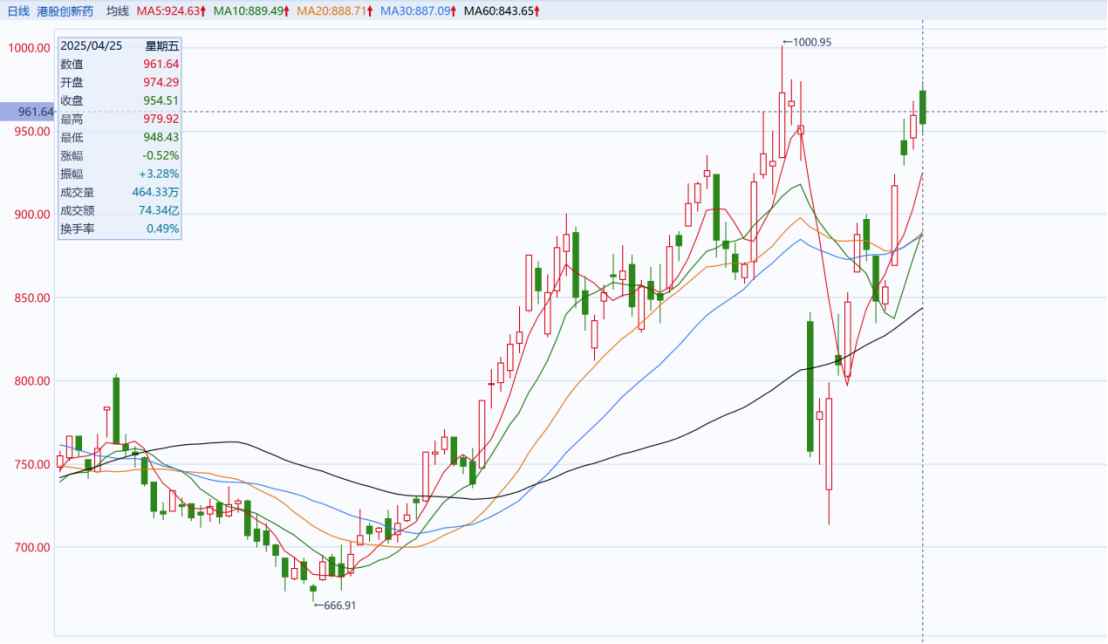
Group 1 - The Hong Kong innovative drug sector has rebounded rapidly due to a favorable external environment, with the China Securities Hong Kong Innovative Drug Index (931787) experiencing a significant recovery since its low on April 9, 2023 [1][3] - As of April 25, 2023, the index reached a peak of 979.92 points, showing a maximum cumulative increase of 37.43% from its previous low [1] - The overall increase in the Hong Kong innovative drug sector has outperformed the Hang Seng Technology Index, which has only seen a year-to-date increase of 12.48% compared to the innovative drug index's 31.03% [3] Group 2 - Recent data indicates a collective performance improvement among Hong Kong innovative drug companies, significantly exceeding market expectations [4] - In 2024, 10 out of 12 Hong Kong innovative drug companies with a market capitalization over 10 billion HKD reported positive revenue growth, with 8 companies also showing positive profit growth [4] - The company with the highest revenue growth is CloudTop New Drug-B (01952), with a revenue growth rate of 341.8%, while Innovent Biologics (01801) reported a net profit growth of 91.8% [4] Group 3 - The trend of "going global" has become a key topic, with Chinese pharmaceutical companies achieving significant growth in overseas licensing transactions [6][8] - The total transaction amount for licensing-out by Chinese pharmaceutical companies reached a historical high of 51.9 billion USD in 2024, indicating a strong global competitiveness in innovative drug development [6] - The NewCo model has emerged as a favorable strategy for domestic biotech companies, allowing for cash flow support and risk sharing in international collaborations [8] Group 4 - New industry trends in pharmaceuticals, such as weight-loss drugs, dual-antibody drugs, ADC drugs, and innovative medical devices, are expected to create new investment opportunities [9] - The Chinese government is increasing support for innovative drug exports, as evidenced by recent policies aimed at facilitating the import of research materials for biopharmaceutical companies [9] - Despite market fluctuations due to trade tensions, the pharmaceutical sector remains relatively insulated, presenting a favorable opportunity for large-scale investments [9] Group 5 - The Hong Kong innovative drug sector is poised for a valuation recovery, with significant inflows of capital from southbound investors since the beginning of the year [11] - As of April 24, 2023, net capital inflows from A-share investors into Hong Kong stocks reached 611.1 billion HKD, with healthcare becoming the second most net inflow sector [11] - The current price-to-earnings ratio (TTM) for the pharmaceutical and biotechnology sector is 27.1, indicating that the sector is undervalued compared to other growth sectors [12][13]
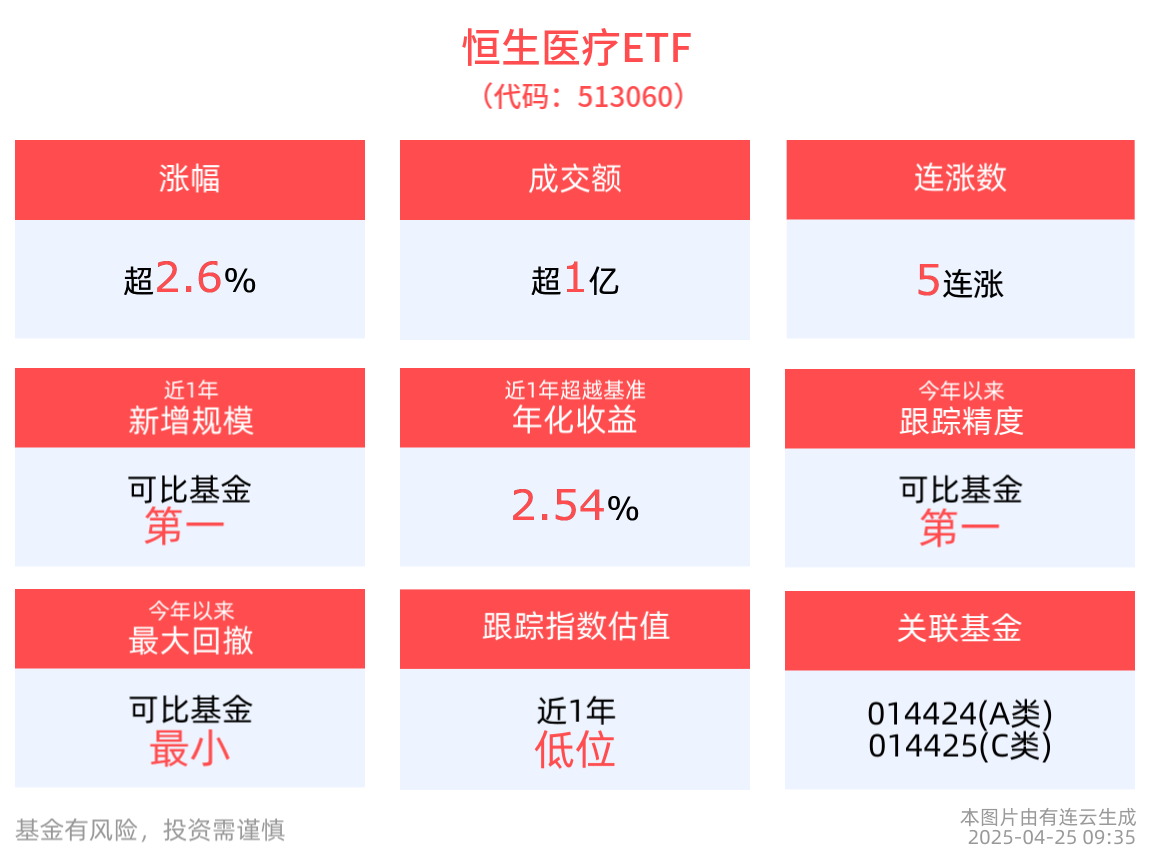
医药工业数智化转型实施方案落地,恒生医疗ETF(513060)高开高走上涨2.68%,医渡科技涨超10%
Sou Hu Cai Jing· 2025-04-25 01:52
Core Viewpoint - The Hang Seng Healthcare Index (HSHCI) has shown strong performance, with significant increases in constituent stocks and a notable rise in the Hang Seng Healthcare ETF, reflecting positive market sentiment and growth potential in the healthcare sector [3][4]. Group 1: Market Performance - As of April 25, 2025, the HSHCI rose by 1.77%, with notable gains from stocks such as Yidu Tech (10.15%) and WeDoctor (7.05%) [3]. - The Hang Seng Healthcare ETF (513060) opened high and increased by 2.68%, marking its fifth consecutive rise, with a latest price of 0.50 yuan [3]. - Over the past week, the Hang Seng Healthcare ETF has accumulated an 8.50% increase [3]. Group 2: Liquidity and Trading Volume - The Hang Seng Healthcare ETF had a turnover rate of 1.57% during the trading session, with a transaction volume of 183 million yuan [3]. - The ETF's average daily trading volume over the past month was 2.072 billion yuan, ranking first among comparable funds [3]. Group 3: Policy and Industry Outlook - On April 24, 2025, the Ministry of Industry and Information Technology and six other departments issued a notice on the "Implementation Plan for the Digital Transformation of the Pharmaceutical Industry (2025-2030)," aimed at enhancing the integration of AI and new information technologies within the pharmaceutical industry [3]. Group 4: Fund Performance and Metrics - The Hang Seng Healthcare ETF has seen a net asset growth of 715 million yuan over the past year, ranking in the top third among comparable funds [4]. - As of April 24, 2025, the ETF's net value increased by 41.16% over the past year, with a maximum monthly return of 28.34% since inception [4]. - The ETF's Sharpe ratio was reported at 1.34, indicating strong risk-adjusted returns [5]. Group 5: Valuation and Holdings - The latest price-to-earnings ratio (PE-TTM) for the HSHCI is 25.11, which is below 92.78% of the historical data over the past year, indicating a low valuation [5]. - The top ten weighted stocks in the HSHCI account for 57.54% of the index, with companies like BeiGene and WuXi Biologics being significant contributors [5].