招商银行

Search documents
多家上市银行大股东或高管增持落地!
Xin Lang Cai Jing· 2026-01-14 00:20
Core Viewpoint - The recent increase in shareholding by major shareholders and executives in several banks reflects confidence in the banking sector's development and may signal a potential valuation recovery for bank stocks [1][6]. Group 1: Shareholder and Executive Purchases - Yunnan Rural Commercial Bank announced that several directors and senior management purchased 192,000 shares between January 5 and January 7, 2026, at prices ranging from RMB 6.36 to RMB 6.42 per share [7]. - Nanjing Bank reported that its major shareholder, Zijin Group, increased its stake by 123,472,060 shares, representing 1.00% of the total share capital, between September 11, 2025, and January 12, 2026 [7]. - Qilu Bank disclosed that its directors, supervisors, and senior management successfully purchased 771,000 shares for a total of RMB 4.48 million, exceeding their initial commitment of at least RMB 3.5 million [2][7]. Group 2: Market Signals and Insights - Analyst Yang Haiping indicated that the increase in shareholding sends three signals: it supplements the capital of listed banks, demonstrates shareholder confidence in future performance, and may serve as a catalyst for valuation recovery [8]. - The insurance sector is increasingly investing in bank stocks, with significant purchases from companies like Ping An Life, reflecting a strategic long-term choice rather than a short-term tactical adjustment [9]. Group 3: Future Outlook - Multiple institutions predict that the trend of increasing interest in bank stocks will continue into 2026, with a focus on the dividend attributes of bank shares attracting long-term capital [10]. - Analysts believe that the valuation of bank stocks remains low, suggesting further potential for appreciation in the banking sector [11].



多家上市银行大股东或高管增持落地 或迎来估值修复
Zheng Quan Ri Bao· 2026-01-14 00:08
Core Viewpoint - The recent increase in shareholding by major shareholders and executives in several banks indicates confidence in the banking sector's development and potential valuation recovery [1][2][3]. Group 1: Shareholder Actions - Yunnan Rural Commercial Bank announced that six core executives collectively increased their holdings, buying 192,000 shares at prices between RMB 6.36 and RMB 6.42 per share [2]. - Nanjing Bank's major shareholder, Zijin Group, increased its stake by 123,472,060 shares, representing 1.00% of the total share capital [2]. - Qilu Bank's executives exceeded their planned share purchase, acquiring 771,000 shares for a total of RMB 4.48 million, surpassing the initial target of RMB 3.5 million [2]. Group 2: Market Signals - Analysts suggest that the increase in shareholding sends three key signals: it enhances the capital of listed banks, reflects shareholder confidence in future development, and may serve as a catalyst for valuation recovery [3]. - The actions of insurance companies, such as Ping An Life increasing their holdings in Agricultural Bank and China Merchants Bank, highlight a trend of insurance capital increasing their investments in bank stocks [4]. Group 3: Investment Outlook - The insurance sector is expected to inject over RMB 2 trillion into the market in 2026, with a growing demand for dividend-yielding assets, particularly state-owned banks offering over 4% dividend yields [4]. - Analysts from Galaxy Securities predict that the trend of long-term funds, represented by insurance capital, will continue to favor bank stocks due to their dividend characteristics and stable cash flow [5]. - Overall, the valuation of bank stocks remains low, suggesting potential for further appreciation in the sector [5].
智通ADR统计 | 1月14日
智通财经网· 2026-01-13 22:43
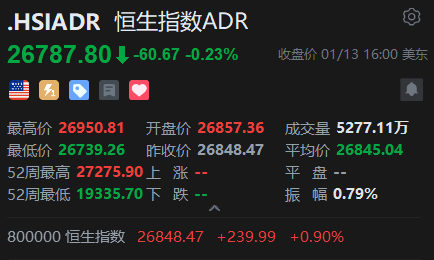
Core Viewpoint - The Hang Seng Index (HSI) experienced a slight decline, closing at 26,787.80, down 0.23% from the previous close, indicating a mixed performance in the Hong Kong stock market [1]. Group 1: Market Performance - The Hang Seng Index closed at 26,787.80, down 60.67 points or 0.23% [1]. - The index reached a high of 26,950.81 and a low of 26,739.26 during the trading session, with a trading volume of 52.77 million shares [1]. - The average price for the session was 26,845.04, with a 52-week high of 27,275.90 and a low of 19,335.70 [1]. Group 2: Major Blue-Chip Stocks - HSBC Holdings closed at HKD 127.188, up 0.62% compared to the previous close [2]. - Tencent Holdings closed at HKD 624.864, down 0.42% from the previous close [2]. - Alibaba Group saw a price increase of 3.63%, closing at HKD 159.900 [3]. - Other notable performances include AIA Group up 0.84% at HKD 84.400 and China Construction Bank up 1.17% at HKD 7.810 [3].




云南金融系统有力有效支持实体经济发展——精准滴灌 纾困兴业
Xin Lang Cai Jing· 2026-01-13 20:54
Core Viewpoint - The financial system in Yunnan is effectively supporting the real economy, with a notable increase in loan volume and a decrease in interest rates, contributing to high-quality economic development [1][2]. Group 1: Financial Support for Agriculture - As of November 2025, the total loan balance for agriculture in Yunnan reached 1.39 trillion yuan, significantly supporting the agricultural sector [2]. - Innovative financial products like "Cane Loan" and "Cloud Flower Loan" have been introduced to address specific financing needs in the sugarcane and jasmine flower industries, with the latter receiving 11 million yuan in loans [1][2]. - Agricultural facility mortgage loans in pilot areas reached 642 million yuan by the end of Q3 2025, marking a 45.6% year-on-year increase, addressing long-standing collateral issues in the agricultural sector [2]. Group 2: Financial Innovation and Technology - A technology-focused agricultural company received a 10 million yuan credit loan through the "Science and Technology Loan" program, enhancing its processing capacity by 40% and reducing loss rates by 15% [4]. - The balance of technology loans in Yunnan grew by 10.79% year-on-year, with loans to technology SMEs increasing by 15.65% [5]. - The establishment of a financing credit service platform has facilitated connections between 241 financial institutions and 183.7 million registered enterprises, leading to a total credit issuance of 573.5 billion yuan [6]. Group 3: Financial Support for Tourism and Elderly Care - The "Golden Travel Loan" product provided 500,000 yuan to support a hospitality business in Lugu Lake, showcasing financial support for the tourism sector [7]. - Loans for the elderly care industry increased by 133.64% year-on-year, with cultural, entertainment, transportation, and accommodation loans reaching 1.14 trillion yuan, a 70% increase compared to the end of the 13th Five-Year Plan [7][8]. - Financial resources are being directed towards developing a comprehensive financial ecosystem for tourism, including support for various new business models in the sector [8].
Personal-Trading Probe Led to Firing of Two Scotiabank Analysts
MINT· 2026-01-13 18:47
Core Viewpoint - Two brothers, Michael and George Doumet, are suing Bank of Nova Scotia for wrongful termination from their stock-analyst positions, claiming unjust treatment and breaches of the bank's personal-trading policy led to their dismissals [1][2][19]. Group 1: Termination Details - The Doumet brothers were terminated after a compliance review revealed Michael Doumet's frequent trading in a small-cap stock and communication with the company's CFO, leading to allegations of policy breaches [3][10]. - Following the firings, three senior compliance employees were also dismissed for failing to escalate trading concerns, indicating a broader issue within the compliance department [4][5]. - The firings occurred swiftly, with both brothers receiving termination letters in separate five-minute meetings with their supervisor [8]. Group 2: Financial Background - Michael Doumet earned approximately C$400,000 (about $290,000) in total compensation in 2023, while George Doumet earned around C$490,000 [7]. - The brothers are seeking a combined C$1.65 million in severance pay and damages in their lawsuit against Scotiabank [9]. Group 3: Compliance and Investigations - The compliance department's internal probe was prompted by a whistleblower complaint, leading to an external investigation by law firm Torys LLP [4][16]. - The Doumet brothers failed to register their wives' trading accounts as related-party investment accounts, which was cited as a violation of the bank's trading policy [17][20]. - Scotiabank has faced increased scrutiny regarding its compliance controls, particularly following a significant anti-money-laundering settlement with US authorities [5].


多家上市银行大股东或高管增持落地
Zheng Quan Ri Bao· 2026-01-13 16:51
Core Viewpoint - The recent increase in shareholding by major shareholders and executives in several banks indicates confidence in the banking sector's development and potential for valuation recovery [1][3]. Group 1: Shareholder Actions - Yunnan Rural Commercial Bank announced that six core executives collectively increased their holdings by purchasing 192,000 shares at prices ranging from RMB 6.36 to 6.42 per share [2]. - Nanjing Bank reported that its major shareholder, Zijin Group, increased its stake by 123,472,060 shares, representing 1.00% of the total share capital [2]. - Qilu Bank's executives exceeded their planned share purchase, acquiring 771,000 shares for a total of RMB 4.48 million, surpassing the initial target of RMB 3.5 million [2]. Group 2: Market Signals - Analysts suggest that the increase in shareholding by major shareholders sends three key signals: it enhances the capital of listed banks, reflects confidence in future development and stock performance, and may serve as a catalyst for valuation recovery [3]. - The actions of insurance companies, such as Ping An Life, to increase holdings in major banks highlight a trend of institutional investment in the banking sector, driven by the attractive dividend yields of over 4% [4]. Group 3: Investment Outlook - The insurance sector is expected to inject over RMB 2 trillion into the market in 2026, with a growing demand for high-dividend assets, making state-owned banks attractive long-term investment targets [4]. - Analysts from Galaxy Securities maintain a positive outlook on the banking sector, anticipating continued interest from long-term funds, particularly from insurance capital [5]. - Industry insiders believe that the valuation of bank stocks remains low, suggesting potential for further appreciation [6].
招商银行大宗交易成交781.47万元
Zheng Quan Shi Bao Wang· 2026-01-13 14:56
进一步统计,近3个月内该股累计发生9笔大宗交易,合计成交金额为4.56亿元。 据天眼查APP显示,招商银行股份有限公司成立于1987年03月31日,注册资本2521984.5601万人民币。 (数据宝) 1月13日招商银行大宗交易一览 | 成交量 (万 | 成交金额 | 成交价 格 | 相对当日收盘 | 买方营业部 | 卖方营业部 | | --- | --- | --- | --- | --- | --- | | | (万元) | | 折溢价(%) | | | | 股) | | (元) | | | | | 19.00 | 781.47 | 41.13 | 0.00 | 中信证券股份有限公司 | 广发证券股份有限公司上海 | | | | | | 总部(非营业场所) | 西藏南路证券营业部 | (文章来源:证券时报网) 招商银行1月13日大宗交易平台出现一笔成交,成交量19.00万股,成交金额781.47万元,大宗交易成交 价为41.13元。该笔交易的买方营业部为中信证券股份有限公司总部(非营业场所),卖方营业部为广发证 券股份有限公司上海西藏南路证券营业部。 证券时报·数据宝统计显示,招商银行今日收盘价为41. ...
最高兑换超3000元!银行打响“资产提升战”
Zhong Guo Jing Ying Bao· 2026-01-13 14:48
Group 1 - Major banks in China have launched "asset enhancement" activities to attract funds, with rewards exceeding 3000 yuan for qualifying customers [1][2] - Agricultural Bank of China has introduced a program where customers can earn rewards based on the increase in their average financial assets, with a notable example being a reward of 2,400,000 points for an increase of over 6 million yuan [2] - Other banks, including Beijing Bank and Nanjing Bank, are also participating in similar initiatives, aligning with the traditional marketing peak period known as "opening red" [3] Group 2 - The marketing strategies are focused on high-net-worth individuals and effective customers, aiming to expand the base of quality clients and enhance their overall contribution [3] - There is a growing trend of "sheep shearing" tactics among customers, where individuals exploit promotional offers without maintaining high balances, prompting banks to consider how to manage this behavior effectively [4] - Banks are recognizing the potential value of the "sheep shearing" group, suggesting that their participation can generate market interest and attract more potential clients [4]
又一家股份行总资产突破10万亿!
Xin Lang Cai Jing· 2026-01-13 14:16
Group 1 - The core point of the article is that Shanghai Pudong Development Bank (SPDB) has officially joined the "10 trillion club," with total assets reaching 100,817.46 billion yuan, a growth of 6.55% compared to the end of the previous year [1][11] - SPDB's total liabilities also increased to 92,573.16 billion yuan, reflecting a growth of 6.20% year-on-year [1][11] - With SPDB's entry, the number of banks in China's "10 trillion club" has expanded to nine, indicating a significant differentiation among joint-stock banks [3][13] Group 2 - In 2025, SPDB achieved a dual increase in operating efficiency and asset quality, with operating income reaching 1,739.64 billion yuan, a year-on-year increase of 1.88%, and net profit attributable to shareholders of 500.17 billion yuan, up 10.52% [7][15] - The bank's non-performing loan balance decreased to 719.90 billion yuan, down by 11.64 billion yuan from the previous year, and the non-performing loan ratio fell to 1.26%, a decrease of 0.10 percentage points [7][15] - The bank's provision coverage ratio improved to 200.72%, an increase of 13.76 percentage points from the previous year, indicating a positive trend in asset quality [8][15] Group 3 - SPDB's strategic focus on five key areas—technology finance, supply chain finance, inclusive finance, cross-border finance, and treasury finance—has contributed to its growth [8][16] - The bank is also enhancing its credit allocation to key sectors and regions, aiming for both qualitative and quantitative improvements in credit assets [8][16] - The stabilization of net interest margin is a significant indicator for the bank's future performance, pending confirmation from other banks' annual reports [8][16]

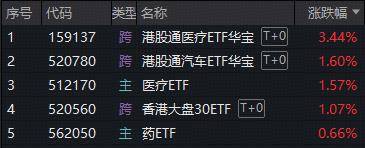
ETF复盘资讯|沪指止步17连阳!商业航天巨震,通用航空ETF跌7.27%!港股逆袭,港股通医疗ETF(159137)一度涨停
Sou Hu Cai Jing· 2026-01-13 13:54
Group 1: Market Overview - The A-share market experienced a collective pullback on January 13, with the Shanghai Composite Index down 0.64%, ending a 17-day winning streak, while the Shenzhen Component Index fell 1.37% and the ChiNext Index dropped 1.96% [1] - The trading volume in the Shanghai, Shenzhen, and Beijing markets exceeded 3.6 trillion yuan, marking a slight increase from the previous day and setting a new historical high [1] Group 2: AI Medical Sector - The AI medical sector continues to thrive, with significant gains; the Hong Kong medical ETF (159137) surged by 3.44% and reached a near-limit-up level, while the largest A-share medical ETF (512170) hit a three-month high with a peak increase of 3.67% [4][6] - AI medical concept stocks saw substantial increases, with Ark Health rising over 76% after announcing a collaboration with Tencent Health on an "AI + chronic disease management" plan [4][8] Group 3: Banking Sector - The banking sector showed resilience, with several banks like Ningbo Bank and Hangzhou Bank seeing gains of over 4% and 3% respectively, while the top banking ETF (512800) rose by 0.37% [11][13] - The first bank executive buyback announcement of 2026 was made by Chongqing Rural Commercial Bank, indicating confidence in the company's fundamentals [13] - Historical data suggests that the banking sector tends to perform well before the Spring Festival, with an average absolute return of 4.4% [16] Group 4: Commercial Aerospace Sector - The commercial aerospace sector faced volatility, with the general aviation ETF (159231) experiencing a significant drop of 7.27%, despite a net inflow of 46 million yuan on the same day [18][19] - The sector's performance has been mixed, with 44 out of 50 component stocks declining, while some stocks like Tianyin Electromechanical and Haige Communication saw gains [18] Group 5: Future Outlook - Analysts suggest that the current market liquidity is ample, and thematic trading is expected to continue, with a focus on the "Musk Chain" and non-bank financial investment opportunities [3] - The market is anticipated to exhibit structural opportunities, with a theme-driven approach and rapid capital rotation among different industry lines [3]