海富通基金

Search documents
321只ETF获融资净买入 富国中债7—10年政策性金融债ETF居首
Zheng Quan Shi Bao Wang· 2025-12-17 03:53
Core Viewpoint - As of December 16, the total margin balance of ETFs in the Shanghai and Shenzhen markets reached 124.408 billion yuan, an increase of 6.429 billion yuan from the previous trading day [1] Group 1: ETF Financing and Margin Balances - The ETF financing balance was 117.118 billion yuan, up by 6.598 billion yuan compared to the previous trading day [1] - The ETF margin short balance was 7.29 billion yuan, showing a decrease of 0.169 billion yuan from the previous trading day [1] Group 2: Net Inflows into ETFs - On December 16, 321 ETFs experienced net financing inflows, with the top net inflow being the Fuguo Zhongzhai 7-10 Year Policy Financial Bond ETF, which saw a net inflow of 3.25 billion yuan [1] - Other ETFs with significant net inflows included the Bosera Zhongzhai 0-3 Year National Development Bank ETF, the Guotai Securities Shanghai Stock Exchange 5-Year Government Bond ETF, the Haifutong Zhongzhai Short-term Bond ETF, and the Huaxia Hang Seng Technology ETF [1]
两市ETF两融余额增加6158.22万元丨ETF融资融券日报
2 1 Shi Ji Jing Ji Bao Dao· 2025-12-16 06:19
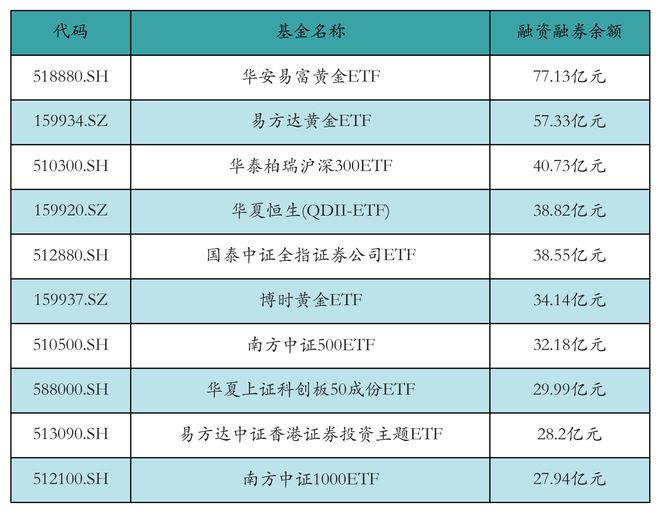
Market Overview - On December 15, the total ETF margin balance in the two markets reached 117.979 billion yuan, an increase of 615.822 million yuan from the previous trading day. The financing balance was 110.52 billion yuan, up by 614 million yuan, while the securities lending balance decreased by 552 million yuan to 7.46 billion yuan [1] - In the Shanghai market, the ETF margin balance was 82.677 billion yuan, a decrease of 10.3 million yuan from the previous trading day. The financing balance increased by 43.7 million yuan to 76.174 billion yuan, while the securities lending balance decreased by 540 million yuan to 6.503 billion yuan [1] - In the Shenzhen market, the ETF margin balance was 35.302 billion yuan, an increase of 16.5 million yuan from the previous trading day. The financing balance rose by 17.7 million yuan to 34.346 billion yuan, while the securities lending balance decreased by 12.552 million yuan to 956 million yuan [1] ETF Margin Financing Balances - The top three ETF margin financing balances on December 15 were: 1. Huaan Yifu Gold ETF (7.556 billion yuan) 2. E Fund Gold ETF (5.647 billion yuan) 3. Huatai-PB CSI 300 ETF (3.956 billion yuan) [2] ETF Financing Buy Amounts - The top three ETF financing buy amounts on December 15 were: 1. Hai Fudong CSI Short-term Bond ETF (1.931 billion yuan) 2. E Fund CSI Hong Kong Securities Investment Theme ETF (1.233 billion yuan) 3. Huatai-PB Southern Dongying Hang Seng Technology Index (0.744 billion yuan) [4] ETF Financing Net Buy Amounts - The top three ETF financing net buy amounts on December 15 were: 1. Fuguo Medium-term Policy Financial Bond ETF (194 million yuan) 2. E Fund ChiNext ETF (126 million yuan) 3. Harvest CSI Sci-Tech Innovation Board Chip ETF (115 million yuan) [5] ETF Securities Lending Sell Amounts - The top three ETF securities lending sell amounts on December 15 were: 1. Southern CSI 1000 ETF (31.8015 million yuan) 2. Huatai-PB CSI 300 ETF (17.6759 million yuan) 3. Huaxia SSE 50 ETF (16.7387 million yuan) [6]

天府证券ETF日报-20251211
天府证券· 2025-12-11 09:21
Market Overview - On December 11, 2025, the Shanghai Composite Index fell 0.70% to close at 3873.32 points, the Shenzhen Component Index fell 1.27% to close at 13147.39 points, and the ChiNext Index fell 1.41% to close at 3163.67 points. The trading volume of A-shares in the two markets was 1885.4 billion yuan. The top-performing industry was banking with a 0.17% increase, while the bottom-performing industries were comprehensive (-4.31%), communication (-3.14%), and real estate (-3.06%) [2][6]. Stock ETF - The top-traded stock ETFs on this day were Huatai-PineBridge CSI A500 ETF, which fell 0.89% with a discount rate of -0.77%; ChinaAMC CSI A500 ETF, which fell 0.69% with a discount rate of -0.69%; and Southern CSI A500 ETF, which fell 0.66% with a discount rate of -0.66% [3][7]. Bond ETF - The top-traded bond ETFs were Haitong CSI Short-term Financing Bond ETF, which rose 0.00% with a discount rate of -0.01%; E Fund CSI AAA Science and Technology Innovation Corporate Bond ETF, which rose 0.05% with a discount rate of -0.21%; and ChinaAMC Shanghai Stock Exchange Benchmark Market-making Treasury Bond ETF, which rose 0.15% with a discount rate of 0.14% [4][9]. Gold ETF - Gold AU9999 rose 0.16% and Shanghai Gold rose 0.15%. The top-traded gold ETFs were HuaAn Gold ETF, which rose 0.16% with a discount rate of 0.22%; E Fund Gold ETF, which rose 0.20% with a discount rate of 0.22%; and Bosera Gold ETF, which rose 0.19% with a discount rate of 0.21% [12]. Commodity Futures ETF - Dacheng Nonferrous Metals Futures ETF had a 0.00% change with a discount rate of 0.44%; ChinaAMC Feed Soybean Meal Futures ETF fell 0.36% with a discount rate of 2.33%; and CCB YiSheng Zhengzhou Commodity Exchange Energy and Chemical Futures ETF fell 0.08% with a discount rate of -0.07% [13]. Cross - border ETF - The previous day, the Dow Jones Industrial Average rose 1.05%, the Nasdaq rose 0.33%, the S&P 500 rose 0.67%, and the German DAX fell 0.13%. On this day, the Hang Seng Index fell 0.04% and the Hang Seng China Enterprises Index fell 0.23%. The top-traded cross - border ETFs were E Fund CSI Hong Kong Securities Investment Theme ETF, which fell 1.18% with a discount rate of -1.51%; GF CSI Hong Kong Innovative Drugs ETF, which fell 0.46% with a discount rate of -0.19%; and Huatai - PineBridge Hang Seng Technology ETF, which fell 0.82% with a discount rate of -0.86% [16]. Money ETF - The top-traded money ETFs were YinHua RiLi ETF, HuaBao TianYi ETF, and Money ETF [18].
从“卖产品”到“创价值” 基金代销机构考核转向
Zheng Quan Ri Bao· 2025-12-09 15:53
Core Viewpoint - The ongoing termination of partnerships between fund managers and distribution agencies reflects a shift in the public fund industry towards a value-oriented assessment of partners, driven by rising compliance costs, fee reform impacts, and intensified competition among leading firms [1][4]. Group 1: Termination of Partnerships - As of December 9, 34 fund managers have announced the termination of partnerships with 16 distribution agencies, including independent sales institutions, banks, and futures companies [1]. - Notable terminations include Zhongyou Chuangye Fund's cessation of collaboration with Beijing Weidongli Fund Sales Co., and the complete withdrawal of Fangzheng Zhongqi Futures from fund sales, effective November 28 [2]. - The terminations predominantly involve small independent sales agencies and cross-industry participants like futures companies, which struggle to sustain resource investment in fund sales [2]. Group 2: Market Dynamics - The fund distribution industry has developed a pronounced head effect, with large distribution agencies dominating market share, client resources, and brand influence, making it difficult for smaller agencies to compete [3]. - The reform of public fund fee structures has led to a decline in management fees, custody fees, and distribution commissions, directly impacting the profitability of distribution agencies, particularly smaller ones [3]. Group 3: Compliance and Internal Control - The survival of small distribution agencies is increasingly challenged by pressures related to compliance, resources, profitability, and the need for business model transformation [4]. - Regulatory bodies have intensified compliance requirements for fund distribution, while many small agencies remain reliant on traditional sales models and lack technological investment and innovative service capabilities [4]. Group 4: Shift in Evaluation Criteria - Fund companies are shifting their evaluation criteria for distribution partners from a focus on scale to a more comprehensive and long-term assessment, considering compliance, client scale, market influence, and sales performance [4]. - This transition is part of a broader regulatory push to guide the industry from a "seller-driven" model to a "buyer advisory" model, emphasizing the creation of long-term value for clients [5]. Group 5: Strategic Adaptation - Distribution agencies are encouraged to explore differentiated services or transition into technology service providers as viable strategies to navigate the industry reshuffle [6]. - The choice of strategy should align with the agency's available resources and business strengths to effectively stand out in a competitive landscape [6].
两市ETF两融余额增加2.26亿元丨ETF融资融券日报
2 1 Shi Ji Jing Ji Bao Dao· 2025-12-09 08:17
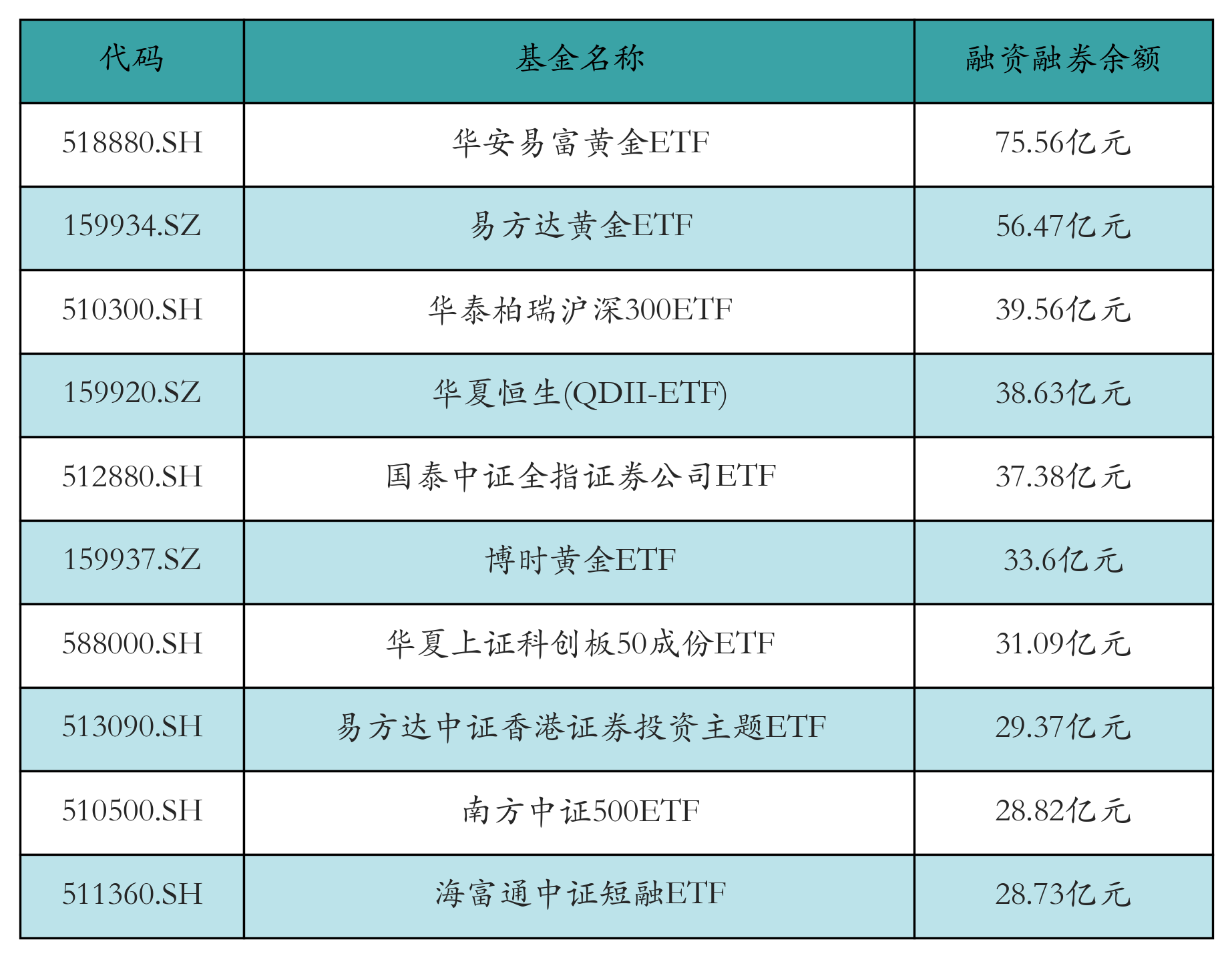
Market Overview - On December 8, the total ETF margin balance in the two markets reached 118.274 billion yuan, an increase of 0.226 billion yuan from the previous trading day [1] - The financing balance was 110.272 billion yuan, up by 0.181 billion yuan, while the securities lending balance was 8.003 billion yuan, increasing by 44.806 million yuan [1] - In the Shanghai market, the ETF margin balance was 82.695 billion yuan, with a slight increase of 43.056 million yuan from the previous day [1] - The financing balance in the Shanghai market decreased by 5.0863 million yuan to 75.654 billion yuan, while the securities lending balance increased by 48.1423 million yuan to 7.041 billion yuan [1] - In the Shenzhen market, the ETF margin balance was 35.58 billion yuan, increasing by 1.83 billion yuan [1] - The financing balance in the Shenzhen market rose by 1.86 billion yuan to 34.618 billion yuan, while the securities lending balance decreased by 3.3357 million yuan to 0.962 billion yuan [1] ETF Margin Balance - The top three ETFs by margin balance on December 8 were: - Huaan Yifu Gold ETF (7.579 billion yuan) - E Fund Gold ETF (5.734 billion yuan) - Huatai-PB CSI 300 ETF (3.985 billion yuan) [2] ETF Financing Amount - The top three ETFs by financing amount on December 8 were: - E Fund CSI Hong Kong Securities Investment Theme ETF (1.853 billion yuan) - Haifutong CSI Short Bond ETF (1.347 billion yuan) - Huatai-PB Southern Dongying Hang Seng Technology Index (QDII-ETF) (0.761 billion yuan) [4] ETF Financing Net Amount - The top three ETFs by financing net amount on December 8 were: - Guotai CSI All-Index Communication Equipment ETF (740.699 million yuan) - Harvest CSI STAR Market Chip ETF (634.591 million yuan) - Yongying National Certificate Commercial Satellite Communication Industry ETF (511.868 million yuan) [6] ETF Securities Lending Amount - The top three ETFs by securities lending amount on December 8 were: - Huatai-PB CSI 300 ETF (392.657 million yuan) - Huaxia CSI 1000 ETF (200.044 million yuan) - Huaxia Shanghai 50 ETF (178.288 million yuan) [8]
海富通基金总经理任志强:科技赋能公募行业迈向高质量发展
2 1 Shi Ji Jing Ji Bao Dao· 2025-12-08 11:44
12月6日,在南方财经论坛2025年会基金业分论坛上,海富通基金总经理任志强发表了题为《科技赋能 公募行业迈向高质量发展》的主题演讲,分享了基金公司探索科技赋能的实践路径。 "当前我们正站在科技革命与公募基金行业改革的交汇点,作为资本市场的'压舱石'和'助推器',公募基 金如何以科技之力破局立新?"任志强表示,以海富通基金为例,公司立足行业趋势与自身发展,积极 探索将大数据、人工智能等先进技术融入投研、合规风控、销售等核心业务环节,建立起全业务场景的 数字化赋能体系,以科技手段增强服务投资者与实体经济的效能。 投研体系升级 在任志强看来,人工智能的引入还将推动客户服务向智能化、个性化、场景化方向发展。 他举例谈道,一些机构采用的AI客服系统可实现7×24小时不间断服务,回答基金净值查询、产品信 息、交易流程、账户管理等高频问题,大幅降低人工客服压力,助力提升客户满意度。 AI还支持客户画像的构建与行为分析,通过数据挖掘识别客户风险偏好、投资习惯与服务需求,从而 实现个性化产品推荐与定制化服务建议。这种"千人千面"的服务模式不仅增强客户体验,也有助于提升 销售转化与客户留存。 在投资者教育方面,AI也展现出强大 ...
两市ETF两融余额减少8.83亿元丨ETF融资融券日报
2 1 Shi Ji Jing Ji Bao Dao· 2025-12-08 03:15
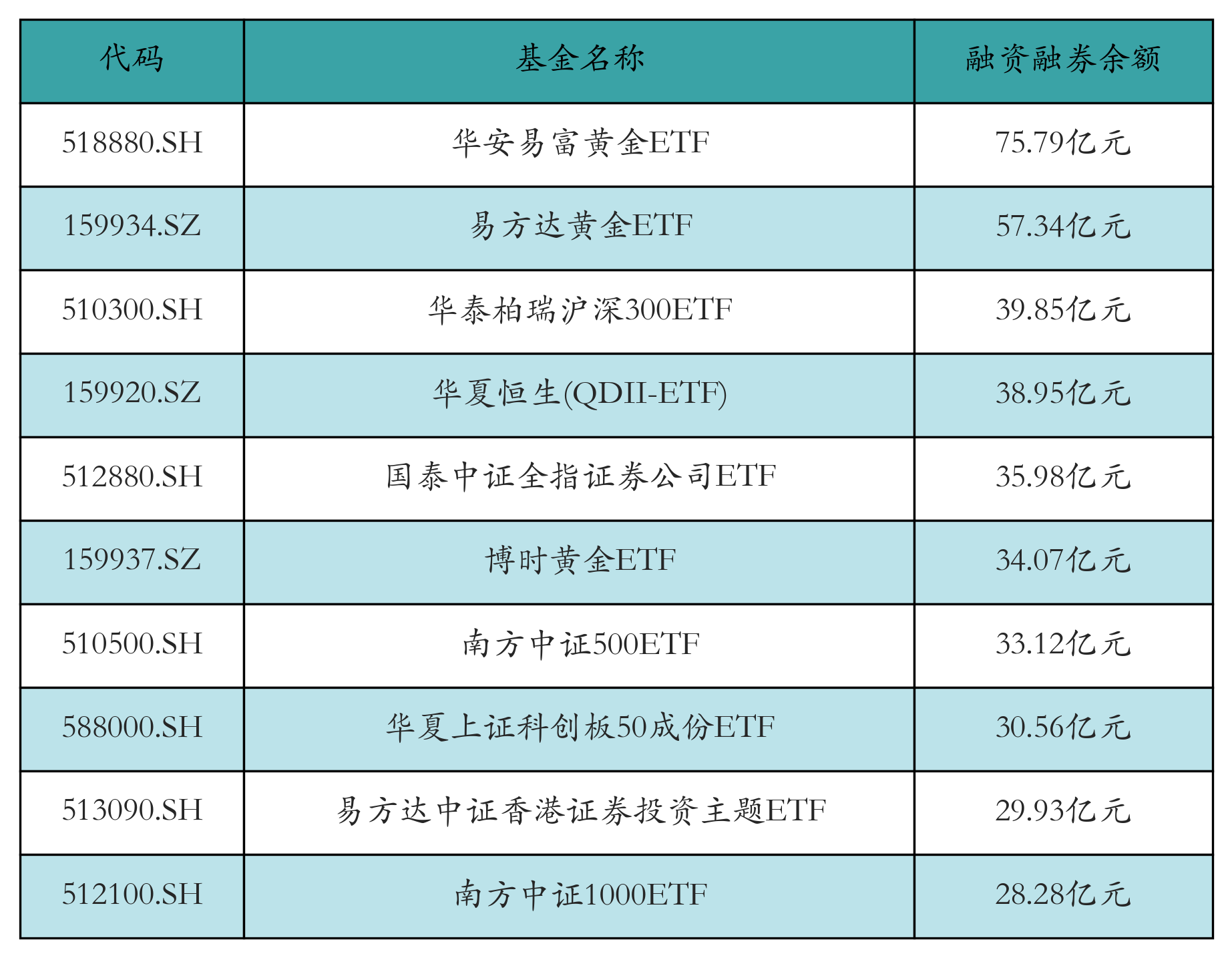
Market Overview - As of December 5, the total ETF margin balance in the two markets is 118.049 billion yuan, a decrease of 0.883 billion yuan from the previous trading day [1] - The financing balance is 110.091 billion yuan, down by 0.884 billion yuan, while the securities lending balance is 7.958 billion yuan, which increased by 1.6077 million yuan [1] - In the Shanghai market, the ETF margin balance is 82.652 billion yuan, a decrease of 0.73 billion yuan, with a financing balance of 75.659 billion yuan, down by 0.728 billion yuan [1] - In the Shenzhen market, the ETF margin balance is 35.397 billion yuan, a decrease of 0.153 billion yuan, with a financing balance of 34.432 billion yuan, down by 0.157 billion yuan [1] ETF Margin Balance - The top three ETFs by margin balance on December 5 are: - Huaan Yifu Gold ETF (7.605 billion yuan) - E Fund Gold ETF (5.735 billion yuan) - Huatai-PB CSI 300 ETF (4.056 billion yuan) [2] - The detailed top 10 ETFs by margin balance include: - 3rd: Huatai-PB CSI 300 ETF (4.056 billion yuan) - 4th: Huaxia Hang Seng (QDII-ETF) (3.885 billion yuan) - 5th: Guotai CSI All-Share Securities Company ETF (3.771 billion yuan) [2] ETF Financing Buy Amount - The top three ETFs by financing buy amount on December 5 are: - E Fund CSI Hong Kong Securities Investment Theme ETF (1.978 billion yuan) - Haifutong CSI Short Bond ETF (1.830 billion yuan) - Huatai-PB Southern Dongying Hang Seng Technology Index (QDII-ETF) (0.786 billion yuan) [3][4] ETF Financing Net Buy Amount - The top three ETFs by financing net buy amount on December 5 are: - E Fund CSI Hong Kong Securities Investment Theme ETF (135 million yuan) - Southern CSI 500 ETF (97.096 million yuan) - Huaxia Shanghai Stock Exchange Sci-Tech Innovation Board 50 ETF (35.297 million yuan) [5][6] ETF Securities Lending Sell Amount - The top three ETFs by securities lending sell amount on December 5 are: - Huatai-PB CSI 300 ETF (20.7074 million yuan) - Southern CSI 1000 ETF (20.318 million yuan) - Bosera CSI Convertible Bonds and Exchangeable Bonds ETF (19.9818 million yuan) [7][8]
信用债ETF规模升至5000亿+
HUAXI Securities· 2025-12-08 02:32
1. Report Industry Investment Rating - No information provided in the report 2. Core View of the Report - As of December 5, the latest scale of credit - bond ETFs reached 502.2 billion yuan, a slight increase of 2.6 billion yuan compared to November 28. The trading activity of science - innovation bond ETFs remained low, and the duration and industry preferences of bond holdings changed under the influence of bond market adjustments [1] 3. Summary by Relevant Content Credit - bond ETF Scale - As of December 5, the total scale of 35 credit - bond ETFs was 502.2 billion yuan, a 2.6 - billion - yuan increase from November 28. Among them, the scale of Harvest Science - innovation Bond ETF increased by 3.1 billion yuan to 24 billion yuan, with a 15% increase, being the product with the highest existing scale of science - innovation bond ETFs. Invesco Great Wall Science - innovation Bond ETF had the largest increase rate of 28%, and its scale increased to 3.6 billion yuan [1][4] Duration of Credit - bond ETFs - The median duration of 24 science - innovation bond ETFs was 3.5 years. Most credit - bond ETFs' durations continued to decline slightly, while only a few products extended their durations. The duration of E Fund Science - innovation Bond ETF increased by 0.3 years to 3.3 years in the past week, with the largest increase, but it was still at a relatively low level among science - innovation bond ETFs. The duration of benchmark market - making credit - bond ETFs remained basically the same as the previous week, ranging from 2.8 to 3.9 years, with a weekly change of no more than 0.05 years [1] Trading and Bond - holding Conditions of Science - innovation Bond ETFs - This week, the ratio of the number of trading transactions of science - innovation bond ETF component bonds to that of credit bonds was 6%, which was a slight increase from the previous week but still at a low level since October, and the buying force was still limited. Affected by the bond market adjustment, the duration of the bonds held by science - innovation bond ETFs decreased. From December 1 - 5, they mainly increased their holdings of 2 - 3 - year bonds, while in the previous week they mainly increased their holdings of 4 - 5 - year bonds. The industries with increased holdings were mainly securities and coal, and the industries with decreased holdings mainly involved urban investment, oil and gas, etc [2] Trading and Bond - holding Conditions of Benchmark Market - making Credit - bond ETFs - The duration of the bonds held by benchmark market - making credit - bond ETFs also decreased. From December 1 - 5, they mainly increased their holdings of bonds with a duration of less than 1 year, while in the previous week they mainly increased their holdings of 4 - 5 - year bonds. The industries with increased and decreased holdings were relatively scattered, with the amount of single - bond increased holdings being less than 100 million yuan, and only one bond with a decreased holding amount exceeding 100 million yuan, which was a mining industry bond [2] Valuation of Science - innovation Bond ETFs - This week, the component bonds of science - innovation bond ETFs continued to decline slightly. The median spread between non - component bonds and component bonds of science - innovation bond ETFs had narrowed for three consecutive weeks. On December 1, it narrowed by 1bp to 5.3bp compared to November 28. After screening the samples with compressed spreads between non - component bonds and component bonds, it was found that compared with non - component bonds, the average increase in the valuation of component bonds was 1.7bp higher (the median was 1.2bp higher), and most of these component bonds were traded at high valuations, with the median high - valuation trading amplitude being 1.8bp [2]
[12月7日]美股指数估值数据(全球股市上涨;日元加息对全球市场会有啥影响;全球指数星级更新)
银行螺丝钉· 2025-12-07 13:43
Group 1 - The global stock market experienced a slight increase this week, with minimal volatility, particularly in the Asia-Pacific and European regions [2] - The A-share market also saw an overall rise this week [3] Group 2 - There is an increasing expectation for interest rate hikes in Japan, which may impact global markets [4] - In the late 1980s, Japan's stock market and real estate experienced a bubble, with stock prices nearing a hundred times earnings and real estate values at peak levels [5] - Following this, the Japanese stock market faced a prolonged decline lasting 19 years, with a drop of over 80% from its peak in 1989 to 2008 [6] - During this decline, the Bank of Japan attempted to stimulate the economy by lowering interest rates [7] - The yield on Japan's 10-year government bonds fell from around 8.5% in the 1980s to near zero by 2015, maintaining this low rate until 2020 [8][9] Group 3 - The low interest rates in Japan led to an international arbitrage investment strategy, borrowing yen at low costs to invest in other assets [11] - This strategy allowed investors to benefit from both currency and interest rate gains, with Warren Buffett also employing a similar approach [14] - Buffett issued low-interest yen bonds after the Japanese stock market crash in 2020, financing at less than 1% to invest in major Japanese trading companies with high dividend yields [15][16] Group 4 - Japanese companies often engage in cross-shareholding to defend against hostile takeovers and strengthen collaboration, a common practice among listed companies [17][18] - The five major trading companies in Japan have diverse business operations across various sectors and offer relatively high dividend yields, averaging around 4-5% during Buffett's investment period [20][21][22] Group 5 - If Japan enters an interest rate hike cycle, the previously successful arbitrage strategy may become less effective due to potential yen appreciation and increased borrowing costs [26] - The impact of changes in the yen's value and borrowing costs could affect assets financed through yen loans [27] Group 6 - A global stock market star rating chart indicates that the market was undervalued at 4-5 stars during certain periods in 2018, 2020, and 2022 [30] - After a significant drop in April 2025, the global stock market rating returned to 4.1-4.2 stars, followed by a rebound to over 2 stars in subsequent quarters, but currently sits around 3.0 stars [31][32] Group 7 - There are global stock index funds available in overseas markets, with a total scale exceeding one trillion dollars, but such funds are not yet available in mainland China [35] - The company has launched a "Global Index Advisory Portfolio" that diversifies investments across various stock markets, including US, UK, Hong Kong, and A-shares [36] Group 8 - A new edition of the book "The Long-Term Investment Secret" has been released, which has been influential in the investment field for 30 years and includes updated data and new chapters [41][42] - The book emphasizes that stocks are the best long-term investment for wealth accumulation, suggesting that a portion of household assets should be allocated to stocks [43]
两市ETF两融余额较增加4.23亿元丨ETF融资融券日报
2 1 Shi Ji Jing Ji Bao Dao· 2025-12-05 02:57
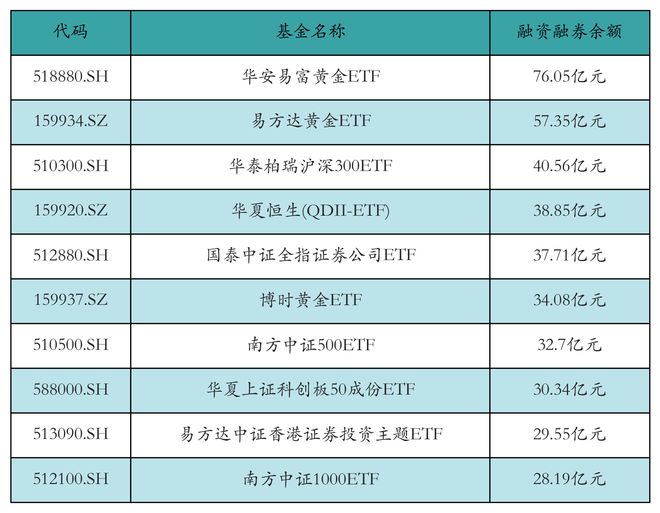
Market Overview - As of December 4, the total ETF margin balance in the two markets reached 118.93 billion yuan, an increase of 423 million yuan from the previous trading day [1] - The financing balance was 110.98 billion yuan, up by 436 million yuan, while the securities lending balance decreased by 13.31 million yuan to 7.96 billion yuan [1] - In the Shanghai market, the ETF margin balance was 83.38 billion yuan, increasing by 454 million yuan, with a financing balance of 76.39 billion yuan, up by 445 million yuan [1] - In the Shenzhen market, the ETF margin balance was 35.55 billion yuan, decreasing by 30.89 million yuan, with a financing balance of 34.59 billion yuan, down by 8.89 million yuan [1] ETF Margin Balances - The top three ETFs by margin balance on December 4 were: - Huaan Yifu Gold ETF (7.71 billion yuan) - E Fund Gold ETF (5.73 billion yuan) - Huatai-PB CSI 300 ETF (4.07 billion yuan) [2] - The total margin balances of the top ten ETFs are detailed in the provided table [2] ETF Financing Amounts - The top three ETFs by financing buy-in amounts on December 4 were: - Hai Futong CSI Short Bond ETF (1.43 billion yuan) - Huatai-PB Southern Dongying Hang Seng Technology Index (QDII-ETF) (853 million yuan) - E Fund CSI Hong Kong Securities Investment Theme ETF (828 million yuan) [3][4] ETF Net Financing Amounts - The top three ETFs by net financing buy-in amounts on December 4 were: - E Fund CSI Hong Kong Securities Investment Theme ETF (141 million yuan) - Huaxia Hang Seng Technology (QDII-ETF) (76.63 million yuan) - Jiashi Shanghai Stock Exchange Sci-Tech Innovation Board Chip ETF (74.78 million yuan) [5][6] ETF Securities Lending Sell Amounts - The top three ETFs by securities lending sell amounts on December 4 were: - Huatai-PB CSI 300 ETF (17.24 million yuan) - Huaxia CSI 1000 ETF (7.88 million yuan) - Southern CSI 500 ETF (7.41 million yuan) [7][8]