默克

Search documents
国泰海通:政策红利驱动科研制药上游国产替代加速 关注泰坦科技等核心标的
Zhi Tong Cai Jing· 2025-04-22 07:44
Group 1 - The core viewpoint is that the upstream pharmaceutical research and development sector is a crucial part of the strategic emerging industry, benefiting from both policy and market drivers [1][2] - The Chinese government has introduced a series of supportive policies for the biopharmaceutical industry, emphasizing the need for domestic substitution and enhancing the safety and stability of the supply chain [2][3] - The report highlights key recommended stocks such as Titan Technology (688133.SH), Aladdin (688179.SH), and Nawei Technology (688690.SH) as core targets for investment [1] Group 2 - The domestic innovation-driven substitution is expected to rapidly increase the domestic substitution rate in the biopharmaceutical market, which is becoming a new emerging market due to its large population and growing demand [3] - The high-end market for life science products has been dominated by European and American companies, but there is significant potential for domestic alternatives to emerge [3] - The cost pressure on imported brands due to tariffs is expected to create a favorable environment for domestic brands, enhancing their competitiveness [4]


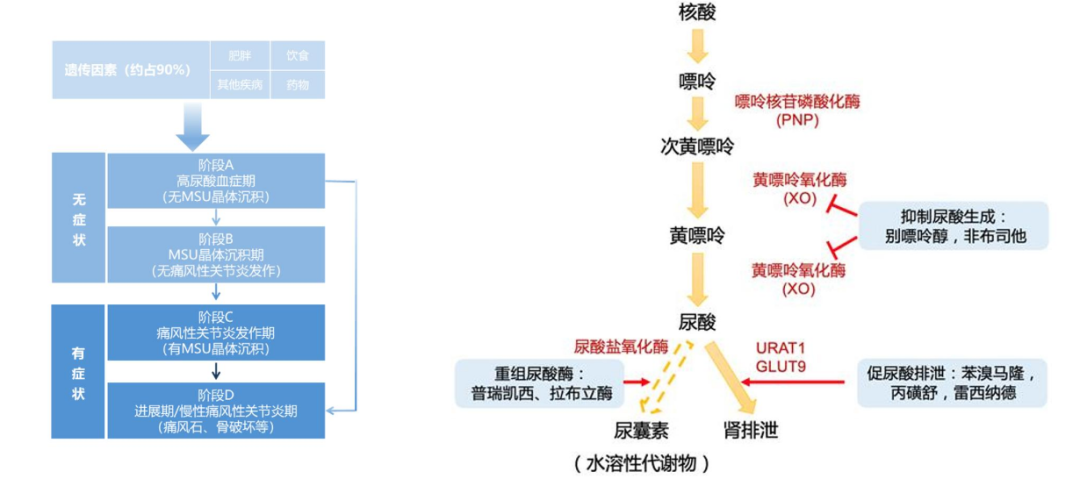
痛风为何没有像糖尿病一样诞生爆款药?
Hu Xiu· 2025-04-14 01:03
Core Viewpoint - The article discusses the significant disparity between the pharmaceutical markets for diabetes and gout, highlighting the large patient base for gout yet the lack of blockbuster drugs in this area despite its similar chronic nature to diabetes [3][4][18]. Group 1: Patient Demographics and Disease Impact - There are approximately 1 billion people globally suffering from high uric acid and gout, making it the second largest metabolic disease after diabetes [4][6]. - In China, there are 177 million individuals with high uric acid levels and 14.66 million gout patients, indicating a substantial patient population [6]. - The pathophysiology of gout involves an imbalance in purine metabolism, leading to elevated uric acid levels and subsequent crystal deposition, which can cause severe inflammation [6][7]. Group 2: Treatment Landscape and Challenges - Current gout treatments are limited, with no drug achieving annual sales exceeding $1 billion, contrasting sharply with diabetes medications [4][10][18]. - Existing gout medications face significant safety concerns, including severe side effects and low treatment adherence among patients, with many relying solely on pain relief rather than long-term management [10][11][15]. - The complexity of gout's pathogenesis complicates drug development, as effective treatment requires addressing multiple metabolic pathways [7][10]. Group 3: Market Dynamics and Future Outlook - The global market for gout medications is projected to be only $3.3 billion by 2024, while the diabetes drug market approaches $100 billion, influencing pharmaceutical companies to prioritize diabetes research [18]. - Despite the challenges, domestic pharmaceutical companies in China are showing innovation in gout treatment, with several drugs in advanced clinical stages, suggesting potential growth in this market [19]. - The article posits that the focus on gout treatment could lead to a "marginal revolution" in medicine, similar to past breakthroughs in other areas [19].

FDA计划逐步让“猴哥”退出新药研发? 提出三大替代方向,但业内认为还需更多研究
Mei Ri Jing Ji Xin Wen· 2025-04-12 14:44
Core Viewpoint - The FDA's recent policy shift aims to gradually eliminate mandatory animal testing in monoclonal antibody therapies and drug development, promoting alternatives like AI, organoids, and organ-on-a-chip technologies [1][2]. Group 1: Impact on Companies - Traditional CROs like Zhaoyan New Drug and Charles River Laboratories faced significant stock price declines following the announcement, with Charles River's stock dropping 28.13% and Zhaoyan's by 9.98% [1]. - The FDA's new policy is seen as a potential game-changer for the industry, providing a clear direction for reducing reliance on animal testing [3][4]. Group 2: Industry Perspectives - Industry experts acknowledge that while the new regulations indicate a shift, substantial clinical data is still needed to validate the effectiveness of organoids in toxicity prediction compared to animal testing [2][6]. - The TGN1412 incident highlights the limitations of animal testing, as severe reactions occurred in human trials that were not predicted by prior monkey studies, underscoring the need for alternative methods [2][5]. Group 3: Technological Advancements - Organoid and organ-on-a-chip technologies have been in development for over a decade and are now being recognized for their potential to simulate human responses more accurately than animal models [4][5]. - The FDA has identified specific organ models, such as liver and heart, that can be utilized in drug development, indicating a structured approach to integrating these technologies into regulatory frameworks [5][6]. Group 4: Financial and Market Trends - The organoid and organ-on-a-chip sectors are still in early development stages, with significant investments from major pharmaceutical companies like Johnson & Johnson and Merck, indicating growing confidence in these technologies [9][10]. - Despite a challenging investment climate, the organoid industry has seen optimistic funding trends, with companies securing millions in financing even during downturns [9]. Group 5: Future Outlook - The combination of organoids and AI is expected to enhance drug efficacy predictions and reduce toxicity screening failures, which are critical for successful drug development [10]. - As the industry moves towards adopting these technologies, the potential for improved drug safety and efficacy could redefine the landscape of pharmaceutical research and development [10].


美国“关税”冲击,中国医药产业影响几何
2 1 Shi Ji Jing Ji Bao Dao· 2025-04-07 08:36
Group 1 - The U.S. government has implemented a 10% "minimum benchmark tariff" on trade partners, with certain exemptions for pharmaceuticals and other products [1][2] - The pharmaceutical sector has reacted negatively in the market, with significant declines in various related sectors, including medical services and biopharmaceuticals, with drops ranging from 9.55% to 14.69% [1] - The exemption of pharmaceuticals from the tariff is due to the high reliance of the U.S. on imported active pharmaceutical ingredients (APIs), with 80% of APIs sourced from abroad [2][3] Group 2 - Local pharmaceutical companies have reported minimal impact from the tariff changes, as the tariffs do not apply to innovative drug licensing and trade [5][6] - Companies like Mindray Medical and others have proactively prepared for potential tariff impacts by adjusting their supply chains and inventory strategies [6][5] - The focus on high-quality innovation is emphasized as a key strategy for the Chinese pharmaceutical industry to navigate the challenges posed by tariffs and global competition [8][7] Group 3 - The number of innovative drugs developed by Chinese companies is rapidly increasing, with projections indicating that by the end of 2024, there will be 3,575 active innovative drugs, surpassing the U.S. [7] - Chinese pharmaceutical companies are actively expanding into international markets, with significant license-out transactions and collaborations with multinational corporations [7][8] - The "NewCo" model is emerging as a viable path for Chinese biopharmaceutical companies to innovate and expand internationally, despite geopolitical challenges [8]

恒瑞医药20250331
2025-04-01 07:43
Summary of the Conference Call for 恒瑞医药 (Hengrui Medicine) Company Overview - **Company**: 恒瑞医药 (Hengrui Medicine) - **Fiscal Year**: 2024 - **Revenue**: 27.9 billion RMB, a 22% increase year-on-year [3][5][29] Key Financial Performance - **Revenue Breakdown**: - Innovative drug sales increased by 30%, accounting for over 50% of total product sales [3][5] - Licensing income confirmed at 2.7 billion RMB, with significant contributions from partnerships with Merck and Calithera [3][7] - **Total Costs**: 21 billion RMB, a 15% increase, primarily due to rising sales and R&D expenses [3] - **Net Profit**: 6.3 billion RMB, a 47% increase, driven by growth in innovative drug sales and licensing income [3] Innovation and R&D - **Innovative Drug Pipeline**: - 19 first-class and 4 second-class innovative drugs approved for market [3][5] - Over 90 self-innovated products in clinical stages, with approximately 400 clinical trials ongoing [3][5] - **R&D Investment**: - R&D spending exceeded 8 billion RMB, representing over 30% of sales, aiming to reduce this ratio to around 20% in the future [3][22] - Focus on improving R&D efficiency while maintaining necessary funding for over 300 clinical trials [22] Internationalization Strategy - **Global Expansion**: - Achieved breakthroughs in internationalization, including three first-generic qualifications in the U.S. [3][5] - Plans to issue shares in Hong Kong to diversify funding sources and enhance international brand image [6] - **Collaborations**: - Engaged in partnerships with leading global pharmaceutical companies, prioritizing collaborations that retain domestic development rights [6][30] Sales and Marketing - **Sales Expense Trends**: - Sales expense ratio has been decreasing due to increased BDI income, expected to remain within a reasonable range [3][10] - **Market Positioning**: - Focus on innovative drugs while managing the impact of centralized procurement policies on generic drug sales [29] Regulatory and Tax Considerations - **Tax Rate Changes**: - Increased effective tax rate due to rising R&D expenses and inability to fully offset losses with profits [31] - **Impact of VAT Adjustments**: - Monitoring the implications of VAT changes on financial performance, with no immediate adjustments required for current products [15][17] Future Outlook - **Growth Projections**: - Anticipated growth in innovative drug sales exceeding 26% over the next two to three years, while generic drug growth remains uncertain due to policy impacts [29] - **BD Strategy**: - Plans to expand BD transactions, focusing on early-stage products to recover R&D costs and mitigate risks [12][30] Additional Insights - **Clinical Research Developments**: - Positive data from multiple clinical trials, including advancements in ADC platforms and dual-specific antibodies [20][33] - **Market Competitiveness**: - Strategies in HR-positive breast cancer treatment and the development of new CDK inhibitors to enhance patient outcomes [24][25] This summary encapsulates the key points from the conference call, highlighting the financial performance, innovation strategies, internationalization efforts, and future growth outlook for 恒瑞医药.

【倒计时7天】第六届半导体湿电子化学品与电子气体论坛3月19日杭州召开!中石油、金宏气体、润晶科技、华为实验室、江苏集萃齐聚
国芯网· 2025-03-12 04:22
Core Viewpoint - The semiconductor wet electronic chemicals and electronic gases market in China is experiencing significant growth opportunities, driven by domestic production capabilities and increasing demand in the semiconductor manufacturing sector [1][3]. Market Overview - In 2023, the market size for electronic chemicals in China reached 24.04 billion yuan, a year-on-year decrease of 7.6%, accounting for 34.6% of the wafer manufacturing materials market [1]. - The wet electronic chemicals sales revenue in 2023 was 8.7 billion yuan, with a year-on-year growth of 9.3%, and is expected to rise to 9.94 billion yuan in 2024 [2]. - The electronic gases market size in 2023 was 8.26 billion yuan, experiencing a decline of approximately 7% compared to 2022, while sales revenue for electronic gas companies reached 17.41 billion yuan, a year-on-year increase of 22.1% [2]. Domestic Production and Growth - Domestic wet electronic chemicals have made significant progress, with over 80% localization in 12-inch integrated circuit production lines and more than 40% in logic products [2]. - The overall sales revenue of electronic chemicals in China was approximately 28.95 billion yuan in 2023, reflecting a substantial year-on-year growth of 14.9% [3]. - The demand for wet electronic chemicals and electronic gases is expected to grow faster than the global average due to the expansion of traditional wafer factories and the acceleration of third-generation semiconductor projects [3]. Forum Information - The 6th Semiconductor Wet Electronic Chemicals and Electronic Gases Forum will be held on March 19, 2025, in Hangzhou, Zhejiang, organized by Asia Chemical Consulting [1][4]. - The forum will feature presentations from leaders and experts from various companies and institutions, including PetroChina, Runjing Technology, and Huawei Electronic Materials Laboratory [1][3]. Sponsorship Opportunities - Various sponsorship options are available for the forum, including keynote speeches, advertising in the conference materials, and on-site exhibition opportunities [8].

京东健康2024年业绩超市场预期:AI驱动下的互联网医疗新生态
21世纪经济报道· 2025-03-07 10:35
3月6日,京东健康发布2024年全年业绩公告,为中国互联网医疗产业标注了新的价值刻度。 公 告 显 示 , 2 0 2 4 年 京 东 健 康 总 收 入 为 人 民 币 5 8 2 亿 元 , 非 国 际 财 务 报 告 准 则 指 标 下 ( No n - IFRS)净利润达4 7 . 9亿元,收入和净利润双双超过市场预期。 这份亮眼的成绩单,不仅再次印证了"健康中国"战略下新型健康消费的澎湃动能,更揭示了 数字技术重塑的互联网医疗的新商业范式,也映射出互联网医疗正在迈向价值创造的全新战 场。 重塑渠道效率 近些年,健康消费已然成为新型消费的重要趋势。在刚刚发布的两会政府工作报告中强调, 要从增加优质供给、创新和丰富消费场景等方面入手,扩大健康、养老、托幼、家政等多元 化服务供给;加快数字、绿色、智能等新型消费发展。健康消费成为当前经济环境下,极具 确定性的消费需求。 作为" 线上健康消费第一入口" 的新型医疗健康服务企业,京东健康通过" 自营+ 平台+ 即时零 售"三轮驱动,实现了供应链渠道效率的重塑,还以"线上+线下"的融合模式全面升级健康消 费场景,持续拓展服务半径,实现全人群、全周期的健康覆盖,将 ...

【第六届半导体湿电子化学品与电子气体论坛】3月19日杭州开幕,中石油、金宏气体、润晶科技、中科院过程所、华为实验室、江苏集萃齐聚
国芯网· 2025-03-06 04:35
Core Viewpoint - The semiconductor wet electronic chemicals and electronic gases market in China is experiencing significant growth opportunities, driven by domestic production capabilities and increasing demand in the semiconductor manufacturing sector [1][3]. Market Overview - In 2023, the market size for electronic chemicals in China reached 24.04 billion yuan, a year-on-year decrease of 7.6%, accounting for 34.6% of the wafer manufacturing materials market [1]. - The wet electronic chemicals sales revenue in 2023 was 8.7 billion yuan, with a year-on-year growth of 9.3%, and is expected to rise to 9.94 billion yuan in 2024 [2]. - The electronic gases market size in 2023 was 8.26 billion yuan, experiencing a decline of approximately 7% compared to 2022, while sales revenue for electronic gas companies reached 17.41 billion yuan, a year-on-year increase of 22.1% [2]. Domestic Production and Trends - Domestic wet electronic chemicals have made significant progress, with over 80% localization in 12-inch integrated circuit production lines and more than 40% in logic products [2]. - The overall sales revenue of electronic chemicals in China was approximately 28.95 billion yuan in 2023, reflecting a substantial year-on-year growth of 14.9% [3]. - The demand for wet electronic chemicals and electronic gases is expected to grow faster than the global average due to the expansion of traditional wafer factories and the acceleration of third-generation semiconductor projects [3]. Forum Information - The 6th Semiconductor Wet Electronic Chemicals and Electronic Gases Forum will be held on March 19, 2025, in Hangzhou, Zhejiang, organized by Asia Chemical Consulting [1][4]. - The forum will feature presentations from industry leaders and experts, covering topics such as market trends and advancements in high-purity electronic chemicals [5][9].

中石油、金宏气体、润晶科技、中科院过程所、华为实验室、江苏集萃共聚杭州【第六届半导体湿电子化学品与电子气体论坛】3月19日启幕
国芯网· 2025-03-03 12:23
Core Viewpoint - The semiconductor wet electronic chemicals and electronic gases market in China is experiencing significant growth opportunities, driven by domestic production capabilities and increasing demand in the semiconductor manufacturing sector [1][3]. Market Overview - In 2023, the market size for electronic chemicals in China reached 24.04 billion yuan, a year-on-year decrease of 7.6%, accounting for 34.6% of the wafer manufacturing materials market [1]. - The wet electronic chemicals sales revenue in 2023 was 8.7 billion yuan, with a year-on-year growth of 9.3%, and is expected to rise to 9.94 billion yuan in 2024 [2]. - The electronic gases market size in 2023 was 8.26 billion yuan, experiencing a decline of approximately 7% compared to 2022, while sales revenue for electronic gas companies reached 17.41 billion yuan, a year-on-year increase of 22.1% [2]. Domestic Production and Trends - Domestic wet electronic chemicals have made significant progress, with over 80% localization in 12-inch integrated circuit production lines and more than 40% in logic products [2]. - The overall sales revenue of electronic chemicals in China was approximately 28.95 billion yuan in 2023, reflecting a substantial year-on-year growth of 14.9% [3]. - The demand for wet electronic chemicals and electronic gases is expected to grow faster than the global average due to the expansion of traditional wafer factories and the acceleration of third-generation semiconductor projects [3]. Forum Information - The 6th Semiconductor Wet Electronic Chemicals and Electronic Gases Forum will be held on March 19, 2025, in Hangzhou, Zhejiang, organized by Asia Chemical Consulting [1][4]. - The forum will feature presentations from industry leaders and experts, covering topics such as market trends and advancements in high-purity electronic chemicals [5][6].

中石油、金宏气体、润晶科技、中科院过程所、华为实验室、江苏集萃等齐聚,【第六届半导体湿电子化学品与电子气体论坛】3月19杭州召开
国芯网· 2025-02-26 04:49
Core Viewpoint - The semiconductor wet electronic chemicals and electronic gases market in China is experiencing significant growth opportunities, driven by domestic production capabilities and increasing demand in the semiconductor manufacturing sector [1][3]. Market Overview - In 2023, the electronic chemicals market in China reached a scale of 24.04 billion yuan, a year-on-year decrease of 7.6%, accounting for 34.6% of the wafer manufacturing materials market [1]. - The wet electronic chemicals sales revenue was 8.7 billion yuan in 2023, with a year-on-year growth of 9.3%, and is expected to rise to 9.94 billion yuan in 2024 [2]. - The electronic gases market size in China was 8.26 billion yuan in 2023, down approximately 7% from 2022, while sales revenue for electronic gas companies reached 17.41 billion yuan, a year-on-year increase of 22.1% [2]. Domestic Production and Growth - Domestic wet electronic chemicals have made significant progress, with over 80% localization in 12-inch integrated circuit production lines and more than 40% in logic products [2]. - The overall sales revenue of electronic chemicals in China was approximately 28.95 billion yuan in 2023, reflecting a substantial year-on-year growth of 14.9% [3]. - The semiconductor manufacturing industry in China is expected to grow rapidly in the coming years, driven by traditional wafer factory expansions, advanced process demand, and domestic substitution [3]. Upcoming Forum - The 6th Semiconductor Wet Electronic Chemicals and Electronic Gases Forum will be held on March 19, 2025, in Hangzhou, Zhejiang, organized by Asia Chemical Consulting [1][4]. - The forum will feature reports from leaders and experts from various companies, including PetroChina, Runjing Technology, and Huawei Electronic Materials Laboratory [1][4].