
先导智能

Search documents
全固态电池概念癫狂背后:大规模产业化远未到来
2 1 Shi Ji Jing Ji Bao Dao· 2025-09-12 23:08
Core Viewpoint - The solid-state battery sector has seen a significant rise in capital market interest, with the solid-state battery index increasing by 77.7% from April 9 to September 12, 2023, despite ongoing uncertainties regarding its industrialization [1][4][16]. Industry Overview - Solid-state batteries are defined as batteries that completely replace liquid electrolytes with solid electrolytes, enabling lithium ion conduction [1]. - The industry consensus indicates that solid-state battery industrialization is still in its early exploratory phase, with semi-solid batteries being more feasible in the short term [6][18]. Technological Challenges - The path to mass production of solid-state batteries is fraught with challenges, including interface resistance, material stability, and cost control [3][13]. - Current laboratory results show energy densities of 300-400 Wh/kg and fast charging capabilities, but these have not yet been achieved in mass production [3][12]. Market Dynamics - Despite the technological hurdles, the stock prices of companies involved in solid-state battery production have surged, reflecting a disconnect between market enthusiasm and industrial reality [4][16]. - Companies like Ganfeng Lithium and others are pursuing multiple technological routes, including sulfide, oxide, and polymer systems, with a focus on sulfide electrolytes for solid-state batteries [7][11]. Production Capacity - Current production capabilities for solid-state batteries are limited, with few manufacturers able to produce cells larger than 20 Ah, and achieving 50 Ah is seen as a critical milestone [9][10]. - Companies such as Guoxuan High-Tech and EVE Energy are making strides in developing solid-state battery pilot lines, with energy densities reported at 350 Wh/kg and 300 Wh/kg respectively [10][11]. Future Outlook - The general expectation is that mass production of solid-state batteries will not occur until 2027 for specific applications, with broader adoption likely not happening until 2030 [15][18]. - The solid-state battery technology is viewed as a long-term strategic reserve rather than an immediate solution, with significant time and investment required to overcome existing challenges [13][14].
招股书失效18天火速再战港股 思格新能源“患”单一产品依赖症
Xin Jing Bao· 2025-09-12 21:28
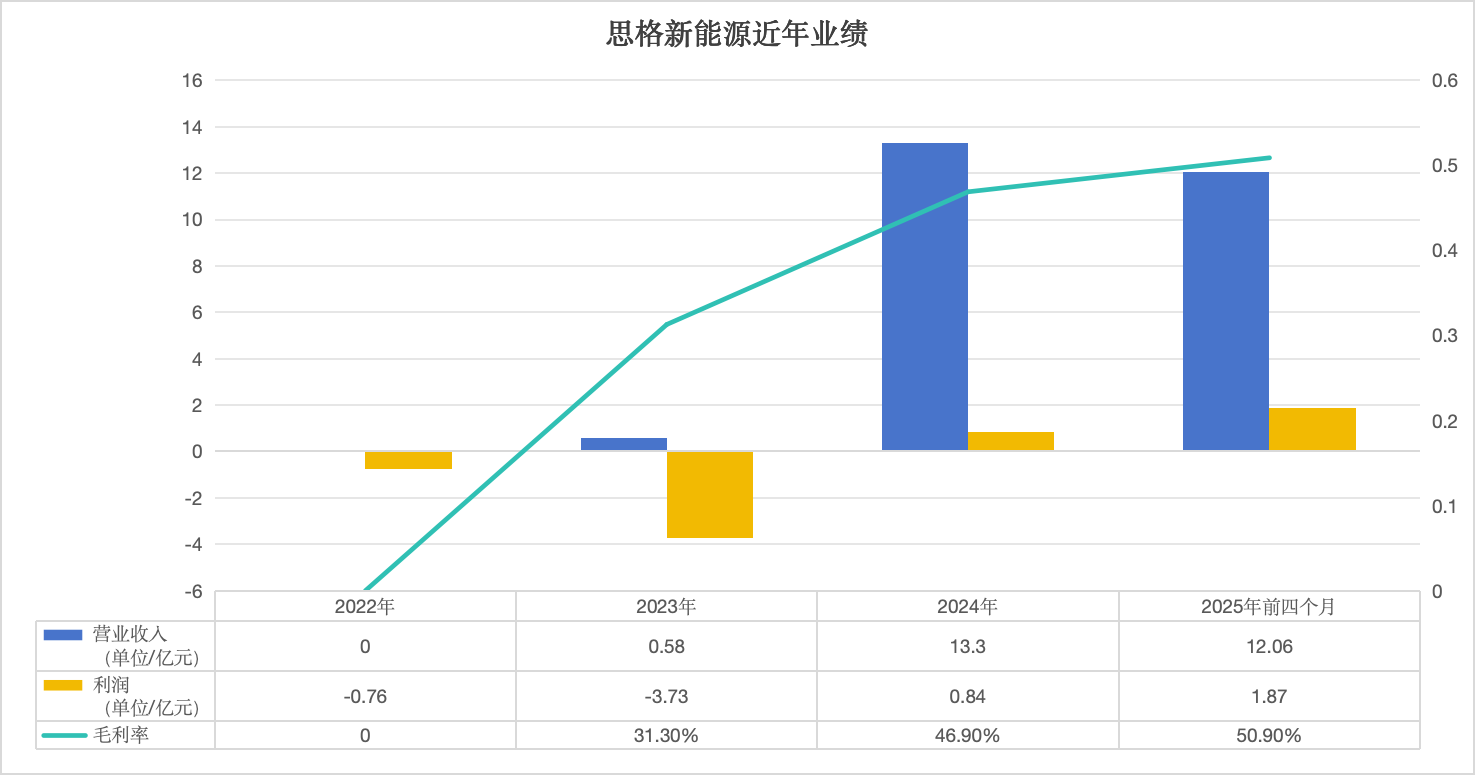
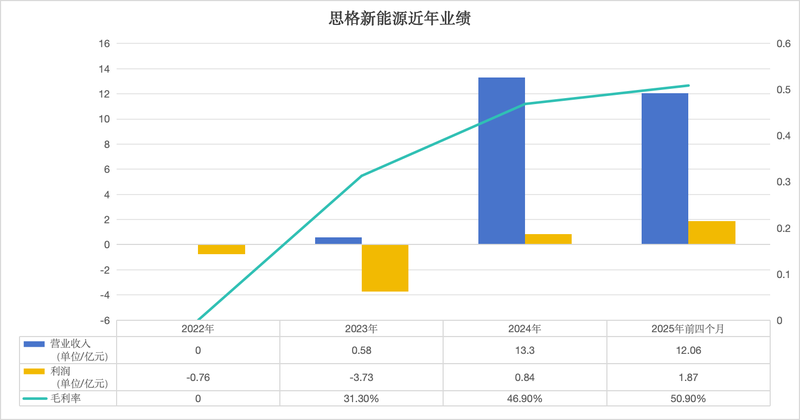
Core Viewpoint - Sige New Energy (Shanghai) Co., Ltd. is attempting to reapply for a Hong Kong IPO after its initial application expired 18 days prior, highlighting the challenges and strategies companies face in the volatile market environment [1][2]. Company Overview - Founded in May 2022 by former Huawei executive Xu Yingtong, Sige New Energy focuses on a niche within the energy storage sector, specifically stackable distributed solar-storage integrated solutions [1][4]. - The company generates over 90% of its revenue from its flagship product, the SigenStor, launched in June 2023, which is primarily used in residential applications [3][6]. Financial Performance - Sige New Energy reported revenues of 0 million in 2022, 0.58 million in 2023, and projected revenues of 13.30 million in 2024, with 12.06 million generated in the first four months of 2025 [5]. - The company achieved profitability in 2024 after two years of losses, with a profit of 1.87 million in the first four months of 2025 [7][10]. Market Position - Sige New Energy claims to be the global leader in stackable distributed solar-storage integrated solutions, with a projected market share of 28.6% in 2024 [3]. - The company faces competition from major players like Huawei (18% market share), Tesla (6.4%), and others, with its own market share in the broader distributed solar-storage sector at 1.3% [3]. Pricing and Sales Strategy - The average selling price of the SigenStor has decreased from 3.17 yuan per watt in 2023 to 2.54 yuan per watt in the first four months of 2025, attributed to higher sales rebates to distributors [6]. - Over 90% of the company's revenue comes from a distribution model, which is similar to Huawei's approach, allowing for quicker local market penetration [10]. Research and Development - Sige New Energy's R&D expenditure has significantly decreased from 331% of revenue in 2023 to 11.2% in the first four months of 2025, although this remains above the industry median [10]. - The company plans to use IPO proceeds to expand its R&D team, enhance marketing efforts, and increase production capacity [10].

A股怎么敢炒新能源了?
虎嗅APP· 2025-09-12 15:08
Core Viewpoint - The article discusses the recent fluctuations in the A-share market, highlighting the shifting focus of market funds between sectors, particularly between AI computing power and new energy sectors like solid-state batteries and energy storage [2][5]. Group 1: AI Computing Power - The leading sector in the current market rally is AI computing power, with companies like Cambricon, NewEase, and Tianfu Communication showing significant growth [9][12]. - The growth in AI computing power is driven by unexpected advancements in application and computing power industries, leading to increased capital expenditures from major players like Meta, Google, and AWS [11]. - Despite the high expectations, the AI computing power sector has seen a decline in stock prices as the market digests these expectations, with companies like Cambricon facing high valuation metrics [14]. Group 2: New Energy Sector - The new energy sector, particularly solid-state batteries and energy storage, is experiencing a resurgence, although it faces challenges such as overcapacity and low prices [17][18]. - Solid-state batteries are gaining attention due to their safety and performance advantages, with companies like Gotion High-Tech and EVE Energy planning to launch new products in the coming years [21][24]. - Energy storage systems have seen record-high order volumes, indicating strong domestic demand and a shift towards independent energy storage business models [27][30]. - The photovoltaic sector is awaiting policy changes to address overcapacity issues, particularly concerning silicon material production, which is crucial for the industry's supply-demand balance [36][38]. Group 3: Market Dynamics - The article emphasizes the need for new narratives and expectations in the market, as funds shift from high-performing sectors like AI to those with potential for recovery, such as new energy [8][15]. - The solid-state battery sector still has room for growth and narrative development, while energy storage requires further confirmation through orders and tenders [41]. - The interplay between AI computing power and new energy developments illustrates the dynamic nature of market investments, with capital continuously seeking value [41].

招股书失效18天火速再战港股,思格新能源“患”单一产品依赖症
Xin Jing Bao· 2025-09-12 13:56
Core Viewpoint - Sige New Energy (Shanghai) Co., Ltd. is attempting to relaunch its IPO in Hong Kong after its initial prospectus expired, with a focus on its flagship product, the SigenStor, which accounts for over 90% of its revenue [1][5]. Group 1: Company Overview - Sige New Energy was founded in May 2022 and launched its flagship product, the SigenStor, in June 2023, primarily targeting residential applications [3]. - The company operates in a niche segment of the energy storage market, specifically in stackable distributed solar-storage integrated solutions, which represents approximately 0.7% of the overall energy storage system market [3]. - Sige New Energy claims to be the global leader in this niche, with a projected market share of 28.6% in 2024 [3]. Group 2: Financial Performance - The company reported revenues of 0, 0.58 billion, and 13.30 billion yuan for the years 2022, 2023, and 2024 respectively, with 12.06 billion yuan generated in the first four months of 2025 [5][7]. - The average selling price of the SigenStor has decreased from 3.17 yuan per watt in 2023 to 2.54 yuan per watt in the first four months of 2024, primarily due to higher sales rebates offered to distributors [5]. - Despite the price decline, the gross profit margin for the SigenStor reached 51.2% in the first four months of 2024, indicating improved profitability as sales volume increases [5]. Group 3: Market Strategy - The company relies heavily on a distribution model, with over 90% of its revenue coming from distributors, similar to the approach used by Huawei [8]. - Sige New Energy plans to expand its distributor network from 119 as of April 2024 to approximately 200 by 2029, which will test its channel management capabilities and product competitiveness [8]. - The European market is the largest revenue source for the company, contributing over 60%, followed by the Asia-Pacific region at around 20% [8]. Group 4: Leadership and R&D - The founder and actual controller, Xu Yingtong, has over 25 years of experience in the telecommunications, renewable energy, and AI sectors, having previously worked at Huawei [4]. - The company has seen a significant reduction in R&D spending, from 331% of revenue in 2023 to 21.1% in 2024, and further down to 11.2% in the first four months of 2025, although this remains above the industry median [8].
【12日资金路线图】两市主力资金净流出超370亿元 有色金属等行业实现净流入
Zheng Quan Shi Bao· 2025-09-12 13:48
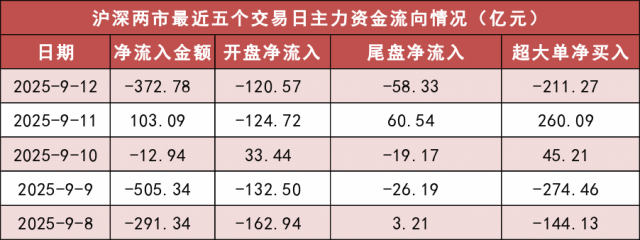
Market Overview - The A-share market showed a mixed performance on September 12, with the Shanghai Composite Index closing at 3870.6 points, down 0.12%, the Shenzhen Component Index at 12924.13 points, down 0.43%, and the ChiNext Index at 3020.42 points, down 1.09% [1] - The total trading volume for both markets reached 25,209.25 billion yuan, an increase of 832.07 billion yuan compared to the previous trading day [1] Capital Flow - The net outflow of main funds from the Shanghai and Shenzhen markets exceeded 370 billion yuan, with a total net outflow of 372.78 billion yuan for the day [2] - The net outflow for the CSI 300 index was 185.06 billion yuan, while the ChiNext saw a net outflow of 189.48 billion yuan [4] Sector Performance - The non-ferrous metals sector experienced a net inflow of 20.57 billion yuan, with a growth of 1.95%, led by Northern Rare Earth [6][7] - Other sectors with net inflows included steel (13.97 billion yuan, up 1.73%), real estate (12.69 billion yuan, up 1.74%), and construction decoration (7.05 billion yuan, up 0.74%) [7] - Conversely, the power equipment sector faced a significant net outflow of 164.52 billion yuan, down 0.53%, followed by the automotive sector with a net outflow of 105.13 billion yuan, also down 0.53% [7] Institutional Activity - The top stocks with net inflows from institutions included Shanzi Gaoke (12,283.85 million yuan), Jinxin Nuo (6,955.87 million yuan), and Demingli (5,587.22 million yuan) [11] - Notable stocks with significant institutional selling included Xinyuan Technology (-89,768.89 million yuan) and Zongtai Automobile (-5,892.67 million yuan) [11] Institutional Focus - Institutions have recently shown interest in stocks such as Hualan Biological (target price 19.45 yuan, current price 16.78 yuan, potential upside 15.91%), and Bairi Tianheng (target price 500.68 yuan, current price 349.79 yuan, potential upside 43.14%) [12]
【12日资金路线图】两市主力资金净流出超370亿元 有色金属等行业实现净流入
证券时报· 2025-09-12 13:19
Market Overview - The A-share market showed a mixed performance on September 12, with the Shanghai Composite Index closing at 3870.6 points, down 0.12%, the Shenzhen Component at 12924.13 points, down 0.43%, and the ChiNext Index at 3020.42 points, down 1.09% [2] - The total trading volume of both markets reached 25,209.25 billion yuan, an increase of 832.07 billion yuan compared to the previous trading day [2] Capital Flow - The net outflow of main funds from the two markets exceeded 370 billion yuan, with an opening net outflow of 120.57 billion yuan and a closing net outflow of 58.33 billion yuan, totaling 372.78 billion yuan for the day [3][4] - The CSI 300 index experienced a net outflow of 185.06 billion yuan, while the ChiNext saw a net outflow of 189.48 billion yuan [5][6] Sector Performance - The non-ferrous metals sector saw a net inflow of 20.57 billion yuan, with a growth of 1.95%, led by Northern Rare Earth [8] - Other sectors with net inflows included steel (13.97 billion yuan, up 1.73%), real estate (12.69 billion yuan, up 1.74%), and construction decoration (7.05 billion yuan, up 0.74%) [8] - Conversely, the power equipment sector faced a significant net outflow of 164.52 billion yuan, down 0.53%, followed by the automotive sector with a net outflow of 105.13 billion yuan, also down 0.53% [8] Institutional Activity - The top stocks with net inflows from institutions included Shanzi Gaoke (12,283.85 million yuan), Jinxin Nuo (6,955.87 million yuan), and Demingli (5,587.22 million yuan) [12] - Notable stocks with significant institutional net outflows included Xinyuan Technology (-89,768.89 million yuan) and Zongtai Automobile (-5,892.67 million yuan) [12] Institutional Focus - Institutions have recently shown interest in stocks such as Hualan Biological (target price 19.45 yuan, current price 16.78 yuan, potential upside 15.91%), and Yuantong Express (target price 25.4 yuan, current price 18.41 yuan, potential upside 37.97%) [13]
两市主力资金净流出536.40亿元,非银金融行业净流出居首
Zheng Quan Shi Bao Wang· 2025-09-12 13:15
Market Overview - On September 12, the Shanghai Composite Index fell by 0.12%, the Shenzhen Component Index decreased by 0.43%, the ChiNext Index dropped by 1.09%, and the CSI 300 Index declined by 0.57% [1] - Among the tradable A-shares, 1,926 stocks rose, accounting for 35.51%, while 3,373 stocks fell [1] Capital Flow - The main capital experienced a net outflow of 53.64 billion yuan throughout the day [1] - The ChiNext saw a net outflow of 17.11 billion yuan, while the STAR Market had a net outflow of 2.39 billion yuan, and the CSI 300 constituents faced a net outflow of 33.89 billion yuan [1] Industry Performance - Out of the 28 primary industries classified by Shenwan, 9 industries saw gains, with the non-ferrous metals and real estate sectors leading with increases of 1.96% and 1.51%, respectively [1] - The industries with the largest declines were telecommunications and comprehensive sectors, which fell by 2.13% and 1.95%, respectively [1] Industry Capital Inflow - Six industries experienced net capital inflows, with the non-ferrous metals sector leading with a net inflow of 2.168 billion yuan and a daily increase of 1.96% [1] - The construction decoration industry followed with a daily increase of 0.96% and a net inflow of 721 million yuan [1] Industry Capital Outflow - Twenty-five industries faced net capital outflows, with the non-bank financial sector leading with a net outflow of 8.138 billion yuan and a daily decline of 1.46% [1] - The electronics sector had a net outflow of 7.517 billion yuan despite a daily increase of 1.16% [1] Individual Stock Performance - A total of 1,982 stocks saw net capital inflows, with 763 stocks having inflows exceeding 10 million yuan, and 102 stocks with inflows over 100 million yuan [2] - The stock with the highest net inflow was Wolong Electric Drive, which rose by 10.01% with a net inflow of 2.174 billion yuan [2] - The stocks with the largest net outflows included Luxshare Precision, Industrial Fulian, and Xian Dao Intelligent, with net outflows of 2.592 billion yuan, 1.405 billion yuan, and 1.308 billion yuan, respectively [2]




BC电池概念下跌1.02%,主力资金净流出32股
Zheng Quan Shi Bao Wang· 2025-09-12 13:12
Market Performance - The BC battery concept index declined by 1.02% as of the market close on September 12, ranking among the top decliners in the concept sector [1] - Within the BC battery sector, leading stocks such as XianDao Intelligent, JuHe Materials, and DiEr Laser experienced significant declines, while stocks like Robotech, Inno Laser, and Dongcai Technology saw gains of 8.83%, 4.57%, and 3.43% respectively [1] Capital Flow - The BC battery concept sector experienced a net outflow of 2.538 billion yuan, with 32 stocks facing net outflows, and 5 stocks seeing outflows exceeding 100 million yuan [2] - XianDao Intelligent led the outflow with a net withdrawal of 1.308 billion yuan, followed by Dongcai Technology, Longi Green Energy, and JuHe Materials with outflows of 267 million yuan, 201 million yuan, and 158 million yuan respectively [2] Top Gainers and Losers - The top gainers in the BC battery concept included Robotech, Foster, and Arctech, with net inflows of 88.06 million yuan, 72.77 million yuan, and 40.07 million yuan respectively [3] - The top decliners in the BC battery concept included XianDao Intelligent with a decline of 8.86%, JuHe Materials with a decline of 6.64%, and DiEr Laser with a decline of 6.16% [2][3]





确认过眼神 全固态电池概念癫狂
2 1 Shi Ji Jing Ji Bao Dao· 2025-09-12 12:46
Core Viewpoint - The solid-state battery sector has seen significant capital market interest, with the solid-state battery index rising by 77.7% from April 9 to September 12, 2023, despite ongoing uncertainties regarding industrialization [1][2][3]. Industry Overview - Solid-state batteries are defined as batteries that completely replace liquid electrolytes with solid electrolytes, enabling lithium ion conduction [1]. - The industry consensus indicates that solid-state battery industrialization is still in its early exploratory phase, with semi-solid batteries being more feasible at this stage [5][10]. Technological Challenges - The path to mass production of solid-state batteries is fraught with challenges, including interface resistance, material stability, and cost control [3][11]. - Current energy densities achieved in laboratories (300-400 Wh/kg) have not yet translated into mass production due to various technical hurdles [3][10]. Market Dynamics - Despite the technological challenges, the stock prices of companies involved in solid-state battery production have surged, reflecting a disconnect between market enthusiasm and industrial realities [3][14]. - Companies like Ganfeng Lithium and others are pursuing multiple technological routes, including sulfide, oxide, and polymer systems, with a focus on sulfide electrolytes for solid-state batteries [6][9]. Production Milestones - Companies such as Guoxuan High-Tech and EVE Energy are making strides in solid-state battery production, with Guoxuan High-Tech achieving a cell energy density of 350 Wh/kg and EVE Energy targeting a 60 Ah battery by the end of the year [8][9]. - The automotive industry is also exploring solid-state battery applications, with major manufacturers like Honda and Toyota planning mass production between 2028 and 2030 [9][12]. Investment Sentiment - The capital market's enthusiasm for solid-state batteries has led to significant stock price increases for companies involved, with some experiencing over 100% price increases in a short period [14][15]. - However, there are concerns about market valuation bubbles, as many companies are not yet generating stable revenue from solid-state battery technologies [15][16].
确认过眼神,全固态电池概念癫狂
2 1 Shi Ji Jing Ji Bao Dao· 2025-09-12 12:40
Core Viewpoint - The solid-state battery sector has seen significant capital market interest, with the solid-state battery index rising 77.7% from April to September 2023, despite ongoing uncertainties regarding industrialization [1][4][16]. Industry Overview - Solid-state batteries are defined as batteries that completely lack liquid electrolytes, relying instead on solid electrolytes to facilitate lithium ion conduction [1]. - The industry consensus indicates that solid-state battery industrialization is still in its early exploratory phase, with semi-solid batteries being viewed as more feasible [6][18]. - The technology involves multiple routes based on electrolyte types, primarily including sulfide, oxide, and polymer systems, with most domestic manufacturers favoring sulfide electrolytes [7][18]. Production Challenges - The industry anticipates trial production within two years and mass production in five years, but significant technical hurdles remain, including interface resistance, material stability, and cost control [3][15]. - Current production capabilities for solid-state batteries are limited, with few manufacturers able to produce cells larger than 20Ah, and achieving 50Ah is seen as a critical milestone [9][10]. - Major manufacturers like CATL and BYD are exploring various combinations of materials and technologies, with mass production timelines extending to 2027 or later [11][15]. Market Dynamics - Despite the hype surrounding solid-state batteries, the market is experiencing signs of valuation bubbles, with companies like Xian Dai Intelligent and Li Yuan Heng seeing stock price surges despite the ongoing technological challenges [16][17]. - Some companies not directly involved in solid-state battery production have also benefited from the market's enthusiasm, highlighting the speculative nature of the current investment climate [17][18]. Future Outlook - The solid-state battery technology is expected to take 5-10 years to fully replace liquid batteries, with initial applications likely in specialized fields rather than mainstream automotive use [14][15][18]. - The industry is characterized by a complex interplay between capital market speculation and the slow, methodical pace of technological development and industrial readiness [3][14].




