
南京银行

Search documents
近20家中小银行下调存款利率 三年期、五年期定存普遍降至2%以下
Cai Jing Wang· 2025-09-01 06:10
Core Viewpoint - The recent trend of interest rate cuts on deposits by small and medium-sized banks follows the collective reduction by major state-owned banks, aimed at controlling liability costs and responding to competitive pressures in the banking sector [1][4][7] Summary by Relevant Sections Interest Rate Cuts - Since August, nearly 20 small and medium-sized banks, including Jiangsu Bank and Shenzhou Ruifeng Village Bank, have lowered their deposit rates, with three-year and five-year fixed deposit rates generally reduced by 10 to 20 basis points, now below 2% [1][3] - Specific examples include Guangdong Chaozhou Rural Commercial Bank reducing its three-year and five-year rates to 1.3% and 1.35%, respectively, and Jilin Longtan Huayi Village Bank lowering its three-year and five-year rates to 1.75% and 1.70% [2][3] Market Response and Strategies - To alleviate deposit pressure, many banks are introducing higher-yielding large-denomination certificates of deposit (CDs), with rates reaching up to 2.3% for certain products [5][6] - The trend of lowering deposit rates is seen as a response to the competitive landscape created by state-owned banks, which have also reduced their rates, prompting smaller banks to follow suit to manage their liability costs [4][7] Recommendations for Small and Medium-Sized Banks - Experts suggest that small and medium-sized banks should optimize their liability structures, enhance customer retention through technology, and develop differentiated financial products to attract stable funding sources [8] - There is an emphasis on the need for banks to improve their asset-liability management and avoid over-reliance on high-interest deposits, which could lead to unsustainable practices [6][8]
中小银行如何更好服务地方绿色发展?
Zhong Guo Huan Jing Bao· 2025-09-01 02:08
Core Viewpoint - Local small and medium-sized banks play an indispensable role in promoting green development and supporting ecological and environmental protection initiatives, necessitating a shift in traditional thinking to align with national strategies and embed green finance concepts throughout their business processes [1][2]. Group 1: Integration with National Strategy - Local small and medium-sized banks should actively integrate into the national green development strategy, enhancing their financial service capabilities for ecological and environmental projects [1]. - Establishing green credit quotas to prioritize funding for key areas such as energy conservation, clean energy, and circular economy projects is essential [1]. Group 2: Innovation in Financial Products - Accelerating the innovation of green financial products and service models is crucial, focusing on sectors like green agriculture, forestry carbon sinks, wetland protection, and eco-tourism [2]. - Development of region-specific green credit products and initiatives like the "Carbon Effect Loan" series, which links loan interest rates to companies' carbon performance, is recommended [2]. Group 3: Diversification of Financial Tools - Local small and medium-sized banks should introduce exclusive credit schemes for sustainable agricultural practices and explore financing tools based on environmental rights such as carbon emission rights [3]. - Expanding the application of green bonds, green funds, and green supply chain finance to cover the entire lifecycle of enterprises is necessary [3]. Group 4: Collaboration and Ecosystem Building - Strengthening collaboration with government, ecological departments, and third-party service providers to create a multi-party green finance ecosystem is vital [3]. - Engaging in government-led green industry guidance funds and organizing green project roadshows can effectively align policy direction with market mechanisms [3]. Group 5: Technological Integration - Utilizing modern technologies such as big data, blockchain, and artificial intelligence to enhance green identification capabilities and risk assessment levels is important [4]. - Establishing a green project database for dynamic information sharing and involving professional environmental assessment agencies for project evaluations can strengthen decision-making and oversight in green credit [4].
光大证券晨会速递-20250901
EBSCN· 2025-09-01 01:02
2025 年 9 月 1 日 晨会速递 分析师点评 市场数据 重点交流 【公用事业】盈利水平边际改善,同业竞争解决持续兑现——国网信通(600131.SH) 2025 年中报点评(买入) 公司发布 2025 年中报。2025 年上半年公司实现营收 35.25 亿元,同比-4.55%(调 整后);归母净利润 2.66 亿元,同比-11.01%(调整后)。我们预计公司 2025-2027 年归母净利润为 8.44/10.25/12.53 亿元,折合 EPS 分别为 0.70/0.85/1.04 元,对应 PE 为 26/21/18X。我们维持 "买入"评级。 总量研究 【宏观】8 月经济运行的三点特征——2025 年 8 月 PMI 点评 8 月制造业 PMI 小幅回升,非制造业活动加快扩张,关注三点特征:一是,尽管"抢 出口"效应消退,但受益于出口多元化、新兴市场需求提振影响,8 月出口动能趋稳, 叠加极端天气扰动减弱,制造业产需活动回升。二是,"反内卷"推动价格指数继续 回升,预计 8 月起 PPI 同比增速将步入上行通道。三是,受资本市场活跃、暑期出行 热度较高、信息服务活动扩张带动,8 月服务业景气度明显 ...
上海多家银行房贷利率细则落地 新增房贷利率不再区分首套、二套
Mei Ri Jing Ji Xin Wen· 2025-09-01 00:25
Core Viewpoint - The introduction of the "825 New Policy" in Shanghai has led to multiple banks adjusting their commercial personal housing loan interest rate pricing mechanisms, eliminating the distinction between first and second homes, allowing banks to set rates based on market conditions and individual risk profiles [1][2]. Group 1: Policy Changes - Several banks in Shanghai have announced adjustments to their commercial personal housing loan interest rate pricing mechanisms, following the issuance of a notification by six departments in Shanghai [1]. - The new pricing mechanism allows banks to determine specific interest rates based on the Shanghai market interest rate pricing self-discipline mechanism, as well as their operational conditions and customer risk profiles [2]. Group 2: Implementation Details - Different banks have varying procedures for borrowers to apply for interest rate adjustments, including in-person applications, phone notifications, and mobile banking options [3]. - The effective dates for these adjustments vary, with some banks implementing changes as early as September 1, while others may start on September 5 [3]. Group 3: Interest Rate Adjustments - For existing second-home loans, if the current interest rate exceeds the average new loan interest rate by 30 basis points, borrowers can apply for a rate adjustment [2]. - The minimum interest rate for first-time home loans is currently 3.05%, while some banks are offering a minimum of 3.09% for new second-home loans [3]. Group 4: Recommendations - It is suggested that relevant departments enhance their communication regarding the new policies to clarify the specifics of loan interest rates and ensure effective implementation to stimulate housing demand [4].

中泰证券:预计全年银行股营收业绩延续平稳改善趋势
智通财经网· 2025-08-31 23:49
Core Viewpoint - Listed banks in China have shown a positive growth trend in revenue and net profit for the first half of 2025, with stable asset quality and expenses, indicating a steady improvement in performance for the year ahead [1][2][7]. Revenue and Profit Analysis - Revenue growth turned positive in 1H25, with a year-on-year increase of 0.8%, compared to a decline of 1.8% in 1Q25, driven by low base effects and non-interest income recovery [2][3]. - Net profit also saw a year-on-year increase of 0.8% in 1H25, improving from a decline of 1.2% in 1Q25, supported by revenue growth and cost improvements [2][3]. - The overall asset quality remains stable, with a non-performing loan (NPL) generation rate of 0.75% in 2Q25, showing a slight year-on-year increase of 4 basis points [5][6]. Interest and Non-Interest Income - Net interest income for the industry decreased by 1.3% year-on-year in 1H25, but the growth rate of interest-earning assets increased by 9.7% [4]. - Non-interest income turned positive with a year-on-year growth of 6.6% in 1H25, driven by a recovery in fee income, which increased by 3.1% [4]. Asset Quality and Provisions - The industry maintained a stable asset quality, with the NPL ratio at 1.23% in 2Q25, remaining stable across various sectors [5][6]. - The provision coverage ratio increased by 59 basis points to 238.58% in 1H25, primarily driven by state-owned banks [6]. Investment Recommendations - The investment logic for bank stocks has shifted from "pro-cyclical" to "weak-cyclical," with high dividend yields becoming attractive during periods of economic stagnation [1][7]. - Two main investment themes are identified: regional banks with strong certainty and high dividend yield large banks, including major state-owned banks and selected joint-stock banks [1][7].

超17家银行将派发2375亿“红包”,国有大行成绝对主力
Bei Jing Shang Bao· 2025-08-31 14:05
Core Viewpoint - The mid-term profit distribution plans of listed banks in A-shares for 2025 show a significant increase in total dividends, reaching 237.54 billion yuan, with state-owned banks being the primary contributors [2][3][4]. Group 1: Dividend Distribution Overview - Among 42 listed banks, 17 have announced their mid-term dividend plans for 2025, with a total dividend amount of 237.54 billion yuan [2][3]. - The six major state-owned banks contributed 204.66 billion yuan, accounting for 86% of the total dividends announced by the 17 banks [3][4]. - Industrial and Commercial Bank of China leads with a dividend of 50.40 billion yuan, followed by China Construction Bank and Agricultural Bank of China with 48.61 billion yuan and 41.82 billion yuan respectively [3][4]. Group 2: Factors Influencing Dividend Decisions - The ability of state-owned banks to distribute dividends is supported by their strong capital strength, stable profitability, and ample cash flow, allowing them to maintain high dividend payouts [4][9]. - The decision to distribute dividends is influenced by a balance of capital adequacy, business expansion needs, regulatory requirements, and shareholder return expectations [4][9][10]. - Some banks, such as Zhengzhou Bank and Qingdao Rural Commercial Bank, have explicitly stated they will not distribute dividends for the first half of 2025, citing performance pressures and capital replenishment needs [8][9]. Group 3: Trends in Dividend Distribution - The trend of increasing mid-term and quarterly dividends among listed banks has been noted since the introduction of the new "National Nine Articles" policy, which encourages multiple dividend distributions within a year [2][4]. - Several joint-stock banks, including CITIC Bank and Minsheng Bank, have announced their mid-term dividend plans, with CITIC Bank aiming for a dividend payout ratio of 30.7% [4][6]. - The distribution landscape shows a clear differentiation, with some banks actively pursuing dividends while others pause due to various operational challenges [8][9].




金融中报观|超17家银行将派发2375亿“红包”,国有大行成绝对主力
Bei Jing Shang Bao· 2025-08-31 13:55
Core Viewpoint - The mid-term profit distribution plans of listed banks in A-shares for 2025 are gradually being revealed, with a total mid-term dividend amount reaching 237.54 billion yuan, indicating a clear differentiation in the dividend distribution landscape among banks [1][3][4]. Group 1: Dividend Distribution Overview - Among 42 listed banks, 17 have announced their mid-term dividend plans for 2025, with state-owned banks leading the distribution [3][4]. - The six major state-owned banks have a combined dividend amount of 204.66 billion yuan, accounting for 86% of the total mid-term dividends announced by the 17 banks [3][4]. - Industrial and Commercial Bank of China leads with a dividend of 50.40 billion yuan, followed by China Construction Bank and Agricultural Bank of China with 48.61 billion yuan and 41.82 billion yuan respectively [3][4]. Group 2: Factors Influencing Dividend Decisions - The ability of state-owned banks to distribute dividends is supported by their strong capital strength, stable profitability, and ample cash flow, allowing them to actively pursue dividend plans [4][9]. - The dividend decisions of banks are influenced by a combination of capital adequacy ratios, business expansion needs, regulatory requirements, and shareholder return expectations [1][8]. - Some banks, such as China Merchants Bank and Nanjing Bank, are in the process of finalizing their mid-term dividend plans, while others like Shanghai Pudong Development Bank and Zhengzhou Bank have explicitly stated they will not distribute dividends for the first half of 2025 [6][7]. Group 3: Emerging Trends and Future Outlook - The new "National Nine Articles" policy encourages listed companies to increase dividend distributions, leading to a noticeable rise in mid-term and quarterly dividends among listed banks [3][4]. - Smaller banks are showing a clear divide in their dividend policies, with some opting not to distribute dividends due to performance pressures and urgent capital replenishment needs [7][8]. - The balance between short-term investor returns and long-term operational stability is crucial for banks when deciding on dividend distributions, with a focus on maintaining adequate capital for future growth [9].



【财富周报】多家中小银行下调人民币存款利率,沪市ETF规模超3.7万亿元
Sou Hu Cai Jing· 2025-08-31 13:49
Group 1: Economic Indicators - The manufacturing Purchasing Managers' Index (PMI) for August is reported at 49.4%, showing a month-on-month increase of 0.1 percentage points, indicating an improvement in manufacturing sentiment [1] - Large enterprises have a PMI of 50.8%, up 0.5 percentage points from the previous month, exceeding the neutral threshold; medium enterprises have a PMI of 48.9%, down 0.6 percentage points, below the threshold; small enterprises have a PMI of 46.6%, up 0.2 percentage points, also below the threshold [1] Group 2: Investment Trends - Central Huijin has increased its holdings in several ETFs, including broad-based ETFs and sector-specific ETFs such as those related to liquor and chemicals, as disclosed in the latest public fund mid-term report [2] - Over 430 listed companies have announced share repurchase plans this year, with a total repurchase amount exceeding 100 billion yuan; more than 440 companies have announced shareholder buyback plans, with the highest buyback amount exceeding 70 billion yuan [5] - As of the end of August, the scale of ETFs in the Shanghai market has surpassed 3.7 trillion yuan, with domestic ETFs accounting for over 70% of the total; significant inflows of over 350 billion yuan have been recorded this year [6] Group 3: Pension Fund Developments - The number of personal pension funds has increased to 303, up from 297 at the end of June, with several large fund companies participating [7] - The newly added personal pension funds since July are primarily enhanced index funds, indicating a shift in investment strategy [8]

260万银行人,半年平均薪酬“曝光”,5家月薪超4.5万
Zhong Guo Ji Jin Bao· 2025-08-30 12:41
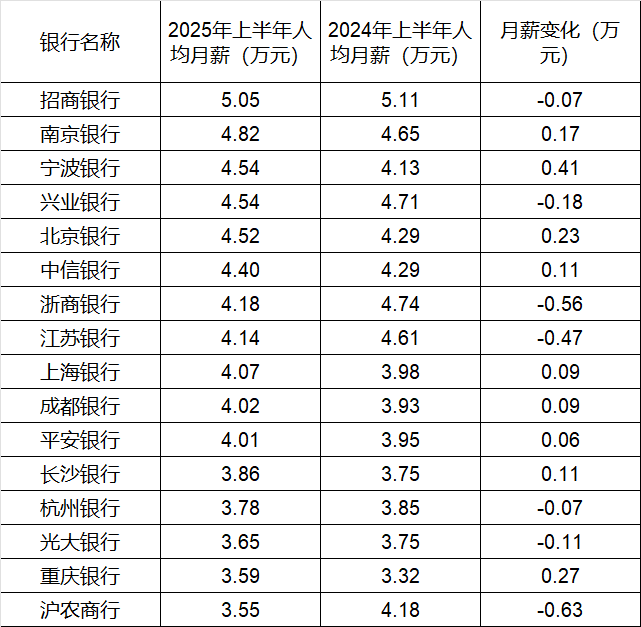
Core Insights - The average salary for bank employees in the first half of 2025 has slightly increased compared to the same period in 2024, with an average salary of 18.1 million yuan and an average monthly salary of 3.02 million yuan, reflecting a rise of approximately 1,300 yuan [2][4] - The salary trends show a balanced distribution, with about half of the banks increasing salaries while the other half decreased them [1][2] Salary Overview - The average monthly salary for major banks such as China Merchants Bank, Nanjing Bank, Ningbo Bank, Industrial Bank, and Beijing Bank exceeded 45,000 yuan in the first half of 2025 [1][2] - Specific monthly salaries for leading banks are as follows: China Merchants Bank at 50,500 yuan, Nanjing Bank at 48,200 yuan, and both Ningbo Bank and Industrial Bank at 45,400 yuan [2][3] Salary Changes - The salary changes for various banks from the first half of 2024 to the first half of 2025 are as follows: - China Merchants Bank: decreased by 700 yuan - Nanjing Bank: increased by 1,700 yuan - Ningbo Bank: increased by 4,100 yuan - Industrial Bank: decreased by 1,800 yuan - Beijing Bank: increased by 2,300 yuan [3] Employment and Compensation Strategy - The six major state-owned banks employ approximately 1.84 million people, accounting for over 70% of the total workforce in the banking sector [5] - State-owned banks are focusing on salary policies that favor grassroots employees, with initiatives to enhance compensation for those in county-level positions [5]



260万银行人,半年平均薪酬“曝光”,5家月薪超4.5万
中国基金报· 2025-08-30 12:39
Core Viewpoint - The average salary of bank employees in China has slightly increased in the first half of 2025 compared to the same period in 2024, with a notable number of banks experiencing salary increases while others saw declines [2][4]. Salary Overview - The average salary for 2.6 million bank employees in the first half of 2025 is approximately 181,000 yuan, translating to an average monthly salary of 30,200 yuan, which is an increase of about 1,300 yuan from the previous year [5]. - The average salary for the first half of 2024 was lower, with a decrease of over 5,000 yuan compared to the first half of 2023 [4]. Leading Banks in Salary - Joint-stock banks and city commercial banks lead in average salary levels, with several banks reporting average monthly salaries exceeding 45,000 yuan in the first half of 2025 [3]. - Specific banks with high average monthly salaries include: - China Merchants Bank: 50,500 yuan - Nanjing Bank: 48,200 yuan - Ningbo Bank: 45,400 yuan - Industrial Bank: 45,400 yuan - Beijing Bank: 45,200 yuan [5][6]. State-Owned Banks Salary Comparison - Among the six major state-owned banks, the average monthly salaries are significantly lower, with: - Bank of China: 28,200 yuan - Bank of Communications: 27,500 yuan - Industrial and Commercial Bank of China: 26,300 yuan - China Construction Bank: 26,200 yuan - Agricultural Bank of China: 25,200 yuan - Postal Savings Bank: 24,900 yuan [7][8]. Salary Policy Trends - Major state-owned banks are focusing on salary policies that favor grassroots employees, aiming to enhance talent development in county-level branches and improve employee engagement [10][11].

