万洲国际

Search documents
突然,这一股暴涨超80%!
Zheng Quan Shi Bao· 2025-11-17 04:39
消息面上,今天上午碳酸锂期货暴涨,国内碳酸锂期货主力合约盘中涨超8%,创出年内新高,盘中突破90000元/吨关口。 A股市场今天(11月17日)上午整体窄幅震荡。包括国防军工、计算机板块、锂矿概念等在内的多个板块掀起涨停潮,表现较好。 港股市场今天上午整体走低,恒生指数盘中跌幅一度超过0.8%。港股靖洋集团盘中一度大涨超过80%。 A股多个板块掀起涨停潮 A股市场今天上午整体窄幅震荡,主要指数不同程度走低。 主要行业板块和赛道方面,若按照申万一级行业划分,国防军工板块大涨,板块盘中涨幅一度超过2.5%。江龙船艇(300589)盘中触及"20cm"涨停,晨 曦航空(300581)、天和防务(300397)盘中涨幅超过10%。长城军工(601606)、航天发展(000547)盘中触及涨停。 计算机板块也掀起涨停潮,板块盘中涨幅一度接近2%。博睿数据盘中"20cm"涨停,海峡创新(300300)、东方国信(300166)、高伟达(300465)等多 股盘中涨幅超过10%。达华智能(002512)、华胜天成(600410)、三六零(601360)、直真科技(003007)、格尔软件(603232)、浪潮软件 (600 ...


突然,这一股暴涨超80%!
证券时报· 2025-11-17 04:35
A股市场今天上午整体窄幅震荡,主要指数不同程度走低。 主要行业板块和赛道方面,若按照申万一级行业划分,国防军工板块大涨,板块盘中涨幅一度超过2.5%。江龙船艇盘中触及"20cm"涨停,晨曦航空、天和防务盘中 涨幅超过10%。长城军工、航天发展盘中触及涨停。 A股市场今天(11月17日)上午整体窄幅震荡。包括国防军工、计算机板块、锂矿概念等在内的多个板块掀起涨停潮,表现较好。 港股市场今天上午整体走低,恒生指数盘中跌幅一度超过0.8%。港股靖洋集团盘中一度大涨超过80%。 A股多个板块掀起涨停潮 计算机板块也掀起涨停潮,板块盘中涨幅一度接近2%。博睿数据盘中"20cm"涨停,海峡创新、东方国信、高伟达等多股盘中涨幅超过10%。达华智能、华胜天成、 三六零、直真科技、格尔软件、浪潮软件、榕基软件等多股盘中触及涨停。 石油石化、煤炭、房地产等板块盘中涨幅也居于前列。 医药生物、电力设备、银行、非银金融等板块跌幅居前。 概念板块方面,锂矿概念大涨,相关概念也掀起涨停潮。天华新能大涨15.06%,盛新锂能、融捷股份、大中矿业、金圆股份等多股涨停。 消息面上,今天上午碳酸锂期货暴涨,国内碳酸锂期货主力合约盘中涨超8%,创 ...

2025年电商“双十一”大促季行业层面增长温和,聚焦一键打包互联网电商龙头+新消费的港股消费ETF(513230)
Mei Ri Jing Ji Xin Wen· 2025-11-17 03:45
11月17日早盘,港股消费板块早盘低开后窄幅震荡,港股消费ETF(513230)现小幅微跌近0.5%。 持仓股中,统一企业中国、新秀丽、康师傅控股、波司登、万洲国际等涨幅居前,巨子生物、零跑汽 车、蜜雪集团、思摩尔国际、百威亚太等跌幅居前。 每日经济新闻 (责任编辑:董萍萍 ) 【免责声明】本文仅代表作者本人观点,与和讯网无关。和讯网站对文中陈述、观点判断保持中立,不对所包含内容 的准确性、可靠性或完整性提供任何明示或暗示的保证。请读者仅作参考,并请自行承担全部责任。邮箱: news_center@staff.hexun.com 华泰证券估算,2025年电商"双十一"大促季行业层面增长温和,GMV或同比增长中高个位数至 10%之间,平稳增长得益于各平台的积极补贴及大促时间线的进一步拉长,但亦部分被去年同期国补行 动带来的较高家电品类销售额基数所抵消。平台角度,主要电商平台或延续分化表现。展望2026年,预 计电商平台围绕流量入口、核心用户权益等维度的竞争将延续激烈态势。消费者终端商品价格的企稳则 是电商平台及上游供货商业绩表现企稳的重要驱动,潜在的政策刺激及消费者情绪的边际变化值得持续 关注。 港股消费ETF ...
港股收评:指数集体下挫!科技、金融股拖累市场,生物医药逆势飘红
Ge Long Hui· 2025-11-14 08:41
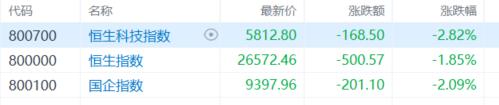
Market Overview - The Asia-Pacific stock markets showed a collective decline influenced by the overnight drop in US stocks, with the Hang Seng Index falling below the 27,000-point mark [1] - On November 14, the three major indices in Hong Kong all fell, with the Hang Seng Technology Index down 2.82%, the Hang Seng Index down 1.85%, and the National Enterprises Index down 2.09% [1] Stock Performance - Major technology stocks experienced significant declines, with Baidu down over 7%, JD.com down over 6%, and Alibaba down over 4% [4][5] - The film and entertainment sector led the declines, with DaMai Entertainment dropping over 10% [6] - Cryptocurrency-related stocks also fell sharply, coinciding with Bitcoin dropping below $97,000, marking a new low since May 8 [7] Sector Performance - The banking, insurance, and Chinese brokerage stocks were sluggish, with CITIC Securities, GF Securities, and China Galaxy all down over 4% [8][9] - Conversely, the biopharmaceutical sector saw gains, with Gilead Sciences rising over 15% and other pharmaceutical stocks also performing well [10][11] Notable Stocks - The pork concept stocks were active, with WH Group rising 1.64%, supported by favorable market outlooks for pork prices in the US and China [12] - Southbound capital saw a net inflow of HKD 12.887 billion, indicating continued interest in Hong Kong stocks [13] Market Outlook - According to GF Securities, the foundation of the Hong Kong bull market remains intact, but the evolution is expected to be characterized by "oscillating upward" rather than rapid increases, emphasizing the importance of high-prosperity sectors [15]
港股收评:全天低迷!科指大跌2.8%,恒指再度27000点,科技金融权重齐挫
Ge Long Hui· 2025-11-14 08:22
Core Viewpoint - The Asia-Pacific stock markets experienced a collective downturn influenced by a significant drop in the US stock market, with major indices in Hong Kong falling sharply [1] Group 1: Market Performance - The Hang Seng Technology Index plummeted by 3.1% at one point, ultimately closing down 2.83% [1] - The Hang Seng Index and the China Enterprises Index declined by 1.85% and 2.09%, respectively, with the Hang Seng Index losing 500 points and falling below the 27,000 mark [1] Group 2: Sector Performance - Major sectors such as large technology stocks, financials (including banks, insurance, and brokerages), and state-owned enterprises contributed to the market decline [1] - Baidu's stock dropped over 7% following its earnings report, while CITIC Securities fell more than 5%, China Life Insurance declined nearly 3%, and Agricultural Bank of China decreased by nearly 2% [1] - Bitcoin fell below $97,000, leading to a broader decline in cryptocurrency-related stocks, while semiconductor, automotive, photovoltaic, aviation, military, and precious metal stocks also experienced losses [1] Group 3: Resilient Sectors - Conversely, the biopharmaceutical sector saw gains, with Gilead Sciences rising over 15%, and both Lai Kai Pharmaceutical and Saint Noble Pharmaceutical increasing by over 12% [1] - JD Health led the internet healthcare stocks with a rise of over 6% [1] - Citigroup noted favorable prospects for pork prices in the China-US market, contributing to a historical high for the leading pork stock, WH Group [1]
中国消费市场-2025 年第三季度总结_整体需求趋弱,前景仍谨慎;高端消费成亮点-China Consumer_ Pulse Check_ 3Q25 wrap-up_ Overall demand softer and outlook remains prudent; high-end consumption a bright spot
2025-11-13 02:48
Summary of China Consumer Pulse Check: 3Q25 Industry Overview - The report focuses on the **China Consumer** sector, highlighting softer consumption trends in **3Q25** across various industries including spirits, sportswear, cosmetics, and dairy [2][12]. Key Findings - **Overall Demand**: Consumption trends have softened, with earnings misses and growth deceleration noted in multiple sectors. Home appliances, despite benefiting from trade-in policies, also experienced a deceleration due to tougher comparisons and subsidy controls [2][12]. - **Peak Season Performance**: Goods consumption during peak seasons, such as the National Day holiday and Double 11, was weaker than expected, indicating a broader trend of demand softness [2][12]. - **Price Pressure**: The softness in demand has continued to pressure prices in categories like sportswear, spirits, and dairy. However, some players in prepared food and air conditioning are becoming more disciplined in their promotions due to limited economic value [2][12]. - **Bright Spots**: Some multinational corporations, particularly in the premium segments like luxury goods and cosmetics, reported signs of improvement in trends, attributed to wealth effects, foreign exchange impacts, easier comparisons, and improved operations [2][12]. - **Cautious Outlook**: Despite some positive signs, the overall outlook remains cautious due to broad-based softness observed in 3Q results and deteriorating macro data related to consumption [2][12]. Sector Preferences - **Preferred Sectors**: The most preferred sectors identified are diversified retailers, beverages, and pet food. The apparel and footwear OEM sector preference has been lifted to Neutral from least preferred due to easing tariff uncertainties [3][12]. - **Least Preferred Sectors**: The least preferred sectors include sports retailers, furniture, projectors, discretionary small kitchen appliances, and non-super-premium spirits [3][12]. Investment Focus - The report emphasizes focusing on companies with idiosyncratic growth opportunities, particularly in the new consumption space, despite softening sentiment due to brand cycles and base concerns. Companies with high shareholder returns and market share efficiency are viewed as more defensive in the current consumption backdrop [2][12]. Additional Insights - **Earnings Visibility**: Companies with relatively high earnings visibility into the next year, such as those driven by store and category expansion in freshly made drinks, are highlighted as potential investment opportunities [2][12]. - **Market Dynamics**: The report notes that while some sectors are facing challenges, there are still opportunities for growth in niche and premium brands, which are expected to outperform the broader industry despite a likely slowdown compared to the first half of the year [12][14]. Conclusion - The overall sentiment in the China consumer market for 3Q25 indicates a cautious approach due to softer demand trends, with specific sectors showing resilience and potential for growth. Investors are advised to focus on companies with strong fundamentals and growth visibility while remaining aware of the broader economic challenges.
万洲国际(00288.HK)再涨超4% 月内累涨近15%
Mei Ri Jing Ji Xin Wen· 2025-11-12 07:57
每经AI快讯,万洲国际(00288.HK)再涨超4%,月内累计涨幅接近15%。截至发稿,涨4.03%,报8.51港 元,成交额2.8亿港元。 ...

万洲国际再涨超4% 月内累涨近15% 花旗称中美市场猪肉价格前景仍然有利
Zhi Tong Cai Jing· 2025-11-12 07:47
花旗发布研报称,万洲国际三季经营利润按年增长2%,符合该行预期;EBITDA及净利润分别按年增长 13%及15%,均优于预期,主要受一次性项目带动,包括保险赔偿及诉讼费用回拨。该行认为今年第四 季及明年,美国及中国市场的猪肉价格前景仍然有利。维持"买入"评级,目标价由8.6港元上调8.7港 元。 万洲国际(00288)再涨超4%,月内累计涨幅接近15%。截至发稿,涨4.03%,报8.51港元,成交额2.8亿港 元。 消息面上,万洲国际近期发布前三季度业绩,生物公允价值调整前,该集团取得收入204.77亿美元,同 比增加8.54%;公司拥有人应占利润11.68亿美元,同比增加8.05%。期内,万洲国际肉制品销量223.1 吨,猪肉销量296.7吨。 ...
港股异动 | 万洲国际(00288)再涨超4% 月内累涨近15% 花旗称中美市场猪肉价格前景仍然有利
智通财经网· 2025-11-12 07:41
Core Viewpoint - Wan Zhou International (00288) has seen a stock price increase of over 4%, with a cumulative rise of nearly 15% in the month, reflecting positive market sentiment following its recent financial performance announcement [1] Financial Performance - For the first three quarters, Wan Zhou International reported a revenue of $20.477 billion, representing an 8.54% year-on-year increase [1] - The profit attributable to the company's owners reached $1.168 billion, marking an 8.05% increase compared to the previous year [1] - The company sold 223.1 tons of meat products and 296.7 tons of pork during the period [1] Market Analysis - Citigroup's research report indicates that Wan Zhou International's operating profit grew by 2% year-on-year in Q3, aligning with the bank's expectations [1] - EBITDA and net profit increased by 13% and 15% year-on-year, respectively, surpassing expectations, primarily driven by one-time items such as insurance compensation and litigation cost reversals [1] - The outlook for pork prices in the U.S. and China remains favorable for Q4 of this year and into next year, according to Citigroup [1] - Citigroup maintains a "Buy" rating on the stock, raising the target price from HKD 8.6 to HKD 8.7 [1]
港股私有化热潮背后:跳出流动性困境 推动战略转型
Zheng Quan Shi Bao· 2025-11-06 17:56
Core Insights - The Hong Kong stock market is experiencing an unprecedented wave of privatizations, with over 20 companies delisted due to privatization as of November 6, surpassing the total of 15 for the entire year of 2024 [1] - Privatization has become a mainstream method for delisting in the Hong Kong market, accounting for 42.31% of all delisted companies this year, compared to 30.61% in 2024 [2] Summary by Category Market Trends - A total of 52 companies have been delisted from the Hong Kong stock market this year, with 28 due to cancellation of listing status and 22 due to privatization [2] - The privatization trend spans various sectors, including finance, real estate, consumer goods, and technology [2] Reasons for Privatization - Companies are primarily driven to privatize due to low valuations that do not reflect their true value, hindering further financing potential [2] - Low trading volumes have rendered public trading meaningless, prompting companies to seek privatization [3] Strategic Considerations - Strategic transformation needs are also a significant factor driving privatization, as seen with Dongfeng Group's plan to spin off its electric vehicle subsidiary, Lantu Motors, and privatize itself to focus on new energy vehicles [4] - Companies like Fosun Tourism Culture have cited long-term low stock prices and liquidity issues as reasons for their privatization decisions [4] Market Implications - Privatization allows companies to avoid stock price volatility, reduce listing costs, and focus on long-term strategic transformations and mergers [5] - The concentration of privatized companies in traditional industries may temporarily suppress market activity but is expected to attract new capital into emerging sectors in the long run [5] Resource Optimization - Privatization can enhance resource allocation and operational efficiency, as demonstrated by HSBC's plan to privatize Hang Seng Bank while maintaining customer interactions [6] - The process of privatization is seen as a way to eliminate public shareholder constraints, integrate resources, and improve management efficiency [6]