线上零售商

Search documents
集体拉升!大反弹在即?
格隆汇APP· 2026-03-25 09:36
Core Viewpoint - The article discusses the recent downturn in the Hang Seng Technology Index, attributing it to three main negative factors, and questions whether the index has reached a value bottom [2][3]. Group 1: Factors Driving the Downturn - The first factor is the heightened global risk aversion due to the Iran conflict, which has led to significant disruptions in the Strait of Hormuz and increased oil prices, with Brent crude surpassing $100 per barrel [4][5][6][7]. - The second factor is the renewed expectations of monetary tightening by the Federal Reserve, as indicated by Chairman Powell's hawkish remarks, which have raised concerns about liquidity and inflation [9][10][12][13]. - The third factor involves disappointing market reactions to earnings reports from major tech companies like Tencent and Alibaba, despite their solid financial performance, due to concerns over AI capital expenditures and competitive dynamics [14][15][16]. Group 2: Current Valuation of the Hang Seng Technology Index - The Hang Seng Technology Index is currently at a historical low valuation, with a PE (TTM) ratio of 21.41, placing it in the 19.66% historical percentile, indicating that 80% of the time, valuations have been higher [20]. - Relative to similar indices, the Hang Seng Technology Index is significantly undervalued, with the Nasdaq at 37.43 and the ChiNext Index at 40.1, suggesting that the Hang Seng's valuation is slightly more than half of the Nasdaq and equal to about half of the ChiNext [23][24]. - Earnings growth expectations for the Hang Seng Technology Index are projected at 34% for 2026, with a PEG ratio of less than 1, indicating that the low valuation is not based on deteriorating earnings expectations but rather on market sentiment and external liquidity pressures [25][26]. Group 3: Market Sentiment and Fund Flows - Domestic investors are actively buying into the market, with net inflows from southbound funds reaching HKD 403.84 billion since March, indicating a positive long-term outlook despite the current downturn [36]. - The Hang Seng Technology ETF has seen a net inflow of HKD 1.342 billion this year, reflecting continued interest in core technology assets [37]. - In contrast, foreign investors remain cautious, although interest in Chinese stocks has reportedly increased, with only about 10% of surveyed clients considering Chinese stocks "uninvestable," a significant improvement from two years ago [41][42]. Group 4: Conditions for a Potential Rebound - A potential rebound in the Hang Seng Technology Index may depend on several conditions, including a de-escalation of the Iran conflict and a subsequent improvement in market sentiment regarding oil prices, inflation, and interest rates [30][31]. - The commercial viability of AI technologies is also crucial, as evidenced by Tencent and Alibaba's earnings reports showing tangible benefits from AI, which could provide fundamental support for the sector [32][33]. - Overall, while the index is currently undervalued, a sustained rebound will require careful monitoring of geopolitical risks, monetary policy expectations, and the pace of AI commercialization [45].


京东集团股价跌破60日均线,市场情绪与资金流出成主因
Jing Ji Guan Cha Wang· 2026-02-14 21:23
Market Overview - JD Group's stock closed at HKD 106.40 on February 13, down 1.85%, falling below the 60-day moving average of HKD 113.187, primarily due to weak market conditions [1] - The Hang Seng Index dropped by 1.72% and the Hang Seng Tech Index fell by 0.90%, with the online retail sector declining by 1.98%, reflecting overall market sentiment [1] Fund and Technical Analysis - There was a net outflow of HKD 44.7193 million in JD's stock on February 13, with large sell orders accounting for 24%, indicating strong short-term selling pressure from institutions [2] - The stock has been trading below the 60-day moving average for several consecutive days, with the MACD histogram remaining negative and the KDJ indicator in the oversold zone, suggesting increased technical selling pressure [2] Company Developments - Despite JD's announcement of over HKD 1.3 billion in welfare subsidies for the Spring Festival and a future investment of HKD 22 billion in the "Little Brother Home" initiative, the market remains focused on short-term performance pressures and the impact of new business investments on profitability [3] - An incident involving the theft of goods from a warehouse in Paris was reported, with most items recovered by February 14; however, this event occurred in December 2025 and had limited direct impact on the stock price as of February 13 [3] Valuation Metrics - As of February 13, JD's price-to-earnings ratio stood at 8.56 and the price-to-book ratio at 1.19, indicating that the stock is at a historical low valuation; however, concerns about slowing growth in the e-commerce sector and increased competition are suppressing the potential for valuation recovery [4] - The decline below the 60-day moving average is attributed to a combination of overall market sentiment, capital outflows, and technical breakdowns rather than a single negative event [4]

港股收评:三大指数集体下跌!教育股逆势上涨,贵金属急回调
Ge Long Hui· 2026-01-30 08:48
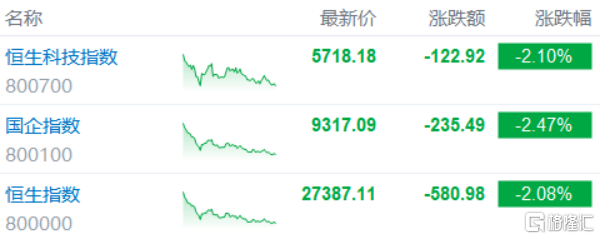
Market Performance - The Hong Kong stock market indices showed weak performance on January 30, with the Hang Seng Index falling by 2.08% to 27,387.11 points, the Hang Seng China Enterprises Index down by 2.47%, and the Hang Seng Tech Index decreasing by 2.1% [1][2] - For the month, the Hang Seng Index recorded a cumulative increase of 6.85%, briefly surpassing 28,000 points, marking a four-year high, while the Hang Seng China Enterprises Index rose by 4.53% and the Hang Seng Tech Index increased by 3.67% [1] Sector Performance - Major technology stocks mostly declined, with Kuaishou and Xiaomi dropping over 3%, and Tencent falling by 2.57% [2][4] - Precious metals experienced a significant sell-off, with gold, aluminum, and copper prices retreating sharply [2] - The application software sector continued to decline, with Kingdee International dropping by 7.7% and Kingsoft falling nearly 4% [2] - Local retail stocks in Hong Kong saw widespread declines, with Chow Tai Fook down by 6.7% [2] - Some education stocks rose against the trend, with China Spring rising over 22% and New Oriental increasing by 5.5% [2][14] Specific Stock Movements - Kingdee International's stock price fell to 12.95 HKD, down 7.7% [5] - Kuaishou's stock price decreased to 80.15 HKD, down 3.38% [5] - Tencent's stock price fell to 606.00 HKD, down 2.57% [5] - Precious metal stocks like Chifeng Jilong Gold and Shandong Gold saw declines of over 14% [7] - Ganfeng Lithium's stock price dropped by 10.90% to 60.50 HKD [9] Educational Sector Insights - New Oriental reported a net revenue of 1.19 billion USD for Q2 of FY2026, a year-on-year increase of 14.7%, with a net profit of 45.45 million USD, up 42.3% [14] - The management expressed confidence in exceeding annual targets, with a profit margin expansion of 300 basis points [14] Capital Flows - Southbound funds recorded a net inflow of 3.218 billion HKD, with 2.036 billion HKD from the Shanghai-Hong Kong Stock Connect and 1.182 billion HKD from the Shenzhen-Hong Kong Stock Connect [20] Market Outlook - According to Everbright Securities, the Hong Kong stock market is expected to trend positively due to earnings recovery, improved liquidity, low valuations, and policy support, with a structural rebound anticipated in Q1 [22]
恒指跌1%
Jin Rong Jie· 2026-01-30 01:56
Group 1 - The Hang Seng Index has expanded its decline to 1% [1] - The Hang Seng Tech Index has decreased by 1.44% [1] - Most precious metals and online retail concept stocks have seen a decline [1]
港股收评:新年开门红!恒科指大涨4%,科技股、芯片股大爆发
Ge Long Hui· 2026-01-02 08:57
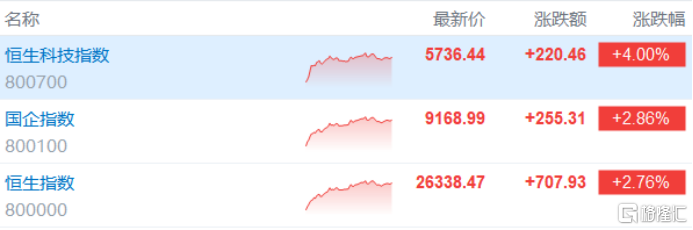
Market Overview - The Hong Kong stock market experienced a significant rally on January 2, with the Hang Seng Index rising by 2.76% to close at 26,338.47 points, the Hang Seng China Enterprises Index increasing by 2.86%, and the Hang Seng Tech Index surging by 4% [1] Sector Performance - Major technology stocks saw collective gains, with Baidu rising by 9.35%, Tencent and Alibaba increasing by over 4%, and Kuaishou and JD.com gaining over 3% [3][5] - Semiconductor stocks also performed well, with Hua Hong Semiconductor up by 9.4% and SMIC increasing by over 5% [3][10] - Wind power equipment stocks surged, with Goldwind Technology rising nearly 21% [3] - The gaming sector saw broad increases, with NetEase, Zhongyou Game, and Qingci Game all rising over 6% [3][14] - Some sectors, including film, lottery, and dairy products, showed weakness [3] Notable Stocks - Hua Hong Semiconductor's stock price reached 81.30 HKD, up by 9.42% [6][11] - Baidu's stock price closed at 143.80 HKD, up by 9.35% [6][16] - Goldwind Technology's stock price increased to 16.22 HKD, up by 20.95% [9] - The stock of the newly listed company, Birun Technology, surged by 75.8% on its debut, reaching a market capitalization of nearly 81.3 billion HKD [10] Industry Developments - The aerospace and defense sector saw gains, with Dalu Aerospace Technology Holdings rising over 13% [8] - The electric power equipment sector experienced widespread increases, with several companies, including Shanghai Electric and Harbin Electric, also showing positive performance [9] - The tourism and travel sector was active, with Hong Kong Travel and Ctrip Group both rising over 5% [12][13] - The gaming sector remained vibrant, with multiple companies, including Feiyu Technology and NetEase, showing significant gains [14] Future Outlook - According to industry analysts, the Hong Kong stock market is expected to continue its bullish trend in 2026, with a focus on growth and value reconstruction [20] - The net profit growth rate for Hong Kong Stock Connect constituent stocks is projected to reach 7.3% year-on-year, with sectors like information technology, discretionary consumption, and healthcare leading the growth [20]


把握AI时代科技发展机遇 华安恒生港股通科技主题ETF7月28日发行
Quan Jing Wang· 2025-12-21 04:23
Group 1 - The technology sector is becoming the core driver of China's economic growth, with the Hong Kong stock market's technology sector offering more investment options [1] - The Huazhang Hang Seng Hong Kong Stock Connect Technology Theme ETF (subscription code: 520843) has been launched, focusing on the AI industry chain and providing a new tool for investors in the Hong Kong technology sector [1] - The ETF closely tracks the Hang Seng Hong Kong Stock Connect Technology Theme Index, which includes key sectors such as information technology, electronic components, interactive media and services, online retailers, and payment services, covering the entire AI industry chain [1] Group 2 - The Hang Seng Hong Kong Stock Connect Technology Theme Index includes major tech companies like Xiaomi, Alibaba, Tencent, Kuaishou, SMIC, Meituan, and Lenovo, and is more focused on the AI industry chain compared to other indices [1] - The index consists of 30 constituent stocks, with a quarterly adjustment frequency, and has a stock weight cap of 10%, which is higher than the 8% cap of the Hang Seng Technology Index, indicating a more concentrated weight distribution [1] - The Hong Kong stock market is expected to see revenue growth of 3.4% and profit growth of 8.5% in 2024, with the technology sector benefiting from the overall development of the AI industry, projecting a profit growth rate of 51% for the Hang Seng Hong Kong Stock Connect Technology sector in 2024 [2]
港股收评:恒指涨0.58%,保险股大涨,航空股走低
Ge Long Hui· 2025-12-05 08:32
Market Overview - The Hong Kong stock market indices showed a significant recovery, with the Hang Seng Index rising by 0.58% to close above 26,000 points, while the Hang Seng China Enterprises Index and the Hang Seng Tech Index increased by 1.01% and 0.84%, respectively [1][2]. - For the week, the Hang Seng Index gained 0.87%, the China Enterprises Index rose by 0.75%, and the Hang Seng Tech Index increased by 1.13% [1]. Sector Performance - Major technology stocks experienced notable gains, with Baidu rising nearly 8% during the afternoon session and closing up 5% [2][4]. - Financial stocks, particularly in insurance, banking, and brokerage, contributed to the market's upward movement, aided by regulatory adjustments that lowered risk factors for insurance company investments [2][9]. - Copper, aluminum, and gold stocks remained active, with Jiangxi Copper and China Nonferrous Mining both rising over 5% [6]. Specific Stock Movements - Baidu Group saw a price increase of 5.01%, closing at 121.60, while Kingdee International rose by 3.43% to 13.87 [5]. - Insurance stocks performed strongly, with China Pacific Insurance leading the sector with a 7.10% increase, followed by Ping An Insurance at 6.71% [9]. - Heavy machinery stocks continued their upward trend, with Zoomlion Heavy Industry rising over 5% [7]. New Listings and Market Reactions - Two new stocks listed today faced declines, with Yujian Xiaomian dropping nearly 28% and Tianyu Semiconductor falling over 30% [2][13]. Future Outlook - According to Everbright Securities, the Hang Seng Index may have the potential to exceed 30,000 points in 2026, with investment opportunities identified in sectors such as Chinese finance, smart technology, and energy materials [15].

港股收评:恒科指涨1.45%,科技股集体回暖,有色金属股转跌
Ge Long Hui A P P· 2025-12-04 08:44
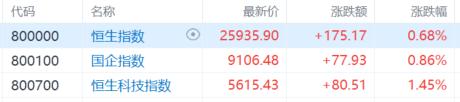
Market Overview - The Hong Kong stock market showed a rebound in sentiment, with the Hang Seng Technology Index rising by 1.45% to above 5600 points, while the Hang Seng Index increased by 0.68% to 25935 points, and the National Enterprises Index rose by 0.86% to 9106 points [1][2]. Sector Performance - Large technology stocks collectively rose, with notable gains from Xiaomi (over 4%) and Meituan (over 2%). The pharmaceutical sector saw a surge in orders for flu medications, with some stocks in this category performing strongly [2][4]. - The semiconductor sector was active, with companies like Cambrian increasing chip production by three times, leading to a rise in semiconductor stocks [2][9]. - The biopharmaceutical sector experienced significant gains, with WuXi AppTec rising over 9% and other related stocks also showing strong performance due to increased demand for flu medications [6][8]. - The automotive, real estate, and pharmaceutical sectors showed positive movements, while the restaurant and gaming sectors faced declines [3][13][15]. Notable Stocks - Horizon Robotics saw a rise of over 6%, while Xiaomi and Trip.com also reported gains of over 4% and 3%, respectively [4][5]. - In the biopharmaceutical space, WuXi AppTec and other related stocks saw increases of over 8% [6]. - The robotics sector was strong, with companies like CloudMinds and others showing significant gains [7][8]. - The entertainment sector also saw some upward movement, with Lemon Films rising over 5% [11][12]. Capital Flows - Southbound funds recorded a net inflow of 1.48 billion HKD, indicating positive investor sentiment towards Hong Kong stocks [19]. Future Outlook - Analysts predict that the Hong Kong stock market may experience fluctuations in the coming months, with the Hang Seng Index expected to range between 23500 and 30500 points in 2026. Recommendations include buying on dips and focusing on sectors such as technology, high-end manufacturing, and renewable energy [21].



港股收评:阶段新低!科技、金融拖累市场,半导体重挫
Ge Long Hui· 2025-11-21 08:46
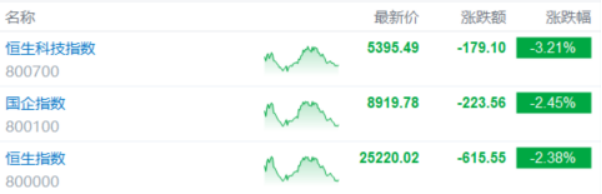
Market Overview - The Hong Kong stock market experienced significant declines, with the Hang Seng Tech Index dropping by 3.21%, while the Hang Seng Index and the China Enterprises Index fell by 2.38% and 2.45%, respectively, reaching new lows for the period [1][2]. Sector Performance - Major sectors such as large technology stocks, financials (including banks, insurance, and brokerage), and state-owned enterprises faced collective pressure, negatively impacting market sentiment. Notable declines included Baidu down nearly 6% and Alibaba down 4.65% [2][3]. - The semiconductor sector saw substantial losses, with companies like JD Health dropping over 8%, and SMIC and Huahong Semiconductor both falling over 6% [5][6]. - The lithium battery sector also faced declines, with Ganfeng Lithium down over 12% and Tianqi Lithium down over 11% [8][15]. - Conversely, some retail stocks showed resilience, with certain real estate stocks like R&F Properties, Country Garden, and Longfor Group rising against the trend [2]. Individual Stock Movements - JD Health reported a decline of 8.60%, closing at 62.15 HKD, while SMIC and Huahong Semiconductor fell by 6.39% and 6.09%, respectively [6][11]. - Ganfeng Lithium's stock price dropped to 50.90 HKD, marking a 12.47% decrease, while Tianqi Lithium fell to 47.16 HKD, down 11.93% [8][15]. - The advertising and promotion sector saw activity, with companies like Runge Interactive rising over 10% [14]. Market Sentiment and Future Outlook - The market sentiment was influenced by external factors, including concerns over potential overheating in AI investments, as highlighted by a report on Nvidia that affected the AI hardware sector [9]. - Looking ahead, the macroeconomic environment is expected to improve with the potential for a more accommodative global liquidity situation, driven by anticipated interest rate cuts by the Federal Reserve [18].
港股收评:指数集体下挫!科技、金融股拖累市场,生物医药逆势飘红
Ge Long Hui· 2025-11-14 08:41
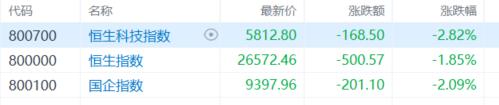
Market Overview - The Asia-Pacific stock markets showed a collective decline influenced by the overnight drop in US stocks, with the Hang Seng Index falling below the 27,000-point mark [1] - On November 14, the three major indices in Hong Kong all fell, with the Hang Seng Technology Index down 2.82%, the Hang Seng Index down 1.85%, and the National Enterprises Index down 2.09% [1] Stock Performance - Major technology stocks experienced significant declines, with Baidu down over 7%, JD.com down over 6%, and Alibaba down over 4% [4][5] - The film and entertainment sector led the declines, with DaMai Entertainment dropping over 10% [6] - Cryptocurrency-related stocks also fell sharply, coinciding with Bitcoin dropping below $97,000, marking a new low since May 8 [7] Sector Performance - The banking, insurance, and Chinese brokerage stocks were sluggish, with CITIC Securities, GF Securities, and China Galaxy all down over 4% [8][9] - Conversely, the biopharmaceutical sector saw gains, with Gilead Sciences rising over 15% and other pharmaceutical stocks also performing well [10][11] Notable Stocks - The pork concept stocks were active, with WH Group rising 1.64%, supported by favorable market outlooks for pork prices in the US and China [12] - Southbound capital saw a net inflow of HKD 12.887 billion, indicating continued interest in Hong Kong stocks [13] Market Outlook - According to GF Securities, the foundation of the Hong Kong bull market remains intact, but the evolution is expected to be characterized by "oscillating upward" rather than rapid increases, emphasizing the importance of high-prosperity sectors [15]