
中国进出口银行

Search documents
贯彻落实党的二十届四中全会精神 多家银行为“十五五”金融工作“划重点”
Zheng Quan Ri Bao· 2025-10-26 16:38
Core Viewpoint - Recent meetings held by policy banks and major state-owned banks focus on implementing the spirit of the 20th Central Committee's Fourth Plenary Session, emphasizing financial services for the "14th Five-Year Plan" period and aligning with national development strategies [1][2]. Group 1: Policy Banks and State-Owned Banks' Focus - Policy banks are crucial platforms for implementing national development strategies, with the Agricultural Development Bank of China emphasizing support for food security, poverty alleviation, rural development, and ecological construction [1]. - The Export-Import Bank of China aims to enhance high-level opening-up and promote trade innovation and investment cooperation, contributing to the Belt and Road Initiative [1]. - State-owned banks are committed to balancing service to the real economy with sustainable development, integrating high-quality development into their management processes [1][2]. Group 2: Specific Strategies of Major Banks - Industrial and Commercial Bank of China plans to leverage international platforms to support high-level opening-up [3]. - Agricultural Bank of China focuses on common prosperity and increasing financial support for rural areas [3]. - Bank of China aims to enhance global competitiveness and support the internationalization of the RMB [3]. - China Construction Bank emphasizes infrastructure support and consumer finance initiatives [3]. - Bank of Communications is refining its strategic direction and priorities [3]. - Postal Savings Bank of China is committed to high-quality development and its unique financial strategies [3]. Group 3: Future Planning and Strategic Directions - Agricultural Bank of China will focus on key areas such as modern industrial systems, green transformation, and regional coordinated development over the next five years [4]. - The bank will prioritize intelligent, green, and integrated development while enhancing service quality for the real economy [4]. - China Construction Bank plans to optimize funding structures and promote regional development while managing potential risks [4].



政策性银行全力推进新型政策性金融工具投放
Zheng Quan Ri Bao· 2025-10-25 16:44
Core Insights - The new policy financial tools established by major policy banks, including the National Development Bank (NDB), Agricultural Development Bank (ADB), and Export-Import Bank, have significantly contributed to project funding, with a total investment of 1,893.5 billion yuan as of October 17, expected to stimulate a total project investment of 2.8 trillion yuan [1][2][3]. Group 1: Investment Distribution - The NDB has allocated 1,465.8 billion yuan to 12 major economic provinces, accounting for 77.4% of its total funding [3]. - The ADB has invested 671.36 billion yuan into 407 investment projects in major economic provinces [4]. - The Export-Import Bank has directed 40% of its funding towards private capital participation in projects, supporting the development of the private economy [1][2]. Group 2: Sector Focus - 40% of the funding from these banks has been directed towards projects in the digital economy and artificial intelligence, aligning with national strategic priorities [1][2]. - The NDB has invested 710.5 billion yuan in sectors such as digital economy, artificial intelligence, and consumption, representing 37.5% of its total funding [3]. Group 3: Operational Efficiency - The policy banks have established dedicated teams and leadership groups to ensure efficient fund allocation and compliance with regulations [2][3]. - The ADB has committed to accelerating project reviews and funding processes while adhering to legal and regulatory frameworks [4][5]. - The NDB aims to maintain a high standard of operational efficiency and risk control in its funding activities [5].
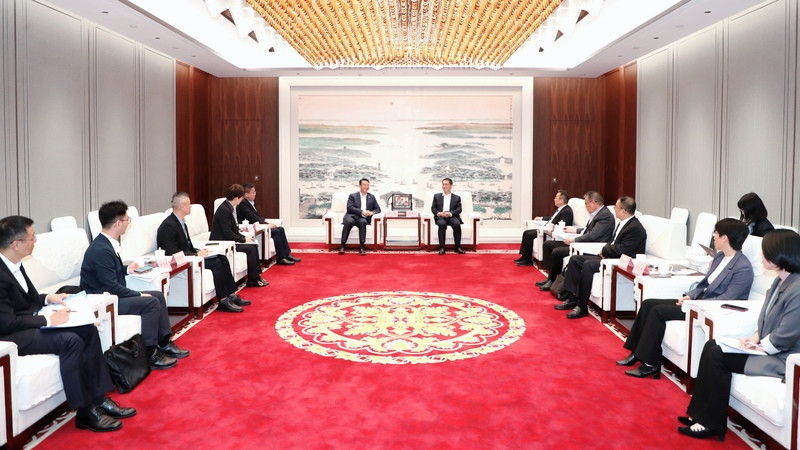
吴庆文会见中国进出口银行副行长王康
Su Zhou Ri Bao· 2025-10-24 00:33
Core Points - The meeting between Wu Qingwen, the Deputy Secretary of the Municipal Party Committee and Mayor of Suzhou, and Wang Kang, Vice President of the Export-Import Bank of China, highlights the importance of financial support for Suzhou's economic development [1][4] - Wu emphasized the city's commitment to high-level opening-up and stabilizing foreign trade and investment, indicating a positive economic trend [4] - Wang acknowledged Suzhou's economic vitality and expressed the bank's intention to enhance cooperation, focusing on policy-driven financial support for key sectors [4] Group 1 - Wu Qingwen welcomed the delegation from the Export-Import Bank of China and expressed gratitude for their support in Suzhou's development [4] - The meeting underscored the role of the Export-Import Bank as a state-owned policy bank in promoting international economic cooperation [4] - The bank aims to provide targeted financial support to Suzhou's foreign trade enterprises and manufacturing sectors, enhancing the city's open economy [4] Group 2 - Wang Kang highlighted the broad cooperation potential between the bank and Suzhou, given the city's status as a major economic and foreign trade hub [4] - The bank plans to focus on national strategies and strengthen the deployment of various financial resources, particularly new policy financial tools [4] - The collaboration will emphasize support for advanced manufacturing, digital economy, and facilitating enterprises' international expansion [4]

从“看报表”到“看赛道” 金融助力科技型小微企业发展
Zhong Guo Xin Wen Wang· 2025-10-23 20:32
Group 1 - The China Banking Association is exploring financial support measures for technology-oriented small and micro enterprises in Zhejiang [1] - Technology-oriented small and micro enterprises face challenges such as insufficient credit limits and high financing costs due to a lack of traditional collateral [1] - Zhejiang banks are implementing special financing plans that leverage intellectual property as collateral, moving away from traditional asset-based lending [1] Group 2 - As of the end of September, the balance of inclusive loans for small and micro enterprises in Zhejiang reached 5.76 trillion yuan, with a financing coverage rate of 40% for active small and micro entities [1] - The China Export-Import Bank's Zhejiang branch has provided 100 million yuan in intellectual property pledge loans to companies like Zhejiang Deshman Technology [1] - The China Bank of Zhejiang Province has developed a self-research evaluation tool to assess the potential of technology enterprises based on various "soft power" indicators [1] Group 3 - The "New Quality Loan" product from the China Bank of Zhejiang Province has supported over 1,500 technology-oriented small and micro enterprises with approximately 11.8 billion yuan in credit [2] - Zhejiang Merchants Bank has introduced targeted credit products such as "Talent Loan" and "Innovation Loan" to address financing difficulties during the R&D phase [2] - The shift in financial services from traditional metrics to evaluating industry potential reflects a change in risk perception and operational capability among banks [2]
新型政策性金融工具投放过半 助力四季度信贷社融
Sou Hu Cai Jing· 2025-10-23 16:33
Core Insights - The new policy financial tools have been launched rapidly, with nearly 300 billion yuan already deployed, expected to drive total project investments exceeding 4 trillion yuan [1][5]. Group 1: Financial Tool Deployment - As of October 17, the China Development Bank (CDB) and Agricultural Development Bank have deployed 1,893.5 billion yuan and 1,001.11 billion yuan respectively, totaling nearly 3 trillion yuan [2][3]. - The CDB's new financial tool is projected to stimulate total project investments of 2.8 trillion yuan, with 77.4% of the funds directed towards 12 major economic provinces [2][4]. - The Agricultural Development Bank achieved a record of "same-day approval and deployment," completing the registration and initial fund deployment of 104.83 billion yuan on the same day it received regulatory approval [3]. Group 2: Focus Areas and Impact - The new financial tools emphasize support for digital economy, artificial intelligence, and consumption sectors, with 37.5% of CDB's investments directed towards these areas [2][4]. - The Export-Import Bank has focused on supporting private enterprises in foreign trade, particularly in Hubei, to enhance production capacity and global expansion [3][4]. - The deployment of these tools is expected to have a multiplier effect on credit growth, potentially leading to an additional 2 to 2.5 trillion yuan in new credit [6][7]. Group 3: Economic Implications - The new financial tools are seen as a key mechanism for stabilizing economic growth, with expectations of a sustained impact on credit and social financing growth [5][6]. - If fully deployed in October, the tools could increase the year-on-year growth rate of social financing by approximately 0.1 percentage points [6][7]. - The gradual release of credit demand is anticipated, with project cycles typically spanning 3 to 5 years, ensuring ongoing support for bank credit needs [7][8].
今年以来广义财政收入增速首次转正 增量政策陆续出台实施 | 财税益侃
Di Yi Cai Jing· 2025-10-23 14:23
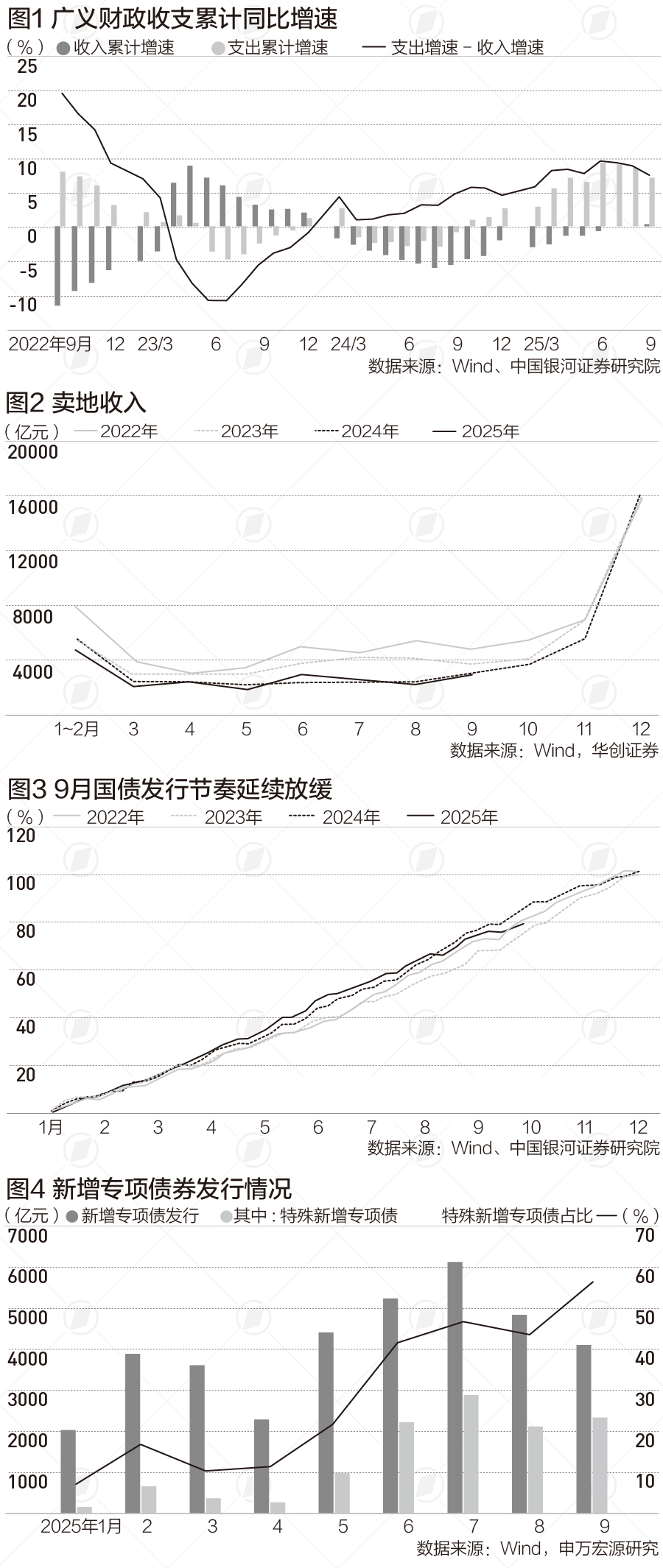
Core Viewpoint - China's economy has shown stable performance in 2023, leading to a recovery in fiscal revenue, supported by proactive fiscal policies aimed at stabilizing employment, businesses, and market expectations [1][11]. Fiscal Revenue and Taxation - In the first three quarters of 2023, the broad fiscal revenue reached 19.46 trillion yuan, a year-on-year increase of approximately 0.4%, marking the first positive growth in fiscal revenue this year [1]. - The general public budget revenue was 16.39 trillion yuan, with tax revenue at 13.27 trillion yuan, reflecting a year-on-year growth of 0.5% and 0.7% respectively [2]. - Tax revenue growth turned positive in recent months, with September showing an 8.7% year-on-year increase, the highest for the year, driven by improved corporate performance and active capital market transactions [2][3]. Non-Tax Revenue - Non-tax revenue in the general public budget decreased by 0.4% year-on-year to 312.12 billion yuan, significantly lower than the previous year's growth of 13.5% [4]. - The decline in non-tax revenue is attributed to a high base from previous years and stricter regulations on administrative penalties [4][7]. Government Bonds and Fiscal Expenditure - The net financing of government bonds reached 1.146 trillion yuan in the first three quarters, an increase of 428 billion yuan year-on-year [10]. - Fiscal expenditure for the same period was 20.81 trillion yuan, a year-on-year increase of 3.1%, with significant allocations towards social security, education, and healthcare [11]. - The government has accelerated the issuance of special bonds to support major projects, with a total expenditure of 4.21 trillion yuan from various bond types [14][15]. Real Estate and Land Revenue - The revenue from government funds, primarily from land sales, decreased by 0.5% year-on-year to 30.72 billion yuan, with land use rights revenue dropping by 4.2% [7][8]. - Policies aimed at stabilizing the real estate market have led to a narrowing decline in land sale revenues and related taxes [8]. Investment and Economic Stability - The introduction of new policy financial tools worth 500 billion yuan aims to enhance project capital and stimulate total investment by approximately 4.8 trillion yuan [15]. - The fiscal policies are designed to support local governments in managing existing debts and facilitating economic recovery [15].
今年以来广义财政收入增速首次转正,增量政策陆续出台实施|财税益侃
Di Yi Cai Jing· 2025-10-23 11:43
Core Insights - In September, national tax revenue increased by 8.7% year-on-year, marking the highest growth rate of the year [1] - The overall fiscal revenue in the first three quarters reached 19.46 trillion yuan, with a year-on-year growth of approximately 0.4%, indicating a recovery in fiscal income [2][3] - The growth in tax revenue is primarily driven by improved corporate performance and active capital market transactions [3] Fiscal Revenue and Expenditure - The general public budget revenue for the first three quarters was 16.39 trillion yuan, with a year-on-year increase of 0.5%, while tax revenue reached 13.27 trillion yuan, growing by 0.7% [3] - Fiscal expenditure for the same period was 28.30 trillion yuan, up 7.9%, exceeding the economic growth rate of 5.2% [2] - Expenditure on social security and employment, education, and health care grew by 10%, 5.4%, and 4.7% respectively, reflecting a focus on social welfare [12] Tax Revenue Trends - Tax revenue growth has turned positive after being negative earlier in the year, with September's growth significantly higher than August's by 5.3 percentage points [3] - The capital market's performance has positively influenced tax revenue, with securities transaction stamp duty increasing by 110.5% year-on-year [3] - The decline in the Producer Price Index (PPI) has also contributed to the recent tax revenue growth [4] Non-Tax Revenue - Non-tax revenue in the general public budget decreased by 0.4% year-on-year, contrasting with a 13.5% increase in the previous year [5] - The decline in non-tax revenue is attributed to a high base from previous years and stricter regulation on administrative penalties [5][9] Government Fund Revenue - Government fund revenue, primarily from land sales, was 30.72 trillion yuan, down 0.5% year-on-year, with land use rights revenue decreasing by 4.2% [10] - The decline in land sales revenue is expected to narrow due to policies aimed at stabilizing the real estate market [10] Debt Financing and Investment - Net financing from government bonds reached 1.146 trillion yuan, an increase of 428 billion yuan year-on-year [11] - The government has accelerated the issuance of special bonds to support major projects, with a total expenditure of 4.21 trillion yuan from various bond types [15] - New policy financial tools worth 500 billion yuan have been introduced to enhance project capital, expected to drive total project investment by 4.8 trillion yuan [16]
新型政策性金融工具投放过半,助力四季度信贷社融
Di Yi Cai Jing· 2025-10-23 10:10
Core Viewpoint - The introduction of new policy financial tools by major banks is expected to significantly boost credit issuance and social financing growth through the leverage effect of project capital supplementation [1][5]. Group 1: Policy Financial Tools Implementation - Three major policy banks have collectively invested nearly 300 billion yuan in new policy financial tools, exceeding half of the 500 billion yuan quota, which is projected to stimulate total project investments exceeding 4 trillion yuan [1][2]. - As of October 17, the China Development Bank (CDB) and Agricultural Development Bank of China (ADBC) have invested 1,893.5 billion yuan and 1,001.11 billion yuan respectively, with the Export-Import Bank of China yet to disclose specific amounts [2][3]. - The CDB has focused its investments on 12 major economic provinces, with 77.4% of its funding directed there, and has allocated 37.5% of its investments to digital economy and artificial intelligence projects [2][4]. Group 2: Economic Impact and Projections - The new policy financial tools are anticipated to play a crucial role in stabilizing investments and promoting economic transformation, with a potential to support credit growth and social financing [2][5]. - The tools are expected to have a leverage effect, potentially increasing credit demand by 2 to 2.5 trillion yuan, thereby supporting credit growth in the fourth quarter and early next year [6][5]. - The demand for credit is projected to be gradual and long-term, with project construction cycles typically spanning 3 to 5 years, leading to sustained support for credit growth over multiple quarters [7][5].
进出口银行运用新型政策性金融工具助推山西生物医药产业升级
Zhong Guo Jing Ji Wang· 2025-10-23 07:33
Core Insights - China Export-Import Bank's Shanxi branch provides financial support to Shanxi Shuangyan Health Industry Group for its biopharmaceutical industrial park project, enhancing capital for project acceleration [1][2] - The biopharmaceutical industrial park project aims to promote regional industrial upgrading and aligns with Shanxi province's high-quality development goals, utilizing green low-carbon technologies [1] - The project is expected to improve the core competitiveness of the regional pharmaceutical industry and ensure the safety and health needs of the public [1] Financial Support Mechanism - As a private enterprise, Shanxi Shuangyan faced challenges in capital requirements and fundraising cycles for major fixed asset investments [2] - The bank played a proactive role in addressing these challenges by quickly engaging with the company and facilitating project approval with local authorities [2] - The entire loan process was expedited, taking only four days from project review to loan disbursement, demonstrating the efficiency of policy-driven financial support for private enterprises [2]
5000亿新型政策性金融工具投放过半,机构:有望撬动银行信贷过万亿元
2 1 Shi Ji Jing Ji Bao Dao· 2025-10-23 04:04
Group 1 - The new policy financial tools introduced by three policy banks (China Development Bank, Agricultural Development Bank, and Export-Import Bank) have a total scale of 500 billion yuan, with nearly 300 billion yuan already allocated, expected to drive total project investment exceeding 4 trillion yuan [1] - As of October 17, the China Development Bank has allocated 189.35 billion yuan, projected to stimulate project investment of 2.8 trillion yuan, while the Agricultural Development Bank has allocated 100.11 billion yuan, supporting 562 projects with an expected investment of over 1.26 trillion yuan [1] - The funding structure shows a focus on major economic provinces, with increased support for private investment and emerging industries such as digital economy and artificial intelligence [1] Group 2 - The 500 billion yuan capital can leverage matching loans, positively impacting bank credit demand, with estimates suggesting it could stimulate 4-5 trillion yuan in investment and approximately 3-4 trillion yuan in credit demand [2] - If the proportion of new policy financial tools to capital is lower, it could further enhance investment scale and credit demand, overall boosting bank credit demand [2] - The Bank ETF fund closely tracks the CSI Bank Index, with top-weighted stocks including China Merchants Bank, Industrial and Commercial Bank of China, and Agricultural Bank of China [2]
