
新质贷

Search documents
1月份金融数据“开门红”成色十足
Jin Rong Shi Bao· 2026-02-24 02:16
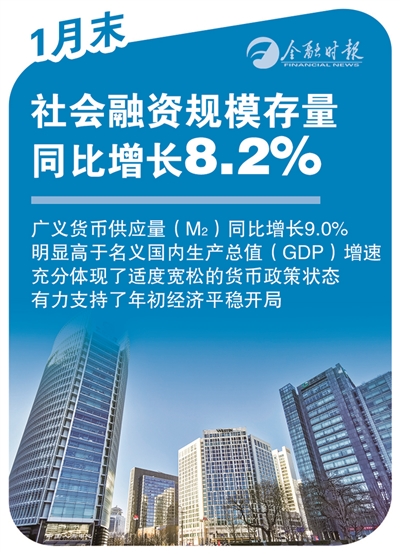
Core Viewpoint - The latest financial statistics released by the central bank indicate that the growth rates of M2 and social financing remain high, creating a favorable monetary environment for economic recovery [1][3]. Monetary Policy and Financing Growth - As of the end of January, the stock of social financing increased by 8.2% year-on-year, while M2 grew by 9.0%, significantly outpacing nominal GDP growth, reflecting a moderately loose monetary policy [3][4]. - The proactive macroeconomic policies, including a reduction in the structural tool interest rate by 0.25 percentage points and increased government bond financing, are key drivers of this growth [3][4]. - In January, government bond financing reached 976.4 billion yuan, an increase of 283.1 billion yuan compared to the same period last year, with its share in total social financing at 13.5%, the highest since 2021 [3][4]. Direct Financing Channels - Besides government bonds, corporate bonds and equity financing are also accelerating, with a focus on providing diversified funding support for high-tech and emerging industries [4][5]. - Companies are increasingly considering a "short loan + long bond" financing model to balance funding costs and durations for project investments and R&D [4]. Credit Growth and Demand Recovery - By the end of January, the balance of RMB loans was 276.62 trillion yuan, growing by 6.1% year-on-year, which is still above nominal economic growth [6][7]. - The first quarter typically sees high credit issuance, and early policy implementation can yield quicker results [6]. - Major projects are driving increased project loan disbursements, with the National Development and Reform Commission announcing a total investment of approximately 295 billion yuan for early construction projects [6]. Support for the Real Economy - In January, new loans to enterprises reached 4.45 trillion yuan, with over 70% being medium- and long-term loans, providing substantial support for manufacturing and emerging industries [7][8]. - Personal loans are also experiencing stable growth due to increased consumer spending ahead of the holiday season, supported by favorable policies extending personal consumption loan interest subsidies [7][8]. High-Quality Development Financing - The growth of inclusive small and micro loans reached 37.16 trillion yuan, with a year-on-year increase of 11.6%, indicating a shift of credit resources towards high-quality development sectors [8][9]. - The central bank's structural monetary policy tools, such as re-loans, are effectively supporting consumption and innovation, with significant increases in funding for small and medium-sized enterprises [9][10]. Future Monetary Policy Focus - Experts suggest that future monetary policy should emphasize structural optimization, as the economy transitions to medium-high growth and faces challenges such as high household leverage and bank asset quality [10].

浙江两会,频提AI
Xin Lang Cai Jing· 2026-01-18 03:00
Core Insights - Artificial intelligence (AI) is a focal point in the Zhejiang provincial government work report, highlighting its strategic importance for future development [2][3][9] - The report emphasizes the urgency and long-term commitment of Zhejiang to establish itself as a hub for AI innovation and development [2][6] Group 1: Government Initiatives and Goals - The Zhejiang provincial government aims to create an "AI innovation development highland" as part of its key work for the 14th Five-Year Plan and specifically for 2026 [2][9] - The government plans to enhance AI industry levels as part of the broader strategy to build the Shanghai (Yangtze River Delta) international technology innovation center [5] - By 2025, the core AI industry in Zhejiang is projected to generate approximately 680 billion yuan, with a growth rate exceeding 20% [7] Group 2: Competitive Landscape - The report cites a competitive landscape for AI development in China, with leading provinces including Beijing, Guangdong, Shanghai, Zhejiang, and Jiangsu [2][3] - Other provinces, such as Beijing and Jiangsu, are also ramping up their AI initiatives, indicating a race to leverage AI as a key driver for future growth [3] Group 3: Innovation and Ecosystem Development - Zhejiang has established a robust ecosystem for AI innovation, with significant contributions from various entities, including Alibaba Cloud and the Zhijiang Laboratory [7][8] - The province is focusing on creating a favorable environment for AI applications, particularly through its large number of small and medium-sized tech enterprises [8] Group 4: Strategic Recommendations and Future Directions - Suggestions from local representatives include accelerating the development of humanoid robots and establishing high-quality multimodal datasets for AI training [10] - The government is urged to implement systematic projects to ensure a continuous supply of high-quality data resources for the AI industry [10]

科创金融的浙江样板
Cai Jing Wang· 2025-12-26 04:50
Group 1 - The core viewpoint emphasizes the importance of integrating technology and finance to enhance productivity and achieve high-quality development, as highlighted in the "14th Five-Year Plan" [1] - Zhejiang province is positioned as a strategic hub in the Yangtze River Delta, fostering a vibrant environment for private enterprises and tech innovation [1] - The banking sector plays a crucial role in developing "tech finance," with various banks in Zhejiang implementing innovative financing solutions tailored to the needs of tech enterprises [2][3] Group 2 - The central financial work conference identified "tech finance" as a priority, aiming to create a virtuous cycle among technology, industry, and finance [2] - Financial institutions are restructuring their service logic to better support tech enterprises characterized by light assets and long cycles, focusing on talent value and intellectual property [2][3] - Zhejiang banks have developed a comprehensive service system covering the entire lifecycle of tech enterprises, offering differentiated products based on the specific needs of companies at various stages [4] Group 3 - Innovative financing solutions, such as intellectual property pledge loans, have been introduced to support tech companies like Zhejiang Deshman Technology, which has over 200 patents and is expanding rapidly [3] - Banks in Zhejiang are creating diverse product matrices and service systems to support tech enterprises through different growth phases, including specialized loans for various stages of development [4][11] - The collaboration between banks and local governments is essential for building a supportive ecosystem for tech finance, as seen in the strategic partnerships formed in regions like Jiaxing [12][10] Group 4 - Banks are enhancing their internal capabilities to better serve tech enterprises, developing proprietary evaluation models to assess the future value of companies [5][13] - The establishment of a comprehensive tech finance service network by banks, including specialized branches and dedicated teams, is aimed at improving service efficiency and coverage [14][15] - Collaborative efforts among banks and other stakeholders are being made to address the financing challenges faced by small and micro tech enterprises, ensuring a more inclusive financial environment [15][16]



中行浙江省分行一案例获评2025年金融服务实体经济高质量发展优秀案例
Zhong Guo Jin Rong Xin Xi Wang· 2025-12-18 13:28
Core Viewpoint - The Bank of China Zhejiang Branch's case "Empowering New Quality Productivity Industry Development through Financial Technology" has been recognized as an excellent example for high-quality financial services supporting the real economy, showcasing its innovative capabilities and commitment to regional development [1][3]. Group 1: Innovation and Service Model - The Bank of China Zhejiang Branch established a Technology Financial Center in July 2024, focusing on the "415X" advanced manufacturing cluster and "315" innovation system in Zhejiang Province [1]. - The branch collaborated with Zhejiang University to launch the Zhejiang New Quality Productivity Industry Index, creating a comprehensive indicator system covering 11 cities and 90 counties, marking a pioneering effort in using index tools for regional industrial upgrades [1][2]. Group 2: Financial Products and Support - The branch developed a full lifecycle financial service model for technology enterprises, addressing their financing challenges with tailored products like "New Quality Loan," which has a loan balance of 9.808 billion and serves 1,492 technology clients [2]. - By the end of November, the branch had provided credit support to over 7,000 technology enterprises, with a total credit balance exceeding 170 billion, positioning itself as a leader in supporting strategic emerging industries in the region [2]. Group 3: Recognition and Future Commitment - The recognition of the case reflects the Bank of China Zhejiang Branch's effective innovation in technology finance and its role in fostering a positive cycle among technology, industry, and finance [3]. - The branch aims to continue enhancing its technology financial services and innovative product offerings to contribute significantly to Zhejiang's advancement in the context of China's modernization journey [3].

五年新坐标|多措并举 助力打造科技创新 “硬实力”
Zhong Guo Xin Wen Wang· 2025-12-10 13:53
Core Insights - The article emphasizes the commitment of the Bank of China to enhance financial support for technological innovation during the 14th Five-Year Plan period, aiming to foster new momentum and advantages in the economy [1] Group 1: Financial Support for Technology Innovation - As of September 2025, the Bank of China's technology loan balance reached 4.7 trillion yuan, with 166,000 credit accounts established, and a cumulative supply of comprehensive services exceeding 830 billion yuan [1] - The establishment of a multi-level organizational system for technology finance, including a central technology finance center and 317 specialized outlets, aims to respond quickly to market demands [2] Group 2: Focus on Emerging Industries - The Bank of China has launched an action plan to support the development of the artificial intelligence industry chain, collaborating with over 2,300 core enterprises in this sector and providing a credit balance of approximately 410 billion yuan [2] - The introduction of the "bond-loan linkage" model and the "Zhongyin Sci-Tech Computing Loan" service in major innovation hubs like Beijing, Shanghai, and Shenzhen has facilitated connections with 773 supply-demand enterprises in the computing sector [2] Group 3: Product and Service Innovation - The Bank of China has innovated financial products to meet the diverse needs of technology enterprises, achieving multiple market firsts, including the launch of a stock repurchase loan policy and the issuance of 200 billion yuan in technology innovation bonds [3] - The "Innovation Credit Loan" has been developed to assess enterprise credit levels and growth potential, enhancing the credit service experience for small and micro technology enterprises [3] Group 4: Building a Financial Ecosystem - The "Zhongyin Sci-Tech Ecological Partner Program" aims to create a collaborative platform for technology innovation, injecting "patient capital" into the primary market for technology [4] - The establishment of 16 AIC equity investment funds, with a total subscription of 11.76 billion yuan, has facilitated investments in sectors such as commercial aerospace and artificial intelligence [4] - The Bank of China plans to continue enhancing its financial services for technology innovation, utilizing various financial tools to support major national technology tasks and small and medium-sized technology enterprises [4]

激活金融赋能新质生产力内生动力
Zhong Guo Jing Ying Bao· 2025-12-10 11:14
Core Viewpoint - Financial institutions must adapt deeply and effectively to drive technological innovation, which is crucial for promoting high-quality economic development in the context of the "14th Five-Year Plan" [1] Group 1: Construction of "Patient Capital" New Paradigm - The cultivation of new productive forces has long cycles and high uncertainty, differing from traditional finance's focus on safety, liquidity, and profitability [2] - To build "patient capital," banks should implement five major transformations: 1. Shift in operational philosophy to become a supportive financial service provider [2] 2. Transformation of product services to cover the entire lifecycle of technology enterprises [2] 3. Change in target clientele to include potential high-tech companies beyond established firms [2] 4. Transition in revenue models towards diversified structures [2] 5. Collaboration shift from isolated efforts to multi-party cooperation [2] Group 2: Internal Mechanism Adjustments - The bank has established a technology finance task force led by the president to strategically position itself in key areas [3] - Key measures include incorporating technology finance credit indicators into the assessment system and creating a supportive environment for lending [3] - Long-term assessment cycles for technology finance business are emphasized to encourage internal motivation [3] Group 3: Innovative Products and Service Ecosystem - The introduction of the "New Quality Loan" product signifies a fundamental shift in evaluation logic, focusing on future potential rather than traditional financial metrics [4] - The bank is exploring innovative products like "Equity Option Loans" to align with the characteristics of technology enterprises [4] - A comprehensive service ecosystem is being developed to support companies throughout their lifecycle, including risk-sharing loans for startups and one-stop financing services for growing firms [4] Group 4: Early Identification of Core Clients - The bank has created a proactive "scout" mechanism to identify future core clients early [5] - Establishing specialized industry teams and technology finance centers in key regions enhances early engagement with potential clients [5] - Collaboration with local government initiatives and industry funds is aimed at building a supportive ecosystem for early-stage technology enterprises [5] Group 5: Risk Management Enhancements - The bank is leveraging technology to enhance risk identification and pricing capabilities through a multi-dimensional assessment approach [6] - The risk management philosophy has evolved from traditional financial analysis to a dynamic evaluation model incorporating technology, industry, and policy factors [6] - The bank aims to integrate various financial services into its development strategy to support the growth of new productive forces [6]
锚定“十五五”蓝图 哈尔滨银行金融赋能龙江振兴
Zhong Guo Jin Rong Xin Xi Wang· 2025-12-02 01:49
Core Insights - Harbin Bank is actively integrating into local strategies through three main initiatives: empowering industrial upgrades, deepening rural revitalization, and extending inclusive finance, injecting financial momentum into the comprehensive revitalization of Heilongjiang Province [1][2] Group 1: Financial Performance and Services - As of now, Harbin Bank's green loan balance is nearly 20 billion, agricultural loan balance is 26.59 billion, and inclusive loans for small and micro enterprises exceed 41.1 billion, showcasing effective financial service metrics [1] - The bank has launched "Agricultural Property Rights Financing Loans" and "Black Soil Quality Products Loans," with the latter contributing over 170 million to agricultural brand development [2] - The average pricing for loans through the digital product "Money to Home" has decreased by 0.5 percentage points, with a growth rate of 11.69% [2] Group 2: Strategic Focus and Future Plans - Harbin Bank aims to deepen reform and transformation, focusing on technology finance, green finance, and inclusive finance, to optimize the precision of financial supply [4] - The bank's strategy aligns with Heilongjiang's "Three Bases, One Barrier, One High Ground" positioning and the "4567" modern industrial system construction needs [1] - The bank is committed to supporting the real economy, particularly in high value-added industrial chains and innovative enterprises, with a focus on long-term loan supply [1]
锚定十五五新蓝图 哈尔滨银行以金融力量助力龙江经济高质量发展
智通财经网· 2025-11-29 01:30
Core Viewpoint - The article emphasizes the strategic initiatives of Harbin Bank in alignment with the "14th Five-Year Plan" of Heilongjiang Province, focusing on supporting the real economy, rural revitalization, and green finance to foster high-quality development. Group 1: Economic Development and Industry Support - Harbin Bank prioritizes serving the real economy, increasing credit support for key sectors as outlined in the provincial plan, particularly in manufacturing upgrades [1] - The bank aims to enhance the supply of medium to long-term loans to high-value enterprises in the manufacturing sector, facilitating structural optimization [1] Group 2: Innovation in Technology Financing - The bank addresses the financing challenges faced by tech enterprises by innovating financial products and mechanisms, including the launch of the "New Quality Loan" [2] - As of now, the "New Quality Loan" has a disbursement amount of 115 million yuan, utilizing a scoring card system to evaluate innovation capabilities [2] Group 3: Green Finance Initiatives - Harbin Bank integrates green principles into its operations, establishing a comprehensive green finance service system and promoting sustainable development-linked loans [3] - The bank's green loan balance is nearly 20 billion yuan, contributing to a carbon reduction of 69,000 tons annually in Heilongjiang Province [3] Group 4: Rural Revitalization Efforts - The bank plays a crucial role in rural revitalization, offering a range of financial products tailored to agricultural needs, with a total agricultural loan balance of 26.59 billion yuan [4] - Innovative products like the "Agricultural Property Financing Loan" and "Black Soil Quality Products Loan" have been introduced to support agricultural development [4] Group 5: Inclusive Finance and Social Welfare - Harbin Bank focuses on inclusive finance, enhancing services for small and micro enterprises, with a loan balance of 41.187 billion yuan and a growth rate of 11.69% [5] - The bank has developed a digital product "Money to Home" to streamline lending processes for small businesses [5] Group 6: Retail Financial Services - The bank is transforming its retail financial services through an integrated online and offline approach, serving over 15.08 million retail customers [6] - Specialized services for different demographics, such as the elderly and children, are being enhanced to improve customer satisfaction [6] Group 7: Future Strategic Directions - Moving forward, Harbin Bank aims to continue aligning with national and provincial goals, focusing on breakthroughs in technology finance, green finance, and digital finance to support the modernization of the industrial system [8]
上海科创专项信贷产品创新清单不断拉长
Xin Hua Cai Jing· 2025-11-19 05:30
Core Viewpoint - Shanghai's banking sector is continuously innovating its special credit products to better meet the financing needs of technology enterprises, with a focus on intellectual property pledge financing and supportive policies to maximize patent resource value [1][2]. Group 1: Financing Innovations - Shanghai has introduced various special credit products such as "Science and Technology Innovation Assistance Loan" and "New Quality Loan" to address the financing challenges faced by technology companies [1]. - The city has seen a significant increase in intellectual property pledge financing, with 2,223 registrations and a total scale of 32 billion yuan in 2024, representing year-on-year growth of 62.3% and 40.6% respectively [1]. Group 2: Ecosystem Development - The Shanghai Zhujiao High-tech Zone has developed into a "billion-yuan park," generating over 10 billion yuan in fiscal revenue for three consecutive years, and is home to numerous industry leaders and a vibrant knowledge innovation community [1][2]. - The Zhujiao High-tech Zone has established a comprehensive support system for technology finance, including a "platform + service + ecosystem" model, which has facilitated over 3 billion yuan in credit financing and 30 billion yuan in equity financing for enterprises [2]. Group 3: Financial Advisory and Support - The establishment of a financial advisory system covering all 16 districts in Shanghai aims to provide precise financial service recommendations to enterprises through high-level expert advisors [3]. - Financial advisors from various institutions are engaging with technology enterprises to offer tailored advice on credit loans and risk management strategies, enhancing the financial support for early-stage technology companies [3].
以金融活水精准滴灌科技创新
Jin Rong Shi Bao· 2025-11-11 02:11
Core Insights - China Bank's Zhejiang branch focuses on nurturing new productive forces by investing in early-stage, small, long-term, and hard technology projects to support technological innovation with financial resources [1] Group 1: Financial Support for Technology Companies - China Bank's Hangzhou branch provided 45 million yuan in pure credit to five companies under Xingyao Holding Group, a leading domestic unmanned helicopter manufacturer, to support its technological innovation and global strategy [2] - Xingyao Holding Group has a smart manufacturing base of 330,000 square meters and an annual production capacity of 1,800 units, with over 320 core invention patents and 400 software copyrights [2] - The bank's quick response allowed for approval and disbursement within one day, significantly accelerating the R&D process for Xingyao Group's next-generation unmanned helicopters, which are set to achieve international leading levels in key performance indicators [3] Group 2: Support for Integrated Circuit Industry - A technology company in Jinhua, Zhejiang, specializing in memory chip design and AI computing solutions, has been recognized as a national high-tech enterprise and a "little giant" enterprise by the Ministry of Industry and Information Technology [4] - China Bank's Jinhua branch has been a financial partner since 2021, providing 8 million yuan in credit support to help the company expand its chip production capacity and accelerate technological iteration [4] - As the company prepares for an IPO in 2025, China Bank is developing a comprehensive financial plan to support its funding needs, including 100 million yuan in credit support for R&D and operational stability [5] Group 3: Overall Impact on the Industry - The technology company has become a significant player in the domestic memory chip design sector, contributing to the high-quality development of Zhejiang's integrated circuit industry [6]