众擎机器人

Search documents
具身智能产业深度研究(七):新一代“蓝领”:人形机器人如何站上工厂流水线
Haitong Securities· 2025-12-17 06:28
Investment Rating - The report does not explicitly state an investment rating for the industry Core Insights - In industrial scenarios, humanoid robots are primarily suited for handling and quality inspection tasks, with a focus on ROI and the potential for expansion into more processes as their generalization capabilities improve [1][10][11] - The market demand for humanoid robots in China's industrial sectors, including automotive manufacturing, electronics manufacturing, and logistics warehousing, is projected to reach 484,000 units by 2035, with a market space exceeding 48 billion yuan [4][12] Summary by Sections 1. Core Insights - Humanoid robots are best suited for handling and quality inspection tasks, gradually expanding into basic assembly tasks as their capabilities develop [3][11] - The commercial viability hinges on achieving a return on investment (ROI) within two years, necessitating a reduction in robot prices to around 100,000 yuan and efficiency improvements to match human performance [3][11] 2. Industrial Manufacturing Flexibility - The demand for flexibility in manufacturing is increasing, with humanoid robots starting from short-chain tasks and gradually taking on more complex tasks [2][16] - Humanoid robots complement industrial robots, adapting to flexible production needs and enhancing operational efficiency [2][17] 3. Market Potential - The total demand for humanoid robots in the industrial sector is expected to reach 484,000 units by 2035, with a market potential of 48.36 billion yuan [4][12] - Collaboration between automotive companies and robotics firms is crucial for the deployment of humanoid robots in industrial settings, with companies like Tesla and XPeng leading the way [4][12]


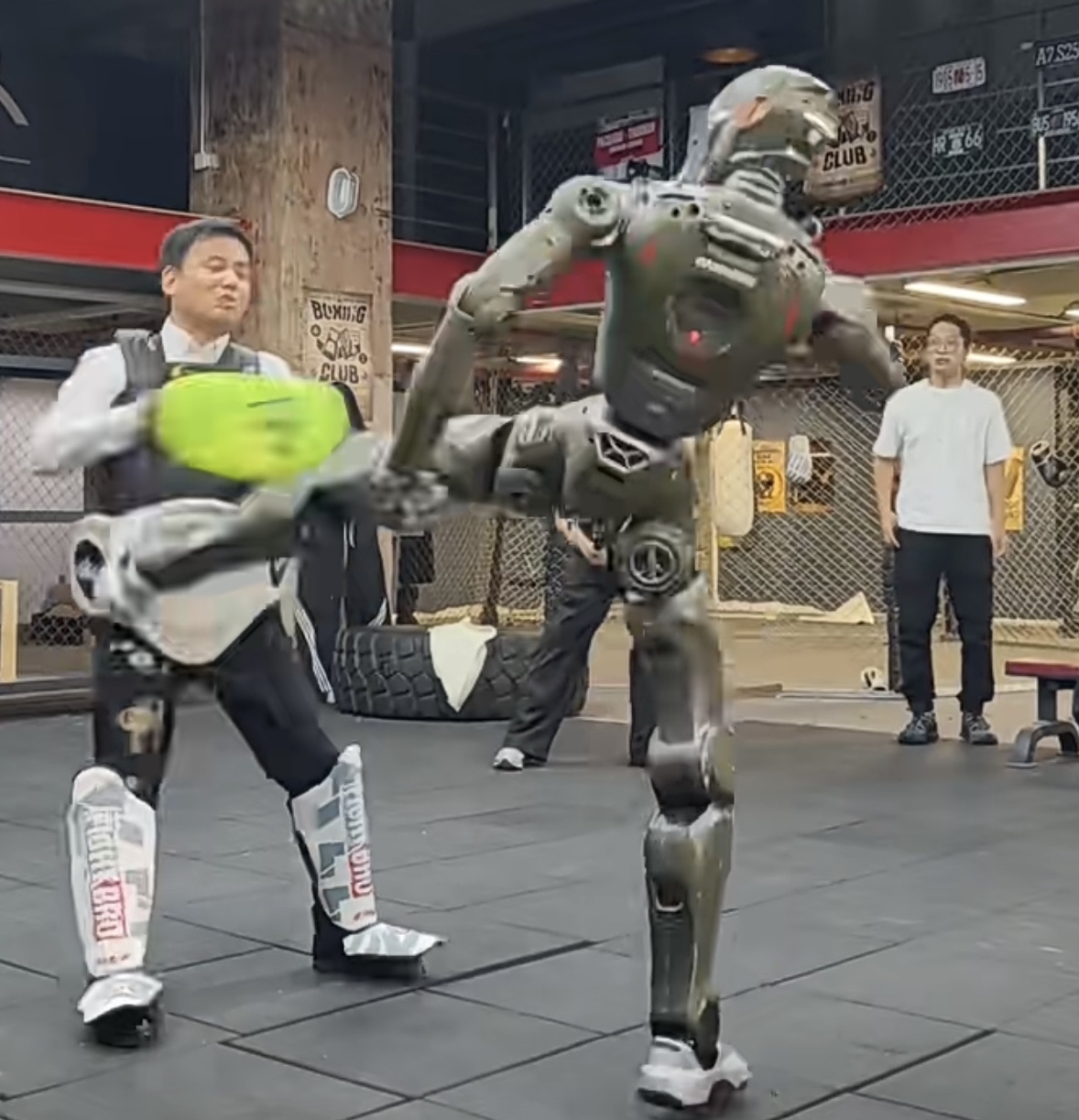
机器人安全“千疮百孔”?黑客一小时攻破,失控可能挥拳伤人
第一财经· 2025-12-16 09:29
Core Viewpoint - The article highlights significant security vulnerabilities in robotic systems, emphasizing the need for improved safety measures as robots increasingly enter public spaces [3][4][5]. Group 1: Security Vulnerabilities - The current state of robot security is described as "full of holes," with researchers easily finding and exploiting vulnerabilities in various robotic products [4]. - A specific example includes a team discovering a low-level security issue in a quadruped robot within just one hour, indicating widespread security flaws across the industry [4]. - The process of compromising a robot's control is described as multi-phased, starting with unauthorized remote access, which can lead to potentially harmful actions by the robot [4][5]. Group 2: Industry Response and Developments - Companies like Yushun Technology are reportedly taking steps to address security issues by establishing dedicated departments for safety [7]. - The article notes that as robots are increasingly deployed in public settings, the discussion around safety will shift from technical debates to real-world challenges [8]. - Recent data indicates that in 2024, approximately 80% of Yushun's quadruped robots were used in research, education, and consumer sectors, highlighting the current focus of the industry [5]. Group 3: Market Trends and Deliveries - The article mentions that by the end of 2025, the focus will shift to the number of orders delivered in the industry, with companies like UBTECH and ZhiYuan Robotics reporting significant production milestones [8]. - UBTECH anticipates delivering around 500 industrial humanoid robots in 2025, with a total capacity of 1,000 units [8]. - ZhiYuan Robotics has completed the mass production delivery of its 5,000th robot, indicating a growing market presence [8].


人形火爆:15天融资超20亿
Sou Hu Cai Jing· 2025-12-16 08:50
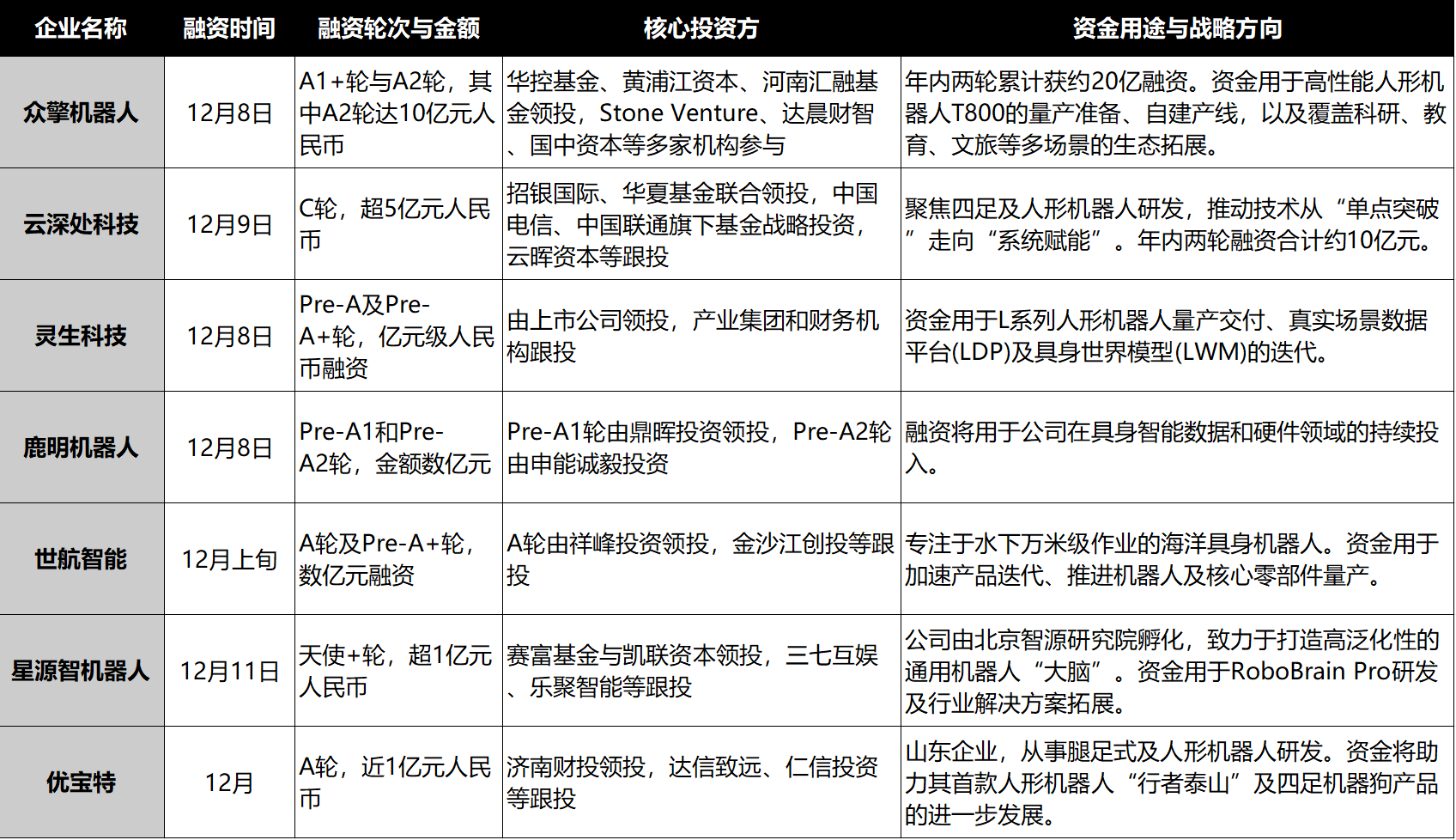
Core Insights - The human-shaped robot and embodied intelligence industry in China experienced a significant surge in financing in December 2025, marking a strong start to what is recognized as a "capital year" [1] - The financing activities showcased a trend of "multiple blooming, rising scale, and strategic differentiation," indicating a robust investment landscape driven by policy support [1] Financing Events Summary - **Zhongjing Robot**: On December 8, raised 1 billion RMB in A1+ and A2 rounds led by Huakong Fund and Huangpujiang Capital, with participation from multiple institutions [1] - **Yunshen Technology**: On December 9, secured over 500 million RMB in C round financing, with strategic investments from China Telecom and China Unicom [1] - **Ling Sheng Technology**: On December 8, completed A+ round financing in the range of 100 million RMB [1] - **Luming Robot**: On December 8, raised several hundred million RMB in Pre-A1 and Pre-A2 rounds [1] - **Shihang Intelligent**: Early December, raised several hundred million RMB in A and Pre-A+ rounds [1] - **Xingyuan Intelligent Robot**: On December 11, secured over 100 million RMB in angel+ round financing [1] - **Yobote**: Raised nearly 100 million RMB in A round financing in December [1] Capital Trends - Capital is shifting from general exploration to heavy bets on leading potential companies, as evidenced by Zhongjing Robot's rapid acquisition of 1 billion RMB in funding [2] - The investment landscape includes a mix of national funds, local state-owned capital, industrial capital, and overseas investors, providing substantial financial backing for companies transitioning from R&D to mass production [2] - The involvement of major telecommunications companies in financing indicates a strategic interest in positioning human-shaped robots as future mobile 5G/6G network terminals [2] Strategic Pathways - The industry is witnessing a bifurcation in core competitive dimensions, with "hardware performance" and "general intelligence" approaches emerging [4] - Companies like Zhongjing Robot focus on enhancing physical capabilities and reliable hardware, while others like Ling Sheng Technology aim to develop universal intelligent platforms [4][5] - This strategic differentiation reflects a consensus that the "brain" of robots may hold greater long-term value than the hardware itself [4] Commercialization Insights - A cautious yet confident approach to commercialization is being adopted, emphasizing product stability and scene adaptability [5] - Companies are increasingly focusing on specific scenarios with clear economic models, as demonstrated by Shihang Intelligent's underwater robots providing immediate economic benefits [6] Policy and Ecosystem - Strong policy support is driving capital activities, with the "14th Five-Year Plan" identifying embodied intelligence as a new economic growth point [7] - Local governments are actively promoting action plans to build a comprehensive industry ecosystem, which is crucial for attracting diverse capital [7] Future Challenges - The financing wave in December 2025 solidified the position of human-shaped robots as a top-tier sector, but the industry faces significant challenges ahead [8] - Key factors for success will include production and delivery capabilities, product reliability in complex environments, and the efficient collaboration between the "brain" and "body" of robots [8][9][10]
机器人安全“千疮百孔”?黑客一小时攻破,失控可能挥拳伤人
Di Yi Cai Jing· 2025-12-16 07:33
Core Viewpoint - The current state of humanoid robots is characterized by significant security vulnerabilities, with many still considered "in development" rather than fully secure end products [1][5][6]. Group 1: Security Vulnerabilities - The security of robots is described as "full of holes," with researchers easily finding vulnerabilities in various robotic products, including those from leading brands [2]. - A specific example includes a team discovering a low-level security issue in a quadruped robot within just one hour of testing [2]. - The process of compromising a robot's security involves multiple stages, starting with unauthorized remote control, which can lead to executing harmful actions not intended by the manufacturer [2][5]. Group 2: Industry Response and Development - Companies like Yushun Technology have been informed of security vulnerabilities and have taken steps to address them, including establishing dedicated departments for security [6]. - The majority of current robotic products are aimed at research and education, with about 80% of Yushun's products in these sectors, which often retain developer interfaces that can pose security risks [5][6]. - As robots increasingly enter public spaces, the potential for security issues to manifest in real-world harm becomes a pressing concern for the industry [7]. Group 3: Market Trends and Future Outlook - The delivery of industrial humanoid robots is projected to reach approximately 500 units in 2025, with total production capacity expected to hit 1,000 units [7]. - Companies like ZhiYuan Robotics have successfully completed the mass production of their 5,000th robot, indicating a growing market presence [7]. - The transition of security discussions from technical aspects to real-world implications is anticipated as robots become more integrated into everyday environments [7].

中国人形机器人登陆日本
3 6 Ke· 2025-12-16 04:50
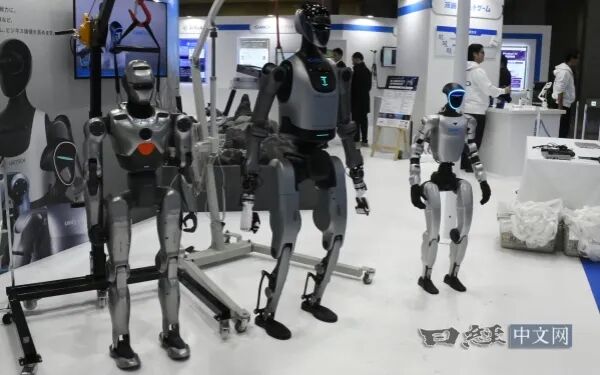
Group 1 - Japan's humanoid robot industry is experiencing significant changes, with Chinese and American companies leading in development, while Japan's presence is currently weak [2][11][12] - The market for humanoid robots is projected to reach $5 trillion by 2050, with over 1 billion humanoid robots expected to be in operation globally [8][11] - The introduction of humanoid robots at the 2025 International Robot Exhibition, including models like the G1 from Chinese company Yushu Technology, highlights the growing competition [4][6] Group 2 - Japanese companies, such as GMO Internet Group, are actively seeking to introduce humanoid robots, but currently, only Chinese products are available for mass production and sale [7][12] - The development of humanoid robots is being driven by advancements in artificial intelligence, which are redefining robots as the "body" of AI [8][11] - Japan is advised to focus on its strengths, such as addressing domestic needs in elder care, rather than directly competing with China and the U.S. in humanoid robot development [12]
机器人融资热潮周:一周14家企业密集融资,总金额预计达40~70亿元
Sou Hu Cai Jing· 2025-12-16 03:20
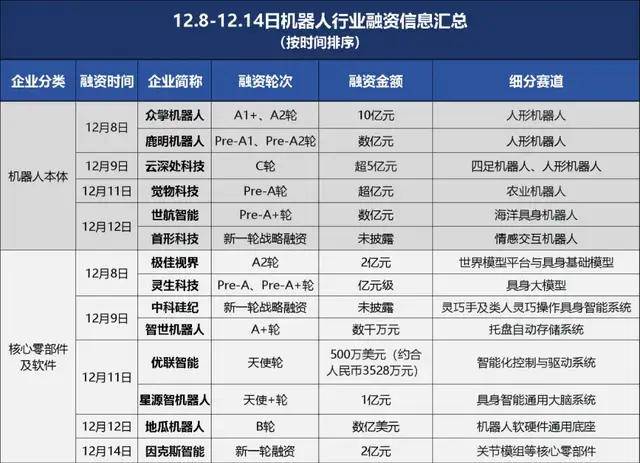
上周(12.8-12.14)机器人行业陷入融资热潮。《智能新观察》基于公开信息的不完全统计,梳理出12 月8日-12月14日机器人行业的融资消息汇总。短短一周内,共有14家企业获得资本加持,总披露融资金 额预计在40~70亿元。 从企业构成看,14家企业既有机器人本体企业,也包括机器人核心零部件技术企业。涉及的机器人类型 涵盖人形机器人、四足机器人、农业机器人、海洋机器人等多个细分领域。显示出资本市场对机器人赛 道的高度关注,更揭示出产业正在加速迈向规模化商业落地。 | | | | 12.8-12.14日机器人行业融资信息汇总 | | | | --- | --- | --- | --- | --- | --- | | | | | | (按时间排序) | | | 在北分类 | 融资时间 | 企业简称 | 融资轮次 | 融资金额 | 细分害道 | | 机器人本体 | 12月8日 | 众學机器人 | A1+、A2轮 | 10亿元 | 人形机器人 | | | | 鹿明机器人 | Pre-A1, Pre-A242 | 数亿元 | 人形机器人 | | | 12月9日 | 云深处科技 | C轮 | 超5亿元 | 四足机器人 ...
中国人形机器人登陆日本
日经中文网· 2025-12-16 02:54
Core Viewpoint - The competition in humanoid robot development is shifting, with Chinese and American companies taking the lead, while Japan's presence is diminishing in this sector [2][15]. Group 1: Market Dynamics - The humanoid robot market is projected to reach $5 trillion by 2050, with over 1 billion humanoid robots expected to be in operation globally [11]. - The industry is redefining robots as the "body" of AI, indicating a significant shift in their role and application [11]. - Chinese companies are advancing through national strategies and a focus on domestic production of key components, while American firms are entering practical application stages [13]. Group 2: Key Players - Major Chinese companies in humanoid robotics include UTree Technology, UBTECH Robotics, and Zhongqing Robotics [14]. - Notable American companies include Agility Robotics, Tesla, and Boston Dynamics [14]. - Japanese companies, such as Kawasaki Heavy Industries, have a weaker presence in humanoid robotics compared to their industrial robot offerings [15]. Group 3: Technological Advancements - The G1 humanoid robot developed by UTree Technology can assist customers in cafes by taking orders and delivering food, showcasing advanced mobility and interaction capabilities [6]. - The Walker E robot from UBTECH can carry loads of up to 30 kg, indicating its potential use in factories and warehouses [8]. Group 4: Strategic Insights - Japanese companies are encouraged to leverage their strengths in addressing domestic needs, such as elderly care, rather than directly competing with China and the U.S. [15]. - The application of humanoid robots extends beyond manufacturing and logistics to include disaster response and service scenarios, highlighting their versatility [15].

临近年关,机器人行业展望2026年
Xin Lang Cai Jing· 2025-12-15 09:56
Core Insights - The robotics industry continues to thrive, with significant product launches and advancements in technology, as seen with the introduction of the ZHONGQING T800 and the launch of the 5000th Lingxi X2 robot by ZhiYuan Robotics [1][2] Group 1: Commercialization Progress - The robotics sector has seen a surge in investment and financing, with companies not lacking in capital as they transition from rapid growth to a more stable market environment [2] - In 2025, leading companies like Yushutech and UBTECH achieved impressive commercial results, with Yushutech securing nearly 1.2 billion yuan in orders and UBTECH exceeding 800 million yuan [3] - Different companies are adopting varied commercialization strategies, such as UBTECH's "strong alliances" approach, which focuses on partnerships with major manufacturers to enhance industrial applications [3][4] Group 2: Production Capacity - The ability to scale production is crucial for sustaining order fulfillment and generating repeat business, with companies needing to demonstrate reliable and cost-effective manufacturing capabilities [6] - UBTECH exemplifies a collaborative production path by partnering with automotive giants to validate their robots in real-world scenarios, thus refining their production standards [8][9] - ZhiYuan Robotics has shifted to a hybrid production model, combining in-house manufacturing with certified outsourcing to enhance production efficiency [10] Group 3: Diverse Application Scenarios - The industry is expected to focus on diversifying application scenarios, with industrial robots needing to meet high standards of endurance, precision, and stability [11] - In retail, smaller companies will increasingly adopt robots, emphasizing cost-effectiveness and user experience as key factors for market penetration [12] - The household robotics market is gradually expanding, with safety and interaction capabilities becoming essential, while companies aim to enhance public awareness of household robots' functionalities [12]
人形机器人产业周报:智元机器人实现5000台量产规模,众擎机器人完成A1+轮与A2轮融资-20251215
Guoyuan Securities· 2025-12-15 06:30
[Table_Main] 行业研究|工业 证券研究报告 产品技术迭代方面,优必选斩获 AI 大模型公司超 0.5 亿人形机器人 订单,产品以全球首款自主换电的工业人形机器人 Walker S2 为主, 将在今年内完成交付;智元机器人实现 5000 台量产规模,预计明年将 至万台;迦智科技与浙江人形机器人创新中心联合发布两款轮臂人形 机器人。 工业行业周报、月报 2025 年 12 月 15 日 [Table_Title] 智元机器人实现 5000 台量产规模, 众擎机器人完成 A1+轮与 A2 轮融资 [Table_Summary] 报告要点: 周度行情回顾 2025 年 12 月 7 日至 12 月 12 日,人形机器人概念指数下跌 0.19%, 相较沪深 300 指数跑输 0.11pct;年初至今累计涨跌幅来看,人形机 器人概念指数上涨 67.40%,相较沪深 300 指数跑赢 47.49pct。 A 股人形机器人指数(iFinD 概念)相关个股中,超捷股份周涨幅 最大(+39.03%),睿能科技周跌幅最大(-13.78%)。 周度热点回顾 政策端,12 月 11 日,北京人形机器人创新中心发布全国首个全 ...



汽车行业周报-20251214
Huaxin Securities· 2025-12-14 14:01
Investment Rating - The report maintains a "Recommended" investment rating for the automotive industry and humanoid robotics sector [2][4][6]. Core Insights - The humanoid robotics sector is expected to reach a pivotal point in the next one to two years, with significant advancements anticipated in the field of embodied intelligence [3][4]. - The automotive industry has achieved record monthly production and sales figures, with a notable increase in the production of new energy vehicles [5][6]. Summary by Sections Humanoid Robotics Sector - The Huaxin humanoid robotics index decreased by 0.94% this week, but has a cumulative return of 94.3% year-to-date [16]. - The sensor segment within the humanoid robotics sector showed positive performance, increasing by 1.1%, while other segments like actuators and reducers experienced declines [19]. - Key companies in the robotics sector, such as Zhongjian Technology and Zhongding Shares, saw significant stock price increases [24]. Automotive Sector - The CITIC automotive index rose by 0.1%, outperforming the broader market by 0.2% [32]. - The motorcycle and other segments within the automotive sector performed well, with a 1.6% increase, while automotive sales and services dropped by 3.5% [35]. - The automotive industry's PE ratio is at 31.8, placing it in the 36.4% percentile over the past four years, indicating a relatively stable valuation [48]. Key Companies and Profit Forecasts - Recommended companies include: - New Spring Co., Ltd. (EPS: 0.68, PE: 16.22, Rating: Buy) [8] - Shuanglin Co., Ltd. (EPS: 1.24, PE: 30.45, Rating: Buy) [8] - Jianghuai Automobile (EPS: 0.12, PE: 412.83, Rating: Buy) [8] - Other notable mentions include KaiDi Co., Ltd. and Kete Co., Ltd. [7][10].