
优必选科技

Search documents
优必选再获1.26亿元订单
Bei Ke Cai Jing· 2025-10-19 07:59
Core Insights - UBTECH Robotics, known as the "first humanoid robot stock," has won a significant contract for the procurement and installation of intelligent data collection and testing center equipment in Guangxi, amounting to 126 million yuan [1] - The project involves UBTECH's latest autonomous humanoid robot, Walker S2, which features self-replaceable batteries, with delivery expected to be completed within 2025 after contract signing [1] - This contract follows a record-breaking 250 million yuan order received in September and several other multi-million yuan contracts, marking another major win for UBTECH [1] - To date, the Walker series humanoid robots have secured over 630 million yuan in orders for the year [1]
解锁柔性机器人精准导向能力!加州大学《Sci. Adv.》:LCE材料驱动毫米级软体机器人实现突破性外翻运动
机器人大讲堂· 2025-10-18 08:27
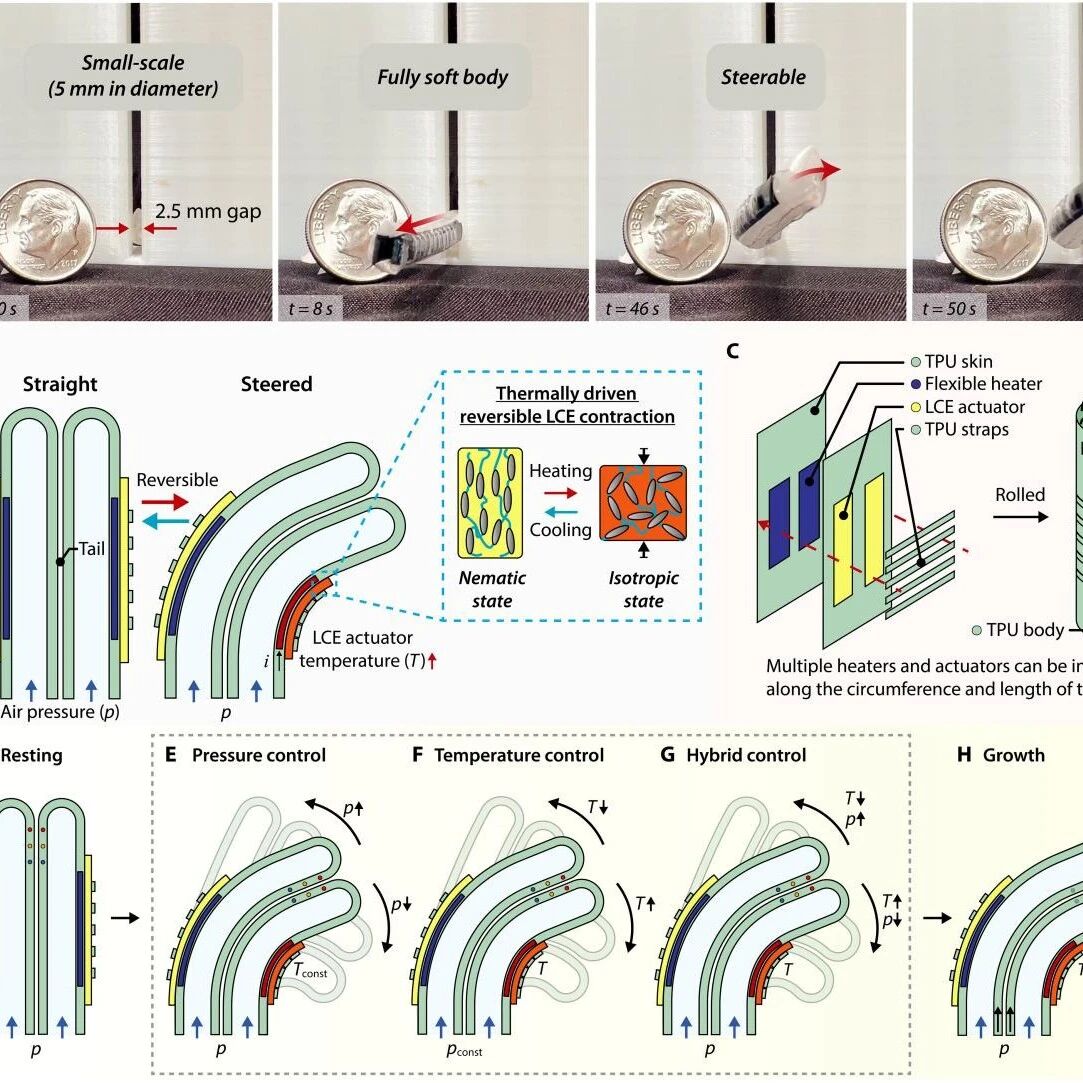
Core Insights - The article discusses the development of a new type of soft robot that utilizes liquid crystal elastomer (LCE) actuators for flexible and steerable movement in constrained environments, particularly in medical and industrial applications [2][3][4]. Group 1: Challenges and Innovations - Traditional continuum robots face challenges in maintaining low environmental interference and high adaptability in tight spaces, such as blood vessels, due to their reliance on rigid structures [1]. - Soft robots inspired by biological movements, particularly the everting robot design, reduce interaction with the environment, minimizing collisions and friction during movement [1]. Group 2: LCE Technology - LCEs combine liquid crystal elements with polymer networks, exhibiting significant temperature-responsive characteristics, allowing for reversible shape changes [3]. - The robot's skin is made from flexible thermoplastic polyurethane (TPU) and incorporates LCE strips and conductive polymer heaters, enabling both protection and actuation [4]. Group 3: Control Mechanisms - The internal air pressure and LCE temperature are identified as key parameters for controlling the robot's bending angles, with pressure adjustments allowing for a bending angle range of 36° to 101° [5][8]. - A hybrid control strategy that adjusts both air pressure and temperature is proposed to enhance the robot's maneuverability and stability [9]. Group 4: Performance Testing - The research team tested prototypes with diameters of 3-7 mm, demonstrating that a 5 mm diameter robot could achieve bending angles exceeding 100° and navigate through narrow gaps effectively [10]. - The robot's performance in traversing a 2.5 mm gap and delivering a catheter in a complex aortic arch model showed a tenfold reduction in force applied to blood vessel walls compared to traditional catheters [12][15]. Group 5: Application Scenarios - The robot's flexible structure and precise steering capabilities have been validated in various scenarios, including industrial inspections and medical procedures, showcasing its potential advantages over traditional rigid instruments [11]. - In jet engine model inspections, the robot demonstrated enhanced coverage and flexibility, achieving a 60% improvement in detection capabilities compared to conventional endoscopes [16].

打破复杂水域探测困境!浙大仿生机器鱼登CELL子刊,双游动模式展现卓越环境适应性,负重54倍稳定前行
机器人大讲堂· 2025-10-16 11:59
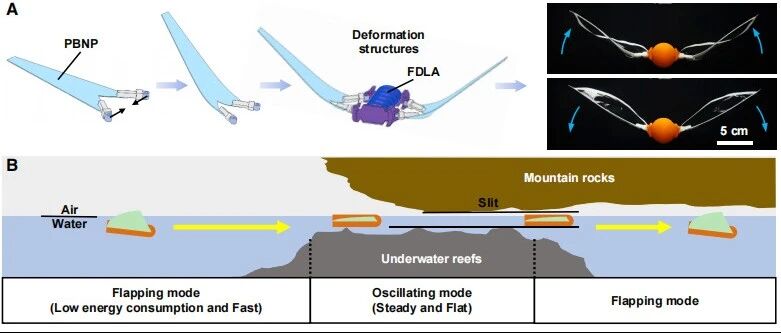
Core Insights - The article discusses the development of a bionic robotic fish by Zhejiang University, which addresses the challenges of underwater exploration and monitoring in complex marine environments [1][3]. Innovation and Design - The robotic fish features a novel drive/deformation system based on a structure called "Post-Buckling Notched Plates" (PBNP), which mimics the pectoral fins of manta rays to convert small linear movements into significant fin flapping [5][7]. - The design allows for controlled and efficient deformation, enabling the robotic fish to navigate both narrow spaces and open waters effectively [1][5]. Performance and Modes - The swimming behavior of the robotic fish is controlled by three parameters: vacuum pressure, frequency, and duty cycle, which influence the fin flapping and overall swimming performance [10][12]. - It operates in two modes: "flapping mode" for rapid propulsion and efficient cruising at low frequencies (0-4 Hz), and "oscillation mode" for stable movement in confined spaces at higher frequencies (above 4 Hz) [12][16]. Environmental Adaptability - The robotic fish demonstrates exceptional adaptability to extreme conditions, functioning in temperatures ranging from 0.6°C to 87.2°C, making it suitable for various marine environments [19][20]. - It can seamlessly switch between modes to navigate through different environmental challenges, such as strong currents and narrow gaps [22][24]. Multi-Functionality - A non-tethered version of the robotic fish integrates multiple functions, including propulsion, monitoring, and communication, into a compact design, enhancing its operational reliability [25][27]. - The system can sample water quality in real-time and distribute substances like feed or water treatment agents during operation, transforming the robotic fish into a mobile workstation for aquaculture and environmental monitoring [27][28]. Future Developments - Future research aims to optimize the fish's shape to reduce hydrodynamic drag and enhance its autonomous navigation capabilities through advanced sensor integration [29].
快讯|云迹科技赴港上市;智元机器人精灵G2首发;优必选再获3200万订单;哈工大博士团队获B+轮融资等
机器人大讲堂· 2025-10-16 11:59
Group 1: Company Listings and Financing - Yunji Technology officially listed on the Hong Kong Stock Exchange, issuing 6.9 million shares at a price of HKD 95.6 per share, raising approximately HKD 590 million (about RMB 541 million) [3] - Since its establishment in 2014, Yunji Technology has completed 8 rounds of financing, with investors including Alibaba, Tencent, and Lenovo, achieving a post-investment valuation of RMB 4.08 billion in its last round in December 2021 [3] - Suzhou Junyue Robot Co., Ltd. completed a B+ round of financing, with funds aimed at increasing investment in new product development and global market expansion [16] Group 2: Product Launches and Orders - ZhiYuan Robotics launched the new generation industrial interactive robot, ZhiYuan Spirit G2, which has already secured orders worth several hundred million yuan [6] - UBTECH Technology announced a procurement agreement with a well-known automotive technology company for humanoid robots worth RMB 32 million, adding to a previous order of RMB 250 million, bringing the total contract amount for the Walker series to nearly RMB 500 million [9] Group 3: Industry Developments - RoboChallenge, the world's first large-scale physical robot benchmark evaluation platform, was launched to test robots on various tasks, bridging the gap between simulation testing and real-world deployment [12] - The ZhiYuan Spirit G2 is designed with high-performance motion joints and advanced spatial perception systems, supporting rapid learning and deployment across multiple scenarios [6]

跑步入场:人形最火爆,工业先落地
Jing Ji Wang· 2025-10-16 08:27
Core Insights - The rapid development of humanoid robots is supported by strong infrastructure and collaborative innovation within the industry, leading to smarter, more capable robots across various applications [1][6][9] - The humanoid robot sector is currently the most dynamic within the field of embodied intelligence, with significant interest and investment anticipated in the coming years [8][10] Industry Overview - The humanoid robot market is characterized by various product forms, including collaborative robotic arms, quadrupedal robots, wheeled/tracked mobile robots, and humanoid robots, each with distinct advantages and disadvantages [6][7] - The Ministry of Industry and Information Technology of China has issued guidelines indicating that humanoid robots, integrating advanced technologies, are expected to become disruptive products in the future [8] Market Challenges - Despite the excitement surrounding humanoid robots, achieving technological breakthroughs and commercial viability is expected to be a long and challenging process, with a consensus that widespread adoption may take 5 to 10 years [8][9] - The current stage of the humanoid robot industry is marked by technical challenges and the need for sustained investment in core technologies [9][18] Application and Innovation - Companies like Shenzhen Bomengwei Technology Co., Ltd. are focusing on specialized robots for unique applications, such as urban underground pipeline inspection, highlighting the importance of addressing real-world needs [10][11][12] - The integration of data information systems with specialized robots is emerging as a comprehensive solution in urban infrastructure maintenance [12] Competitive Landscape - The embodied intelligence sector is attracting both traditional companies and new entrants, with major players from the internet and automotive industries leveraging their existing technologies and supply chains [16][17] - The competition in the humanoid robot market is expected to be intense, with traditional and new players vying for market share, similar to the dynamics seen in the electric vehicle sector [16][17] Investment Trends - There is a significant influx of policy-driven funding in the humanoid robot sector, but investors are advised to focus on companies that address core technological challenges rather than merely manufacturing capabilities [18] - The market is cautioned against companies that may be overvalued based on hype rather than substantive technological advancements [18]
人形机器人落地潮,2025年第二届中关村具身智能机器人应用大赛聚焦落地,持续征集报名中
机器人大讲堂· 2025-10-15 09:00
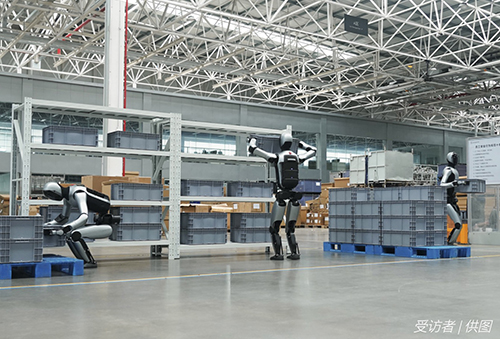
Core Viewpoint - The humanoid robot industry is entering a critical opportunity period, transitioning from "laboratory exploration" to "scene application," driven by policy design, market demand, technological advancements, and capital support [1] Industrial Scene - The industrial sector is becoming a testing ground for the large-scale application of humanoid robots, focusing on repetitive labor tasks that require flexibility and precision, such as material handling in engine assembly and quality inspection in 3C manufacturing [2][3] - In 2025, global orders for industrial humanoid robots are expected to exceed 10,000 units, with companies like UBTECH and Zhiyuan securing orders worth hundreds of millions [3] Commercial Service Scene - The commercial service sector is poised for significant humanoid robot applications, with over 80 projects awarded in the first half of 2025, totaling more than 330 million yuan, covering retail, dining, and healthcare [5][7] - The rental model is emerging as a solution to cost challenges, with the domestic service robot rental market expected to surpass 2 billion yuan in 2025, lowering entry barriers for small businesses [7] Home Scene - The home scene presents substantial consumer potential but also faces the highest technical challenges and commercialization difficulties, focusing on elderly care, daily chores, and educational companionship [8] - Despite the potential, the commercialization of humanoid robots in home settings is still in its early stages, hindered by issues such as insufficient technology maturity and high costs [8] Upcoming Events - The second Zhongguancun Embodied Intelligent Robot Application Competition will take place in November 2025, focusing on the practical application of humanoid robots and providing a platform for testing their capabilities in various scenarios [10][12] - The competition will feature multiple tracks, including challenges for embodied intelligence models and applications in family services, commercial services, and industrial manufacturing [13]
“十四五”答卷·创新驱动产业蝶变|人形机器人产业:迎来跨越发展 赋能千行百业
Ke Ji Ri Bao· 2025-10-14 03:08
Core Insights - The human-shaped robot industry in China is experiencing rapid development, transitioning from the "technology verification period" to the "scale commercialization period" by 2025, with the global embodied intelligence market expected to reach 19.525 billion yuan, nearly half of which will come from China [1][2] Industry Developments - The rise of human-shaped robots is attributed to breakthroughs in embodied intelligence technology, which integrates artificial intelligence into physical entities, enabling them to perceive, learn, and interact with their environment like humans [2] - The structure of embodied intelligence is categorized into "brain," "cerebellum," and "body," where the "brain" refers to AI models responsible for language interaction and task decision-making, while the "cerebellum" focuses on motion control algorithms [2] - Significant advancements in AI models have enhanced the perception, decision-making, and natural interaction capabilities of human-shaped robots, moving them from mere mechanical execution to intelligent agents [2] Technological Breakthroughs - Continuous improvements in core components such as perception algorithms, servo motors, and reducers have significantly increased the dexterity, stability, and autonomy of robots, laying a solid foundation for practical applications [3] - The development of end-to-end unified models allows for low-cost hardware to perform intricate tasks like grasping and folding clothes, showcasing the progress in the "brain" aspect of human-shaped robots [2] Real-World Applications - Human-shaped robots are now being deployed in various sectors, including factories, healthcare, and homes, demonstrating their ability to perform complex tasks autonomously, such as quality inspection and component sorting [4] - The "Galbot" robot from Galaxy General is a prime example, capable of visual perception-based object recognition and path planning, marking a shift from traditional industrial robots that rely on preset routes [4] - In the healthcare sector, exoskeleton robots are assisting stroke patients in relearning to walk, utilizing AI algorithms to provide personalized rehabilitation strategies [5] Future Outlook - The human-shaped robot market is expected to evolve from specialized to general-purpose robots, with companies focusing on developing versatile robots that can adapt to various unstructured environments [5] - As production scales and technology matures, the costs associated with human-shaped robots are anticipated to decrease, similar to the trend observed with industrial robots in the early 2000s [5] - Future general-purpose human-shaped robots are envisioned to be intelligent companions that understand human intentions and adapt proactively to their surroundings [5]

人形机器人产业:迎来跨越发展 赋能千行百业
Ke Ji Ri Bao· 2025-10-13 23:08
Core Insights - The humanoid robot industry in China is experiencing rapid development during the "14th Five-Year Plan" period, transitioning from a "technology verification phase" to a "scale commercialization phase" by 2025, with the global embodied intelligence market expected to reach 19.525 billion yuan, of which China's market share is nearly half [1][2] Group 1: Technological Breakthroughs - The rise of humanoid robots is attributed to breakthroughs in embodied intelligence technology, which integrates artificial intelligence into physical entities, enabling them to perceive, learn, and interact with their environment like humans [2] - The structure of embodied intelligence is categorized into "brain," "cerebellum," and "body," where the "brain" refers to AI models responsible for language interaction and decision-making, while the "cerebellum" involves motion control algorithms [2] - Significant advancements in AI models have enhanced humanoid robots' capabilities, allowing them to perform complex tasks such as grasping and manipulating irregular objects with low-cost hardware [2][3] Group 2: Industry Applications - Humanoid robots are now being deployed in various real-world applications, such as in factories for tasks like quality inspection and component sorting, exemplified by the Galbot robot from Galaxy General [4] - In the healthcare sector, humanoid robots are assisting in rehabilitation, such as exoskeleton robots helping stroke patients relearn walking by analyzing muscle signals and adjusting support strategies in real-time [5] - The development of general-purpose humanoid robots is underway, aiming to create robots that can adapt to various unstructured environments, moving from being specialized tools to intelligent companions that understand human intentions [5]
改革开放走在前丨广东要再造一个万亿级产业
Zhong Guo Xin Wen Wang· 2025-10-13 13:38
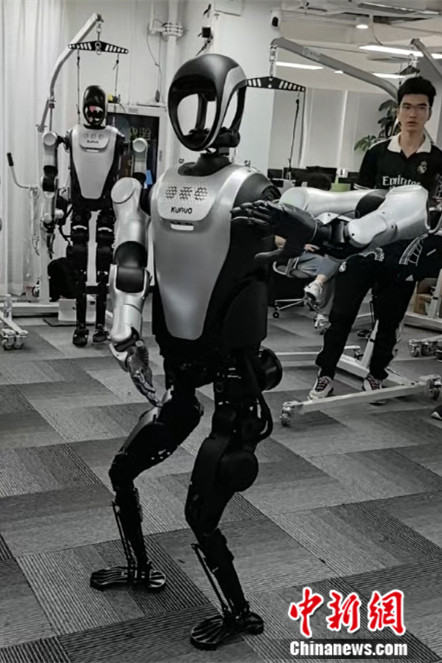
中新网10月13日电(记者张尼)机器人打太极、跳英歌舞、跑马拉松……这不是科幻电影里的硅基生命觉醒场景, 而是广东科创的鲜活日常。作为改革开放的前沿阵地,经济大省广东已把目光瞄准了人工智能与机器人这一未来 产业制高点。 日前,记者跟随由广东省委网信办主办、南方新闻网承办的"改革开放走在前——广东科创新气象"主题宣传活动 走进珠海、深圳、汕头多地,感受前沿创新成果。 "夸父"机器人打太极中新网张尼摄 "深圳硬件工业体系成熟,零件供应效率十分高,有时候甚至可以做到上午出设计图下午零件就能制作出来,这对 机器人产业来说是非常大的支持。"乐聚机器人副总裁吴雨璁在接受记者采访时如是说。 对于产业未来的发展前景,业界充满信心。 以人形机器人为例,据统计,全球人形机器人约38%的供应链企业在中国,而中国约57%的供应链企业在粤港澳 大湾区。 作为国内人工智能和机器人产业的"双高地",仅深圳南山区就集聚了200余家优质机器人企业,其中上市企业14 家,专精特新"小巨人"30家,工业百强8家。 在深圳湾以西、粤海街道与深圳科技园及周边的机器人湾,也云集着一大批机器人企业,它们聚焦"高端制造+国 际合作",重点发展无人机、工业机 ...
具身智能产业亿元级订单频现,重点关注产业链龙头奥比中光、柯力传感
Tianfeng Securities· 2025-10-12 13:50
Investment Rating - Industry rating is maintained at "Outperform the Market" [5] Core Insights - The emergence of billion-level orders in the embodied intelligence sector indicates accelerated commercialization, with significant contracts signed recently, including a multi-billion yuan framework order for the ZhiYuan Spirit G2 robot and a record-breaking 260 million yuan project with ShiHua Cultural Tourism [1][2] - The rapid expansion of the market is supported by strategic collaborations among listed companies and local policies, with the Chinese embodied intelligence market expected to reach 5.295 billion yuan by 2025, accounting for approximately 27% of the global market [2] - The industry is witnessing a systematic leap, driven by technological breakthroughs and supportive policies, solidifying China's leading position in the global robotics industry [2] Company Summaries - **Aobi Zhongguang**: A leading company in 3D visual perception, deeply partnered with Microsoft and Nvidia, holding over 70% market share in domestic service robot visual sensors [3] - **Keli Sensor**: A leading manufacturer of strain sensors, with a complete product series developed for humanoid robots, mastering key technologies such as structural decoupling and high-speed sampling communication [3]

