大疆

Search documents
超目标102倍!中国桌面机床刷爆海外众筹,下一个拓竹要来了?
机器人大讲堂· 2026-02-08 04:06
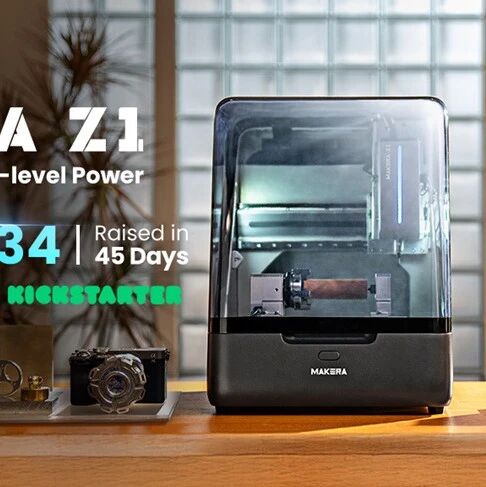
Core Viewpoint - The article highlights the remarkable success of the "Makera Z1," a desktop CNC machine from Beijing's Makera, which raised nearly $10.25 million on Kickstarter, breaking crowdfunding records in the CNC category. This product is designed to make precision manufacturing accessible to everyday users, transforming a traditionally industrial tool into a compact, user-friendly device suitable for home use [2][4][11]. Group 1: Product Overview - The Makera Z1 weighs 17 kg and can cut and engrave various materials, achieving a precision of 0.02 mm. It features user-friendly automation, including automatic leveling and one-click calibration, making it accessible for beginners [2][4][11]. - The crowdfunding price for the Makera Z1 is under $1,000, with a retail price expected to be $1,199, positioning it competitively in the market [4][13]. Group 2: Market Context - The CNC market has traditionally been dominated by expensive industrial machines, but there is a growing demand for desktop CNC machines due to shifts in manufacturing needs towards small-batch, customized production [6][9]. - The desktop CNC search interest surged significantly, indicating a rising trend in personal manufacturing capabilities among users [9]. Group 3: Company Background - Makera was founded in 2019 by Zhang Qiuxi, who has extensive experience in software and hardware development. The company has previously launched successful products on Kickstarter, establishing a strong reputation in the CNC space [10][11]. - The company has already integrated its products into the equipment libraries of major corporations and universities, including Apple, Microsoft, and MIT, which adds credibility to its offerings [10][11]. Group 4: Competitive Landscape - Other players in the desktop CNC market include NestWorks C500 and XMachine, indicating a diverse competitive landscape with varying product focuses from entry-level to high-end solutions [17][18]. - The article suggests that the CNC market is still evolving, with no clear dominant player yet, and emphasizes the importance of software and community ecosystems in determining future success [24]. Group 5: Future Outlook - The CNC market is projected to grow significantly, with estimates suggesting it could expand from $2 billion to $5 billion by 2026, driven by increasing consumer interest and demand for personalized manufacturing solutions [19][24]. - The article concludes that the current landscape is just the beginning for the desktop CNC market, with potential for new entrants and innovations to emerge in the coming years [24].

“一人公司”悄然兴起 深圳各城区这么做
2 1 Shi Ji Jing Ji Bao Dao· 2026-02-08 02:34
Core Insights - The rise of "One Person Companies" (OPC) is reshaping the entrepreneurial landscape, emphasizing the efficiency of intelligent agents over traditional workforce size [1] - Shenzhen's government is actively promoting the OPC model through supportive policies and initiatives, aiming to create a vibrant AI-driven entrepreneurial ecosystem [1] Group 1: OPC Development in Shenzhen - The "One Person Company" model has gained traction in major cities like Shenzhen, Shanghai, and Beijing since 2026, with local governments implementing supportive policies [1] - Shenzhen's "Action Plan for Building an AI OPC Entrepreneurial Ecosystem" aims to foster new business models and industry clusters [1] Group 2: Nanshan District Initiatives - Nanshan District is set to achieve a GDP of 1.01 trillion yuan in 2025, driven by both established tech giants and emerging startups [2] - The "Moli Camp" in Nanshan is the largest AI vertical incubator in the Greater Bay Area, attracting over 700 companies and housing nearly 200 high-quality enterprises with a total valuation exceeding 20 billion yuan [2] - Nanshan's strategy includes a balanced focus on software and hardware, with over 1,300 AI enterprises contributing to 60% of Shenzhen's AI industry cluster value [2] Group 3: Hardware Focus in Bao'an District - Bao'an District is concentrating on hardware entrepreneurship within the OPC framework, aiming to create a comprehensive support system for hardware startups [5][6] - The district plans to leverage its extensive manufacturing base, which includes 58,000 manufacturing companies, to support OPC hardware ventures [5] - Bao'an's initiatives include the "Baoqi Financial Services" brand to facilitate funding and reduce barriers for hardware startups [6] Group 4: Futian District's "One Meter Counter" Upgrade - Futian District is modernizing the "One Meter Counter" concept to serve as a lightweight entrepreneurial platform for AI startups [7] - The district will introduce a list of application scenarios to guide entrepreneurs in focusing on key areas such as AI + hardware and cross-border e-commerce [7] - Futian's ecosystem includes over 115,000 business entities and a transaction volume exceeding 480 billion yuan annually [7] Group 5: Luohu District's Scene-Centric Approach - Luohu District is focusing on creating a "scene city" to leverage its vast application scenarios in finance, healthcare, and urban governance for OPC development [9] - The π Innovation Space and Plug and Play Innovation Center are key components of Luohu's strategy to support AI startups [9][10] - Luohu's first "Innovation Opportunity List" includes 41 projects across six core areas, expected to attract over 100 million yuan in investment [10]
深圳低空经济产业集群增加值突破350亿元
Sou Hu Cai Jing· 2026-02-07 14:39
Core Insights - Shenzhen's low-altitude economy and aerospace industry cluster is projected to achieve an added value of 35.061 billion yuan by 2025, reflecting a year-on-year growth of 31%, indicating robust development momentum [1] Group 1: Policy and Regulatory Framework - The implementation of the "Shenzhen Special Economic Zone Low-altitude Economy Industry Promotion Regulations" in 2024 marks the first local legislation in China specifically targeting the low-altitude economy, establishing a legal framework for the industry's full lifecycle [1] - During the 14th Five-Year Plan period, Shenzhen has introduced multiple policy measures to support the low-altitude economy, including subsidies for eVTOL airworthiness certification, rewards for low-altitude logistics routes, and a 1 billion yuan industry guidance fund [1] Group 2: Industry Development and Innovation - Shenzhen produces 70% of the global consumer drones and 50% of industrial drones, with a complete industrial support system that allows for 100% availability of key materials and core components within a one-hour drive [1] - The establishment of the world's first low-altitude three-dimensional wind tunnel laboratory and multiple national-level research platforms in low-altitude meteorology and air traffic management during the 14th Five-Year Plan period underscores the focus on innovation as a core driver of industry development [2] Group 3: Infrastructure and Network Expansion - By 2025, Shenzhen plans to have over 1,200 takeoff and landing points and nearly 10,000 5G-A and sensing base stations, creating a preliminary network of takeoff facilities and accelerating the construction of a communication navigation monitoring system [2] - The drone logistics network in Shenzhen has expanded to cities in the Greater Bay Area, and innovative projects such as the first "air-ground integrated" urban rescue project and the first air-rail intermodal project have been implemented [2] Group 4: Safety and Risk Management - Shenzhen has established a comprehensive low-altitude safety management system, including the formation of a police aviation unit to address illegal drone activities and monitor related incidents [3] - The "Deep Sky" drone safety management platform has been upgraded to connect with 22 drone research and production companies, monitoring an average of 2,300 flight data entries daily [3] - The introduction of the first national third-party liability insurance service guidelines for drones has led to 14 out of 34 local insurance companies offering low-altitude economy-related insurance, with premium income exceeding 300 million yuan and coverage for over 600,000 drones [3]
数码家电行业周度市场观察-20260207
Ai Rui Zi Xun· 2026-02-07 08:42
Investment Rating - The report does not explicitly provide an investment rating for the industry Core Insights - The digital home appliance industry is experiencing significant transformations driven by AI integration and evolving consumer demands. Major brands are focusing on technological innovation and global expansion to enhance their market positions [18][22]. Industry Trends - AI advertising has become a hot topic at CES 2026, showcasing the deep integration of technology and advertising, with major companies like Disney and Amazon leveraging AI to optimize ad effectiveness [4][3]. - The competition among domestic internet giants in China is intensifying, particularly in the generative AI ecosystem, with Alibaba and ByteDance leading the charge [7][3]. - The emergence of GEO (Generative Engine Optimization) is reshaping how businesses influence AI responses, raising concerns about information manipulation and the need for regulatory measures [7][3]. - The physical AI sector is expected to see explosive growth in 2026, with trends including the commercialization of Robotaxis and humanoid robots, indicating a shift towards real-world applications of AI [9][3]. - AI agents are predicted to explode in popularity, with companies like Doubao and Qianwen focusing on differentiated services to capture market share [11][3]. - The AI smartphone market is evolving, with major players like Apple and Alibaba exploring new models that prioritize user experience and data privacy [12][3]. - The global AI industry is facing challenges related to commercialization and financial sustainability, as exemplified by OpenAI's struggles with profitability despite significant revenue [10][3]. Head Brand Dynamics - Suiyuan Technology has applied for an IPO on the Sci-Tech Innovation Board, aiming to raise 6 billion yuan for AI chip development, highlighting the growth potential in the domestic AI chip market [23][3]. - OpenAI is venturing into the hardware space with a new screenless AI product, reflecting a trend towards minimalistic design in AI interactions [24][3]. - ByteDance is expanding its hardware offerings, including AI recording devices, as part of a broader strategy to enhance its ecosystem and user engagement [25][3]. - Baichuan Intelligence launched a medical AI model that significantly reduces error rates, aiming to improve healthcare applications in China [26][3]. - Alibaba's Qianwen is accelerating its AI initiatives to compete in the consumer market, although it faces challenges in user acquisition and feature maturity [27][3]. - DJI is diversifying its product lines to address growth challenges in the consumer drone market, indicating a strategic shift in response to market saturation [28][3]. - Alibaba's chip design unit, Pingtouge, is restructuring for an IPO, which is seen as a crucial step in enhancing its AI capabilities [29][3].


任泽平:买哪里的房子最保值?这几个城市的房价未来会再创新高
Sou Hu Cai Jing· 2026-02-07 02:48
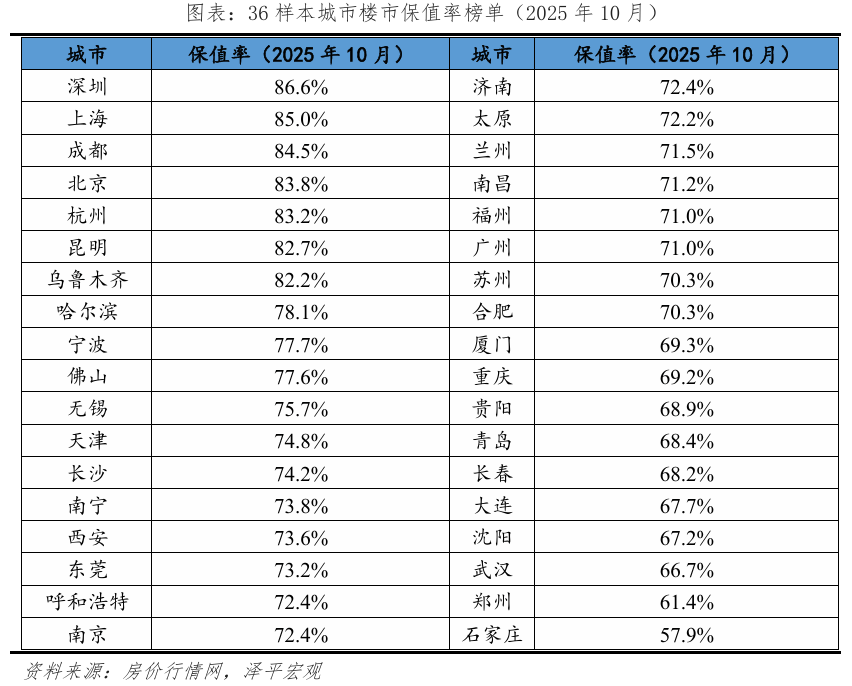
文/泽平宏观团队 现在社会上对房地产的看法分歧很大,有人说2026年买房就是高位站岗,还有人说三四线房子白送都不要,但北上广深可以闭眼买。 究竟买哪里的房子最保值?哪些城市的房价会再创新高? 网上的很多看法,情绪大于逻辑,似是而非,缺少专业的分析。 这些年,出版了三本专著,研究了全球几十个国家的房地产百年历史,总结出了房价保值增值的核心秘密。 这说明什么?后房地产时代,不是所有房子都能保值,能穿越周期的硬通货只是少数。 有人会问:"深圳为什么能排第一?成都、杭州为什么能进前五?"别急,每个保值率高的城市,都有自己的"核心优势",咱们一个个拆解。 先看深圳,深圳房地产保值率为什么能拿第一?核心优势是"创新红利+年轻人口流入",深圳是粤港澳大湾区的龙头,是全国创新最活跃的城市,诞生了 像华为、腾讯、比亚迪、大疆这样的世界级高科技企业,贡献了万亿级的产值,提供了百万级的高薪就业岗位。而且,深圳人口质量在全国首屈一指,在 泽平宏观和智联招聘联合发布的《中国城市95后人才吸引力排名》中,深圳连续两年位居全国榜首,深圳14-35岁青年人口超800万,占全市人口46%,年 轻、高学历、高收入的人口结构,带来了源源不断的购房 ...
买哪里的房子最保值:这几个城市的房价未来会再创新高!
泽平宏观· 2026-02-06 16:06
直奔主题, 买哪里的房子最保值? 究竟买哪里的房子最保值?哪些城市的房价会再创新高? 网上的很多看法,情绪大于逻辑,似是而非,缺少专业的分析。 这些年,出版了三本专著《房地产周期》《全球房地产》《房地产大趋势》,研究了全球几十个国 家的房地产百年历史, 总结出了房价保值增值的核心秘密。 首先,什么是保值? 我们不能像网上的有些言论凭感觉,咱们要靠科学,为此我搜集了大量官方 统计数据,进行"保值率"测算,也就是用最新的二手房均价,与 2017 年以来该城市的二手房价峰值, 进行相比计算。 文 泽平宏观团队 现在社会上对房地产的看法分歧很大,有人说 2026 年买房就是高位站岗,还有人说三四线房子白 送都不要,但北上广深可以闭眼买。 做起来很复杂,花了三个多月时间,咱们直接看结论。 我们发现,全国 36 个重点城市,过去十年 深圳的房地产保值率排第一,上海、成都位列前三,北京、杭州也冲进前五,他们的保值率都超过 80% 。反观有些三四线城市,比如鹤岗、廊坊,保值率早就跌破 60% ,当年买的房子现在打半价都很 难出手。 这说明什么?后房地产时代,不是所有房子都能保值,能穿越周期的硬通货只是少数。 有人会问: " ...
深圳创新“四姐妹”上榜胡润500强前十,迈瑞缩水760亿
Nan Fang Du Shi Bao· 2026-02-06 14:33
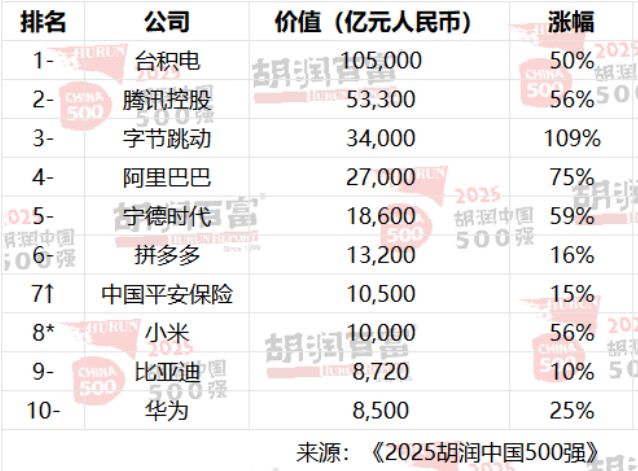
Core Insights - The latest Hurun China 500 list reveals the rankings of 500 non-state-owned enterprises in China, with a notable increase in the entry threshold to 34 billion RMB, a rise of nearly 30% compared to the previous year [1] - The list features 95 new entrants primarily from sectors such as consumer electronics, AI computing power, and new energy, while 99 companies dropped off the list, indicating a trend of fluctuation among companies [1] Group 1: Company Performance - Tencent's value reached 5.3 trillion RMB, marking a 50% increase, driven by strong performances in gaming, advertising, and fintech [2][3] - The "Shenzhen Four Sisters"—Huawei, BYD, Tencent, and China Ping An—are all in the top 10, with values of 850 billion RMB, 872 billion RMB, and 1.05 trillion RMB respectively, reflecting the resilience of Shenzhen's economy [3] - DJI, headquartered in Shenzhen, saw its value double due to its strong position in the consumer drone market and growth in overseas markets [5] Group 2: Industry Trends - The real estate sector saw a decline, with the number of listed companies dropping from 19 to 12 [1] - The Yangtze River Delta region has 161 companies in the Hurun China 500, accounting for 32% of the total, while the Guangdong-Hong Kong-Macau Greater Bay Area has 108 companies, representing 22% [4] - The report highlights that sectors such as AI computing, consumer electronics, innovative pharmaceuticals, and entertainment are key drivers of high-quality development in China's private economy [5]



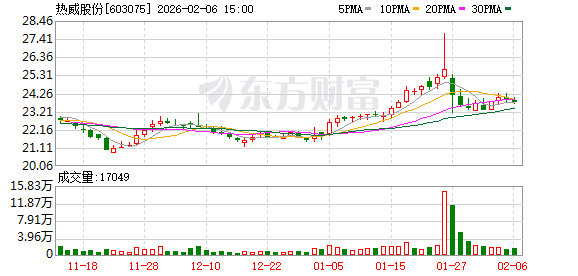
热威股份:公司积极探索在智能家电领域业务的开拓与发展
Zheng Quan Ri Bao· 2026-02-06 12:12
Group 1 - The company is actively exploring and developing its business in the smart home appliance sector [2] - The company has promoted several new technologies and applications in this field [2] - The company has accumulated a significant number of customers in the cleaning appliance category, including brands like Tineco, Roborock, and DJI [2]


vivo、影石围猎大疆,Pocket 还能独占多久?
3 6 Ke· 2026-02-06 11:49
Core Viewpoint - The entry of smartphone manufacturers like vivo into the handheld gimbal camera market signifies a convergence of mobile and camera technology, driven by advancements in supply chains and consumer demand for specialized imaging devices. Group 1: Market Entry and Competition - Vivo has confirmed plans to launch a Vlog camera by the end of 2025, targeting DJI's Pocket series, with an expected release in 2026 [1] - Other companies, such as影石, are also set to release handheld gimbal cameras in the first half of 2026, indicating a growing trend among smartphone manufacturers to enter this market [1][33] - The competition is not limited to vivo; Huawei, Xiaomi, OPPO, and Honor are also exploring similar product developments, highlighting a collective shift in the industry [22][24] Group 2: Technological Advancements - Vivo's confidence in entering the camera market stems from its established supply chain and experience with imaging technology, particularly with the use of Sony's one-inch CMOS sensors [4][6] - The integration of advanced imaging chips, such as vivo's self-developed V3+ chip, allows for high-quality video processing capabilities, positioning the company well in the handheld camera space [6][10] - The design and engineering experience gained from previous smartphone models contribute to vivo's ability to create a competitive handheld gimbal camera [8][10] Group 3: Consumer Needs and Market Potential - Handheld gimbal cameras address common consumer frustrations with smartphones, such as battery life and storage limitations, by providing a dedicated device for video recording [15][17] - The market for handheld gimbal cameras has shown significant potential, with DJI's Osmo Pocket 3 achieving over 10 million units sold in just two years, indicating strong consumer interest [29][30] - The high profit margins and user engagement associated with these devices make them an attractive opportunity for smartphone manufacturers looking for new growth avenues [28][30] Group 4: Innovation and Future Outlook - The handheld gimbal camera format represents an innovative solution to the limitations of both smartphones and traditional cameras, offering portability and ease of use [32] - The potential for seamless integration with smartphone ecosystems, such as direct content transfer and collaborative functionality, presents a strategic advantage for smartphone manufacturers [18][30] - As the market evolves, the competition among smartphone brands to establish a foothold in the handheld camera segment is expected to intensify, leading to rapid advancements and innovations [30][35]
独家|影石“Pocket”将于2026上半年发布,确认带长焦功能
Xin Lang Cai Jing· 2026-02-06 08:35
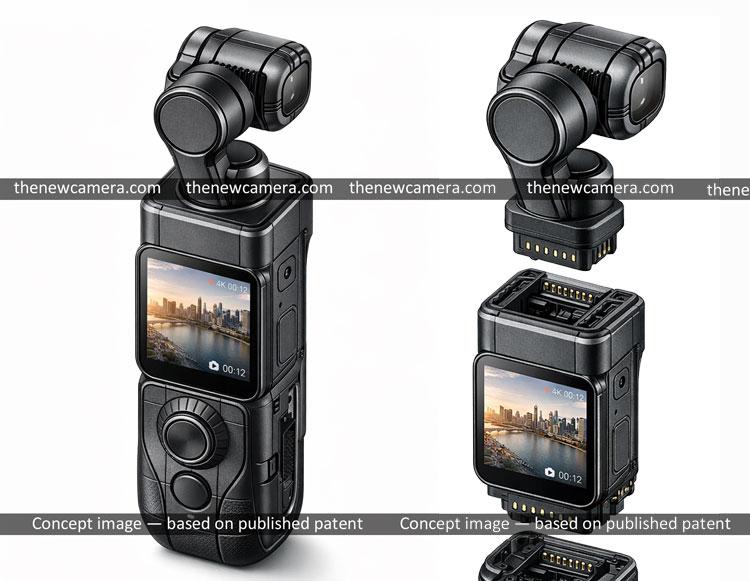
Core Viewpoint - The company YingShi is set to release a handheld gimbal camera in the first half of the year, targeting the DJI Pocket market segment [1] Group 1: Product Features - The handheld gimbal camera from YingShi will be available in multiple color versions [1] - It is expected to feature a modular design and a dual-camera setup, marking the industry's first handheld gimbal camera with telephoto capabilities [1]