
银华基金

Search documents
北美“电荒”催生大机遇 基金抢筹电力赛道
Zheng Quan Shi Bao· 2026-01-18 18:08
Group 1 - The core viewpoint of the articles highlights the increasing demand for AI computing power leading to a power crisis in North America, which presents new opportunities for public funds to invest in Chinese power equipment assets [1][3] - Public funds are intensively increasing their positions in the power equipment sector, with several leading funds focusing on smart distribution and gas turbine segments, indicating a strategic shift towards this traditional yet technologically relevant sector [2][4] - The ongoing power gap in North America has prompted fund managers to recognize the critical role of traditional power sources, with projections indicating a significant increase in power demand for data centers [3][6] Group 2 - The strong performance of individual stocks in the power equipment sector is reflected in the overall rise of the sector, with a reported increase of over 40% in 2025, and specific segments like smart distribution and gas turbine components seeing gains exceeding 60% [5][6] - The demand for power equipment is further supported by the capital market's profit effects, with companies like Siyuan Electric experiencing substantial stock price increases and significant overseas revenue contributions [4][5] - The consensus among industry experts is that the intersection of AI and energy is crucial, with the need for stable power sources driving investments in gas turbines and related technologies, highlighting the importance of the power equipment sector in the context of AI expansion [7][8]


部分宽基指数依旧看多,后市或震荡向上:【金工周报】(20260112-20260116)-20260118
Huachuang Securities· 2026-01-18 11:43
Quantitative Models and Construction Methods 1. Model Name: Volume Model - **Construction Idea**: The model uses trading volume data to predict market trends - **Construction Process**: The model analyzes the trading volume of various broad-based indices to determine market sentiment. If the trading volume increases significantly, it indicates a bullish trend - **Evaluation**: The model is effective in capturing short-term market movements based on trading volume[1][14] 2. Model Name: Feature Longhu Board Institution Model - **Construction Idea**: This model uses institutional trading data from the Longhu Board to predict market trends - **Construction Process**: The model tracks the trading activities of institutions listed on the Longhu Board. A higher level of institutional buying indicates a bullish trend - **Evaluation**: The model is useful for understanding the impact of institutional trading on market trends[1][14] 3. Model Name: Feature Volume Model - **Construction Idea**: Similar to the Volume Model, this model uses specific volume features to predict market trends - **Construction Process**: The model analyzes specific volume features such as spikes or drops in trading volume to determine market sentiment - **Evaluation**: The model provides additional insights by focusing on specific volume features rather than overall volume[1][14] 4. Model Name: Intelligent Algorithm Model (CSI 300 and CSI 500) - **Construction Idea**: The model uses machine learning algorithms to predict market trends for the CSI 300 and CSI 500 indices - **Construction Process**: The model employs various machine learning techniques to analyze historical data and predict future trends for the CSI 300 and CSI 500 indices - **Evaluation**: The model is effective in capturing complex patterns and trends in the market using advanced algorithms[1][14] 5. Model Name: Limit Up and Down Model - **Construction Idea**: The model uses the frequency of limit up and down events to predict market trends - **Construction Process**: The model tracks the number of stocks hitting their daily limit up or down to gauge market sentiment. A higher number of limit up events indicates a bullish trend - **Evaluation**: The model is useful for capturing extreme market movements and sentiment[1][15] 6. Model Name: Up and Down Return Difference Model - **Construction Idea**: The model uses the difference between upward and downward returns to predict market trends - **Construction Process**: The model calculates the difference between the returns of stocks moving up and those moving down. A positive difference indicates a bullish trend - **Evaluation**: The model provides a balanced view of market sentiment by considering both upward and downward movements[1][15] 7. Model Name: Calendar Effect Model - **Construction Idea**: The model uses calendar-based patterns to predict market trends - **Construction Process**: The model analyzes historical data to identify recurring patterns based on the calendar, such as monthly or quarterly trends - **Evaluation**: The model is useful for capturing seasonal trends and patterns in the market[1][15] 8. Model Name: Long-term Momentum Model - **Construction Idea**: The model uses long-term momentum to predict market trends - **Construction Process**: The model tracks the long-term momentum of stocks to determine market sentiment. A positive momentum indicates a bullish trend - **Evaluation**: The model is effective in capturing long-term trends and movements in the market[1][16] 9. Model Name: Comprehensive Weapon V3 Model - **Construction Idea**: The model combines multiple indicators and models to provide a comprehensive market prediction - **Construction Process**: The model integrates various short-term, medium-term, and long-term models to generate a comprehensive market outlook - **Evaluation**: The model provides a holistic view of the market by combining multiple indicators and models[1][17] 10. Model Name: Comprehensive National Certificate 2000 Model - **Construction Idea**: Similar to the Comprehensive Weapon V3 Model, this model focuses on the National Certificate 2000 index - **Construction Process**: The model integrates various indicators and models specifically for the National Certificate 2000 index - **Evaluation**: The model is effective in providing a comprehensive outlook for the National Certificate 2000 index[1][17] Model Backtesting Results - **Volume Model**: All broad-based indices are bullish[1][14] - **Feature Longhu Board Institution Model**: Bullish[1][14] - **Feature Volume Model**: Bullish[1][14] - **Intelligent Algorithm Model (CSI 300)**: Bullish[1][14] - **Intelligent Algorithm Model (CSI 500)**: Bullish[1][14] - **Limit Up and Down Model**: Bullish[1][15] - **Up and Down Return Difference Model**: All broad-based indices are bullish[1][15] - **Calendar Effect Model**: Neutral[1][15] - **Long-term Momentum Model**: Neutral[1][16] - **Comprehensive Weapon V3 Model**: Bullish[1][17] - **Comprehensive National Certificate 2000 Model**: Bullish[1][17]
资金流向,新变化!
Zhong Guo Zheng Quan Bao· 2026-01-16 13:06
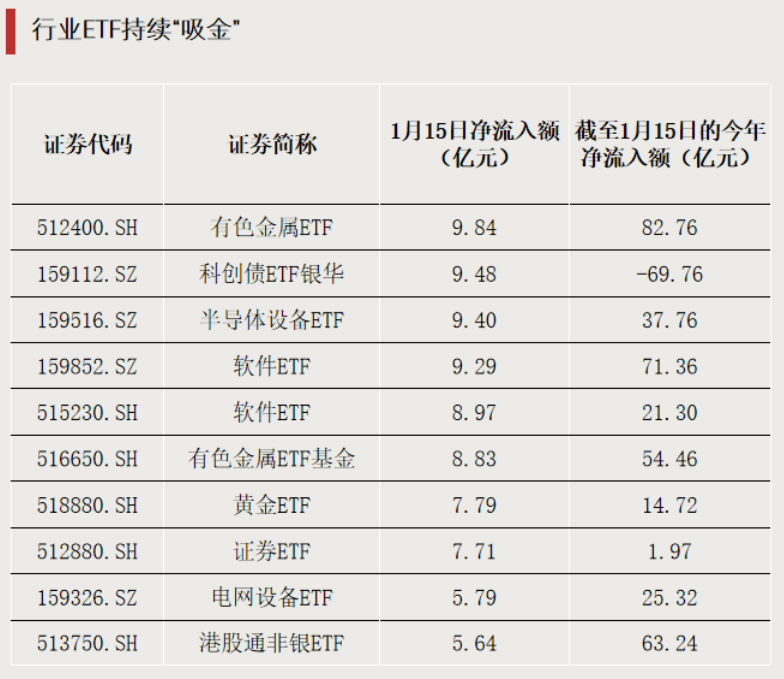
Group 1: ETF Market Overview - On January 16, the overall ETF market experienced a decline, with semiconductor-themed ETFs showing strong performance, as several products rose against the trend and entered the top ten gainers of the day [1][4] - The total trading volume of ETFs exceeded 750 billion yuan, setting a historical record, with 23 ETFs having a single-day trading volume exceeding 10 billion yuan [2][12] - The ETF market saw a significant net outflow of over 68 billion yuan, marking the highest single-day outflow of the year, with a clear divergence in fund flows [3][8] Group 2: Sector Performance - Semiconductor-themed ETFs surged, with seven out of the top ten gainers focusing on the semiconductor sector, particularly tracking the Shanghai Stock Exchange's semiconductor materials and equipment index [4][5] - The leading semiconductor ETF, Penghua (589020), rose by 8.74% on the day and has accumulated a year-to-date increase of 29.93%, making it the highest-performing ETF in the same period [4] - Conversely, media and entertainment-themed ETFs experienced a notable decline, with the top six losers all dropping over 4%, and some trading at a discount [6][7] Group 3: Fund Flow Dynamics - The net outflow from the ETF market was primarily driven by stock-type ETFs, which saw a net outflow of over 67 billion yuan, while industry ETFs continued to attract capital [8][9] - Among the top ten net inflows, several industry ETFs focused on non-ferrous metals, semiconductor equipment, software, gold, and securities [8] - The non-ferrous metals ETF (512400) led with a net inflow of 9.84 billion yuan, with a year-to-date net inflow exceeding 8 billion yuan, ranking second in the market [9] Group 4: Future Industry Insights - The investment outlook for the AI industry chain is high, with expectations of significant growth driven by AI, supply chain restructuring, and structural inflation [10] - The storage industry is anticipated to perform well in 2026, driven by AI-induced supply-demand imbalances, with increasing demand for advanced storage solutions [10]

富淼科技股价跌5.07%,银华基金旗下1只基金重仓,持有1640股浮亏损失2345.2元
Xin Lang Cai Jing· 2026-01-16 03:00
1月16日,富淼科技跌5.07%,截至发稿,报26.75元/股,成交5684.55万元,换手率1.75%,总市值31.96 亿元。 银华汇益一年持有期混合A(008384)基金经理为冯帆。 截至发稿,冯帆累计任职时间5年20天,现任基金资产总规模84.36亿元,任职期间最佳基金回报 22.17%, 任职期间最差基金回报3.1%。 风险提示:市场有风险,投资需谨慎。本文为AI大模型自动发布,任何在本文出现的信息(包括但不 限于个股、评论、预测、图表、指标、理论、任何形式的表述等)均只作为参考,不构成个人投资建 议。 责任编辑:小浪快报 从基金十大重仓股角度 数据显示,银华基金旗下1只基金重仓富淼科技。银华汇益一年持有期混合A(008384)三季度持有股 数1640股,占基金净值比例为0.05%,位居第十大重仓股。根据测算,今日浮亏损失约2345.2元。 银华汇益一年持有期混合A(008384)成立日期2020年8月24日,最新规模7466.15万。今年以来收益 0.69%,同类排名7782/8847;近一年收益4.52%,同类排名7375/8094;成立以来收益12.07%。 资料显示,江苏富淼科技股份有限公司 ...

多只宽基ETF成交量放大 有色金属相关ETF领涨
Xin Lang Cai Jing· 2026-01-15 05:04
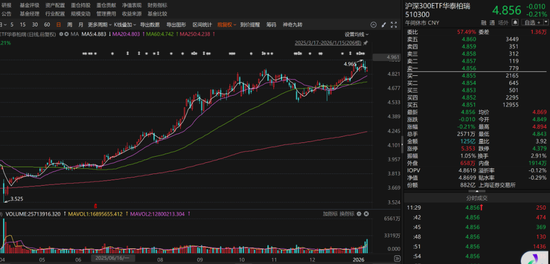
Group 1: ETF Market Performance - On January 15, multiple broad-based ETFs saw a significant increase in trading volume, with the Huatai-PB CSI 300 ETF achieving a half-day trading volume of 12.5 billion yuan, surpassing the highest daily trading volume since April 9, 2025 [1][11] - The Huatai-PB CSI 300 ETF experienced a slight decline of 0.21%, but its trading volume exceeded the previous day's total of 10.5 billion yuan [1][11] - Other ETFs, such as the Huatai-PB CSI A500 ETF and the Huaxia CSI A500 ETF, also reported substantial trading volumes of 12.6 billion yuan and 12.3 billion yuan, respectively, indicating a strong market interest [3][11] Group 2: Sector Performance - The performance of ETFs related to non-ferrous metals and batteries led the market on January 15, with the Southern Non-Ferrous Metals ETF rising by 2.75%, the GF Rare Metals ETF increasing by 2.45%, and the ICBC Credit Suisse Lithium Battery ETF up by 2.42% [6][13] - Analysts from Huatai Securities noted that the recent rise in resource prices is driven by multiple factors, including global monetary easing and increased demand for copper, silver, and rare metals due to AI data centers [13][14] Group 3: Investment Insights - The managers of the Ping An Resource Selected Mixed Fund highlighted a significant structural market for resource products in 2025, with precious metals and industrial metals like copper leading the gains [15] - They emphasized the importance of focusing on key sub-industry investment opportunities in 2026, particularly in industrial metals such as copper and aluminum, as well as in new energy metals like lithium and rare earths [15][16] - The long-term investment value of precious metals, particularly gold and silver, was also underscored, with gold being a core asset for risk diversification [16][17]
港股消费(159735)已连续5日获得资金净申购,区间净流入额6982.19万元
Xin Lang Cai Jing· 2026-01-15 02:27
Core Viewpoint - The Hong Kong Consumption ETF (159735) has seen significant net inflows, indicating growing investor interest in the fund and the underlying consumer sector in Hong Kong [1][2]. Group 1: Fund Performance - As of January 14, the Hong Kong Consumption ETF (159735) recorded a net subscription of 4.8298 million yuan, ranking 27th out of 208 in cross-border ETF net inflows for the day [1]. - The fund's latest size is 814 million yuan, up from 802 million yuan the previous day, reflecting a 0.60% increase in net inflow relative to the previous day's size [1]. - Over the past five days, the fund has accumulated a net subscription of 69.8219 million yuan, ranking 28th out of 208 in cross-border ETF net inflows [1][2]. Group 2: Fund Details - The Hong Kong Consumption ETF (159735) was established on May 25, 2021, with an annual management fee of 0.50% and a custody fee of 0.10% [2]. - The fund's latest share count is 1.007 billion shares, with a year-to-date increase of 9.46% in shares and a 12.08% increase in size compared to December 31, 2025 [2]. - The fund has a total trading volume of 922 million yuan over the last 20 trading days, averaging 46.0913 million yuan per day [2]. Group 3: Holdings and Composition - Major holdings in the Hong Kong Consumption ETF include Alibaba (19.54%), Tencent (16.59%), and Pop Mart (7.99%), among others, with the total market value of these holdings detailed [3]. - The ETF tracks the Hong Kong Consumption CNY index (931455), and its performance is compared with another fund, Hong Kong Consumption (513590), which has a smaller size and negative net subscriptions [3].





基金分红:银华优质增长混合基金1月19日分红
Sou Hu Cai Jing· 2026-01-15 01:42
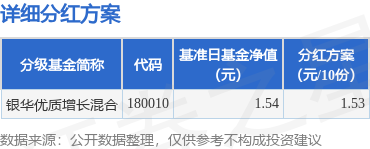
证券之星消息,1月15日发布《银华优质增长混合型证券投资基金分红公告》。本次分红为2025年度第 一次分红。公告显示,本次分红的收益分配基准日为12月12日,详细分红方案如下: 本次分红对象为权益登记日在本基金注册登记机构登记在册的本基金全体基金份额持有人,权益登记日 为1月16日,现金红利发放日为1月19日。选择红利再投资的投资者,其现金红利以2026年1月19日的基 金份额净值(NAV)转换为相应基金份额。根据财政部、国家税务总局的财税字[2002]128号《关于开放式 证券投资基金有关税收问题的通知》,基金向投资者分配的基金收益,暂免征收所得税。1)本基金本次 收益分配免收收益分配手续费;2)收益分配采用红利再投资方式免收再投资的费用。 以上内容为证券之星据公开信息整理,由AI算法生成(网信算备310104345710301240019号),不构成 投资建议。 | 分级基金筒称 | 代码 | 夏港台東金浄值 | 分红方案 | | | --- | --- | --- | --- | --- | | | | (元) | (元/10份) | | | 银华优质增长混合 | 180010 | 1.54 | | 1 ...
银华惠增利货币A基金经理变动:增聘邓舒文,冯小莺为基金经理
Sou Hu Cai Jing· 2026-01-15 01:36
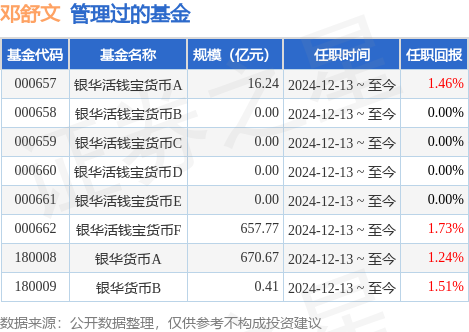
其管理过的公募基金如下: | 基金代码 | 基金名称 | 规模(亿元) | 任职时间 | 任职回报 | | --- | --- | --- | --- | --- | | 000604 | 银华多利宝货币A | | 18.56 2025-10-15~至今 | 0.30% | | 000605 | 银华多利宝货币B | | 107.52 2025-10-15 ~ 至今 | 0.36% | | 025729 银华双喜增利货币 | | | -- 2025-11-05 ~ 至今 | 0.20% | | 基金代码 | 基金名称 | 规模(亿元) | 任职时间 | 任职回报 | | --- | --- | --- | --- | --- | | 000657 | 银华活钱宝货币A | 16.24 | 2024-12-13 ~ 至今 | 1.46% | | 000658 | 银华活钱宝货币B | 0.00 | 2024-12-13~至今 | 0.00% | | 000659 | 银华活钱宝货币C | 0.00 | 2024-12-13 ~ 至今 | 0.00% | | 000660 | 银华活钱宝货币D | 0.00 | ...
基金分红:银华信用精选18个月定期开放债券基金1月19日分红
Sou Hu Cai Jing· 2026-01-15 01:36
本次分红对象为权益登记日在本基金注册登记机构登记在册的本基金全体基金份额持有人。,权益登记 日为1月16日,现金红利发放日为1月19日。选择红利再投资的投资者,其现金红利以2026年1月16日的 基金份额净值(NAV)转换为相应基金份额。根据财政部、国家税务总局的财税字[2002]128号《关于开放 式证券投资基金有关税收问题的通知》,基金向投资者分配的基金收益,暂免征收所得税。1)本基金本 次收益分配免收收益分配手续费;2)收益分配采用红利再投资方式免收再投资的费用。 以上内容为证券之星据公开信息整理,由AI算法生成(网信算备310104345710301240019号),不构成 投资建议。 证券之星消息,1月15日发布《银华信用精选18个月定期开放债券型证券投资基金分红公告》。本次分 红为2025年度第二次分红。公告显示,本次分红的收益分配基准日为12月12日,详细分红方案如下: ...

有色金属主题基金成机构“新宠”
Shang Hai Zheng Quan Bao· 2026-01-14 17:47
Core Viewpoint - The non-ferrous metal sector is becoming a focal point for institutional investment, with a significant increase in the number of themed funds and net subscriptions for ETFs in this category over the past year [1][2]. Group 1: Fund Activity - In the past week, seven non-ferrous metal themed funds have been reported, with several more in the pipeline for issuance [1]. - Over the past year, non-ferrous metal themed ETFs (excluding gold) have seen net subscriptions exceeding 51 billion yuan, with 15 ETFs currently having a total scale of nearly 80 billion yuan [1][2]. - As of January 1, 2025, the total scale of non-ferrous metal themed ETFs was approximately 8.08 billion yuan, which increased to 78.81 billion yuan by January 13, 2026 [2]. Group 2: Index Characteristics - There are multiple non-ferrous metal themed indices, each with different focuses, requiring investors to carefully select ETFs based on their characteristics [1]. - The CSI Shenwan Non-Ferrous Metal Index selects 50 listed companies from the non-ferrous metal and non-metal materials sectors [1]. - The CSI Industrial Non-Ferrous Metal Index focuses on 30 larger market cap companies involved in copper, aluminum, lead-zinc, and rare metals [1]. - The CSI Non-Ferrous Metal Mining Index selects 40 companies with non-ferrous metal mineral resource reserves [1]. Group 3: Market Trends and Drivers - The recent surge in the non-ferrous metal sector is attributed to various factors, including global monetary easing and increased demand from AI data centers for copper, silver, and rare metals [2]. - Supply constraints and regional imbalances in supply and demand, along with frequent mining accidents, contribute to uncertainties in the supply side [2]. - Long-term macroeconomic logic for non-ferrous metals remains intact, with a strategy of accumulating during market adjustments recommended [2]. Group 4: Future Outlook - The current demand for non-ferrous metals is driven by emerging fields such as AI computing and robotics, which have a higher price acceptance for commodities than previously expected [3]. - Despite the strong performance of the non-ferrous sector in 2025, expectations should be moderated for 2026, although the long-term resource cycle is still ongoing [3].
