半导体主题ETF

Search documents
资金流向,新变化!
Zhong Guo Zheng Quan Bao· 2026-01-16 13:06
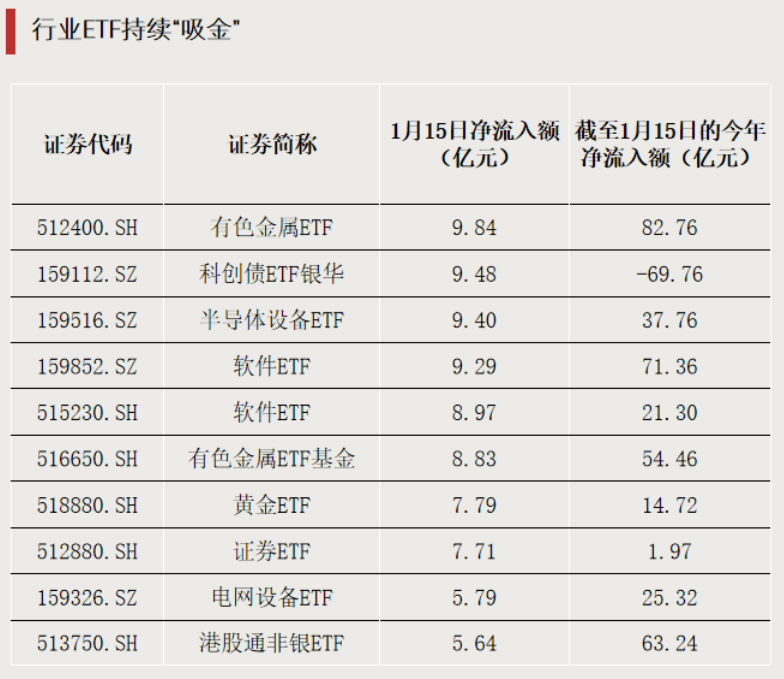
Group 1: ETF Market Overview - On January 16, the overall ETF market experienced a decline, with semiconductor-themed ETFs showing strong performance, as several products rose against the trend and entered the top ten gainers of the day [1][4] - The total trading volume of ETFs exceeded 750 billion yuan, setting a historical record, with 23 ETFs having a single-day trading volume exceeding 10 billion yuan [2][12] - The ETF market saw a significant net outflow of over 68 billion yuan, marking the highest single-day outflow of the year, with a clear divergence in fund flows [3][8] Group 2: Sector Performance - Semiconductor-themed ETFs surged, with seven out of the top ten gainers focusing on the semiconductor sector, particularly tracking the Shanghai Stock Exchange's semiconductor materials and equipment index [4][5] - The leading semiconductor ETF, Penghua (589020), rose by 8.74% on the day and has accumulated a year-to-date increase of 29.93%, making it the highest-performing ETF in the same period [4] - Conversely, media and entertainment-themed ETFs experienced a notable decline, with the top six losers all dropping over 4%, and some trading at a discount [6][7] Group 3: Fund Flow Dynamics - The net outflow from the ETF market was primarily driven by stock-type ETFs, which saw a net outflow of over 67 billion yuan, while industry ETFs continued to attract capital [8][9] - Among the top ten net inflows, several industry ETFs focused on non-ferrous metals, semiconductor equipment, software, gold, and securities [8] - The non-ferrous metals ETF (512400) led with a net inflow of 9.84 billion yuan, with a year-to-date net inflow exceeding 8 billion yuan, ranking second in the market [9] Group 4: Future Industry Insights - The investment outlook for the AI industry chain is high, with expectations of significant growth driven by AI, supply chain restructuring, and structural inflation [10] - The storage industry is anticipated to perform well in 2026, driven by AI-induced supply-demand imbalances, with increasing demand for advanced storage solutions [10]

万亿资金,涌入A股这些方向
Zhong Guo Zheng Quan Bao· 2026-01-05 23:07
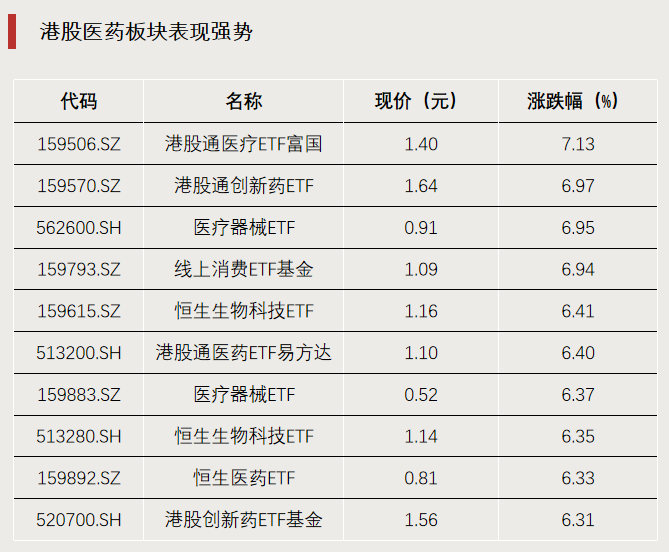
Group 1 - The A-share market shows a strong growth style, with notable performances in the pharmaceutical and semiconductor sectors, where multiple related ETFs rose over 5% in a single day [1] - The Hong Kong pharmaceutical sector is performing strongly, with several ETFs in innovative drugs and medical devices increasing by over 6%, highlighting the attractiveness of the sector post-adjustment [4][5] - The semiconductor sector is also experiencing significant gains, with multiple ETFs in this field rising over 5%, indicating a robust market for semiconductor-related investments [6][7] Group 2 - In December 2025, the A500 and Sci-Tech bonds became major directions for capital inflow, with several ETFs in these categories seeing net inflows exceeding 100 billion yuan [2][8] - The total net inflow for all ETFs in the market reached 11,785.99 billion yuan in 2025, showcasing a strong interest in ETF investments [2] - Specific ETFs such as the FuGuo CSI Hong Kong Internet ETF and the HuaAn Gold ETF saw annual net inflows exceeding 400 billion yuan, indicating strong investor confidence in these funds [10] Group 3 - The Hong Kong market is expected to see a recovery in corporate earnings, particularly benefiting sectors like non-ferrous metals and competitive industry leaders in internet and consumption [10][11] - The anticipated decline in risk-free rates in Hong Kong may lead to improved liquidity, potentially enhancing valuations in the market [11] - Key investment focuses for 2026 are expected to include AI, new consumption, pharmaceuticals, and dividend stocks, reflecting evolving market trends [11]
11月社融数据解读
2025-12-15 01:55
Summary of Conference Call Notes Industry Overview - The conference call discusses the financial data and economic conditions in China, particularly focusing on the banking sector and macroeconomic indicators [1][2][3]. Key Points and Arguments 1. **Loan Growth and Economic Trends** - In January, new loans amounted to 5.1 trillion yuan, indicating a typical credit peak season, but a slight decrease in loan growth is expected in the coming months, aligning with nominal economic growth trends [1][9]. - The demand for household credit remains weak due to multiple factors including a sluggish real estate market, stock market volatility, and declining consumer data [1][10]. 2. **Monetary Supply and Policy Environment** - M1 money supply growth has decreased to 4.9% year-on-year, while M2 growth remains stable at 8%, reflecting a relatively stable policy environment with no urgent need for adjustments [1][4]. - The central bank's financial data shows a year-on-year growth in social financing scale of 8.5%, with loan growth at 6.3%, indicating a stable overall performance but with some discrepancies from market expectations [2]. 3. **ETF Fund Flows and Market Sentiment** - Dividend ETFs continue to attract funds for low-positioning, while the technology sector shows weak liquidity. The CSI 500 ETF saw a net inflow close to 10 billion yuan, while tech-themed ETFs like AI, military, and semiconductors experienced significant net outflows [1][5][6]. - The banking sector is experiencing a daily net outflow of about 500 million yuan, but its fundamental improvement is considered highly certain, suggesting potential investment value [6]. 4. **Future Market Expectations** - An interest rate hike is anticipated around mid-2026 to address potential economic downturn risks. The banking sector's fundamentals are improving, but the overall upward potential is limited to about one or two percentage points [7][8]. - The consumer sector remains a market highlight, and the performance of innovative pharmaceutical stocks in Hong Kong is also noted [8]. 5. **Investment Policy and Economic Recovery** - Attention is required on the implementation of policies from the Central Economic Work Conference, particularly regarding "investment stabilization." Current market reactions are relatively muted, and there is a lack of new directions to boost investment growth [11]. - The potential for large-scale infrastructure projects or new monetary tools to support the economy is acknowledged, but the effectiveness may not match past initiatives like the 4 trillion yuan stimulus plan [11]. 6. **Market Dynamics and Risks** - The overall economic activity is showing signs of weakening, which is viewed as a healthy adjustment. The stock market requires strong policy signals to break out of its current stagnation [12]. - The impact of US-China competition is discussed, indicating that China is not at a disadvantage, which supports the RMB exchange rate and foreign capital allocation [13]. Additional Important Insights - The early loan disbursement by banks in October rather than December may influence corporate project growth [3]. - The current financial data suggests that without unexpected policy support, the stock market may struggle to maintain upward momentum [12]. - The debt market may see recovery opportunities following the Central Financial Conference, as high interest rates currently hinder fiscal debt issuance costs [12].
这一板块,持续走强
Di Yi Cai Jing Zi Xun· 2025-11-28 03:25
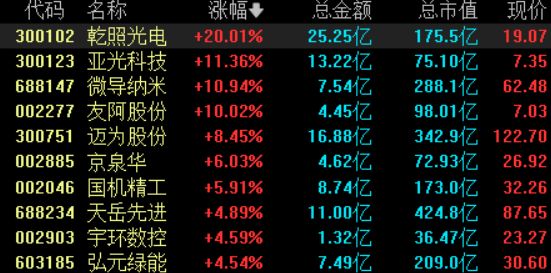
Group 1 - The semiconductor industry chain is experiencing a strong performance, with the third-generation semiconductor sector seeing significant gains, including a 20% limit-up for Qianzhao Optoelectronics and similar increases for other companies [1] - Notable stock performances include Qianzhao Optoelectronics up by 20.01% to 19.07, Yaguang Technology up by 11.36% to 7.35, and Weidao Nano up by 10.94% to 62.48 [2] - The semiconductor-themed ETFs are also rising, with the Kexin Semiconductor ETF and Kexin Semiconductor Equipment ETF both increasing by over 3% [1][2] Group 2 - The trading volume for Qianzhao Optoelectronics reached 25.25 billion, while Yaguang Technology had a trading volume of 13.22 billion [2] - The market capitalization for Weidao Nano is reported at 288.1 billion, indicating strong investor interest [2] - The overall market sentiment in the semiconductor sector is positive, as reflected in the performance of various ETFs tracking semiconductor indices [3]


热门科技类ETF四季度表现承压,调整何时结束?
Guo Ji Jin Rong Bao· 2025-11-19 07:47
Core Viewpoint - The technology sector is experiencing a significant adjustment, with a shift towards value stocks, leading to a debate on whether the market style has switched [1][4]. Market Performance - As of November 18, multiple robotics-themed ETFs have dropped over 14% in the fourth quarter, while previously strong sectors like AI are also seeing declines [2][4]. - The three major indices of the Sci-Tech Innovation Board have experienced varying degrees of decline, with the Sci-Tech 50 Index down 9.19%, the Sci-Tech 100 Index down 8.16%, and the Sci-Tech 200 Index down 6.5% [2][3]. - Despite the recent downturn, the Sci-Tech 50 Index has risen over 37% year-to-date, with the Sci-Tech 100 and 200 indices showing gains exceeding 45% [2]. Factors Influencing Adjustments - The recent adjustments in the technology sector are attributed to three main factors: significant gains in tech stocks since Q2 leading to profit-taking, capital flowing into defensive sectors, and the impact of declining US tech stocks [3][4]. - The current market environment has seen a shift towards traditional value stocks, with sectors like coal, energy, and rare metals leading the market, with the largest ETF in this category rising over 11% [4]. Investment Strategies - Investment professionals suggest a cautious approach to technology ETFs, recommending a gradual accumulation strategy during this adjustment phase [1][6]. - The technology sector is still viewed as a long-term investment focus, supported by policy and industry fundamentals, despite short-term volatility [6]. Future Outlook - Analysts believe that the technology sector may stabilize around Q2 of the following year, contingent on significant policy stimuli or breakthroughs in technology [6]. - The current valuation of the Sci-Tech 50 Index is around 152 times PE (TTM), while the Sci-Tech 100 and 200 indices are above 200 times, indicating a potential caution among investors due to high valuations [4][5].
半导体主题ETF强势霸榜 机构聚焦大盘成长核心资产
Zhong Guo Zheng Quan Bao· 2025-09-28 22:13
Group 1 - The semiconductor industry led the market last week, with several semiconductor-themed ETFs rising over 15% [1][2] - The E Fund semiconductor equipment ETF surged over 16%, leading the entire market [2] - The current growth in AI application users is providing momentum for the semiconductor industry [2] Group 2 - The A500 ETF and the STAR 50 ETF saw significant trading volumes, exceeding 134 billion and 48 billion respectively [4] - The top ten ETFs by net inflow last week were all STAR bond ETFs, indicating strong interest in this sector [4] - The STAR bond ETFs are becoming a key link between social capital and technological innovation, attracting more long-term funds into the tech sector [4] Group 3 - The macro environment remains stable, with policies supporting economic development through manufacturing investment, consumption recovery, and technological innovation [5][6] - There is a shift in market focus from short-term speculation to mid-term structural opportunities, reinforcing the investment logic in growth sectors [5] - Core assets in the market are currently at historically low valuation levels, presenting potential for valuation recovery [5] Group 4 - The tourism ETF experienced a decline of 6.18%, leading the market in losses [3] - Other sectors such as innovative drugs and Hang Seng consumer-related ETFs also saw significant declines [3]
半导体主题ETF强势霸榜机构聚焦大盘成长核心资产
Zhong Guo Zheng Quan Bao· 2025-09-28 20:46
Group 1 - The semiconductor industry led the market last week, with several semiconductor-themed ETFs rising over 15%, particularly the E Fund Semiconductor Equipment ETF which increased by over 16% [1][2] - The current growth in the semiconductor sector is driven by the increasing scale of AI application users both domestically and internationally, providing momentum for the industry [1] - The tourism ETF experienced a decline of 6.18%, leading the market in losses, while innovative drugs and Hang Seng consumer-related ETFs also saw significant drops [2] Group 2 - The trading volume for broad market products was active, with the A500 ETF and the Sci-Tech 50 ETF seeing transaction amounts exceeding 134 billion and 48 billion respectively [2][3] - The net inflow for the top ten ETFs last week was dominated by Sci-Tech bond ETFs, indicating a strong interest in connecting social capital with technological innovation [3] - The macro environment remains stable, with policies supporting economic development through manufacturing investment, consumption recovery, and technological innovation [4] Group 3 - The focus is shifting towards core growth assets in the market, with core asset valuations at historically low levels, suggesting potential for valuation recovery [4] - The outlook for the second half of the year remains optimistic, with active inflows of new capital and expectations of improved corporate earnings [4] - The emphasis on "new quality productivity" is expected to spill over into cyclical sectors, indicating a broader market trend [4]
这一主题ETF,强势上涨
Zhong Guo Zheng Quan Bao· 2025-09-18 12:53
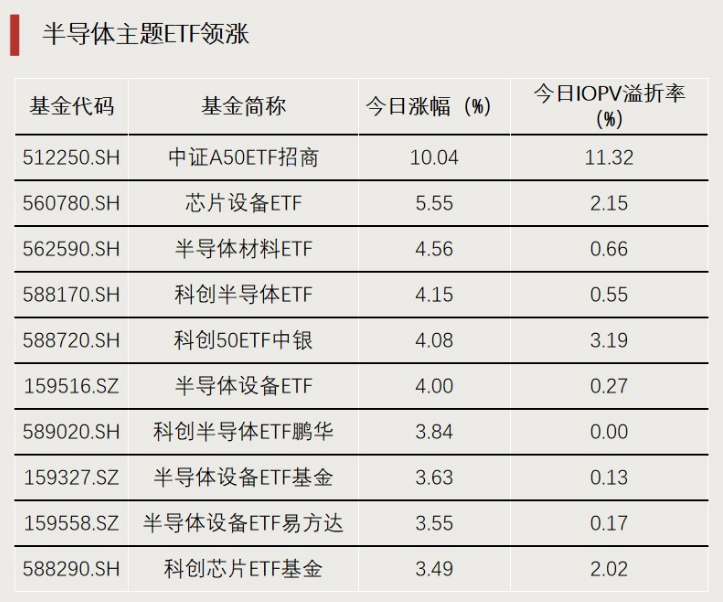
Group 1: Market Reaction to Federal Reserve Rate Cut - On September 18, the Federal Reserve cut interest rates by 25 basis points, leading to a general pullback in A-shares and Hong Kong stocks, while the semiconductor industry chain, particularly technology stocks, saw a strong increase, with Zhongwei Company rising over 11% [1][3] - Multiple semiconductor-themed ETFs rose over 3%, indicating strong investor interest in this sector [1][3] Group 2: ETF Trading Activity - On September 18, trading activity in Hong Kong ETFs was significantly heightened, with the Hang Seng Technology ETF and Hang Seng Technology Index ETF both exceeding 130 billion yuan in trading volume, an increase of over 50 billion yuan from the previous day [1][6] - The semiconductor sector saw notable gains, with the China-Korea Semiconductor ETF rising by 2.72% and its trading volume doubling to 73.75 billion yuan, achieving a turnover rate of nearly 550% [6][7] Group 3: Performance of Semiconductor ETFs - The semiconductor industry chain led the market, with several ETFs tracking semiconductor materials and equipment indices rising over 3%, and some ETFs showing significant premiums [3][4] - Specific ETFs such as the China A50 ETF and Chip Equipment ETF reported notable price increases and premium rates, with the China A50 ETF reaching a premium rate of over 11% [4][3] Group 4: Fundraising and New ETF Launches - On September 18, the second batch of 14 Sci-Tech bond ETFs was announced, with a total fundraising scale exceeding 407 billion yuan, and 13 of the products nearing the 30 billion yuan fundraising cap [2][11]
震荡市安全边际凸显红利资产成资金配置焦点
Zheng Quan Shi Bao· 2025-09-10 18:09
Market Overview - Since September, the A-share market has experienced fluctuations and adjustments, with increased risk aversion leading some funds to shift towards dividend assets characterized by low valuations and high dividends [1] - The Shanghai Composite Index has dropped by 1.18% since September, indicating a structural divergence in the market [2] Sector Performance - The defense, computer, and electronics sectors, which previously led the market, have seen significant corrections, with the defense sector index declining over 10% [2] - Conversely, cyclical sectors such as electric equipment, non-ferrous metals, and public utilities have strengthened, with the electric equipment sector rising over 5% [2] - The strong performance of cyclical sectors is attributed to steady demand recovery and the appeal of high dividend yields in the current market environment [2] Stock Characteristics - Over 3,000 stocks have declined since September, with more than 450 stocks falling over 10%, while over 400 stocks have risen more than 10% [3] - Stocks that have increased by at least 10% exhibit significant high dividend characteristics, with their average market capitalization below 15 billion and average P/E ratios lower than those of declining stocks [4] Fund Flows - Dividend assets have attracted significant capital, with dividend-themed ETFs seeing a net inflow of over 800 million, while other sectors like technology and AI have experienced substantial outflows [5] - Financing balances in sectors such as electric equipment and non-ferrous metals have increased, while sectors like defense and computing have seen declines [5] Stability and Risk Buffer - Dividend assets have shown notable resilience during market downturns, outperforming the Shanghai Composite Index in several instances since 2020 [6][7] - The dividend index has a lower P/E ratio compared to consumer and technology indices, indicating a more attractive valuation for risk-averse investors [8] Investment Strategy - The dividend sector is seen as a strong defensive choice in a volatile market, while the consumer sector offers stable returns and growth potential for long-term investors [9] - The technology sector, despite its high growth potential, carries investment risks due to lower dividend yields and higher valuations [9]
抄底来了!
中国基金报· 2025-06-20 05:37
Core Viewpoint - On June 19, the A-share market experienced a decline, but the overall net inflow of stock ETFs (including cross-border ETFs) reached 50.9 billion yuan, indicating strong investor interest despite market volatility [2][4]. Group 1: Market Performance - The A-share market opened lower and continued to decline throughout the day, with the ChiNext Index leading the drop [4]. - Oil and gas stocks rose against the trend, while short drama concept stocks showed strength [4]. Group 2: ETF Fund Flows - The total net inflow of stock ETFs reached 50.9 billion yuan, bringing the latest total scale to 3.48 trillion yuan [4]. - Industry-themed ETFs saw a net inflow of 27.31 billion yuan, while broad-based ETFs experienced a net outflow of 10.83 billion yuan [4]. Group 3: Top Performing ETFs - The ETFs tracking the Hang Seng Technology Index and the CSI A500 Index had the highest net inflows, amounting to 18.9 billion yuan and 14.02 billion yuan, respectively [5]. - Notable inflows were observed in several leading funds, including the Hang Seng Technology Index ETF with a net inflow of 7.55 billion yuan and the ChiNext ETF with a net inflow of 3.2 billion yuan [5][8]. Group 4: Underperforming Themes - Popular thematic ETFs such as those focused on semiconductors and artificial intelligence saw significant net outflows [6][9]. - Broad-based ETFs like the CSI 300 ETF and A500 ETF were among the largest net outflow contributors [9]. Group 5: Sector Insights - The military sector is expected to benefit from both domestic and international demand, with increased military spending anticipated due to rising global trade uncertainties [9]. - The focus on advanced manufacturing in China is reflected in the investment directions towards core electronic industries and emerging software technologies [9].