北方稀土

Search documents
解密主力资金出逃股 连续5日净流出631股
Zheng Quan Shi Bao Wang· 2025-10-22 10:04
Core Insights - A total of 631 stocks in the Shanghai and Shenzhen markets have experienced net outflows of main funds for five consecutive days or more as of October 22 [1] - The stock with the longest continuous net outflow is Tianma Technology, with 26 days of outflows, followed by Enwei Pharmaceutical with 18 days [1] - The largest total net outflow amount is from Northern Rare Earth, with a cumulative outflow of 5.986 billion yuan over seven days [1] Summary by Category Stocks with Longest Net Outflows - Tianma Technology has seen net outflows for 26 days [1] - Enwei Pharmaceutical has experienced net outflows for 18 days [1] Stocks with Largest Net Outflow Amounts - Northern Rare Earth has a total net outflow of 5.986 billion yuan over seven days [1] - Shanghai Electric follows with a net outflow of 3.732 billion yuan over nine days [1] Stocks with Highest Net Outflow Ratios - Yongxin Zhicheng has the highest net outflow ratio, with a 7-day decline of 11.27% [1] - Other notable stocks include Shanzhi Gaoke and Baogang Co., with significant net outflow ratios and declines [1]





45.02亿元资金今日流出有色金属股
Zheng Quan Shi Bao Wang· 2025-10-22 09:42
Market Overview - The Shanghai Composite Index fell by 0.07% on October 22, with nine industries experiencing gains, led by the petroleum and petrochemical sector, which rose by 1.58% [1] - The total net outflow of funds from the two markets was 44.231 billion yuan, with four industries seeing net inflows, primarily in the petroleum and petrochemical sector, which had a net inflow of 558 million yuan [1] Industry Performance - The non-ferrous metals industry saw a decline of 1.36%, with a total net outflow of 4.502 billion yuan. Out of 137 stocks in this sector, 31 rose while 102 fell [2] - The top three stocks with the highest net inflow in the non-ferrous metals sector were Xinbo Co., which had a net inflow of 119 million yuan, followed by Zhongtung High-tech and China Aluminum, with net inflows of 65.536 million yuan and 62.256 million yuan, respectively [2] Fund Flow Analysis - The non-ferrous metals sector had 33 stocks with net inflows, while 11 stocks experienced net outflows exceeding 100 million yuan. The largest outflows were from Northern Rare Earth, Shenghe Resources, and Zhongjin Gold, with outflows of 709 million yuan, 340 million yuan, and 327 million yuan, respectively [2][3] - The top stocks with the highest net outflows included Northern Rare Earth, which fell by 2.98%, and Shenghe Resources, which dropped by 4.21% [3]





美澳签署稀土协议,一举打破中国垄断?特朗普直言:多到用不完
Sou Hu Cai Jing· 2025-10-22 08:17
Group 1 - The core viewpoint of the article is that the US and Australia have signed a critical rare earth agreement aimed at reducing China's dominance in the rare earth market, with Trump expressing confidence in an oversupply of rare earths in the US within a year [1][3][29] - The agreement involves a total investment of $3 billion from both countries over the next six months to develop Australia's rare earth mining projects, targeting a local rare earth resource valued at $53 billion [3] - The US military plans to build a gallium refining plant in Western Australia, which will produce 100 tons of gallium metal annually, a crucial material for radar, missiles, and satellites [5][29] Group 2 - Australia holds 3% to 4% of global rare earth reserves and half of the world's lithium exports, but faces challenges in processing these resources effectively [5][29] - Despite the optimistic statements, a significant portion of Australia's lithium is still exported to China for processing, highlighting the ongoing dependency on Chinese refining capabilities [7][29] - The process of turning rare earth ore into usable materials involves over 20 steps, with extraction and separation being the core technologies, where China has a substantial advantage due to decades of development [9][29] Group 3 - China's rare earth industry has a well-established supply chain, with significant cost advantages in processing compared to Australia, where environmental regulations and labor costs are much higher [11][29] - The US Geological Survey reports that China holds 44 million tons of rare earth reserves, accounting for 49% of global reserves, and dominates the processing capacity [15][29] - Previous attempts by the US to achieve rare earth independence, such as the "Rare Earth Independence Initiative" during the Obama administration, ended in failure due to high costs and technical challenges [16][29] Group 4 - The recent Chinese restrictions on rare earth exports are a response to US technology blockades, with significant impacts already observed in export volumes and prices [22][24] - Major companies, including Volkswagen, have expressed reluctance to join the US-led rare earth alliance, citing China's efficiency and cost-effectiveness in the supply chain [25][29] - The gallium production plan in Australia faces challenges, including the need for substantial investment in renewable energy to ensure stable power supply for the new plant [27][29] Group 5 - The essence of the rare earth competition is not about resource control but about mastering efficient and low-cost supply chain capabilities, with China having spent decades developing its industry [29] - The global trend towards restructuring supply chains indicates that future competition will focus on technological innovation and sustainable production methods, presenting both challenges and opportunities for China's rare earth industry [29]


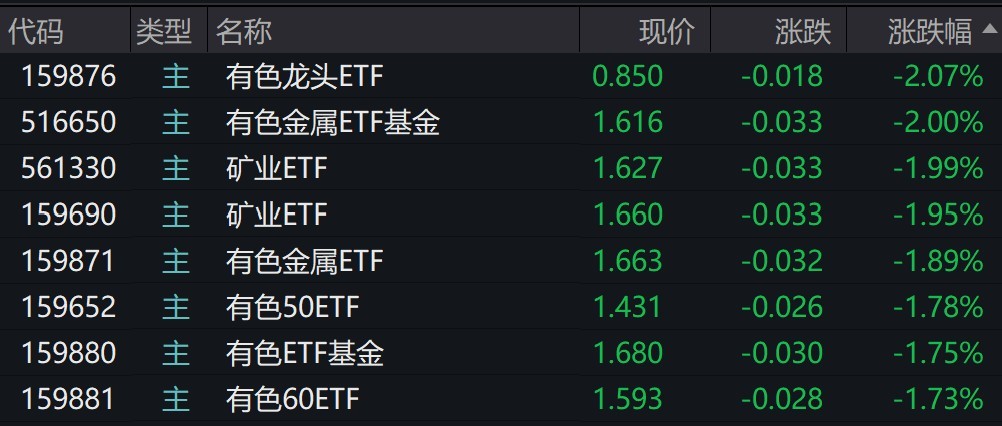
有色金属概念股早盘走低,有色、矿业相关ETF跌约2%
Mei Ri Jing Ji Xin Wen· 2025-10-22 03:01
Group 1 - The core viewpoint indicates that non-ferrous metal stocks are experiencing a decline, with significant drops in companies such as Shandong Gold, Zhongjin Gold, and Chifeng Gold, all falling over 4%, while Zijin Mining and Northern Rare Earth dropped over 2% [1] - Related ETFs in the non-ferrous and mining sectors have also seen a decline of approximately 2% [1] Group 2 - Specific ETF performance shows that the Non-Ferrous Leading ETF is priced at 0.850, down by 2.07%, while the Non-Ferrous Metal ETF Fund is at 1.616, down by 2.00% [2] - A brokerage report suggests that the non-ferrous metal sector will continue to face high market volatility risks in 2025 due to uncertainties from both demand and supply sides [2] - Emerging demand in the downstream structure of copper and aluminum is expected to support a long-term upward shift in the price center of non-ferrous metals [2]




黄金巨震!发生了什么?机构:只要美联储维持降息or下周美国CPI数据上涨,金价仍可能上行!
Xin Lang Ji Jin· 2025-10-22 02:41
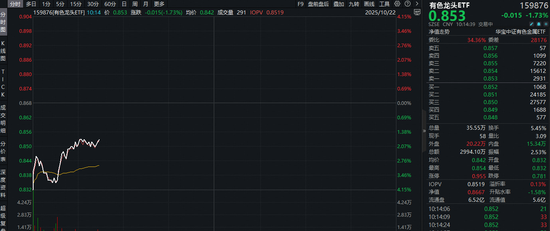
Core Viewpoint - The recent sharp decline in gold prices, attributed to profit-taking and reduced safe-haven demand due to easing geopolitical tensions, has negatively impacted leading companies in the precious metals sector, particularly gold stocks [3]. Summary by Category Market Performance - On October 22, the non-ferrous metal sector ETF (159876) fell by 1.73%, with a trading volume of nearly 300 million yuan, indicating active trading [1]. - As of October 21, the non-ferrous metal sector ETF (159876) had a total size of 565 million yuan, the largest among three ETFs tracking the same index [1]. Stock Movements - Leading gold stocks experienced significant declines, with Western Gold and Hunan Gold dropping over 5%, while Sichuan Gold and Chifeng Gold fell more than 4% [1]. - Conversely, Baotai Co. rose over 2%, and Hailiang Co. and Yun Aluminum gained more than 1%, with several other stocks like Zhongkuang Resources and China Aluminum also performing well [1]. Gold Price Dynamics - Gold prices saw a rare drop of over 6%, marking the largest daily decline since April 2013, primarily due to profit-taking and a stronger dollar making gold more expensive for buyers [3]. - Analysts suggest that while current pressures exist, the long-term outlook for gold remains positive as long as the Federal Reserve maintains its current interest rate path [3]. Sector Outlook - The non-ferrous metals sector is expected to benefit from a long-term supply-demand imbalance, driven by increased capital expenditure and strategic resource reserves amid global manufacturing investment growth [4]. - Specific segments such as rare earths, lithium, and copper are highlighted for their growth potential due to favorable market conditions and technological advancements [3][4]. Investment Strategy - A diversified approach to investing in the non-ferrous metals sector is recommended, utilizing the non-ferrous metal sector ETF (159876) to mitigate risks associated with individual metal investments [6].


中国稀土战略地位进一步强化,稀土ETF嘉实(516150)近5日“吸金”22.51亿元,机构:稀土价格有望进一步上涨
Xin Lang Cai Jing· 2025-10-22 02:23
Core Insights - The China Rare Earth Industry Index has decreased by 1.58% as of October 22, 2025, with mixed performance among constituent stocks, led by Shengxin Lithium Energy with a rise of 1.81% [1] - The recent tightening of rare earth export controls by the Ministry of Commerce is expected to strengthen China's strategic position in the rare earth market, potentially leading to increased prices [3] Group 1: Market Performance - The rare earth ETF, Jiashi, has seen a turnover of 1.52% and a transaction volume of 1.61 billion yuan, with its latest scale reaching 10.875 billion yuan, marking a new high since its inception [2] - Over the past week, Jiashi's shares increased by 5.76 million, leading the comparable funds in terms of new share growth [2] - In the last five trading days, Jiashi has experienced net inflows on four occasions, totaling 2.251 billion yuan [2] Group 2: Fund Performance - As of October 21, 2025, Jiashi's net value has increased by 91.40% over the past two years, ranking 79th out of 2,358 index equity funds, placing it in the top 3.35% [2] - The highest monthly return since inception for Jiashi was 41.25%, with the longest consecutive monthly gain being four months and a maximum increase of 83.89% [2] Group 3: Industry Dynamics - The recent policy changes include increased export controls on five categories of medium and heavy rare earths, as well as restrictions on equipment, technology, and raw materials across the entire industry chain [3] - These measures are expected to complicate the establishment of independent rare earth supply chains overseas, thereby enhancing China's competitive advantage in the long term [3] - The limitations on overseas supply of rare earth magnetic materials are anticipated to boost demand for high-performance ferrite permanent magnets, leading to a significant increase in orders [3] Group 4: Key Stocks - The top ten weighted stocks in the China Rare Earth Industry Index account for 61.96% of the index, with notable performers including Northern Rare Earth and China Rare Earth, which saw declines of 2.69% and 1.81% respectively [2][5]


稀土永磁指数跌幅达3.02%,多股跌超4%
Mei Ri Jing Ji Xin Wen· 2025-10-22 02:12
每经AI快讯,10月22日,稀土永磁指数盘中震荡下行,跌幅达3.02%。成分股方面,多数个股跟随指数 调整,其中铂科新材跌5.33%,金力永磁跌5.19%,银河磁体跌4.49%,盛和资源跌4.30%,北方稀土跌 4.72%。 ...


对美出口不减反增 全球稀土永磁龙头金力永磁逆流而上
2 1 Shi Ji Jing Ji Bao Dao· 2025-10-21 23:16
Core Viewpoint - The company, Jinli Permanent Magnet, has seen an increase in exports to the U.S., with a significant growth in revenue and profitability, indicating strong market demand and operational efficiency [1][4][6]. Group 1: Financial Performance - In the first three quarters, the company achieved a revenue of 5.373 billion yuan, with export sales to the U.S. reaching 354 million yuan, a year-on-year increase of 43.92% [1][4]. - The net profit attributable to the parent company in Q3 was 211 million yuan, representing a year-on-year growth of 172.7% [1][14]. - The company's gross profit margin improved to 19.49%, an increase of 9.46 percentage points compared to the previous year [13]. Group 2: Market Position and Client Base - Jinli Permanent Magnet is the leading enterprise in the rare earth permanent magnet materials industry, both nationally and globally, with a strong presence in the electric vehicle and wind power sectors [1][6][9]. - The company supplies products to five of the top ten wind turbine manufacturers and all top ten electric vehicle manufacturers globally [6][9]. Group 3: Export Growth and Strategy - The company's overseas revenue is projected to exceed 1.2 billion yuan in 2024, accounting for approximately 18% of total revenue, with U.S. exports estimated at 418 million yuan [3][4]. - Following the implementation of export controls on certain rare earth materials, the company has successfully obtained export licenses and continues to expand its international market presence [5][6]. Group 4: Future Outlook and Expansion Plans - The company is in an expansion phase, with plans to increase its production capacity to 60,000 tons by 2027, following the completion of a new project [18]. - Analysts predict that the company's net profit for 2025 could exceed 700 million yuan, with some estimates reaching around 800 million yuan [16].
中国北方稀土(集团)高科技股份有限公司关于召开2025年第三季度业绩说明会的公告
Shang Hai Zheng Quan Bao· 2025-10-21 18:36
Core Viewpoint - China Northern Rare Earth Group High-Tech Co., Ltd. is set to hold a Q3 2025 performance briefing on October 29, 2025, to discuss its operational results and financial status with investors [2][3]. Group 1: Meeting Details - The performance briefing will take place on October 29, 2025, from 15:00 to 16:00 [4]. - The meeting will be held at the Shanghai Stock Exchange Roadshow Center and will be conducted in an interactive online format [4][5]. - Company executives, including the General Manager and independent directors, will participate in the meeting [4]. Group 2: Investor Participation - Investors can join the meeting online via the Shanghai Stock Exchange Roadshow Center [5]. - A pre-submission of questions is encouraged from October 22 to October 28, 2025, allowing the company to address common investor concerns during the briefing [5]. Group 3: Contact Information - The company’s securities department can be contacted at phone numbers 0472-2207799 and 0472-2207788, or via email at cnrezqb@126.com for further inquiries [6].
冲中国稀土地位?一觉醒来,美澳85亿稀土协议落地,誓破中国垄断,特朗普:量多到用不完
Sou Hu Cai Jing· 2025-10-21 16:50
Core Viewpoint - China's recent export control measures on rare earth elements directly impact the U.S., highlighting the latter's dependency on Chinese rare earth materials for high-tech industries, including defense [1][3]. Group 1: China's Export Control Measures - The Chinese Ministry of Commerce has issued six announcements regarding the export control of all seventeen rare earth elements and related technologies, including extraterritorial clauses affecting foreign companies [1]. - Rare earth elements are crucial for modern industries, particularly in semiconductors and military applications, where U.S. defense contractors rely heavily on these materials [1][3]. Group 2: U.S. Response and Agreements - In response to China's export controls, the U.S. has signed an $8.5 billion rare earth supply agreement with Australia, aiming to reduce reliance on Chinese supplies [3][4]. - The agreement includes over $3 billion in investments in Australian rare earth mining projects, with an estimated value of over $53 billion in extractable rare earth minerals [3][6]. Group 3: U.S. Expectations and Challenges - U.S. officials, including former President Trump, express optimism that the agreement will resolve the rare earth supply issues, suggesting that the U.S. will have an abundance of these materials within a year [4][6]. - Despite the U.S. efforts, China's dominance in the rare earth sector is significant, with proven reserves of 44 million tons, accounting for nearly half of global reserves, and a complete supply chain from mining to processing [6][9]. Group 4: China's Competitive Advantages - China controls 90% of the global rare earth separation and purification processes, with major companies holding 85% of domestic mining quotas and 90% of smelting capacity [6][9]. - The country has a strong technological edge, having filed nearly 26,000 rare earth-related patents, surpassing the total of all other countries combined, and achieving high purification efficiencies [9].