中信银行

Search documents
节能国祯(300388.SZ):取得金融机构股票回购专项贷款承诺函
Ge Long Hui A P P· 2025-11-19 11:46
格隆汇11月19日丨节能国祯(300388.SZ)公布,近日,公司取得中信银行股份有限公司合肥分行出具的 《贷款承诺函》,主要内容如下:1.贷款银行:中信银行股份有限公司合肥分行;2.承诺贷款额度:不 超过人民币9,000万元;3.贷款用途:专项用于回购公司股票;4.借款期限:不超过3年;5.承诺函有效 期:自签发之日生效,有效期1年。 ...

腾讯金融,藏不住的“赚钱巨兽”
Xin Lang Cai Jing· 2025-11-19 11:11
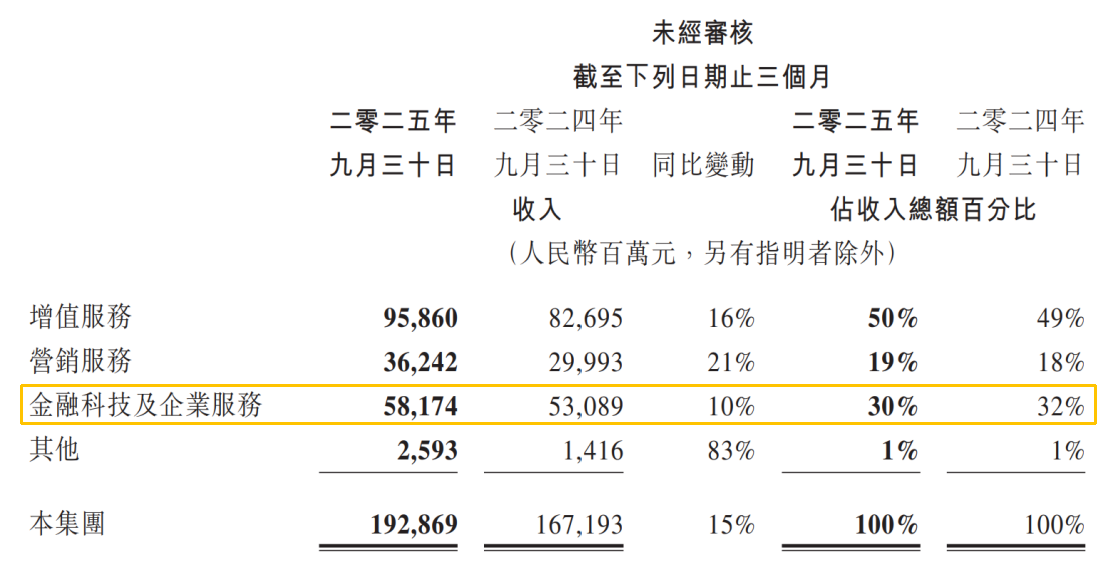
Core Viewpoint - Tencent has reported strong financial performance for Q3 2025, with revenue reaching 192.87 billion yuan, a 15% increase year-on-year, and net profit of 63.13 billion yuan, up 19% from the previous year [1] Financial Performance - Revenue for Q3 2025 was 192.87 billion yuan, an increase of 25.68 billion yuan compared to the same period last year, representing a 15% growth [1] - Net profit attributable to shareholders was 63.13 billion yuan, an increase of nearly 10 billion yuan year-on-year, reflecting a 19% growth [1] - The Financial Technology and Enterprise Services segment generated revenue of 58.17 billion yuan, a 10% increase year-on-year, contributing approximately 30% to total revenue [1][4] Financial Technology Overview - Tencent's financial services are characterized by a diverse range of offerings, including payment, banking, credit, insurance, and wealth management, which are integrated into daily life [6] - WeChat Pay, launched in 2013, is a key component of Tencent's financial ecosystem, with over 1.4 billion monthly active accounts and an average daily usage frequency of about 2.7 times [6] - By Q1 2025, WeChat Pay is projected to surpass Alipay in market share, reaching 59.7% compared to Alipay's 36.2% [6] Strategic Positioning - Tencent's financial strategy emphasizes the role of WeChat Pay as a "super entry point" for data collection and user engagement, which supports its various financial services [7] - The company has established a comprehensive financial ecosystem, including WeBank, which is China's first private and internet bank, and has achieved significant profitability [10][12] - Tencent's wealth management platform, LiCaiTong, has evolved from a tool to a habit for users, indicating strong user engagement and retention [12] International Expansion - Tencent is actively pursuing international opportunities, with investments in digital banks and fintech companies across various countries, including the UK, Brazil, and Germany [15][16] - The company has established a presence in cross-border payments and digital banking, indicating a strategic focus on global financial markets [15][16] Financial Technology Growth - From 2018 to 2024, the revenue from the Financial Technology and Enterprise Services segment grew from 73.14 billion yuan to 211.96 billion yuan, with a compound annual growth rate of nearly 20% [17] - Financial technology is estimated to account for approximately 80% of the revenue in the Financial Technology and Enterprise Services segment, highlighting its significance to Tencent's overall financial performance [20] Cautious Approach - Tencent's financial growth is characterized by a cautious and restrained approach, focusing on stability and compliance in a highly regulated environment [23][29] - The company has not pursued a public listing for its financial services, maintaining a close integration with its core platform [28] - Tencent's strategy involves acting as a "connector" within its financial ecosystem, collaborating with various partners while minimizing direct control to mitigate risks [26][27]


重磅金融会议正式启幕,两大品牌强强联合!笃行作答“五篇大文章”荣誉大奖揭晓
Zheng Quan Shi Bao Wang· 2025-11-19 10:27
Core Viewpoint - The 19th Shenzhen International Financial Expo and the 2025 China Financial Institutions Annual Conference have joined forces to create a high-end platform for discussing development strategies and sharing innovative experiences in the financial sector [1][2]. Group 1: Event Overview - The event is co-hosted by the Shenzhen Municipal Government and the Securities Times, marking the first collaboration between these two significant financial events [1][2]. - The theme of the 2025 China Financial Institutions Annual Conference is "Empowering and Reshaping Value," focusing on the financial sector's role in the context of China's 14th Five-Year Plan conclusion and the 15th Five-Year Plan preparation [1][2]. Group 2: Key Opportunities and Goals - Shenzhen's financial industry is positioned at a critical juncture, with three major opportunities identified: leveraging national policies, utilizing international platforms, and enhancing industry integration [2]. - The city aims to establish itself as a globally influential industrial financial center, focusing on six key areas: technology industry finance, innovative capital formation, financial technology, cross-border RMB services, wealth management, and financial security [2]. Group 3: Industry Insights - The Securities Times has evolved into a key platform for industry wisdom, enhancing the influence and professional depth of the annual conference [3]. - The conference emphasizes the importance of optimizing financial institutions and focusing on core business areas to support high-quality financial development [3]. Group 4: AI in Asset Management - AI is seen as a transformative force in asset management, helping navigate challenges such as low interest rates and increased volatility [4][5]. - The integration of AI is not optional but essential for the asset management industry, expanding service boundaries and reshaping processes [5]. Group 5: Public Fund Development Trends - The public fund industry is expected to focus on dual drivers of "industry" and "livelihood" investments, aligning with national strategies [6][7]. - Key trends include a human-centered approach, expansion of index and pension products, accelerated digital transformation, and international business development [7][8]. Group 6: Awards and Recognition - The "China Financial Industry Awards for Practicing the 'Five Major Articles'" were presented, recognizing institutions that excelled in areas such as technology finance and green finance [9][10]. - The awards aim to encourage further exploration and strategic planning among financial institutions in these critical areas [9].

重磅金融会议正式启幕,两大品牌强强联合!笃行作答“五篇大文章”荣誉大奖揭晓
券商中国· 2025-11-19 09:52
"2025中国金融机构年会"主题为"聚势赋能 重塑价值"。今年恰逢"十四五"收官与"十五五"谋划的关键时点,在金融强国建设蹄疾步稳、中国特色现代金融体系加速 构建的背景下,如何更好践行金融"五篇大文章",成为各类金融机构共同面临的时代课题。本届年会的召开,旨在为行业提供一个共商发展大计、共享创新经验的 高端平台。 两大品牌活动首次联手 在开幕式上,深圳市人民政府副秘书长吴坤生致辞时表示,本届金博会是在全面贯彻党的二十大和二十届四中全会精神的关键时期举办的一次重要盛会。本届金博 会紧扣金融"五篇大文章"核心主线,以"产业金融新高地、科创赋能向未来"为主题,集中展示金融改革开放最新成果,搭建合作交流平台,必将为深圳建设具有全 球重要影响力的产业金融中心注入强大动力。 11月19日,"第十九届深圳国际金融博览会暨2025中国金融机构年会"在深圳开幕。这是深圳市人民政府主办的"深圳国际金融博览会"与由证券时报社主办的"中国金 融机构年会"两大品牌活动首次强强联合。 吴坤生表示,当前,深圳金融业正处在动能迸发、跨越提升的黄金机遇期,要牢牢把握三大机遇:一是胸怀"国之大者",把握政策机遇;二是立足开放前沿,善用 国际舞台 ...

AI重塑银行数字竞争力 机制与人才变革正在进行时
2 1 Shi Ji Jing Ji Bao Dao· 2025-11-19 09:30
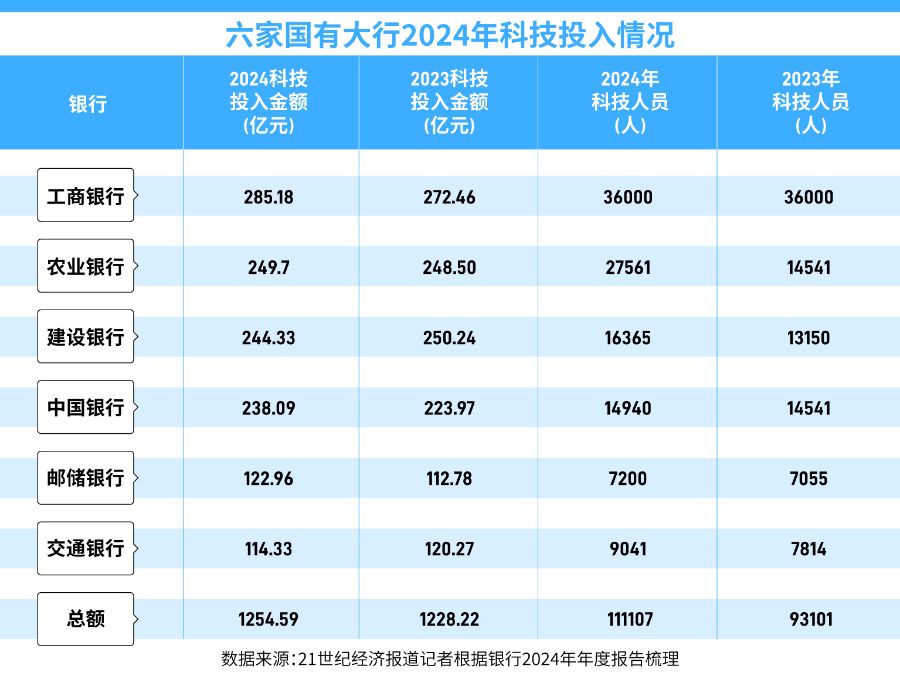
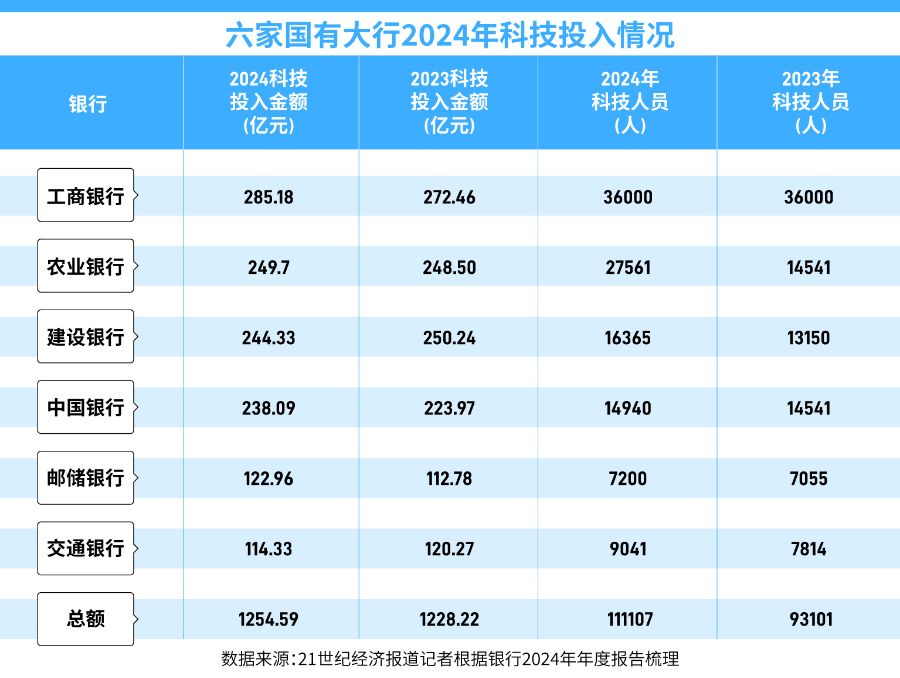
Core Insights - The banking industry is entering a new phase of digital finance development driven by AI applications, which are reshaping competitive dynamics and enabling smaller banks to gain advantages through innovation [1][2]. Group 1: Technology Investment and Governance - In 2024, the total technology investment by six major state-owned banks exceeded 120 billion yuan, marking a year-on-year increase of 2.15%, with a total of over 110,000 technology personnel, up 19.34% from the previous year [2][3]. - The technology investment of these six banks accounts for over 50% of the total technology investment across 59 banks that disclosed relevant data, which exceeded 200 billion yuan in 2024 [3]. - Some banks, such as China Construction Bank and Ping An Bank, reported a decrease in technology investment, with declines of 2.36% and 20.07% respectively, indicating a potential slowdown in technology spending [4]. Group 2: AI Integration and Talent Development - Banks are increasingly focusing on optimizing technology governance structures and enhancing resource management, with a particular emphasis on integrating AI into various business lines [5][6]. - The rise of AI has led to a significant increase in the proportion of technology personnel within banks, with all 11 major banks reporting growth in this area compared to 2023 [8][9]. - Banks are adopting dual pathways for cultivating composite talents, including targeted recruitment and internal mechanisms to foster collaboration between technology and business functions [10][11]. Group 3: Strategic Initiatives and Innovations - Several banks, including Industrial and Commercial Bank of China and Minsheng Bank, are launching strategic initiatives to deepen their digital transformation and AI capabilities [6][7]. - The focus is shifting from merely integrating technology to co-creating business and technology solutions, as highlighted by the emphasis on business involvement in AI model development [12].
港股央企红利ETF(159333)涨0.47%,成交额1638.17万元




Xin Lang Cai Jing· 2025-11-19 09:30
Core Viewpoint - The Wanjiac ZHONGZHENG Hong Kong Stock Connect Central State-Owned Enterprises Dividend ETF (159333) has shown a slight increase in its closing price and has experienced a decrease in both share count and total assets year-to-date [1][2]. Group 1: Fund Performance - As of November 19, 2024, the ETF closed up by 0.47% with a trading volume of 16.38 million yuan [1]. - The fund's management fee is 0.50% annually, and the custody fee is 0.10% annually [1]. - The ETF's performance benchmark is the ZHONGZHENG Hong Kong Stock Connect Central State-Owned Enterprises Dividend Index return (adjusted for valuation exchange rate) [1]. Group 2: Fund Size and Liquidity - As of November 18, 2024, the ETF has 328 million shares outstanding and a total size of 485 million yuan [1]. - Compared to December 31, 2024, the ETF's shares have decreased by 23.90% and its total size has decreased by 5.48% year-to-date [1]. - Over the last 20 trading days, the ETF has accumulated a trading volume of 441 million yuan, with an average daily trading volume of 22.07 million yuan [1]. - Year-to-date, the ETF has recorded a total trading volume of 8.108 billion yuan, with an average daily trading volume of 38.06 million yuan [1]. Group 3: Fund Management and Holdings - The current fund manager is Yang Kun, who has managed the ETF since August 21, 2024, achieving a return of 52.34% during his tenure [2]. - The ETF's top holdings include COSCO Shipping Holdings, China Nonferrous Mining, China Ocean Shipping, Orient Overseas International, CITIC Bank, China Petroleum, China Shenhua Energy, People's Insurance Group of China, CNOOC, and Agricultural Bank of China, with respective holding percentages [2].
AI重塑银行数字竞争力,机制与人才变革正在进行时
2 1 Shi Ji Jing Ji Bao Dao· 2025-11-19 09:26
Core Insights - The banking industry is entering a new phase of digital finance development driven by AI applications, enhancing the integration of technology and business operations [2] - There is a significant increase in technology investment among major banks, with a focus on optimizing governance structures and resource management [3][4] - AI is reshaping competitive dynamics in the banking sector, enabling smaller banks to leverage technology for innovation and growth [2] Technology Investment and Governance - In 2024, the total technology investment by six major state-owned banks exceeded 120 billion yuan, marking a 2.15% year-on-year increase, with a total of over 111,000 technology personnel, up 19.34% from the previous year [3][4] - The technology investment of these six banks accounts for over 50% of the total technology spending in the banking industry, which exceeds 200 billion yuan [4] - Some banks, such as China Construction Bank and Ping An Bank, have reported a decrease in technology investment, indicating a shift towards optimizing technology resource management [5][6] AI Application and Innovation - AI applications are accelerating the integration of business and technology, with various banks launching innovative projects across different scenarios [2][6] - Smaller banks like Qingdao Bank and Hunan Bank have demonstrated significant innovation capabilities through AI, winning multiple awards in recent fintech competitions [2] Talent Development and Resource Allocation - The proportion of technology personnel in major banks has increased, reflecting a growing emphasis on talent as a core resource for digital finance development [9][10] - Banks are adopting dual pathways for cultivating composite talents, focusing on both external recruitment and internal mechanisms to enhance the integration of technology and business [11][12] - The shift towards "business-technology co-creation" is emphasized, with banks encouraging deeper involvement of business units in technology development processes [13]





通威股份:完成5亿元2025年度第三期绿色科创债发行
Xin Lang Cai Jing· 2025-11-19 09:15
通威股份公告称,公司已完成2025年度第三期绿色科技创新债券发行工作。债券简称"25通威GN003(科 创债)",代码132580125,期限1+1年,起息日和兑付日分别为2025年11月19日、2027年11月19日。计划 和实际发行总额均为50000.00万元,发行利率2.02%,发行价100.00(百元面值)。主承销商为兴业银 行,联席主承销商为中国银行和中信银行。募集资金已于11月19日全额到账。 ...

@各位银行股东,你的“中期红包”正陆续到账!
Jin Rong Shi Bao· 2025-11-19 08:56
Core Viewpoint - The banking sector in China is experiencing a mid-term dividend distribution wave, with numerous listed banks announcing substantial cash dividends to reward investors, reflecting a broader trend of increasing shareholder returns across the industry [1][2][5]. Group 1: Dividend Announcements - Hangzhou Bank announced a cash dividend of 0.38 yuan per share, totaling 27.55 billion yuan, marking a year-on-year increase of 24.10% [1]. - As of mid-November, ten listed banks, including Ping An Bank, Minsheng Bank, and Shanghai Bank, have already distributed mid-term dividends [2]. - China’s six major state-owned banks are set to distribute over 204.65 billion yuan in mid-term dividends, with individual banks like China Bank and Construction Bank planning to hold shareholder meetings to approve their dividend proposals [3]. Group 2: Industry Trends - A total of 24 A-share listed banks have disclosed their mid-term dividend plans, with the total cash dividend amount reaching 263.79 billion yuan [3]. - Several banks, including Industrial Bank and Changsha Bank, are implementing mid-term dividends for the first time since their listings [3]. - The trend of increasing mid-term dividends is seen as a response to regulatory encouragement for companies to enhance shareholder returns [5]. Group 3: Market Impact - The mid-term dividend distribution has led to a surge in bank stock prices, with the Shenwan Bank Index rising by 7.7% from October 14 to November 14 [7]. - Major banks have seen significant stock price increases, with Industrial Bank and Agricultural Bank experiencing gains of 13.5% and 23.0%, respectively [7]. - The early timing of dividend distributions this year compared to last year is expected to sustain the upward momentum in bank stocks until the end of November [6][7].

股份制银行板块11月19日涨1.02%,光大银行领涨,主力资金净流入5.77亿元
Zheng Xing Xing Ye Ri Bao· 2025-11-19 08:52
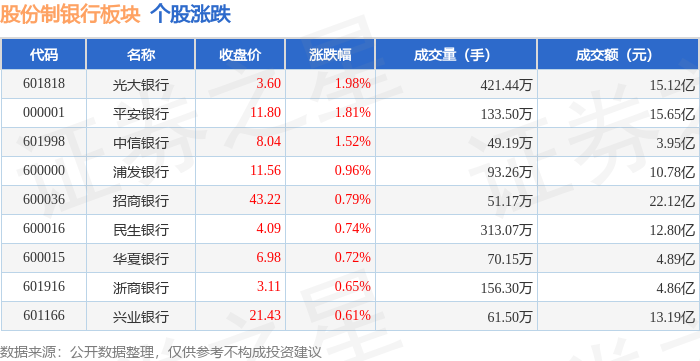
Core Insights - The banking sector saw a rise of 1.02% on November 19, with Everbright Bank leading the gains [1] - The Shanghai Composite Index closed at 3946.74, up 0.18%, while the Shenzhen Component Index closed at 13080.09, unchanged [1] Banking Sector Performance - Everbright Bank's stock price increased by 1.98% to 3.60, with a trading volume of 4.21 million shares and a transaction value of 15.12 million [1] - Ping An Bank rose by 1.81% to 11.80, with a trading volume of 1.34 million shares and a transaction value of 1.56 billion [1] - CITIC Bank's stock price increased by 1.52% to 8.04, with a trading volume of 491,900 shares and a transaction value of 39.5 million [1] - Other banks like Shanghai Pudong Development Bank, China Merchants Bank, and Minsheng Bank also showed positive performance, with varying increases in stock prices and trading volumes [1] Capital Flow Analysis - The banking sector experienced a net inflow of 577 million from main funds, while retail funds saw a net outflow of 174 million [1] - Major banks like China Merchants Bank and Ping An Bank had significant net inflows from main funds, while they faced outflows from retail and speculative funds [2] - Everbright Bank had a net inflow of 24.92 million from main funds but saw a net outflow of 98.58 million from retail investors [2]