
邮储银行

Search documents
邮储银行登封市支行开展反洗钱宣传活动
Huan Qiu Wang· 2025-12-12 05:06
同时,工作人员利用客户等候间隙,用通俗易懂的"家常话"解读"客户尽职调查""大额交易报告"等核心 概念,结合"出租银行卡获利反获刑""虚假投资背后的洗钱陷阱"等真实案例,直观揭示洗钱犯罪的隐蔽 性、危害性。 近日,邮储银行登封市支行以"全民反洗钱,护航新生活"为主题,创新开展"网点阵地宣传+周边商户延 伸推广"双向联动活动,让反洗钱知识走进千家万户,筑牢金融安全民生防线。 作为宣传主阵地,该支行营业大厅精心营造浓厚宣传氛围:LED 屏滚动播放"远离洗钱陷阱,守护财产 安全""不出租出借个人银行账户"等醒目标语;窗口柜台、客户等候区整齐陈列宣传折页,内容涵盖反 洗钱基础知识、典型案例解析、维权途径指引等,方便客户随时取阅学习。 来源:环球网 此次宣传活动通过网点服务与户外推广的有机结合,显著提升了周边公众对反洗钱工作的认知度、警惕 性和参与度。下一步,邮储银行登封市支行将以此次活动为契机,持续深化"厅堂+户外"宣传模式,将 反洗钱宣传深度融入日常金融服务各环节,引导社会各界共同参与反洗钱工作,携手营造安全、健康、 有序的金融生态环境。 为扩大宣传覆盖面,该支行工作人员主动走出网点,深入周边商户、沿街商铺开展延伸 ...

邮储银行正式发布“AI2ALL”数字生态,开启全域智能、生态共生的数字金融新纪元
Cai Jing Wang· 2025-12-12 03:17
Core Insights - The release of the "AI2ALL" digital ecosystem marks a new era in the digital transformation of Postal Savings Bank of China, emphasizing its strategic layout and innovative practices in artificial intelligence [1][8] Group 1: Strategic Layout and AI Integration - Postal Savings Bank has been advancing its "Digital Postal Savings" strategy and deepening its "AI+" initiatives, achieving significant breakthroughs in financial technology, evidenced by winning the People's Bank of China Financial Technology Development Award for three consecutive years [2] - The "AI2ALL" digital ecosystem focuses on four value dimensions: broad customer base, deep customer experience, multi-model scenarios, and micro-detail innovation, planning nearly 260 AI application scenarios to integrate AI capabilities throughout banking operations and customer service [2] Group 2: Internal Efficiency and Employee Empowerment - The bank actively involves employees in the implementation of intelligent applications, collecting innovative ideas and process optimization suggestions to enhance core areas such as precise marketing and risk compliance [3] - In front-office services, the bank has developed intelligent marketing tools that utilize AI technology to achieve personalized outreach, covering over 54 million clients in wealth management marketing, with a conversion rate of 36.2% for personal loan marketing [3] Group 3: Risk Management and Operational Efficiency - In the middle-office risk control area, the bank has created intelligent loan review tools that standardize the review process, achieving an accuracy rate of 98% in image classification and 92% in key information extraction [4] - The intelligent analysis tools in the back office enhance employee capabilities, allowing for data extraction and analysis in just three minutes, with a result adoption rate of 95% [4] Group 4: Customer Experience Enhancement - The bank has redefined customer service touchpoints by integrating AI into various channels, including mobile banking and offline branches, to continuously optimize products and services based on user feedback and data insights [5] - The "process is response" model in offline services has improved operational efficiency by 40%, significantly enhancing customer service experiences [5] Group 5: Remote and Online Service Innovations - The bank's remote service innovations include intelligent outbound calling that enhances customer interaction and emotional connection, responding to customer needs in 1.8 seconds with highly human-like voice responses [6] - The upgraded mobile banking version 11.0 redefines digital financial services, offering personalized features and a dual protection mechanism for high-risk transactions, achieving a top user experience ranking for three consecutive years [7] Group 6: Future Outlook - The launch of the "AI2ALL" digital ecosystem signifies a systematic deployment and large-scale application of the "Digital Postal Savings" strategy, indicating a shift towards a fully intelligent and symbiotic ecosystem in financial services [8]


银行信用卡、消费贷年末优惠密集落地,激活消费有新招
Hua Xia Shi Bao· 2025-12-12 02:00
Core Viewpoint - The banking industry is intensifying credit card promotions and consumer loan activities to stimulate user spending as the "Double Twelve" shopping festival approaches, marking a shift from "scale expansion" to "quality cultivation" in banking operations [2][5]. Group 1: Credit Card Promotions - Major banks are launching various credit card discount activities across platforms like Taobao, JD.com, and Douyin, with specific offers such as discounts for spending thresholds [3][4]. - China Bank announced multiple promotions, including discounts for spending over 200 yuan on Taobao and JD.com, with potential savings reaching up to 188 yuan [3]. - Other banks, such as Zhejiang Merchants Bank, are offering unique promotions tailored to different spending scenarios, including significant discounts on food delivery and transportation services [3][4]. Group 2: Consumer Loan Incentives - Financial institutions are enhancing consumer loan offers, supported by national interest subsidy policies, to further activate consumer spending potential [6][7]. - Jianxin Consumer Finance is providing various incentives for new customers, including interest-free periods and random gift vouchers, to encourage borrowing [6]. - The national subsidy policy allows for a 1% interest rate reduction on personal consumption loans, effective from September 2025 to August 2026, covering various consumer needs [7]. Group 3: Market Dynamics and Strategy - The shift towards digital marketing and precise operations in the banking sector reflects a new phase in financial services, moving away from broad promotional strategies to targeted marketing [5]. - Analysts suggest that the collaboration with large platforms like JD.com allows banks to expand their reach without the need for building their own customer bases, facilitating a transition to managing the entire customer lifecycle [4][5]. - The ongoing asset scarcity and weak corporate loan demand are driving banks to focus on consumer loans, which have lower capital requirements and reduced risk weights, making them a strategic priority for maintaining net interest margins [7].


邮储银行正式推出手机银行11.0版本 以智慧陪伴开启“有温度”的数字金融新体验
Jin Rong Jie Zi Xun· 2025-12-12 01:46
12月10日,中国邮政储蓄银行在"2025年数字金融大会暨手机银行11.0发布会"上,正式推出手机银行 11.0版本。邮储银行手机银行11.0版本以"邮AI,智慧陪伴每一刻"为服务初心,推动手机银行从功能型 工具向陪伴型伙伴演进,为客户提供智慧相伴、场景相通、信任相守的"贴心陪伴"服务。 值得一提的是,在中金金融认证中心(CFCA)最新发布的《2025数字银行调查报告》中,邮储银行手 机银行11.0版本综合评测总得分位列行业第二名,用户体验连续三年位列榜首。 智慧相伴:交互更简单,知心如伙伴 极简的交互体验是邮储银行手机银行11.0版本升级的一大亮点。手机银行11.0将AI技术深度融入客户旅 程,重构智能交互逻辑,将传统的"点击、搜索、跳转"重构为"对话即服务"的伙伴式交互模式。 无论是首页上线的热点资讯,还是生活页升级的"发现"专区,手机银行11.0都实现了"金融服务"与"非金 融服务"两大场景的深度融合,持续向客户提供覆盖金融、消费、乡村等多领域的优质内容。 "一站式"场景在11.0版本中随处可见。例如,此次新焕升级的信用卡频道,深度融合了信用卡金融和生 活场景,增设当季主推、"省"系列活动、精彩焕购、咖 ...
邮储银行12月11日获融资买入6384.92万元,融资余额10.97亿元
Xin Lang Cai Jing· 2025-12-12 01:44
Group 1 - Postal Savings Bank of China (PSBC) experienced a stock price increase of 0.55% on December 11, with a trading volume of 649 million yuan [1] - On the same day, PSBC recorded a financing buy amount of 63.84 million yuan and a financing repayment of 61.26 million yuan, resulting in a net financing purchase of 2.59 million yuan [1] - As of December 11, the total balance of margin trading for PSBC reached 1.103 billion yuan, with the financing balance accounting for 0.30% of the circulating market value, indicating a high level compared to the past year [1] Group 2 - PSBC was established on March 6, 2007, and listed on December 10, 2019, providing a range of banking and financial services in China [2] - The bank's main business segments include personal banking (65.15% of revenue), corporate banking (22.71%), and funding operations (12.10%) [2] - As of September 30, PSBC had 142,600 shareholders, a decrease of 13.09% from the previous period, with an average of 478,570 circulating shares per shareholder, an increase of 15.29% [3] Group 3 - PSBC has distributed a total of 137.80 billion yuan in dividends since its A-share listing, with 77.40 billion yuan distributed over the past three years [4] - As of September 30, 2025, major shareholders included Hong Kong Central Clearing Limited, which held 520 million shares, a decrease of 422 million shares from the previous period [4] - Other significant shareholders include Huaxia SSE 50 ETF and Huatai-PineBridge CSI 300 ETF, both of which also saw reductions in their holdings [4]
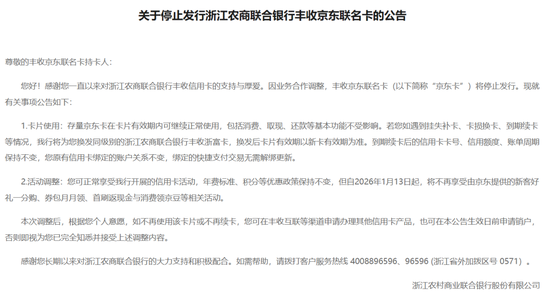
中小银行跟进“停卡潮” 信用卡行业驶入存量竞争新航道
Xin Lang Cai Jing· 2025-12-12 01:24
Core Viewpoint - The credit card market is undergoing significant adjustments, with many banks, especially smaller ones, halting the issuance of co-branded credit cards due to rising costs and risks associated with these products [1][5][6]. Group 1: Market Trends - The trend of halting credit card issuance is not isolated, as it has become a common practice among both national and regional banks throughout the year [1][6]. - Major banks, including China Construction Bank and Postal Savings Bank, have collectively stopped issuing over 100 credit card products since the beginning of 2025, with co-branded cards being a significant portion of these [6][11]. - The total number of credit cards in circulation has decreased by 100 million over the past three years, indicating a shift away from the previous era of aggressive expansion [10][11]. Group 2: Bank Strategies - Banks are transitioning from a focus on quantity to quality in their credit card offerings, prompted by regulatory changes and market dynamics [11][12]. - The recent adjustments include the closure of credit card centers and the integration of credit card functionalities into main banking apps, reflecting a strategic shift towards efficiency and cost reduction [14][15]. - The halting of co-branded cards is seen as a necessary step for banks to concentrate resources on more viable products and improve operational efficiency [8][9]. Group 3: Future Directions - The future of credit card business is expected to focus on three main transformation directions: integrating various service scenarios, upgrading technology for better digital experiences, and deepening customer segmentation to enhance value creation [16].




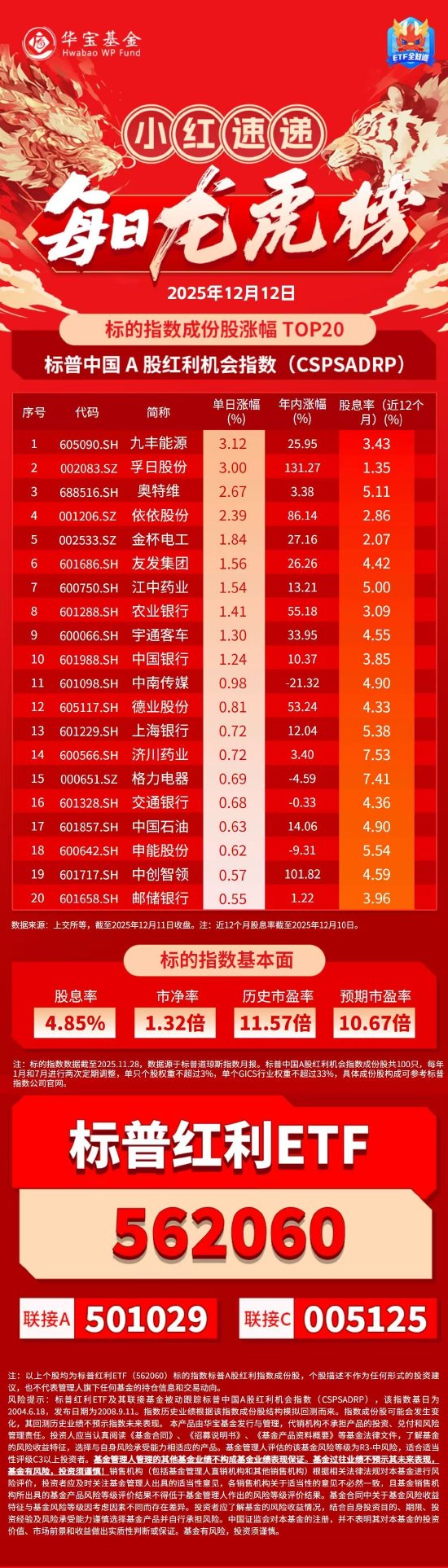
小红日报|银行板块展现韧性,标普红利ETF(562060)标的指数回调0.53%
Xin Lang Cai Jing· 2025-12-12 01:20
Core Insights - The article highlights the top-performing stocks in the S&P China A-Share Dividend Opportunity Index (CSPSADRP) as of December 12, 2025, showcasing significant daily and year-to-date gains along with dividend yields [1][4]. Group 1: Top Performers - The top stock, Jiufeng Energy (605090.SH), recorded a daily increase of 3.12% and a year-to-date increase of 25.95%, with a dividend yield of 3.43% [1][4]. - Furi Shares (002083.SZ) achieved a daily rise of 3.00% and an impressive year-to-date increase of 131.27%, with a dividend yield of 1.35% [1][4]. - Aotewei (688516.SH) saw a daily gain of 2.67% and a year-to-date increase of 3.38%, with a dividend yield of 5.11% [1][4]. Group 2: Notable Trends - The data indicates that several stocks, such as Yuyuan Group (601686.SH) and Agricultural Bank of China (601288.SH), have shown consistent performance with year-to-date increases of 26.26% and 55.18%, respectively [1][4]. - Stocks like Gree Electric (000651.SZ) and China Petroleum (601857.SH) have experienced fluctuations, with year-to-date changes of -4.59% and 14.06%, respectively, indicating varying market conditions [1][4]. - The overall performance of the index reflects a mix of high-growth stocks and those facing challenges, suggesting a diverse investment landscape within the Chinese A-share market [1][4].


部分银行下架5年期定存产品
Jing Ji Ri Bao· 2025-12-11 21:37
Core Viewpoint - The recent adjustment of deposit rates by banks, particularly the removal of 5-year fixed deposit products by smaller banks, reflects a strategic response to the current declining interest rate environment and regulatory pressures [1][2]. Group 1: Deposit Rate Adjustments - The Tongmu Teqi Mengyin Village Bank has announced a reduction in deposit rates for terms ranging from 3 months to 3 years, while also canceling the 5-year fixed deposit option [1]. - Major state-owned and joint-stock banks still offer 5-year fixed deposits, with China Bank's rate at 1.6% [1]. - The decision to eliminate 5-year deposits is primarily seen in smaller banks, indicating a divergence in strategies based on bank size and regulatory constraints [1]. Group 2: Interest Rate Environment - The current interest rate is in a downward cycle, leading banks to avoid locking in long-term deposits at higher costs, which could increase interest rate risk and operational pressure [1]. - There is a notable trend of interest rate inversion for 3-year and 5-year deposits in some smaller banks, suggesting a market-driven adjustment to optimize liability structures and reduce costs [2]. Group 3: Alternative Investment Options - In light of reduced availability or lower rates for 5-year deposits, banks and financial markets continue to offer stable alternatives such as 3-year fixed deposits or large-denomination certificates of deposit, which maintain similar safety and yield characteristics [3]. - For investors seeking long-term returns, government bonds (e.g., electronic savings bonds) are recommended as a secure alternative to fixed deposits, providing clear yields and high safety [3].
银行密集挂牌 零售类不良资产“出清潮”来袭
Bei Jing Shang Bao· 2025-12-11 15:39
Core Viewpoint - A wave of retail non-performing asset (NPA) disposals is occurring among banks in China, driven by the need to optimize year-end financial statements, reduce non-performing loan ratios, and release capital space, while also addressing risks accumulated from years of rapid retail business expansion [1][5] Group 1: Asset Disposal Trends - The pace of retail NPA disposals has accelerated as year-end approaches, with multiple banks, including state-owned and regional banks, participating in the process [3][4] - Ping An Bank has announced multiple personal loan transfer projects, including a package involving 308 loans with an outstanding principal and interest of approximately 52.98 million yuan, and two credit card NPA packages totaling around 84.77 million yuan [4][5] - The average overdue days for these NPAs are significantly high, with some exceeding 2,284 days, indicating severe asset quality deterioration [4][6] Group 2: Challenges in NPA Management - Retail NPAs are characterized by small amounts, dispersion, and lack of collateral, leading to high due diligence costs and valuation difficulties for potential buyers [6][7] - Many of these assets have aged significantly, with recovery rates dropping sharply for loans overdue by more than five years, often falling below 4% [7][8] - The complexity of managing these assets, including the need for legal proceedings and the lack of effective collection methods, poses significant challenges for banks [6][7] Group 3: Future Outlook and Strategic Shifts - The current wave of NPA disposals is expected to continue into the first half of next year, with a potential increase in the scale of disposals, particularly among smaller regional banks [8][9] - Banks are increasingly utilizing financial technology, such as big data and AI, to enhance risk management and monitoring of retail clients, aiming for a comprehensive risk management system [8][9] - A strategic shift towards prioritizing risk control over rapid expansion is necessary for banks to balance growth and risk management effectively [9]

开启数字邮储 i∞纪元|邮储银行以“天地人和”点亮新坐标,以“三维拓扑”绘制新生态
Jing Ji Guan Cha Wang· 2025-12-11 14:13
Core Insights - The China Postal Savings Bank (PSBC) held the 2025 Digital Finance Conference, showcasing its advancements in digital finance and the launch of its mobile banking version 11.0, emphasizing its commitment to technology-driven financial services [1] - The bank's president, Liu Jianjun, highlighted the transformative impact of technology on the banking sector, focusing on AI's role in reshaping traditional financial models and enhancing service delivery [2] Digital Strategy - PSBC has adopted a "Digital Postal Savings" strategy, implementing an "AI+" initiative to optimize financial supply, reduce financing costs, and improve service experiences, maintaining a focus on serving the real economy [2] - The bank has hosted the Digital Finance Conference for three consecutive years, evolving its strategy from initial exploration to practical implementation and now to a new era of digital finance [2] AI Capabilities - PSBC is enhancing its AI capabilities by focusing on data, computing power, and algorithms, establishing a robust AI infrastructure that supports business innovation [3] - The bank has received the People's Bank of China Financial Technology Development Award for three consecutive years, indicating its leadership in financial technology [3] AI2ALL Ecosystem - The "AI2ALL" digital ecosystem aims to integrate AI capabilities across various service dimensions, enhancing internal efficiency and external outreach [4] - PSBC has identified nearly 260 application scenarios for its AI capabilities within the "AI2ALL" framework [4] Operational Efficiency - The bank is utilizing intelligent tools across all operational processes, from front to back office, to enhance organizational efficiency and management precision [5] - In the front office, PSBC is leveraging intelligent marketing tools to provide personalized services, moving away from traditional broad marketing approaches [6] Risk Management - In the middle office, PSBC is using intelligent models to improve risk control and business efficiency, creating a new paradigm that balances business growth with risk management [6] Customer Service Enhancement - PSBC is integrating AI into its service delivery across offline, remote, and online channels, aiming to provide seamless and intelligent customer experiences [7] - The bank has introduced cloud-based services and intelligent outbound calling to enhance customer interaction and responsiveness [7][8] Mobile Banking Innovation - The latest version of PSBC's mobile banking app incorporates AI to redefine financial services, offering personalized features and enhanced security measures [8] - The app has received high ratings in user experience, ranking second in overall evaluation among major banks, with top scores in user experience for three consecutive years [8]