
天弘基金

Search documents
黄金高位震荡,加仓机会来了?三大投资逻辑聚焦
Quan Jing Wang· 2025-06-10 05:15
Group 1 - The core viewpoint is that despite short-term fluctuations, the long-term bullish trend for gold remains intact, with recommendations to consider gold as part of equity asset allocation and to avoid frequent trading [1] - Gold is supported by ongoing economic and policy uncertainties, with expectations of interest rate cuts by the Federal Reserve, increased purchases by central banks, and global uncertainties contributing to its strong performance [1] - Goldman Sachs predicts that gold prices could reach $4,000 per ounce by mid-2026, highlighting the asset's continued appeal as a safe haven amid rising concerns over U.S. debt ceiling issues [1] Group 2 - Recent data from the New York Fed indicates a decrease in consumer inflation expectations, with a one-year inflation expectation dropping to 3.2%, down 0.4 percentage points from the previous month, suggesting improved consumer confidence [2] - The U.S. Congressional Budget Office (CBO) warns that if the debt ceiling remains unchanged, the government's borrowing capacity may be exhausted between mid-August and the end of September 2025, raising market concerns about the U.S. repayment ability [3] Group 3 - Tianhong Shanghai Gold announced an upgrade to its benchmark on June 3, increasing the gold investment proportion to nearly 100%, allowing for more precise tracking of gold price movements, with a potential 6% additional return over three years based on backtesting [4] - The new benchmark consists of 95% spot gold and 5% deferred gold contracts, compared to the old benchmark which included a portion linked to bank deposit rates, indicating a strategic shift towards a more gold-centric investment approach [4]
创新药相关ETF领涨,机构:继续聚焦创新主线丨ETF基金日报
2 1 Shi Ji Jing Ji Bao Dao· 2025-06-10 02:49
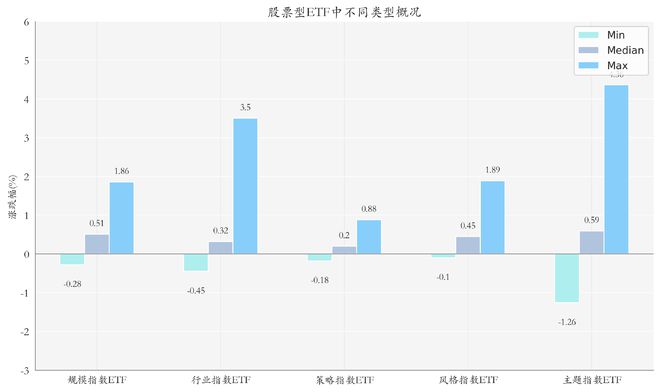
Market Overview - The Shanghai Composite Index rose by 0.43% to close at 3399.77 points, with a daily high of 3402.05 points [1] - The Shenzhen Component Index increased by 0.65% to close at 10250.14 points, reaching a high of 10280.83 points [1] - The ChiNext Index saw a rise of 1.07%, closing at 2061.29 points, with a peak of 2075.58 points [1] ETF Market Performance - The median return for stock ETFs was 0.48%, with the highest return from the Jiashi Shanghai Stock Exchange Science and Technology Innovation Board Comprehensive ETF at 1.86% [2] - The top-performing industry index ETF was the China Tai Chi Next Board Pharmaceutical and Health ETF, yielding 3.5% [2] - The Tianhong Hang Seng Shanghai-Shenzhen-Hong Kong Innovative Drug Selection 50 ETF led the thematic index ETFs with a return of 4.36% [2] ETF Performance Rankings - The top three ETFs by return were: - Tianhong Hang Seng Shanghai-Shenzhen-Hong Kong Innovative Drug Selection 50 ETF (4.36%) - Fuguo China Securities Hong Kong-Shenzhen Innovative Drug Industry ETF (3.57%) - Guotai ChiNext Pharmaceutical and Health ETF (3.5%) [4][5] - The ETFs with the largest declines included: - ICBC Credit Suisse China Securities Hong Kong-Shenzhen Gold Industry ETF (-1.26%) - Ping An China Securities Hong Kong-Shenzhen Gold Industry ETF (-1.11%) - Huaxia China Securities Hong Kong-Shenzhen Gold Industry ETF (-0.89%) [4][5] ETF Fund Flows - The top three ETFs by fund inflow were: - Huaxia Shanghai 50 ETF (inflow of 1.484 billion yuan) - Huatai Baichuan Shanghai-Shenzhen 300 ETF (inflow of 615 million yuan) - Jiashi Shanghai Stock Exchange Science and Technology Innovation Board Chip ETF (inflow of 493 million yuan) [6][7] - The ETFs with the largest outflows included: - Fuguo China Securities Military Industry Leader ETF (outflow of 285 million yuan) - Yifangda Shanghai-Shenzhen 300 Pharmaceutical and Health ETF (outflow of 215 million yuan) - Huitianfu China Securities Major Consumption ETF (outflow of 189 million yuan) [6][7] ETF Margin Trading Overview - The top three ETFs by margin buying were: - Huaxia Shanghai Stock Exchange Science and Technology Innovation Board 50 Component ETF (546 million yuan) - Huatai Baichuan Shanghai-Shenzhen 300 ETF (512 million yuan) - Huaxia Shanghai 50 ETF (306 million yuan) [8][9] - The ETFs with the highest margin selling included: - Southern China Securities 500 ETF (52.67 million yuan) - Huatai Baichuan Shanghai-Shenzhen 300 ETF (7.77 million yuan) - Southern China Securities 1000 ETF (1.90 million yuan) [8][9] Institutional Insights - Changcheng Guorui Securities emphasizes focusing on innovation, identifying three investment opportunities: 1) Platform companies with dual-antibody/multi-antibody technology that can attract international giants 2) Areas with unmet clinical needs, such as advanced liver cancer and non-small cell lung cancer 3) License-out potential targets for domestic innovative pharmaceutical companies [10] - Guoyuan Securities continues to favor innovative drugs, overseas expansion, and the clearing of centralized procurement sectors, noting that China's innovative drugs are entering a stage of realization with significant R&D progress [10]

ETF融资榜 | 数字经济ETF(560800)杠杆资金加速流入;大盘宽基备受关注-20250609
Sou Hu Cai Jing· 2025-06-10 02:15
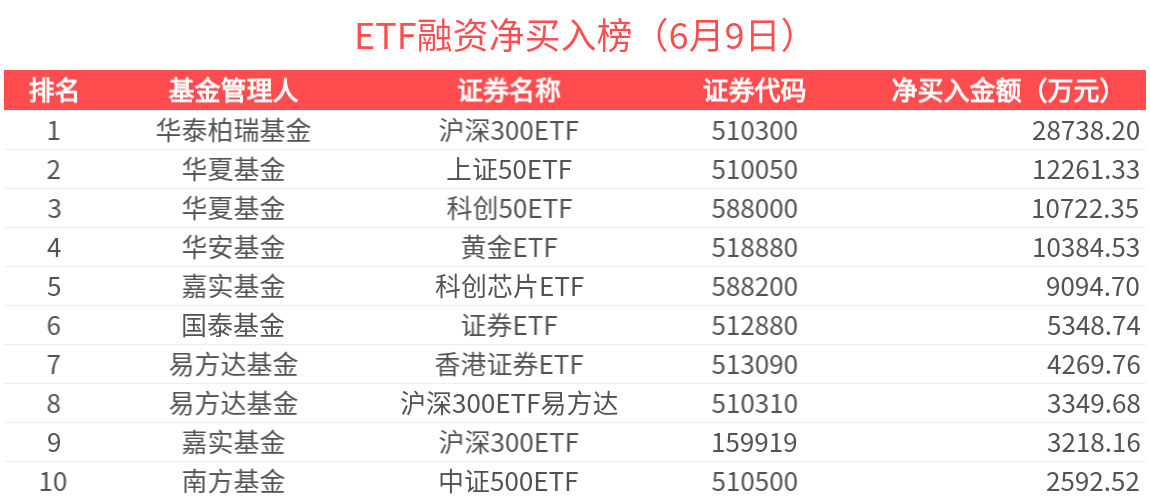
Group 1 - A total of 237 ETF funds experienced net inflows from financing, while 34 funds saw net outflows from securities lending on June 9, 2025 [1] - The amount of net inflows exceeding 5 million yuan was recorded for 52 ETFs, with significant inflows into the CSI 300 ETF (510300.SH) at 287 million yuan, the SSE 50 ETF (510050.SH) at 122 million yuan, and the Sci-Tech 50 ETF (588000.SH) at 107 million yuan [1][3] - The net outflow from securities lending exceeded 5 million yuan for one fund, the CSI 500 ETF (510500.SH), with a total outflow of 43.52 million yuan [1][5] Group 2 - Recently, 90 ETFs have seen continuous net inflows from leveraged financing, with the leading funds being the Sci-Tech Chip 50 ETF, which had net inflows of 20.82 million yuan over 8 days, and the Hong Kong Stock Connect Financial ETF with 4.97 million yuan [1][6] - Over the past 5 days, 58 ETFs recorded net inflows exceeding 5 million yuan, with the CSI 300 ETF leading at 277 million yuan, followed by the Sci-Tech Chip ETF at 162 million yuan [1][6][8] Group 3 - A total of 12 ETFs have experienced continuous net outflows from leveraged securities lending, with the CSI 500 ETF leading with a net outflow of 179 million yuan over 6 days [1][6] - Over the past 5 days, 5 ETFs recorded net outflows exceeding 5 million yuan, with the CSI 500 ETF again leading at 159 million yuan [1][10]
组团认购超1亿元!公募“真金白银”支持新型浮动费率基金发行
Bei Jing Shang Bao· 2025-06-09 13:21
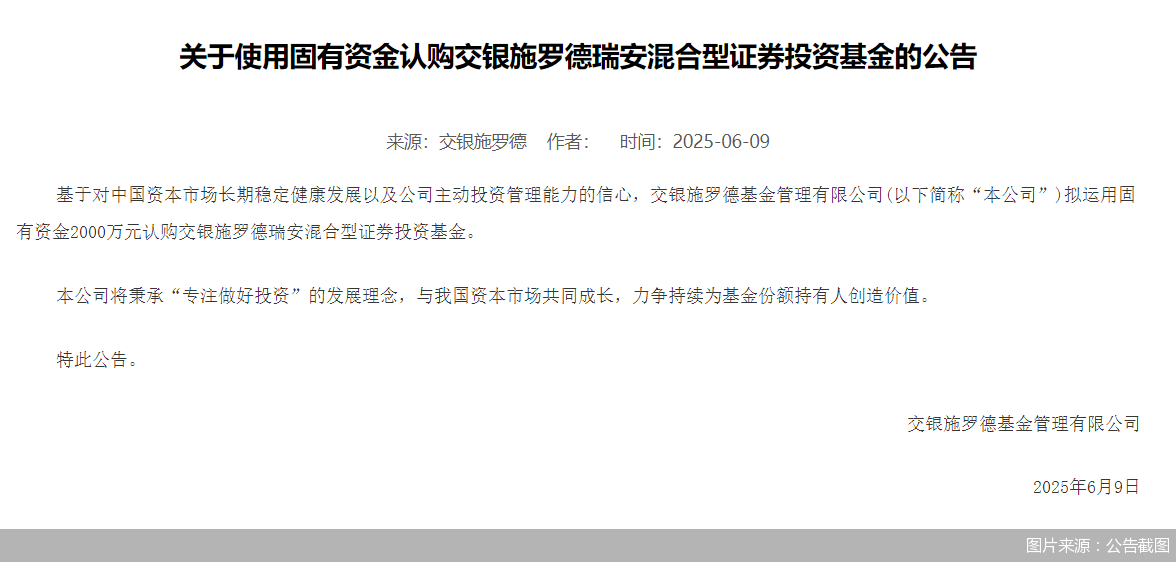
Core Viewpoint - The public fund industry shows strong confidence in the new floating rate funds, with total subscriptions exceeding 100 million yuan, indicating a positive market outlook and potential for these products [1][4][7] Group 1: Fund Subscription Activity - On June 9, China Jianyin Schroder Fund announced a subscription of 20 million yuan for its new floating rate fund, Jianyin Schroder Rui'an Mixed Fund [3] - Multiple public funds have collectively subscribed over 100 million yuan, with several companies announcing their self-purchases, reflecting their belief in the market potential of these products [3][4] - The first batch of 26 floating rate funds began issuing on May 27, with several companies, including Dongfanghong Asset Management, also announcing significant self-purchases [3][5] Group 2: Market Confidence and Expectations - Industry insiders believe that the substantial self-purchase amounts indicate a strong confidence in the market prospects of floating rate funds, which can provide initial capital for better investment operations [4][6] - The first batch of products is expected to achieve considerable fundraising success, with some funds already announcing significant subscription amounts, such as Dongfanghong's 1.991 billion yuan [6][7] - Analysts predict that the overall issuance scale of the first batch of floating rate funds will be substantial, contributing to market stabilization and attracting more incremental capital [6][7] Group 3: Product Features and Investor Interest - The floating rate funds have a fee structure linked to performance and holding periods, which is expected to better incentivize fund managers to enhance investment capabilities [7] - Investors are anticipated to focus more on the long-term investment value of these funds rather than short-term market performance, indicating a shift in investment strategy [7]
8家基金公司自购浮费基金总额突破1亿元 这类产品对投资者来说有哪些好处?需要注意哪些事项?
Sou Hu Cai Jing· 2025-06-09 13:18
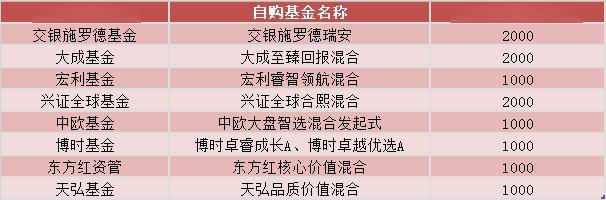
Core Viewpoint - The self-purchase of floating rate funds by fund companies is a significant way to express confidence in the market, with a total self-purchase amount reaching 100 million yuan as of June 9, 2023 [1][2][3]. Group 1: Fund Companies' Self-Purchase Activities - On June 9, 2023,交银施罗德基金 self-purchased 20 million yuan, increasing the number of fund companies participating in self-purchase to eight, with a total self-purchase amount of 100 million yuan [1]. - Fund companies such as 东方红资管, 天弘基金, 博时基金, and 中欧基金 each self-purchased 10 million yuan, while 兴证全球基金 and 大成基金 self-purchased 20 million yuan [2][3]. - The self-purchase activities reflect a commitment to aligning the interests of fund companies with those of investors, enhancing the quality of public fund development [4]. Group 2: Benefits of Floating Rate Funds - Floating rate funds optimize fee structures, reducing holding costs for investors, as management fees can decrease significantly when fund performance is poor [5][6]. - The floating fee mechanism incentivizes fund managers to enhance performance, as management fees are linked to fund performance, promoting a shift from a scale-oriented to a performance-oriented industry [6][10]. - The design of floating rate funds encourages long-term holding by reducing the impact of short-term market fluctuations on investor behavior [7][9]. Group 3: Trust and Confidence in Fund Management - The floating fee mechanism strengthens the binding of interests between investors and fund managers, fostering trust as higher fees are only earned when fund performance is strong [8][12]. - Fund companies' self-purchases, such as that of 宏利基金, demonstrate confidence in their management capabilities, further enhancing investor trust [11]. - The floating fee structure improves the overall investor experience by lowering costs during poor performance and focusing on long-term returns [9][10].
7家基金公司自购浮费基金总额突破1亿元
news flash· 2025-06-09 11:06
Core Viewpoint - Seven fund companies have collectively purchased over 100 million yuan in floating fee funds, indicating a strong confidence in the market and a commitment to aligning interests with investors [1] Group 1: Fund Companies Involved - The fund companies that have participated in the self-purchase include Dongfanghong Asset Management, Tianhong Fund, Bosera Asset Management, and China Universal Asset Management, each contributing 10 million yuan [1] - Xingsheng Global Fund, Great Wall Fund, and Jiao Yin Schroder Fund have made larger purchases of 20 million yuan each [1] Group 2: Total Investment and Market Implications - The total amount of self-purchases by these fund companies has reached 100 million yuan, reflecting a significant trend in the industry [1] - Self-purchase is becoming an important method for fund companies to express their confidence in the market and strengthen ties with investors [1]
大成基金2000万元自购新发浮费基金,公募自购潮持续升温
Nan Fang Du Shi Bao· 2025-06-09 10:01
Core Viewpoint - Dachen Fund Management Co., Ltd. announced a self-purchase of 20 million yuan in its newly launched floating rate fund, Dachen Zhi Zhen Return Mixed Securities Investment Fund, reflecting a growing trend of self-purchases in the public fund industry as firms respond to regulatory fee reforms and strengthen ties with investors [2][5][9]. Group 1: Company Actions - Dachen Fund's self-purchase of 20 million yuan demonstrates confidence in the long-term stability and healthy development of China's capital market and the company's proactive investment capabilities [5]. - The Dachen Zhi Zhen Return Mixed Fund is one of the first floating management fee products, managed by experienced fund manager Du Cong, who has a track record of significant returns [5][6]. - Other institutions, including Jiao Yin Schroder Fund and Zhong Ou Fund, have also announced self-purchases, indicating a trend where self-purchase has become a standard practice for newly issued floating rate funds [7][8]. Group 2: Fund Structure and Mechanism - The Dachen Zhi Zhen Return Mixed Fund has a wide investment scope, including domestic stocks, bonds, and asset-backed securities, and employs a floating fee structure linked to fund performance [6]. - The management fee structure varies based on the holding period and performance, with rates ranging from 0.60% to 1.50% depending on the fund's performance relative to benchmarks [6]. - The floating fee mechanism aims to align the interests of fund companies with those of investors, promoting long-term investment and enhancing active management capabilities [6][9]. Group 3: Industry Trends - The self-purchase actions by Dachen Fund and other institutions signify a shift in the public fund industry towards a focus on returns and long-term performance [9]. - The implementation of floating fee mechanisms represents not only an innovation in fee structures but also a reconfiguration of investment philosophies and assessment systems within the industry [9].

信用债ETF可回购质押,成交跃升
HTSC· 2025-06-09 09:01
Quantitative Models and Construction Methods - **Model Name**: Absolute Return ETF Simulation Portfolio **Model Construction Idea**: The model determines the allocation weights of major asset classes based on "momentum + risk budgeting" and enhances returns at the stock industry level by incorporating an industry rotation model and timing views on dividend assets[3][26] **Model Construction Process**: 1. **Risk Budgeting**: Assign higher risk budgets to assets with stronger recent trends 2. **Industry Rotation**: Use a monthly frequency industry rotation model to allocate weights within equity assets 3. **Dividend Timing**: Incorporate timing views on dividend assets 4. **Portfolio Adjustment**: Adjust weights periodically, such as removing steel, basic chemicals, non-bank finance, and computers while adding pharmaceuticals, consumer services, and dividend assets in the latest rebalancing[26][29] **Model Evaluation**: The model effectively balances risk and return, leveraging momentum and industry rotation to enhance performance[26] Model Backtesting Results - **Absolute Return ETF Simulation Portfolio**: - Annualized Return: 6.45% - Annualized Volatility: 3.85% - Maximum Drawdown: 4.65% - Sharpe Ratio: 1.68 - Calmar Ratio: 1.39 - Year-to-Date Return: 3.94% - Weekly Return: 0.30%[28] Quantitative Factors and Construction Methods - **Factor Name**: Credit Bond ETF as Collateral for Repurchase **Factor Construction Idea**: The factor leverages the inclusion of credit bond ETFs in the general collateral pool for repurchase agreements to enhance liquidity and risk diversification in the credit bond market[7][9] **Factor Construction Process**: 1. **Selection Criteria**: ETFs tracking benchmark market-making credit bonds with large scale and high credit quality are selected 2. **Approval Process**: ETFs meeting the criteria apply to China Securities Depository and Clearing Corporation for inclusion as general collateral for repurchase agreements 3. **Implementation**: The first batch of 9 credit bond ETFs was approved and implemented on June 6, 2025[7][8] **Factor Evaluation**: This factor improves market liquidity, optimizes market structure, and supports the development of the real economy[9] Factor Backtesting Results - **Credit Bond ETF as Collateral for Repurchase**: - Example ETFs: - South China Benchmark Market-Making Corporate Bond ETF (Code: 511070.SH): Scale 124.81 billion, Monthly Average Turnover 48.89 billion - Huaxia Benchmark Market-Making Corporate Bond ETF (Code: 511200.SH): Scale 83.09 billion, Monthly Average Turnover 45.89 billion - Ping An ChinaBond High-Grade Corporate Bond Spread Factor ETF (Code: 511030.SH): Scale 170.70 billion, Monthly Average Turnover 17.76 billion[8]
上证50指数ETF今日合计成交额21.08亿元,环比增加39.98%
Zheng Quan Shi Bao Wang· 2025-06-09 08:48
Group 1 - The total trading volume of the SSE 50 Index ETF reached 2.108 billion yuan today, an increase of 602 million yuan from the previous trading day, representing a growth rate of 39.98% [1] - Specifically, the trading volume of Huaxia SSE 50 ETF (510050) was 1.958 billion yuan, up 560 million yuan from the previous day, with a growth rate of 40.12% [1] - The trading volume of E Fund SSE 50 ETF (510100) was 106 million yuan, an increase of 25.607 million yuan, with a growth rate of 31.88% [1] Group 2 - The SSE 50 Index (000016) closed down 0.08%, while the average decline of related ETFs tracking the SSE 50 Index was 0.01% [2] - The top gainers included E Fund SSE 50 Enhanced Strategy ETF (563090) and SSE 50 ETF Dongcai (530050), which rose by 0.48% and 0.10% respectively [2] - The largest declines were seen in GF SSE 50 ETF (510950) and Huaan SSE 50 ETF (510190), which fell by 0.18% and 0.10% respectively [2]
信用债ETF天弘(159398)规模续创新高,单日获5.37亿元资金净流入
2 1 Shi Ji Jing Ji Bao Dao· 2025-06-09 06:00
Core Viewpoint - The Tianhong Credit Bond ETF (159398) has been experiencing a positive trend, with significant trading volume and liquidity improvements following its inclusion in the general pledge repo system, which enhances its investment appeal and operational efficiency [2][4]. Group 1: Market Performance - The Tianhong Credit Bond ETF has seen a slight decline of 0.02% after three consecutive days of gains, with a trading volume exceeding 2.6 billion yuan and a turnover rate over 40% [1]. - The latest circulating scale of the Tianhong Credit Bond ETF has reached 6.413 billion yuan, marking a historical high [3]. Group 2: Investment Opportunities - The inclusion of the Tianhong Credit Bond ETF in the general pledge repo system is expected to improve liquidity and broaden financing channels, allowing investors to enhance capital efficiency and investment strategies [2]. - Recent data indicates that the Tianhong Credit Bond ETF has attracted over 710 million yuan in net inflows over the past five days, with a single-day inflow of 537 million yuan [2]. Group 3: Industry Insights - The rapid growth of the Shanghai and Shenzhen benchmark market-making credit bond ETF, which has surpassed 70 billion yuan since mid-May, has led to a significant decline in the valuation yield of medium to long-term credit bonds [4]. - Analysts suggest focusing on coupon opportunities and increasing allocations to medium to long-term credit bonds after the seasonal disturbances end [4].