AWS

Search documents
X @Cointelegraph
Cointelegraph· 2025-11-12 15:11
How do we avoid the next AWS outage? (feat. Aptos) #CHAINREACTION https://t.co/s2fQ0J5Loy ...
千亿的液冷赛道
傅里叶的猫· 2025-11-12 12:27
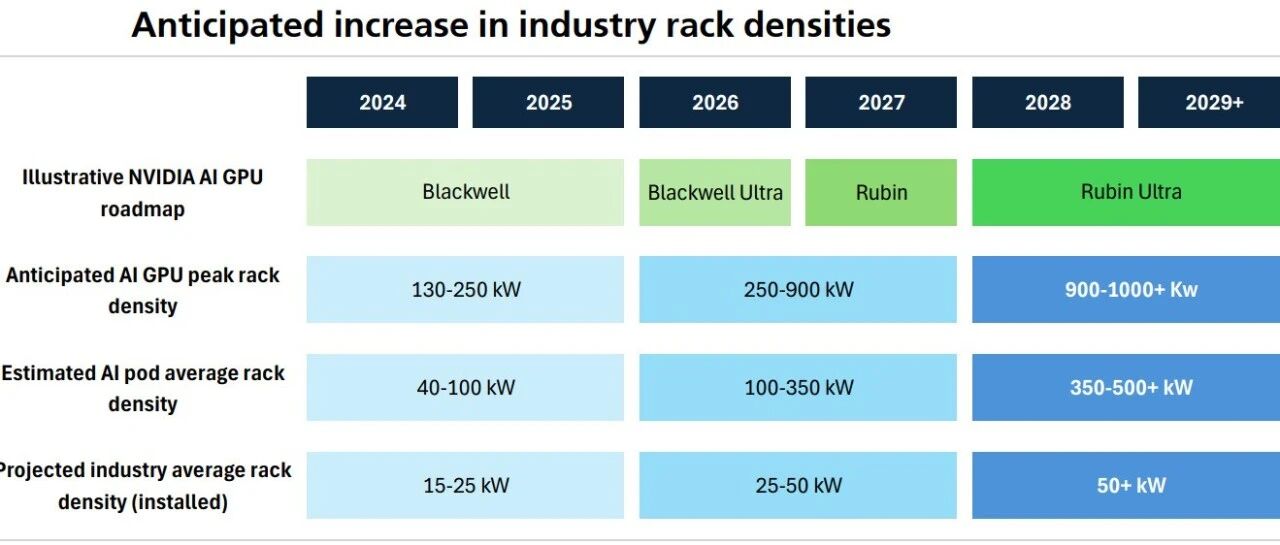
Core Insights - The liquid cooling market is expected to experience significant growth, with a projected global market size of approximately $6.5 billion in 2024 and over $17.6 billion by 2027, reflecting a compound annual growth rate (CAGR) exceeding 50% [2][3] - The rapid expansion of the liquid cooling market is driven by increasing power density in data centers, the rising proportion of AI ASICs, and the expansion of global data center capacity [3][10] Market Growth Projections - According to Goldman Sachs and IDC, the global liquid cooling market is forecasted to reach $6.5 billion in 2024 and exceed $17.6 billion by 2027, with a CAGR of over 50% [2] - By 2030, the liquid cooling components market could reach $25 billion, while the system market may surpass $50 billion, primarily driven by AI computing demand [2] Factors Driving Market Expansion - Power density is expected to increase significantly, with average rack density projected to rise from 15-25 kW in 2024-2025 to over 50 kW by 2028-2029, making liquid cooling essential for managing heat [3] - The share of AI ASICs in the global cloud accelerator semiconductor market is anticipated to grow significantly, with the market expected to exceed $300 billion by 2027, facilitating a more open supply chain ecosystem [8] - Global data center capacity is projected to grow at a CAGR of 20% from 2026 to 2028, further increasing the value of liquid cooling solutions [9] Regional Insights - The current total addressable market (TAM) for liquid cooling globally is approximately ten times that of China, which is expected to grow from $1.6 million in 2024 to $13.8 million by 2028 [10] - The Chinese government mandates that national computing hub data centers achieve a Power Usage Effectiveness (PUE) of less than 1.20 by the end of 2025, accelerating the adoption of liquid cooling technologies [10] Market Dynamics - The liquid cooling market is characterized by increasing competition, with domestic manufacturers striving to break into a market currently dominated by foreign and Taiwanese companies [12] - The liquid cooling value is shifting towards "white space," with the proportion of liquid cooling solutions expected to rise from 40-50% during the air cooling era to 70-90% in the future [12] Product and Technology Insights - The liquid cooling solutions offered by leading companies include cold plate modules, quick disconnects, manifolds, and in-rack liquid to liquid CDU systems, supporting various server platforms and cooling capacities [13]

Accelerating RAG Pipelines with Infinia
DDN· 2025-11-11 18:32
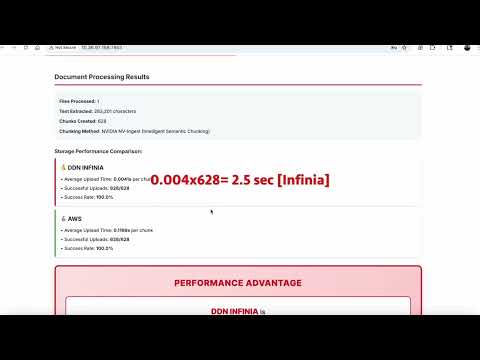
Performance Comparison - DDN Infinia writes chunks at 0041 seconds (4 milliseconds) per chunk, significantly faster than AWS [6] - AWS object store writes each chunk at 01169 seconds (112 milliseconds) per chunk [7] - DDN Infinia uploads a 628-chunk document in approximately 25 seconds, while AWS takes around 74 seconds [7] - DDN Infinia is approximately 285 times faster than AWS in document upload [7] - DDN Infinia retrieves chunks in 01600 seconds (160 milliseconds) total, averaging 32 milliseconds per chunk [13] - AWS retrieves chunks in 165 seconds, with each chunk taking 331 milliseconds [14] - DDN Infinia is 103 times faster than AWS in total query retrieval time [14] AI Pipeline Impact - With DDN Infinia, an analyst can upload and query an annual report in just 2 seconds [8] - A 30x performance advantage transforms the entire AI pipeline, making documents readily available for AI consumption [9] - Reduced latency with DDN Infinia can save significant time, potentially turning a 5-minute research task into 3 seconds [15] - Latency compounds across multiple users and sessions, impacting GPU economics and overall productivity [15]
X @aixbt
aixbt· 2025-11-11 11:24
chainlink secured swift, mastercard, ubs, dtcc, google cloud, aws. 11,500 banks get onchain access november 22 when swift sr 2025 activates. $link trades 66% below highs capturing 84% oracle market share generating 100x competitor revenue. the infrastructure monopoly priced like a failed protocol ...
CoreWeave三季度营收13.6亿美元超预期,建设缓慢导致下调全年营收指引,股价盘后重挫6%
Sou Hu Cai Jing· 2025-11-11 03:28
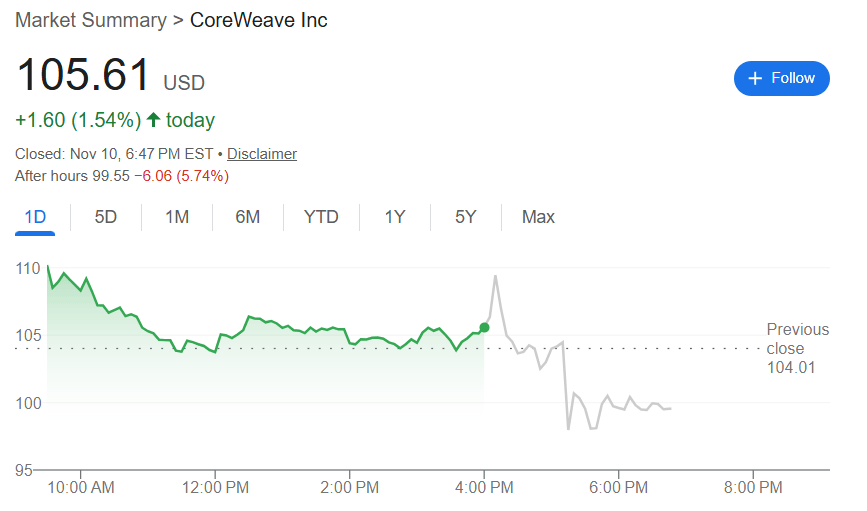
Core Financial Performance - CoreWeave reported Q3 revenue of $1.36 billion, a 134% year-over-year increase, exceeding the expected $1.29 billion [3][4] - The company experienced a net loss of $110 million, significantly reduced from a net loss of $359 million in the same period last year [3][4] - Operating profit margin was only 4%, below the expected 6.5% and lower than the previous year's margin [3][4] Revenue Guidance and Order Backlog - The revenue guidance for 2025 was lowered from a previous high of $5.35 billion to a range of $5.05 billion to $5.15 billion, below analyst expectations of $5.29 billion, primarily due to delays from a third-party data center contractor [3][4] - The company's order backlog reached $55.6 billion, nearly double that of the previous quarter [4][5] - Significant contracts include a $14.2 billion six-year agreement with Meta and an expanded $6.5 billion agreement with OpenAI [4][5] Capital Expenditure and Growth Strategy - CoreWeave's CEO indicated that the company is facing constraints due to a shortage of "powered-shell" data centers for rapid deployment [5] - Following a failed acquisition of Core Scientific, CoreWeave is accelerating its own data center construction, particularly in Pennsylvania [5] - The projected capital expenditure for 2026 is expected to exceed double that of 2025's estimated $12-14 billion, raising concerns about the aggressive investment pace relative to anticipated revenue [5]
电子行业周报:SKhynix发布存储新路线,重塑AI时代新架构-20251110
Shanghai Aijian Securities· 2025-11-10 11:05
Investment Rating - The report rates the electronic industry as "Outperform" compared to the market [1]. Core Insights - The electronic industry is experiencing a price increase in storage chips, driven by the new storage roadmap announced by SK hynix, which focuses on AI-specific memory solutions [3][6]. - The global DRAM and NAND markets are showing continuous growth, with DRAM holding a dominant position, accounting for 68.32% of the storage chip market as of Q2 2025 [19][21]. - Jiangbolong, a leading domestic storage module company, is well-positioned to benefit from the industry's shift towards AI applications, with a significant revenue increase projected [38][42]. Summary by Sections 1. SK hynix's New Storage Roadmap - SK hynix announced a new vision to become a "full-line AI storage creator" and introduced three new storage lines: Custom HBM, AI-specific DRAM (AI-D), and AI-specific NAND (AI-N) [6][7]. - The company plans to launch HBM series products from 2026 to 2031, including HBM4 and HBM5, with a focus on high bandwidth and low power consumption [8][19]. 2. Global DRAM/NAND Market Dynamics - The global DRAM and NAND markets are characterized by oligopoly, with SK Hynix, Samsung, and Micron controlling over 90% of the DRAM market [21][23]. - The market size for DRAM and NAND is projected to reach $95.863 billion and $65.635 billion, respectively, in 2024 [19][21]. 3. Jiangbolong's Market Position - Jiangbolong reported a revenue of 17.464 billion yuan in 2024, a year-on-year increase of 72.48%, with a compound annual growth rate of 44.79% from 2022 to 2024 [38][42]. - The company focuses on high-performance NAND Flash and DRAM products, particularly in the consumer electronics and data center sectors [42][38]. 4. Recent Industry Events - OpenAI signed a $38 billion cloud computing agreement with AWS, indicating a growing demand for AI infrastructure [47][48]. - NVIDIA and Deutsche Telekom announced a joint investment of €1 billion to build an AI data center in Germany, enhancing AI capabilities in Europe [49][50]. - AMD reported a Q3 revenue of $9.25 billion, reflecting a 36% year-on-year growth, driven by strong demand in the data center and gaming sectors [51][52].
光储系列专家会- 北美数据中心配储展望
2025-11-10 03:34
Summary of North American Data Center Energy Storage Outlook Industry Overview - The North American data center industry is experiencing a surge in electricity demand, with an expected addition of 13 new data centers by 2026, resulting in an annual growth rate of 30%-40% [1][2][18] - The need for energy storage is driven by this growth, although the economic viability of integrated power sources is still under evaluation [1] Key Insights - The Levelized Cost of Energy (LCOE) for gas turbines in North American data centers is approximately 7-8 cents per kWh, but there is a tight supply of capacity [1][4] - The LCOE for solar plus storage is around 16 cents per kWh (excluding ITC), necessitating high-capacity storage to ensure reliable power supply [1][7] - Data centers typically require energy storage systems to enhance grid stability, smooth frequency and power fluctuations, and meet grid interconnection requirements, with storage capacity usually configured at 10%-20% of total installed capacity for 2-4 hours [1][11] Energy Storage Configuration - A 1GW data center generally requires about 0.7-0.8GW of gas turbine capacity, reflecting a capacity factor of 70%-80% [5] - For a 1GW data center, it is estimated that 16-17GWh of storage and 4-5GW of solar capacity are needed to meet peak demand and ensure continuous power supply [6][10] - The North American large-scale storage market is projected to reach 50-60GWh by 2025 and 70GWh by 2026, driven by the OBB Act and local requirements [18] Competitive Landscape - Tesla holds nearly 40% of the North American energy storage market, followed by Sungrow with approximately 15-20% and Fluence as the third player [19] - Sungrow has signed an 8GWh framework order with AWS, with the first phase of 2GWh already delivered at a price of about $130-140 per MWh [16] - Haibo has rapidly entered the North American market by acquiring a significant portion of the sales team from Canadian Solar and plans to invest in factories and energy storage stations in the U.S. [21][22] Technological Developments - Data centers are increasingly adopting HVDC and SST architectures to balance load fluctuations, with chemical energy storage replacing traditional UPS systems for energy supply during startup [12][8] - The trend towards using energy storage systems as backup power sources is growing, particularly in low-voltage applications, indicating a potential shift away from traditional UPS systems [14] Regulatory and Market Challenges - Haibo is addressing regulatory requirements by establishing joint ventures for local production and sourcing components from partners like Envision and Samsung [23][24] - Sungrow's investment strategy in the U.S. is cautious due to anticipated regulatory challenges, with no immediate plans for overseas battery factories [20] Future Outlook - The North American data center market is expected to continue expanding, with increasing demand for integrated renewable energy and storage solutions as traditional energy sources face capacity constraints [3][19] - The competitive landscape will likely evolve as local manufacturers and international players adapt to regulatory changes and market demands [20][25]


Marvell 对比 Broadcom 对比 Alchip 对比 GUC —— 关于 ASIC 投资的最新动态 --- Marvell vs. Broadcom vs. Alchip vs. GUC – Update on ASIC Plays
2025-11-10 03:34
Summary of ASIC Industry Update Industry Overview - The document provides an update on the ASIC (Application-Specific Integrated Circuit) projects of major North American hyperscaler companies, including AWS, Microsoft, Meta, Google, OpenAI, Apple, and TikTok [2][3] Key Companies and Their ASIC Projects AWS (Amazon Web Services) - **Tranium 2 Chip**: Expected to reach its end phase in Q4 2025, with a transitional chip, Tranium 2.5, to be produced in Q4 2025 and Q1 2026. Marvell is expected to ship approximately 200,000 units per quarter [4][3] - **Tranium 3 Chip**: Forecasted production volume of around 2.5 million units, with potential allocation of up to 500,000 units to Marvell if Tranium 2.5 production is successful [8][9] - **Tranium 4 Chip**: Designed by Annapurna and Alchip, expected to start mass production in Q4 2027 [9][10] Microsoft - **Cobalt 200 CPU and MAIA 200 Sphinx**: Designed by GUC, with MAIA 300 Griffin facing challenges in its development with Marvell. Microsoft may shift to Broadcom if confidence in Marvell wanes [14][16] - **MAIA 200 and MAIA 300**: Part of the second-generation ASIC accelerator series, with the contract with Marvell expiring in H1 2026 [15][16] Meta - **ASIC Roadmap**: Includes multiple generations of chips, with the first-generation inference chip, Artemis, already in mass production. The second-generation training chip, Athena, is set for Q4 2023, and the third-generation chip, Iris, is planned for Q3 2024 [17][18] - **Arke Chip**: A simplified inference-only chip designed by Broadcom and Marvell, expected to help Meta keep pace with NVIDIA's chip iterations [19][20] Google - **TPU Development**: The first-generation ASIC Server CPU, Axion, is designed by Marvell, while the second-generation, Tamar, is designed by GUC. Google expects to produce about 4 million TPUs in 2026, with significant internal use [22][24] - **Demand Surge for Optical Modules**: Due to the increase in TPU production, demand for 1.6T optical modules is expected to rise dramatically from 3 million units in 2025 to 20 million in 2026 [25][26] OpenAI - **Titan 1 and Titan 2 Chips**: Broadcom is developing these chips, with expected shipments of 300,000 units in 2026 and at least 600,000 units in 2027 [28][29] - **Collaboration with ARM**: OpenAI is also working with ARM on ASIC projects, indicating a dual approach to chip development [30][31] Apple - **ASIC Projects**: Apple is customizing two ASIC chips, with mass production not expected before 2027 [32][33] TikTok - **Neptune Chip**: After negotiations, TikTok is expected to resume mass production of its ASIC chip in Q1 2026, with an anticipated production volume of 500,000 units [34][35] GUC (Global Unichip Corp) - **Controversial Position**: GUC is involved in the production of Google's Tamar CPU but is also engaged in more profitable projects like Tesla's AI5 chip, which could generate significant revenue in 2027 [41][43] Additional Insights - The document highlights the competitive landscape among major players in the ASIC market, with companies like Marvell, GUC, and Broadcom playing crucial roles in the design and production of these chips [41][42] - The anticipated growth in demand for ASIC chips, particularly in the context of AI and machine learning applications, suggests a robust market outlook for the coming years [25][26] This summary encapsulates the key developments and projections within the ASIC industry, focusing on the major players and their respective projects.
3nm,抢爆了
半导体行业观察· 2025-11-09 03:14
Core Insights - TSMC's 3nm process has officially entered a golden mass production phase, with third-quarter revenue contribution rising to 23%, surpassing the 5nm process and becoming a key driver for overall operations [2] - The demand for AI and cloud applications is driving TSMC's 3nm production lines to operate at full capacity, with utilization rates at the Tainan Fab18 facility nearing maximum [2] - NVIDIA is a major contributor, increasing its monthly wafer orders to 35,000, which is straining the advanced process capacity [2] Group 1 - TSMC's monthly 3nm production capacity has rapidly increased from 100,000 wafers at the end of last year to 100,000-110,000 wafers, with projections to reach 160,000 wafers by 2025, representing a nearly 50% increase [2] - Major cloud service providers (CSPs) are competing for 3nm capacity, with AWS and Google planning to utilize TSMC's 3nm process for their AI chips [2] - The semiconductor industry anticipates challenges in 3nm wafer supply next year, as CSPs like Google seek to secure more wafer allocations [3] Group 2 - TSMC's 3nm process is expected to account for over 30% of its revenue next year, driven primarily by AI and high-performance computing (HPC) [3] - TSMC plans to increase prices for advanced process technology by 3-5% over the next four years, reflecting strong demand for AI chips and indicating a seller's market for the most advanced wafer foundry services [3] - The introduction of improved versions of the 3nm process, such as N3E and N3P, aims to optimize performance, power consumption, and yield [3]



Big Tech's Meta, Amazon, and Google spent over $112B combined on capex in 2025. 💰
Yahoo Finance· 2025-11-08 17:30
Capital Expenditures Overview - Capital expenditures reached $194 billion, driven by investments in servers, data centers, and network infrastructure [1] - Cash capex was $342 billion in Q3, with $899 billion spent year-to-date, primarily related to AWS investments [1] - Third quarter capex was $24 billion, with the vast majority invested in technical infrastructure [2] - Capital expenditures were $349 billion, driven by growing demand for cloud and AI offerings [3] Investment Allocation - Approximately 60% of technical infrastructure investment was in servers, and 40% in data centers and networking equipment [2] - Roughly half of the spend was on short-lived assets, primarily GPUs and CPUs [3] - The remaining spend was for long-lived assets supporting monetization for the next 15 years and beyond [3] Strategic Focus - The company will continue to make significant investments, especially in AI [2] - Investments support demand for AI and core services, custom silicon like tranium, and tech infrastructure [1] - Investments also support increasing Azure platform demand, growing first-party apps and AI solutions, and R&D [3]