Mistral AI

Search documents
撒钱40亿美元,亚马逊准备对抗沃尔玛;微软退出巴基斯坦,结束25年南亚市场布局丨Going Global
创业邦· 2025-07-13 11:20
Core Viewpoint - The article highlights significant developments in the global expansion of various companies, focusing on their strategies, market entries, and financial activities in the international arena [2]. Group 1: Major Events in Global Expansion - SHEIN has submitted a draft prospectus for an IPO to the Hong Kong Stock Exchange, shifting focus from London after prolonged efforts to list there [5]. - Temu plans to enter the European food market, establishing local teams in Germany and expanding to Switzerland and Austria, aiming for 80% of sales to come from local sellers using regional warehouses [7]. - TikTok denied reports of developing a U.S.-specific app and refuted claims regarding the sale of its U.S. operations to Oracle [10][12]. - JD Global Sales launched a semi-managed model targeting nine countries, including the U.S. and the U.K., to enhance its overseas operations [18][19]. - The tea brand Cha Yan Yue Se is entering the North American market, focusing on selling snacks and tea-related products rather than tea itself due to regulatory challenges [21]. - Alibaba's Amap launched a multilingual map service for overseas users, adding 14 languages to cater to the growing number of foreign tourists visiting China [23]. Group 2: International Trade and Tariffs - President Trump announced plans to impose tariffs of up to 50% on products from eight countries, including Brazil and the Philippines, starting August 1, 2025 [29][30]. - The U.S. government is considering new tariffs on pharmaceuticals and semiconductors, potentially reaching 200% for foreign-made drugs [30]. Group 3: Corporate Acquisitions and Investments - Rakuten announced a $500 million acquisition of the Asian B2B e-commerce platform B2B Trade, aiming to strengthen its position in the Asian market [46]. - Samsung Electronics signed an agreement to acquire the U.S. healthcare platform Xealth, marking a strategic move into mobile healthcare services [50]. - Indian e-commerce platform Meesho submitted an IPO application to raise approximately $5 million, with a revenue growth of 33% year-on-year [51]. - Bazaar Technologies acquired payment platform Keenu, marking a significant integration of e-commerce and payment systems in Pakistan [43]. - Jumbotail, an Indian B2B e-commerce platform, raised $120 million in a Series D funding round, bringing its total funding to $263 million [53].


下一站“算力主权”!马克龙警告欧洲AI基础设施落后中美
Hua Er Jie Jian Wen· 2025-07-11 04:14
Group 1: AI Sovereignty and Infrastructure - European countries, particularly France and the UK, face a significant shortfall in AI computing power, with Europe accounting for 20% of global AI demand but only 3%-5% of supply capacity, leading to heavy reliance on US and Chinese technology [1][3][4] - The French President emphasized the need for Europe to establish its own computing and chip manufacturing capabilities to reduce external dependencies and achieve "computing sovereignty" [3][4] - France and the UK announced plans to significantly expand their computing infrastructure, with the UK aiming for a 20-fold increase in public computing capacity by 2030 [1][4] Group 2: Talent Retention and Ecosystem Development - There is a pressing issue of talent retention in Europe, with many AI professionals being attracted to other regions; creating an environment conducive to research and innovation is crucial [1][8][9] - France is implementing measures to retain AI talent, including allowing researchers to engage in entrepreneurial activities while remaining in academia and modifying intellectual property laws to facilitate technology transfer [9][34] - The importance of a supportive ecosystem that includes collaboration between public and private sectors, as well as startups, is highlighted as essential for fostering innovation [9][34] Group 3: Technological Leadership and Open Source Strategy - DeepMind's CEO warned that to have a voice in global AI governance, countries must maintain technological leadership, emphasizing that those who can train models and deploy systems hold the real power [5][6][7] - Mistral AI's open-source strategy aims to democratize access to AI models, allowing more researchers to participate in innovation and reducing the dominance of a few large companies [10][11] - The open-source approach is seen as a way for Europe to establish its influence in the global AI ecosystem and create a counterbalance to the US and China [11] Group 4: Global Collaboration and Future Outlook - The discussion emphasized the need for a global approach to AI innovation, with collaboration across borders being essential to address challenges in various sectors, including energy and life sciences [42][43] - The importance of maintaining a competitive edge in computing power and reducing reliance on external sources, particularly in chip manufacturing, is underscored [44][45] - The upcoming AI summits are viewed as critical opportunities for fostering international dialogue and collaboration in the AI space [48][54]

人工智能与大模型专题:央国企科技创新系列报告之四
CMS· 2025-07-09 13:00
Group 1: AI Industry Development - The AI industry follows a "technology-hardware-terminal-application" development model, with a shift from communication networks to large model theoretical research[1] - Domestic chip manufacturers are accelerating technological breakthroughs, enhancing the application ecosystem, and driving the deep integration of generative AI across multiple industries[2] - The global large model technology is entering a deep competitive phase, with differentiated development paths between China and the US[2] Group 2: AI Chip and Hardware Investment - AI chips are the cornerstone of the large model industry, characterized by long R&D cycles, high technical barriers, and significant investment costs[2] - China has established a basic layout in GPU, ASIC, and FPGA chips, meeting standards for various application scenarios[2] - Investment opportunities exist in the AI industry chain, including optical modules, power distribution technology, and liquid cooling technology[2] Group 3: Market Trends and Opportunities - The domestic AI industry is experiencing a strategic transformation from "software-hardware decoupling" to "full-stack collaboration"[2] - The market for AI software ecosystems is still dominated by foreign open-source frameworks, but domestic companies are accelerating their AI ecosystem layout[2] - The procurement rate of domestic large models in key industries like finance and telecommunications has exceeded 45%[2] Group 4: Risks and Challenges - Risks include slower-than-expected technological iterations, industry growth rates, and potential policy risks[2] - The need for high-quality data and standards in model training remains a challenge for the domestic AI industry[2]

2025上半年大模型使用量观察:Gemini系列占一半市场份额,DeepSeek V3用户留存极高
Founder Park· 2025-07-09 06:11
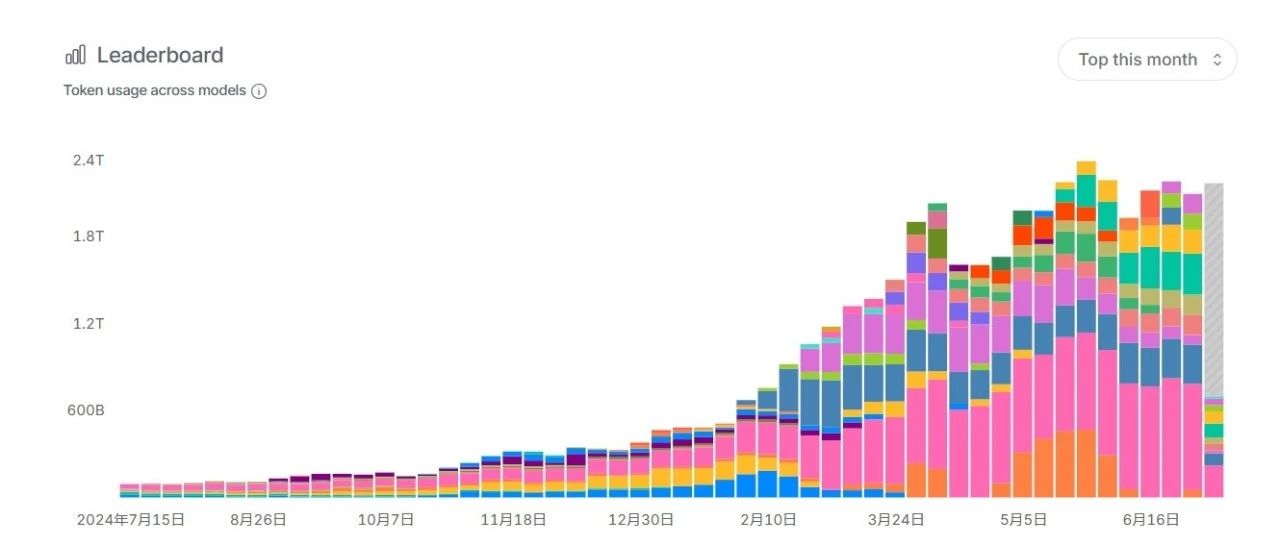
Core Insights - The article discusses the current state and trends of the large model API market in 2025, highlighting significant growth and shifts in market share among key players [1][2][25]. Token Usage Growth - In Q1 2025, the total token usage for AI models increased nearly fourfold compared to the previous quarter, stabilizing at around 2 trillion tokens per week thereafter [7][25]. - The top models by token usage include Gemini-2.0-Flash, Claude-Sonnet-4, and Gemini-2.5-Flash-Preview-0520, with Gemini-2.0-Flash maintaining a strong position due to its low pricing and high performance [2][7]. Market Share Distribution - Google holds a dominant market share of 43.1%, followed by DeepSeek at 19.6% and Anthropic at 18.4% [8][25]. - OpenAI's models show significant volatility in usage, with GPT-4o-mini experiencing notable fluctuations, particularly in May [8][25]. Segment-Specific Insights - In the programming domain, Claude-Sonnet-4 leads with a 44.5% market share, while Gemini-2.5-Pro follows [12]. - For translation tasks, Gemini-2.0-Flash dominates with a 45.7% share, indicating its widespread integration into translation software [17]. - The role-playing model market is fragmented, with small models collectively holding 26.6% of the share, while DeepSeek leads in this area [21]. API Usage Trends - The most utilized APIs on OpenRouter are primarily for code writing, with Cline and RooCode leading the way [25]. - The overall trend indicates a strong preference for tools that facilitate coding and application development [25]. Competitive Landscape - DeepSeek's V3 model has shown strong user retention and is favored over its predecessor, likely due to faster processing times [25]. - Meta's Llama series is declining in popularity, while Mistral AI has captured approximately 3% of the market, primarily among users interested in fine-tuning open-source models [25]. - X-AI's Grok series is still establishing its market position, and the Qwen series holds a modest 1.6% share, indicating room for growth [25].

速递|欧洲AI独角兽再吸金!Mistral AI 拟募资10亿美元,阿布扎比MGX或成关键投资者
Z Potentials· 2025-07-09 05:56
Group 1 - Mistral AI is negotiating with investors, including Abu Dhabi's MGX, to raise $1 billion through equity financing [1] - MGX, supported by the UAE and with assets around $100 billion, has invested in several AI developers, including Anthropic, OpenAI, and xAI [1] - In May, MGX established a joint venture with France's sovereign wealth fund Bpifrance, Mistral, and NVIDIA to build a 1.4 GW data center near Paris [1] Group 2 - Mistral provides AI models and chatbots, including Le Chat, and is building cloud computing services equipped with 18,000 NVIDIA chips [1] - Mistral is also in discussions with lenders, including Bpifrance, to raise hundreds of millions in debt financing for Mistral Compute services [1]
X @Bloomberg
Bloomberg· 2025-07-08 17:10
French artificial intelligence startup Mistral AI is in talks to raise as much as $1 billion in equity from several investors including Abu Dhabi fund MGX https://t.co/IyPi2dRRnm ...
繁荣之下,全是代价:硅谷顶级VC深入300家公司战壕,揭秘成本、路线、人才、产品四大天坑
AI科技大本营· 2025-07-07 08:54
Core Insights - The report titled "The Builder's Playbook" by ICONIQ Capital reveals the dual nature of the AI boom, highlighting both the rapid advancements and the significant challenges faced by builders in the AI space [1][2]. Group 1: Product Strategy - Builders in the AI sector must choose between being "AI-Native" or "AI-Enabled," with AI-Native companies showing a higher success rate in scaling [6][7]. - AI-Native companies have a 47% scaling rate, while only 13% of AI-Enabled companies have reached this stage [6]. Group 2: Market Strategy - Many AI-enabled companies offer AI features as part of higher-tier packages (40%) or for free (33%), which is deemed unsustainable in the long run [30][31]. - The report emphasizes the need for companies to develop telemetry and ROI tracking capabilities to justify pricing models based on usage or outcomes [38]. Group 3: Organizational Talent - Companies with over $100 million in revenue are more likely to have dedicated AI/ML leaders, with the percentage rising from 33% to over 50% as revenue increases [47][51]. - There is a high demand for AI/ML engineers (88%), with a long recruitment cycle of 70 days, indicating a talent shortage in the industry [54][56]. Group 4: Cost Structure - In the pre-launch phase, talent costs account for 57% of the budget, but this shifts dramatically in the scaling phase, where infrastructure and cloud costs become more significant [66][67]. - The average monthly inference cost for high-growth companies can reach $2.3 million during the scaling phase, highlighting the financial pressures associated with AI deployment [68][71]. Group 5: Internal Transformation - While 70% of employees have access to internal AI tools, only about 50% actively use them, indicating a gap between tool availability and actual usage [76][79]. - Programming assistants are identified as the most impactful internal AI application, with high-growth companies achieving a 33% coding rate assisted by AI [81][84].

AI法案监管过严,阿斯麦等多家企业呼吁欧盟推迟实施
Feng Huang Wang· 2025-07-03 09:03
Group 1 - Major European companies, including ASML, SAP, and Mistral AI, are urging the EU to postpone the implementation of the landmark AI Act, citing potential risks to Europe's ambitions in the AI sector [1][2] - A public letter signed by 44 CEOs calls for a two-year delay in regulations concerning powerful AI models and high-risk AI systems, advocating for a more innovation-friendly regulatory approach [1][2] - The letter emphasizes that delaying the regulations and prioritizing regulatory quality over speed would send a strong signal to global innovators and investors about Europe's commitment to deregulation and enhancing competitiveness [1] Group 2 - The AI Act, passed last year, aims to prevent serious misuse of AI technology, requiring developers to disclose training methods and comply with copyright policies [2] - Companies are frustrated with the EU Commission's failure to issue key guidelines and standards, including a compliance guideline for advanced AI companies that was supposed to be released in May but has faced delays and criticism [2] - The US government has expressed concerns regarding the current version of the guidelines, urging the EU to abandon the existing draft due to its perceived overreach beyond the scope of the AI Act [2]

阿斯麦与SAP领衔的110余家公司敦促欧盟暂缓实施“AI法案”:严规危及欧洲AI竞争力
智通财经网· 2025-07-03 08:15
Group 1 - Over 110 institutions, including ASML, SAP, and Mistral AI, have called on the EU to delay the implementation of new AI regulations, emphasizing the need for a more competitive environment for innovation [1] - The core demand from the business sector focuses on the lack of execution details and the pace of regulatory implementation, as the strictest provisions of the EU AI Act are set to take effect in August [1] - The working group, composed of scholars, developers, and rights groups, is still discussing specific execution guidelines, causing significant delays compared to earlier expectations [1] Group 2 - The controversy centers around the EU's proposed voluntary compliance framework, with tech companies criticizing the stringent requirements for third-party model audits and copyright tracing [2] - The EU AI Act, as the world's first comprehensive AI legislation, establishes a tiered regulatory system, imposing heavy penalties on non-compliant companies, including fines of up to 7% of annual revenue for violations [2] - The high compliance costs and vague guidelines are diminishing the attractiveness of the European AI industry, prompting the EU to seek a new balance between regulatory strength and innovation vitality [2]

The AI Revolution in Oil & Gas: A New Era of Smart Energy
ZACKS· 2025-06-30 13:36
Industry Overview - The oil and gas industry is undergoing a significant digital transformation driven by artificial intelligence (AI), which is enhancing efficiency, output, and safety amid rising costs and market unpredictability [1] - Major companies are rapidly adopting AI technologies to gain competitive advantages that were previously unattainable [1] BP's AI Strategy - BP has established a decade-long partnership with Palantir Technologies to create a digital twin of its global oil and gas infrastructure, integrating data from over two million sensors for real-time asset management [2] - A new five-year agreement with Palantir allows BP to utilize AI for faster decision-making, optimizing operational performance and production while minimizing errors [3] Chevron's AI Implementation - Chevron employs AI-powered drones in collaboration with Percepto to monitor shale operations, significantly reducing the need for manual inspections and enhancing safety [4] - The use of drones has led to a notable reduction in downtime and improved production reliability, alongside advanced machine learning models to optimize drilling parameters [5] ExxonMobil's Autonomous Drilling - ExxonMobil is pioneering autonomous drilling technology, claiming to be the first to implement AI-based closed-loop drilling automation in deepwater fields, enhancing safety and reducing costs [6] - The company also applies machine learning in its Permian Basin operations to optimize production and minimize downtime [7] TotalEnergies' AI Initiatives - TotalEnergies has partnered with Mistral AI to establish an innovation hub focused on improving industrial performance and energy efficiency while cutting emissions [9] - AI tools are being deployed across both upstream and downstream operations, aiding in predictive maintenance and emissions management [10] Conclusion on AI's Role - AI is now a fundamental necessity in the oil and gas sector, providing tangible improvements in safety, efficiency, and profitability for companies like BP, Chevron, ExxonMobil, and TotalEnergies [11] - The ability of AI to process large data sets and optimize operations is crucial for maintaining competitiveness in a complex energy landscape [12]