
工商银行

Search documents
商业银行赋能“冷资源”变“热经济”
Zheng Quan Ri Bao· 2026-01-19 16:44
Core Insights - The winter ice and snow economy is becoming a significant driver for consumption upgrades, regional development, and industrial integration, supported by innovative financial services from banks [1] Group 1: Financial Support for the Ice and Snow Economy - Banks are embedding services throughout the entire ice and snow economy chain, providing differentiated financial support tailored to various segments such as infrastructure, equipment manufacturing, and tourism [2] - Construction Bank's Heilongjiang branch has provided billions in loans for major infrastructure projects to enhance tourism connectivity between key ice and snow attractions [2] - Agricultural Bank of China quickly issued a 2.73 million yuan loan to a local beverage company facing cash flow issues during peak tourism season, demonstrating the banks' responsiveness to small and micro enterprises [2][3] Group 2: Support for Small and Micro Enterprises - Small and micro enterprises are crucial to the ice and snow economy, with Construction Bank providing over 100 million yuan in credit support to more than 130 hotels and restaurants in Heilongjiang since 2025 [3] - Financial institutions are actively identifying and addressing the funding needs of local businesses, ensuring they can upgrade facilities and meet increased demand during the winter season [3] Group 3: Consumer Experience and Payment Solutions - Banks are enhancing consumer experiences by integrating financial services into consumption scenarios, such as the "Love Ice and Snow Carnival" campaign by Industrial and Commercial Bank of China, which offers discounts to stimulate spending [4] - Agricultural Bank and Construction Bank have established "Ice and Snow Stations" to provide free services like hot drinks and luggage storage, improving visitor satisfaction [5][6] - The introduction of comprehensive payment solutions, including support for international card payments, aims to accommodate diverse consumer payment preferences [5] Group 4: Future Projections and Strategic Directions - The "China Ice and Snow Tourism Development Report (2026)" predicts that ice and snow tourism will attract 360 million visitors and generate 450 billion yuan in revenue during the 2025-2026 winter season [6] - Financial institutions are encouraged to leverage technology and green finance to support high-tech equipment production and eco-tourism projects, enhancing the overall ice and snow industry [6]



经营贷利率下探至“2字头”
Di Yi Cai Jing Zi Xun· 2026-01-19 14:06
Core Viewpoint - The State Council has implemented a package of policies to promote domestic demand through financial and fiscal collaboration, focusing on optimizing service industry loans and personal consumption loan interest subsidies to lower financing costs and stimulate consumer spending [2] Group 1: Business Loan Market - Business loan interest rates have generally decreased to the "20s" range, with increased flexibility in terms of limits, duration, and product offerings, becoming a key focus for bank credit allocation [2] - State-owned banks maintain stable pricing for business loans, with rates around 3%, while collateralized loans can be as low as 2.5% for qualified clients [3] - Joint-stock banks offer more flexible product structures, with some collateralized loans having rates as low as 2.3%, depending on property evaluations [3][4] - City commercial banks are actively competing, with some offering business loans at rates as low as 2.2% and various repayment options to meet different cash flow needs [4] Group 2: Consumer Loan Market - Personal consumption loan rates have stabilized around 3%, with limited room for further decreases, as products with rates below 3% have largely exited the market [5] - Major state-owned banks have consumer loan rates generally between 3.0% and 4.5%, with specific products like ICBC's "Rong e Borrow" offering rates around 3.5% to 3.65% [5] - Joint-stock and city commercial banks are also active in the consumer loan market, with some offering interest subsidies to enhance product attractiveness [6] Group 3: Risk Management and Market Dynamics - Despite ongoing financial policies to promote consumption, demand for consumer loans remains weak, with significant declines in both short-term and long-term consumer loans reported [7] - Banks are tightening risk controls, with stricter audits on the use of consumer loan funds and customer eligibility to prevent misuse of low-cost funds [7][8] - The asset quality of consumer loans is under scrutiny, with projections indicating a potential increase in non-performing loan rates in 2026 [9]

经营贷利率下探至“2字头”
第一财经· 2026-01-19 13:44
Core Viewpoint - The article discusses the recent implementation of a package of policies by the State Council to promote domestic demand through financial and fiscal collaboration, focusing on optimizing loans for service industry entities and personal consumption loans to lower financing costs and stimulate consumer spending [3]. Group 1: Business Loan Market - Business loan interest rates have generally decreased to the "2" range, with banks increasing loan amounts, terms, and product flexibility, making it a key focus for credit allocation [3][5]. - State-owned banks maintain stable pricing for business loans, with rates around 3%, while collateralized loans can be as low as 2.5% for qualified clients [5]. - Joint-stock banks offer more flexible product structures, with some collateralized loans having rates as low as 2.3%, depending on property evaluations [5][6]. - City commercial banks are competitive, with some offering collateralized business loans at rates as low as 2.2% and flexible repayment options [5]. Group 2: Consumer Loan Market - Consumer loan interest rates have stabilized around 3%, with limited room for further decreases, as products with rates below 3% have largely exited the market [8][9]. - Major state-owned banks have consumer loan rates ranging from 3.0% to 4.5%, with specific products like ICBC's "融e借" averaging 3.5% to 3.65% [8]. - Joint-stock and city commercial banks are also active in the consumer loan market, with some offering interest subsidies to enhance product attractiveness [9]. Group 3: Credit Demand and Risk Control - Despite ongoing financial policies to boost consumption, demand for consumer loans remains weak, with significant declines in both short-term and long-term consumer loans reported [10]. - The tightening of risk controls by banks is evident, with stricter scrutiny on the use of consumer loan funds and customer eligibility to prevent misuse [10][11]. - The asset quality of consumer loans is under observation, with projections indicating a slight increase in the non-performing loan rate for 2026 [11].

利率下探至“2字头” 经营贷成银行新宠
Di Yi Cai Jing· 2026-01-19 13:34
Core Insights - The State Council has implemented a package of fiscal and financial policies to stimulate domestic demand, focusing on optimizing service industry loans and personal consumption loan interest subsidies to lower financing costs and boost consumer spending [1] Group 1: Business Loan Trends - Business loan interest rates have generally decreased to the "2% range," with increased flexibility in terms of limits, duration, and product offerings, becoming a key focus for bank credit allocation [1] - State-owned banks maintain stable pricing for business loans, with rates around 3%, while collateralized loans can be as low as 2.5% for qualified clients [2] - Regional banks are more competitive, with some offering business loans at rates as low as 2.2% and flexible repayment options to meet various cash flow needs [2][3] Group 2: Consumer Loan Trends - Personal consumption loan rates have stabilized around 3%, with limited room for further decreases, as most products now fall within the 3% to 4.5% range [4] - Major banks like ICBC and CCB offer consumer loans with rates between 3.0% and 3.65%, while lower rates below 3% have largely disappeared from the market [4][5] - Some regional banks are enhancing product appeal through interest subsidies for specific consumer categories, such as education and healthcare [5] Group 3: Risk Management and Market Dynamics - Despite ongoing financial policies to promote consumption, demand for consumer loans remains weak, with significant declines in both short-term and long-term consumer loans reported [6] - Banks are tightening risk controls, with stricter scrutiny on the use of consumer loan funds and customer eligibility to prevent misuse of low-cost funds [6][7] - The asset quality of consumer loans is under observation, with projections indicating a potential increase in non-performing loan rates due to stricter regulations and market conditions [7]
2026年中国投资展望:过弯加油:马年牛腾,东升西不落:政策利好有望超预期
Bank of China Securities· 2026-01-19 13:19
Group 1 - The report highlights that after approximately 12 years of restructuring local government responsibilities, the most challenging phase has been overcome, providing a foundation for proactive fiscal, industrial, monetary, and credit policies, which are expected to exceed current market expectations by mid-2026 [4][10][14] - The core of economic activation lies in guiding high-net-worth funds into investment and consumption through moderate inflation and an active capital market, focusing on high-valuation industries such as technology manufacturing, biomedicine, and cultural entertainment [5][22] - The report emphasizes the significant growth potential in China's semiconductor and biomedicine sectors, which currently have market values of less than 1/10 and 1/40 of their U.S. counterparts, respectively [6][31] Group 2 - The report indicates that the strategic easing of U.S.-China relations is fostering internal momentum, while the global potential growth rate remains low, indicating significant room for expansion [7][8] - It notes that China contributes approximately 30% to global growth, yet its weight in the MSCI All Country World Index is less than 3%, suggesting a clear logic for asset allocation and revaluation of Chinese assets [8][9] - The forecast for China's core broad-based stock index is an expected increase of over 40% in 2026, driven by nearly 20% profit growth and a 20% valuation increase, with sectors like technology manufacturing and biomedicine expected to lead the rally [9][10] Group 3 - The report outlines that the government support has played a crucial role in the technological rise of countries like the U.S. and Japan, and that China's technology sector still shows significant gaps in revenue and profitability compared to the U.S. [6][31] - It discusses the importance of strategic industries as core pillars for capital and innovation, highlighting their high growth potential and low competition, which can attract substantial social capital [24][26] - The report identifies four key directions for strategic industries: technology manufacturing, biomedicine, medical insurance, and cultural entertainment, emphasizing the need for a collaborative approach between commercial insurance and industrial investment [26][30]
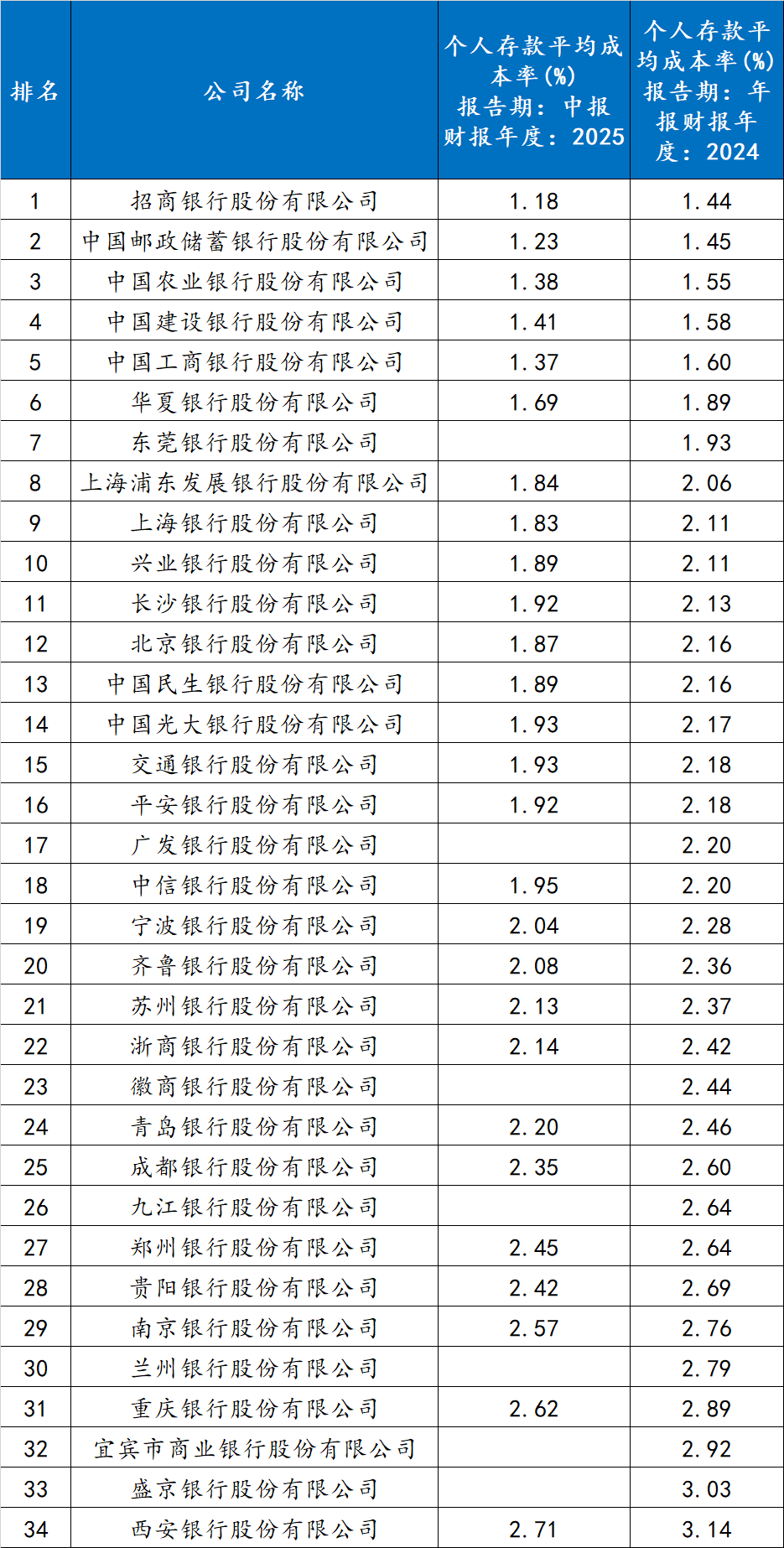
银行个人负债成本排名
Xin Lang Cai Jing· 2026-01-19 13:16
Core Insights - The average cost of personal deposits is a key indicator of banks' liability costs, with lower rates indicating stronger competitiveness in attracting deposits [1][7]. Group 1: Ranking of Banks by Deposit Cost - The banks with the lowest average cost of personal deposits are primarily state-owned large banks and some retail-focused joint-stock banks, with China Merchants Bank leading at 1.18% for the 2025 mid-year report [2][8]. - Following China Merchants Bank are China Postal Savings Bank at 1.23% and Agricultural Bank of China at 1.38%, benefiting from extensive branch networks and strong customer bases [2][8]. - The top six banks all have costs below 2%, indicating strong deposit cost control capabilities [2][8]. Group 2: Cost Trends and Observations - A notable trend is the general decline in average deposit costs across most banks when comparing 2024 annual reports to 2025 mid-year reports, with China Merchants Bank decreasing from 1.44% to 1.18% [6][12]. - This decline reflects a reduction in liability cost pressures for the banking industry, positively impacting net interest margins and profitability [6][12]. - However, lower deposit costs must align with asset yield and risk management capabilities, as a healthy bank seeks to balance these factors [12]. Group 3: Challenges for Joint-Stock and Regional Banks - Joint-stock banks and regional commercial banks generally face higher average deposit costs, often exceeding 2%, which can challenge their net interest margin management [5][11]. - National joint-stock banks like Industrial Bank and Minsheng Bank have costs ranging from 2.11% to 2.18%, while some regional banks experience even greater cost pressures [5][11].



利率下探至“2字头”,经营贷成银行新宠
Di Yi Cai Jing· 2026-01-19 12:52
Core Viewpoint - The recent government policies aim to lower financing costs and stimulate consumer spending, leading to a divergence in bank credit allocation, with operational loan rates dropping to the "2s" and consumer loan rates stabilizing around 3% [1][2][4]. Group 1: Operational Loan Rates - Operational loan rates have generally decreased to the "2s," with banks increasing credit limits, terms, and product flexibility [1][2]. - State-owned banks maintain operational loan rates around 3%, with collateralized loans potentially as low as 2.5% for qualified clients [2]. - Some joint-stock banks offer more flexible product structures, with collateralized loans' rates dynamically adjusted based on property evaluations, with some rates dropping to 2.3% [2]. - City commercial banks are aggressively competing, with some offering collateralized operational loans at rates as low as 2.2% and credit limits up to 20 million yuan [2]. Group 2: Consumer Loan Rates - Consumer loan rates have stabilized around 3%, with limited downward movement expected [4][5]. - Major state-owned banks' consumer loan rates range from 3.0% to 4.5%, with specific products like ICBC's "融e借" averaging between 3.5% and 3.65% [4][5]. - Joint-stock and city commercial banks are also active in the consumer loan market, with some offering interest rate subsidies to enhance product appeal [5]. Group 3: Credit Demand and Risk Control - Despite ongoing financial policies to promote consumption, demand for consumer loans remains weak, with significant declines in both short-term and long-term consumer loans reported [6]. - Banks are tightening risk controls, with stricter scrutiny on the use of consumer loan funds and customer eligibility to prevent misuse [6][7]. - The asset quality of consumer loans is under observation, with projections indicating a potential increase in non-performing loan rates in 2026 [7].
银行股配置重构系列八:指数基金波动,优质银行股超跌
Changjiang Securities· 2026-01-19 12:44
Investment Rating - The investment rating for the banking sector is "Positive" and is maintained [13]. Core Insights - The market sentiment has significantly improved since the beginning of the year, leading to substantial net outflows from major index funds like CSI 300 and SSE 50, with bank stocks experiencing the highest decline among primary sectors [2][6]. - Despite the recent pressure on bank stocks due to net outflows from index funds, there is an expectation that the market will continue to focus on high-quality bank stocks with stable or improving fundamentals, presenting good investment opportunities [2][8]. - The pricing power of fundamental factors for bank stocks is expected to increase in 2026, with a projected reversal in net interest income growth and stable performance from major banks [10]. Summary by Sections Market Dynamics - Since Q3 2025, bank stocks have been under pressure due to capital outflows, primarily from public funds and ETFs, reflecting a shift in institutional investor strategies [6][7]. - The net outflow from CSI 300 and SSE 50 ETFs reached 103.6 billion and 19.7 billion respectively during January 15-16, significantly above normal levels [7]. Valuation and Dividend Yield - Bank stocks are considered systematically undervalued under the PB-ROE framework, with current PB valuations below net asset value [9]. - The expected dividend yields for major state-owned banks have risen above 4%, with some leading banks like China Merchants Bank and Jiangsu Bank reaching yields of 5% to 6% [9][26]. Performance Outlook - Major banks are expected to maintain stable growth in 2026, with credit growth projected to be flat year-on-year, focusing on operational efficiency rather than scale [10]. - The non-interest income pressure from financial market activities has eased, and overall revenue growth is anticipated to be driven by net interest income [10].


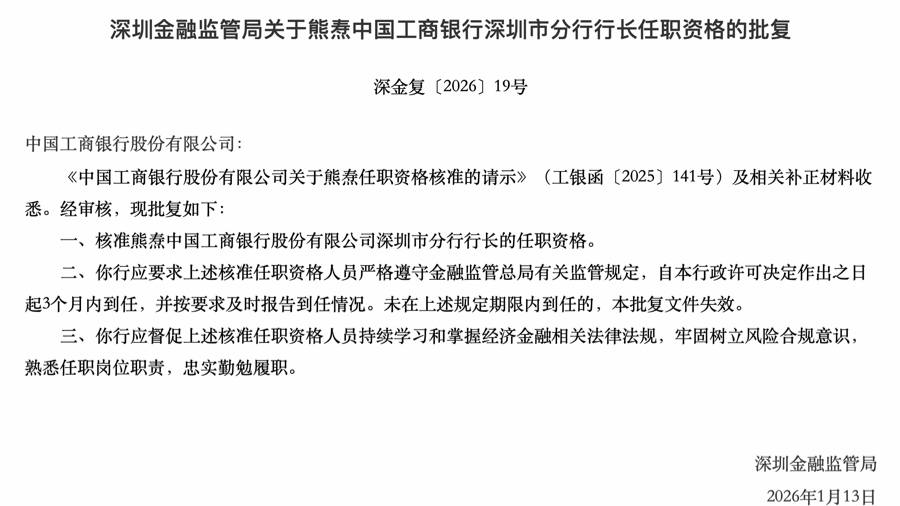
深圳工行新行长熊焘任职获批 原行长已调任总行
2 1 Shi Ji Jing Ji Bao Dao· 2026-01-19 12:43
Group 1 - The Shenzhen Financial Regulatory Bureau has approved the appointment of Xiong Tao as the president of the Industrial and Commercial Bank of China (ICBC) Shenzhen Branch, marking the formalization of this significant personnel change [1] - Xiong Tao previously served as the deputy president of the Guangdong Branch and the president of the Guangzhou Branch, indicating a trend of rotation among key positions within commercial banks [3] - The former president of ICBC Shenzhen Branch, Dong Jianjun, has been reassigned to the General Manager of the Strategic Management and Investor Relations Department at the head office after nearly five years in his previous role [3] Group 2 - Xiong Tao is considered an "old hand" at ICBC, having extensive experience in the banking sector, particularly in investment banking, and has held various positions since joining the bank in 2002 [3] - Under Xiong's leadership, the Guangdong Branch reported a loan balance of 2.6 trillion yuan by the end of 2025, with a net increase of over 1 trillion yuan during the 14th Five-Year Plan period [4] - Dong Jianjun's tenure saw significant achievements, including the Shenzhen Branch becoming the first city branch in the ICBC system to surpass 200 billion yuan in inclusive finance loans, highlighting the strategic importance of inclusive finance for the bank [4]
天益医疗:取得金融机构股票回购专项贷款承诺函
Ge Long Hui· 2026-01-19 12:32
格隆汇1月19日丨天益医疗(301097.SZ)公布,近日,公司取得了中国工商银行股份有限公司宁波市分行 出具的《贷款承诺函》,主要内容如下:1、贷款额度:最高不超过9,000万元人民币。2、贷款期限:不 超过3年。3、贷款用途:专项用于回购公司股票。 ...